Precis Writing in UPSC English Compulsory: Rules & Examples
Master precis writing in UPSC English Compulsory with six core rules, a worked Russell-passage example, common errors table, and a 20-minute daily drill.
Precis writing is the highest-leverage 60-mark segment of the UPSC English Compulsory paper. Unlike the essay, it is scored almost mechanically — examiners check for word count, coverage, sequence, and language. A candidate who drills the rules can reliably score 40+ out of 60.
What UPSC Means by ‘Precis’
A precis is a compressed version of a given passage, roughly one-third its length, written in the student’s own words. The original passage is typically 400–600 words of discursive prose drawn from sources like The Economist, The Hindu, or writings of Russell, Orwell, and Nehru. You are expected to reproduce the argument, not a summary of topics.
The Six Core Rules
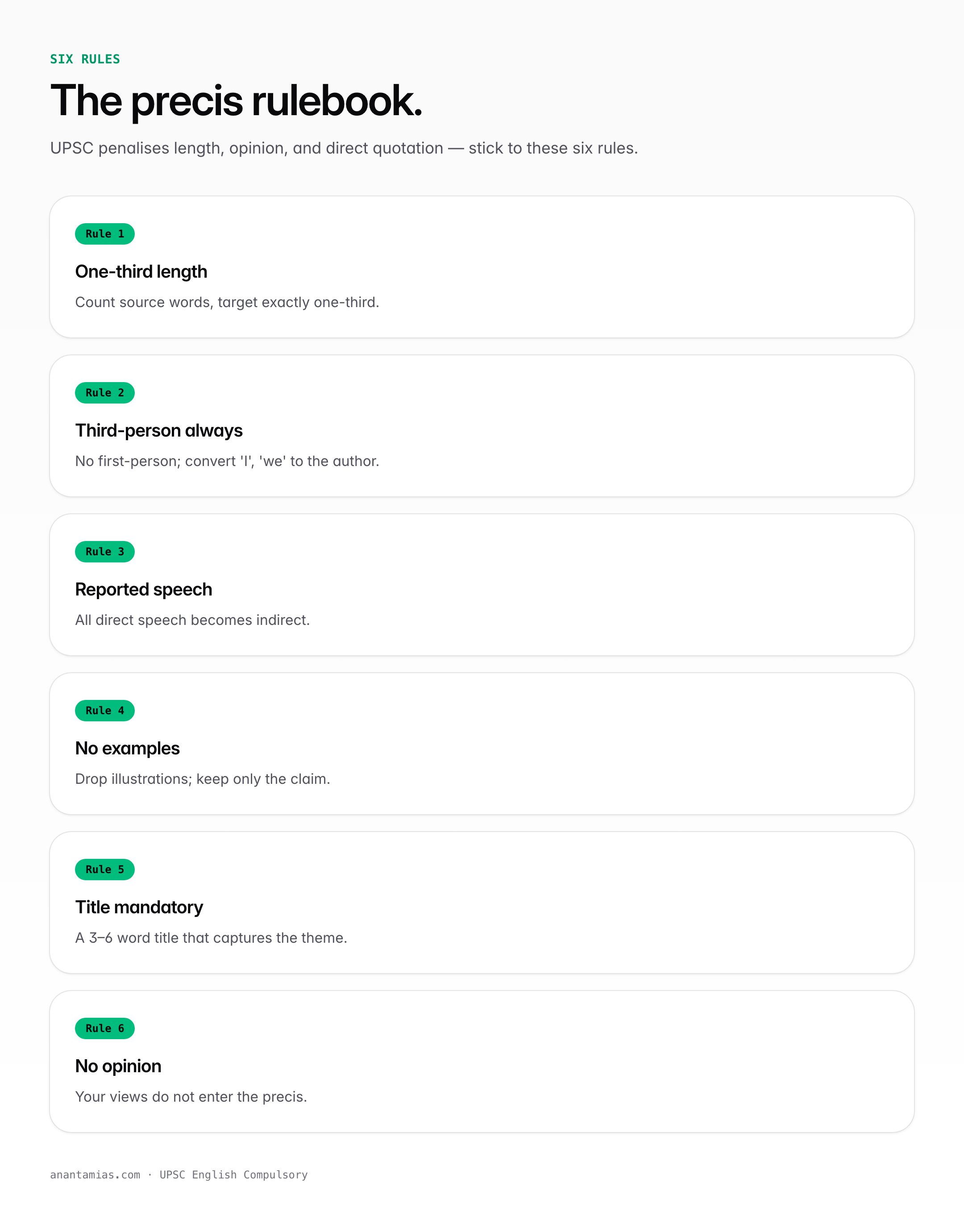
- Length must be approximately one-third of the passage (UPSC prints the exact target word count; deviations beyond ±10% cost marks).
- Use indirect speech. Convert any direct quotations.
- Use third person throughout, even if the passage is in first person.
- Preserve the author’s logical sequence — do not rearrange arguments.
- Do not introduce your own opinions, examples, or illustrations.
- Give the precis a suitable title in not more than 10 words.
Structure of a High-Scoring Precis
A good precis has three movements: the thesis (1–2 sentences), the argument body (connected sentences showing supporting reasoning), and the conclusion (author’s final position). Transitions like however, therefore, and consequently preserve logical flow without adding words.
Word Count Discipline
UPSC specifies the target in the question: for example, “Reduce this passage of 600 words to 200 words.” Count every word — including articles, but excluding the title. Write the final count at the end of your precis in brackets: (197 words). Examiners frequently deduct 2–4 marks for undisclosed counts.
Worked Example
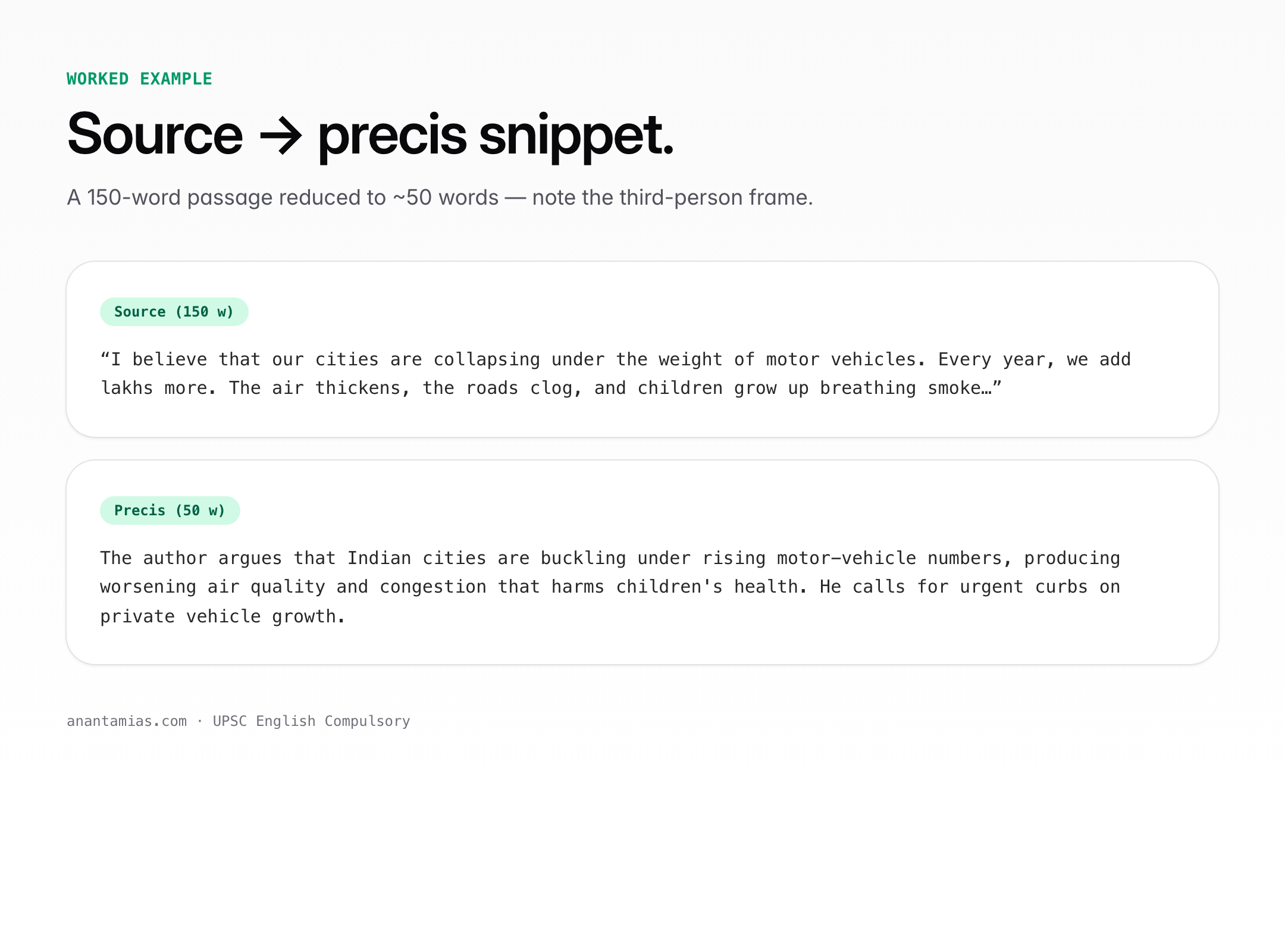
Original passage (280 words, abridged from Bertrand Russell)
“Most of the world’s troubles are due to the fact that men have lost the capacity for reflection. The modern man is continually stimulated by external events — the newspaper, the radio, the cinema — and has lost the habit of sitting quietly with his own thoughts. Boredom, which was once a sign of a slow and natural life, is now feared as a disease. Yet boredom is the cradle of creative thought. The child who cannot endure an empty afternoon grows into an adult who cannot endure an empty mind…”
Model precis (93 words)
Title: The Value of Boredom
Russell argues that modern people, overstimulated by newspapers, radio, and cinema, have lost the capacity for quiet reflection. Where earlier generations treated boredom as a natural rhythm of life, contemporary society fears it as a disease. This fear is mistaken, for boredom is in fact the cradle of creativity: children who cannot bear empty afternoons become adults incapable of bearing empty minds. The remedy, according to the author, lies in restoring the habit of solitude and deliberate stillness, without which original thought cannot arise. (93 words)
Common Precis Errors
| Error | Mark loss | Fix |
|---|---|---|
| Exceeding word limit by 15%+ | 4–6 | Cut adjectives and examples first |
| Copying phrases verbatim | 3–5 | Paraphrase every sentence |
| Missing title | 2 | Write title before starting |
| Adding own opinion | 3–4 | Stick to author’s argument only |
| Breaking logical order | 3 | Outline argument before writing |
A 20-Minute Drill
Pick any 600-word editorial from The Hindu opinion page. Set a timer for 20 minutes: five to underline key arguments, 12 to write, three to count words and polish. Submit one draft to a peer daily. Over 30 days this single drill will raise precis scores by 10–15 marks.
Final Checklist Before Submission
- Word count disclosed at end
- Title written above the precis
- Third person, past tense where applicable
- No quotation marks, no direct speech
- No personal pronouns (I, we, you)
- Author’s conclusion preserved
Frequently Asked Questions
What is the ideal precis length for UPSC?
Exactly one-third of the original passage, as stated in the question. Stay within plus or minus 10 percent of the target.
Should I give a title to my precis?
Yes, always. The title should be under 10 words and capture the passage’s central idea. Missing titles cost about 2 marks.
Can I copy phrases from the passage?
No. Precis must be in your own words. Technical terms can be retained, but full phrases from the original are penalised.
Should I write in first or third person?
Third person throughout, even if the passage is in first person. Convert quotations into indirect speech.
Do I need to disclose the word count?
Yes. Write the count in brackets at the end of your precis. Failing to disclose it typically costs 2–4 marks.
How long should I spend on precis in the exam?
About 35 minutes — five for reading and planning, 25 for writing, five for checking count and grammar.