GS IV Case Studies: Political Pressure, Transfer Threats and the Illegal Oral Order (Solved)
Four worked cases on the commonest dilemma in the paper: an instruction you cannot lawfully carry out, from someone who can damage you. Each is solved to the structure an examiner is looking for.
Case studies carry roughly half the marks in General Studies Paper IV, and they cannot be prepared by reading about them. What can be prepared is a method that survives the clock, and a stock of worked examples showing what a committed answer looks like when the situation genuinely has no clean exit.
This set covers the commonest theme in the paper: you have been asked to do something you cannot lawfully or properly do, by someone with the power to damage your career. Four variants follow, each with a full worked answer. They are written as an officer would actually reason, which means each one names a real cost rather than pretending the right course is free.
How to Use These Cases
Read the situation, close the page, and write your own answer under time before reading mine. The value is in the comparison, not the model.
Two habits matter more than anything else here. Commit to a decision — an answer that lays out considerations and never chooses has not answered the question, and this is the single commonest way marks are lost. And acknowledge the cost of the course you choose. Examiners are not looking for an officer who believes the ethical path is painless; they are looking for one who has counted the price and paid it anyway.
Two things to avoid. Do not invent heroic third options that the facts do not support — “I would convince everyone through dialogue” is not a plan. And do not resign in every case. Resignation removes an honest officer from a post that will be filled by someone else, and it is almost never the strongest answer.
The Method in Brief
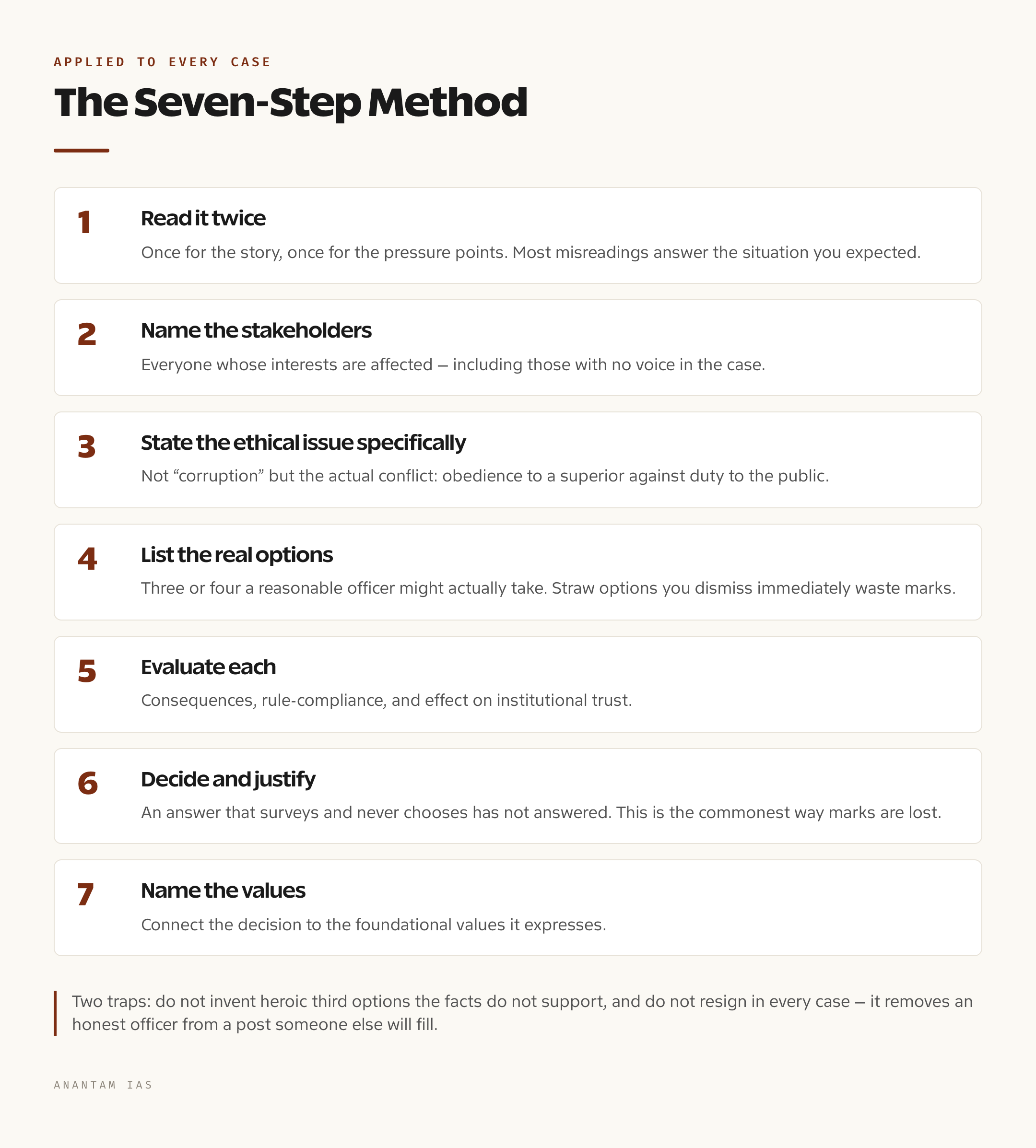
Seven steps, applied in order to every case.
Read it twice — once for the story, once for the pressure points. Name the stakeholders, including the ones with no voice in the case. State the ethical issues specifically: not “corruption” but the actual conflict, such as obedience to a superior against duty to the public. List the real options a reasonable officer might take, three or four of them. Evaluate each on consequences, rule-compliance and effect on institutional trust. Decide and justify. Name the values your decision expresses.
Case 1: The Oral Instruction
You are the District Magistrate. A large private hospital in your district has applied for a completion certificate. Your technical staff report that the building violates the sanctioned plan: two additional floors, and a fire-exit corridor narrowed below the permissible width. The State Minister for Health telephones you. He does not ask you to falsify anything. He says the hospital is the only tertiary facility in three blocks, that a delay will cost lives, that the deviations are “regularisable”, and that he expects you to “use your discretion sensibly”. He asks you to issue the certificate and let the compounding process follow. Nothing is in writing.
Stakeholders. Patients who will use the building; the hospital’s staff; the promoters; the Minister; your technical staff who recorded the violation; residents of nearby blocks lacking tertiary care; future occupants of any building where this precedent is cited; and you.
The real issue. Not bribery — none is offered. It is whether a genuine public benefit can justify certifying a factual state of affairs that does not exist, and whether an unrecorded instruction can transfer responsibility away from the person who signs.
The pressure points. The narrowed fire corridor is not a paper deviation; it is the thing that kills people in a hospital fire. And the instruction is oral, which means the risk is entirely yours.
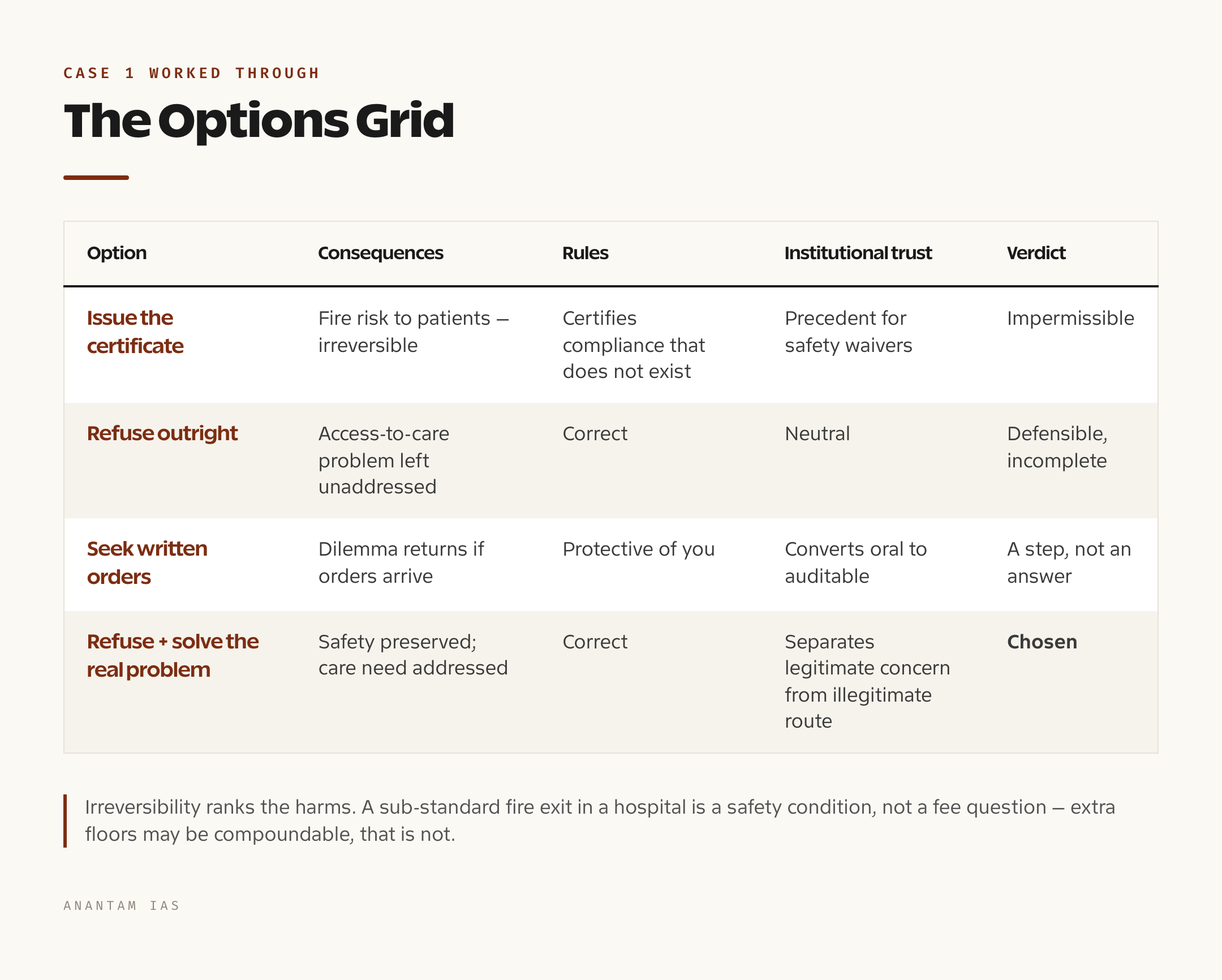
Options. (1) Issue the certificate as asked. (2) Refuse outright and take the consequences. (3) Refuse the certificate but attack the underlying problem — treat the access-to-care argument as a real problem needing a real solution. (4) Seek written instructions.
Evaluation. Option 1 is impermissible. Extra floors may indeed be compoundable, but a sub-standard fire exit is a safety condition, not a fee question, and certifying compliance that does not exist is a false record regardless of motive. Option 2 is defensible but incomplete: it answers the file and ignores the Minister’s substantive point, which is genuine. Option 4 is a useful protective step and a poor whole answer — asking for written instructions is sound practice, but if they arrive in writing the dilemma returns, and treating documentation as the resolution mistakes self-protection for ethics.
Decision. Option 3. I decline to issue the completion certificate while the fire-exit deviation stands, and I record in writing on the file the Minister’s request, my reasons for declining, and the specific defect. Separately and immediately, I take the access-to-care problem seriously: a written, time-bound direction to the hospital to rectify the corridor with a deadline; permission to operate the compliant floors under a partial occupancy arrangement if the law of the state allows it; and a proposal to the department on tertiary-care provision for those three blocks.
Justification. The safety defect is non-negotiable because the harm it risks is irreversible and falls on people with no say in the decision. Recording the request protects the process rather than only me — it converts an untraceable instruction into an auditable one. And addressing the Minister’s real concern separates the legitimate part of his case from the illegitimate route he proposed, which is what distinguishes an officer with judgement from one who simply says no.
Values. Objectivity, moral courage, accountability, and responsiveness to a genuine public need.
Case 2: The Transfer Threat
You are a Sub-Divisional Officer. Over six months you have stopped illegal sand mining on a riverbed, cancelled three leases and registered cases. The mining is connected to a locally powerful politician. You are told through an intermediary that if you continue, you will be transferred to a remote posting within the month — and that your successor “will be more reasonable”. You have a child in the middle of a school year and a spouse whose job is in this town. A colleague advises you to slow the files down for a few weeks until the political situation changes, arguing that a transfer serves nobody.
Stakeholders. Communities downstream affected by riverbed damage; the workers employed in the mining; the leaseholders; the politician; your successor; your family; your subordinate staff, who are watching what happens to an officer who acts; and you.
The real issue. Whether anticipated personal cost can justify slowing lawful enforcement, and whether your colleague’s argument — that being transferred achieves nothing — is prudence or rationalised surrender.
Options. (1) Slow the files as advised. (2) Continue exactly as before and accept the transfer. (3) Continue, and simultaneously make the work irreversible and the pressure visible. (4) Seek a transfer yourself on personal grounds.
Evaluation. Option 1 is the tempting one and must be rejected, but the reason matters. It is wrong not because compromise is always wrong but because the compromise here is concealed: files are slowed while the record shows normal progress, which is a form of misrepresentation. Option 4 is a form of Option 1 with better optics. Option 2 is honourable but naive in one specific respect — it treats your presence as the safeguard, so everything collapses when you leave. Your colleague’s argument has force precisely against Option 2.
Decision. Option 3. I continue enforcement at the same pace. In parallel I do three things designed to outlast me: complete and file the cases so they proceed without my presence, ensure the cancellation orders are fully reasoned and documented so they survive appeal, and put the enforcement record and pending actions on the official file in a form my successor inherits rather than in my personal knowledge. I report the pressure through the proper channel in writing, without theatrics. I do not slow anything, and I do not seek a transfer.
Justification. The point my colleague misses is that the choice is not between staying and being useless. It is between leaving behind a reversible situation and an irreversible one. An officer’s real contribution in this position is institutional: making enforcement independent of the individual enforcing it. On the family cost, this is a genuine loss and worth stating plainly — it is not offset by anything, and a career in public service periodically requires it. What it does not justify is a deception.
Values. Integrity, courage, and institutional thinking over personal indispensability.
Case 3: The Sanctioned Deviation
You head a district education office. The department has directed that a state scholarship be disbursed to all eligible students by 31 March or the allocation lapses. Verification of income certificates is incomplete for about 400 of 2,000 applicants because of a portal failure at the state level. Your superior, in writing, instructs you to disburse to all 2,000 and complete verification afterwards, noting that the lapse of funds would harm genuinely poor students and that recovery is possible in case of ineligibility. You believe perhaps 30 to 60 of the 400 may be ineligible, and that recovery from poor households, once spent, is practically impossible.
Stakeholders. The 1,600 verified students; the 400 unverified, most of whom are probably eligible; the possibly ineligible minority; taxpayers; your superior; the state exchequer; and the students in future years whose allocation may be cut if leakage is reported.
The real issue. This is a genuine dilemma rather than a disguised wrongdoing. The instruction is lawful in form, in writing, and motivated by a real public interest. The conflict is between under-inclusion error — denying poor students their entitlement — and leakage, with the additional feature that the instruction is one you are ordinarily bound to follow.
Options. (1) Comply fully. (2) Refuse and let the funds lapse. (3) Disburse to the verified 1,600 and seek an extension or alternative verification for the 400. (4) Disburse to all, with a documented risk-mitigation plan.
Evaluation. Option 2 is the worst outcome available and is the trap of treating the strictest course as the most ethical: it harms 1,600 verified poor students to avoid a leakage of at most 60, and it protects the officer rather than anyone else. Option 1 without safeguards accepts irrecoverable leakage and leaves you unable to answer an audit. Option 3 is attractive but only if the 400 can actually be reached later, and if the allocation genuinely lapses, it converts a portal failure at the state level into a permanent loss for the poorest applicants.
Decision. A combination of 3 and 4. Disburse immediately to the 1,600 verified applicants. For the 400, use every alternative verification available within the time — self-declaration with supporting documents, ration-card or existing scheme databases, headmaster certification, physical verification of the largest amounts — and disburse to those cleared by any of these. Escalate in writing, the same day, seeking either an extension or authority to hold the residual amount, and state plainly that recovery from poor households is not realistically available so the decision should be taken with that understood.
Justification. Where both errors are real, the ethical task is to minimise the total harm and to be honest about the residue rather than to find a course with no exposure. Under-inclusion harms identifiable poor students immediately and certainly; leakage harms the exchequer diffusely and probably. That asymmetry favours disbursing, but it does not license abandoning verification, which is why alternative verification rather than none is the answer. Escalating in writing is not buck-passing here: the trade-off is a policy judgement above my level, and my duty is to make sure the person making it knows recovery is fictional.
Values. Empathy combined with objectivity, honesty in reporting, and the willingness to decide rather than to protect oneself by inaction.
Case 4: The Successor’s Dilemma
You take charge of a municipal body. Reviewing files, you find that your predecessor approved a solid-waste contract in which the selected bidder’s technical qualification appears to have been relaxed after bids were opened. The contractor has since performed adequately; waste collection has improved measurably and the city is visibly cleaner. Cancelling the contract would mean months of disrupted collection during monsoon, with real public-health risk. Your predecessor is now a senior officer in the department that supervises you, and is regarded as capable and honest.
Stakeholders. City residents, particularly in areas where collection improved; sanitation workers employed by the contractor; the disqualified bidders; the contractor; your predecessor; the department; and future bidders whose willingness to participate depends on believing the process is fair.
The real issue. Whether a good outcome cures a defective process, and what an officer owes when the wrongdoing is historical, the wrongdoer is respected and senior, and correction imposes present harm on the public.
Options. (1) Leave it — outcomes are good, disruption is real. (2) Cancel the contract immediately. (3) Report the irregularity, keep the service running, and fix the process. (4) Raise it informally with the predecessor first.
Evaluation. Option 1 is where most people quietly land, and it is the most damaging over time. It ratifies the principle that a relaxation after bid opening is acceptable if the result is satisfactory — which is precisely the reasoning that makes future manipulation easy, and it wrongs the bidders who were excluded by rules the winner did not have to meet. Option 2 confuses accountability with disruption; the residents did nothing wrong and should not bear a public-health risk for a procedural defect. Option 4 is understandable and inadequate as a whole answer: it converts an institutional matter into a personal one, gives the predecessor an opportunity to shape the record, and puts your discretion where the department’s should be.
Decision. Option 3. I record the irregularity in a written report to the competent authority, disclosing that the officer concerned now supervises my office and requesting that the matter be examined by someone without that conflict. I do not cancel the contract; I allow it to run to its term with tightened monitoring, since discontinuity would harm residents for a defect they did not cause. I fix the process prospectively — no post-bid relaxation of qualification criteria without fresh competition, and documented reasons for every deviation. I inform the predecessor that I have made the report, after making it.
Justification. Process and outcome are separately valuable. A good outcome from a bad process is not evidence that the process was fine; it is luck, and institutionalising luck is how procurement systems decay. Equally, correcting a past wrong at the expense of present public health mistakes symbolic rigour for ethics. Separating the two — report the defect, protect the service — is what allows both duties to be met. Disclosing the conflict rather than managing it privately is what keeps the decision the institution’s rather than mine.
Values. Integrity, impartiality, courage in reporting upwards, and proportionality in remedy.
What the Four Cases Share
Read together, the four make one point: in this theme the answer is almost never a straight refusal or a straight compliance.
The illegitimate route and the legitimate concern are separable. In Cases 1 and 3 the person applying pressure has a real point. Refusing the route while addressing the concern is what a strong answer does.
Documentation is a step, not a resolution. Asking for written orders and recording reasons matter, but they protect the process; they do not decide the question.
Irreversibility ranks the harms. A fire exit, an unrecoverable disbursement, a monsoon without waste collection — the harm you cannot undo dominates.
Institutional thinking beats personal indispensability. Cases 2 and 4 both turn on making the right outcome survive your departure.
State the cost. Every one of these decisions costs something. Answers that pretend otherwise read as naive; answers that count the cost and decide anyway read as the work of someone fit for the job.
Practice Cases
Unsolved, for written practice under time. Forty minutes for the first two, then compare against the reasoning above.
A. You are a District Collector during a communal flare-up. A senior political functionary asks you to delay the arrest of a named local leader by forty-eight hours, arguing that an immediate arrest will inflame the situation and cost lives, and that the police assessment supports him. Your Superintendent of Police believes delay will embolden further violence. Decide.
B. You chair a departmental selection committee. Midway through interviews you realise one shortlisted candidate is the son of an officer who wrote your last performance appraisal. You have not favoured him and believe you can be impartial. Nobody else on the committee knows. Decide.
C. You are a Chief Medical Officer. A pharmaceutical company offers to fund a district immunisation drive with clear public-health benefit, on condition that its logo appears on all materials and its representatives accompany field teams. Your budget for the drive was cut this year. Decide.
D. You discover that a subordinate you rate highly has, for two years, been quietly waiving a small statutory fee for widows and destitute applicants because he considers the fee unjust. Collections are short by a modest amount; no money has been taken. Decide.
FAQ
How many case studies come in GS Paper IV? There is no fixed number stated in the syllabus. In practice there are usually six or more, carrying roughly half the paper’s marks.
Is it acceptable to resign in a case-study answer? Rarely, and almost never as the primary answer. Resignation removes an honest officer from a post that will be filled by someone else, so it usually worsens the outcome it was meant to protest. Reserve it for cases where continuing would require you personally to do something impermissible and no other route exists.
Must I always ask for written orders? It is good practice and worth stating, but it does not resolve the dilemma — if the instruction arrives in writing, the ethical question returns unchanged. Treating documentation as the answer mistakes self-protection for ethics.
How do I choose between two genuinely bad outcomes? Rank by irreversibility and by who bears the harm. Harm that cannot be undone, and harm falling on people with no say in the decision, weigh heaviest. Then minimise total harm and be explicit about the residue you are accepting.
Should I name specific laws and sections? Only where you are certain. A confidently wrong citation costs more than a correct description of the principle. Accuracy about the nature of the duty matters more than the section number.
How long should a case-study answer be? Follow the marks and the word limit given. Structure matters more than length: stakeholders, the actual conflict, real options, evaluation, a committed decision, and the values it expresses.