Food Preservation Techniques: How Drying, Canning and Vacuum Packing Work (UPSC Science & Tech)
Every preservation method does one of two things: starve the microbes or stop the enzymes. Here is the science behind drying, salting, canning, pasteurisation, refrigeration, vacuum packing, MAP and irradiation — why vacuum packing is not a kill step, and how India's cold chain and food-irradiation push fit in — explained for UPSC GS3.
Open any kitchen and you are looking at a small museum of food science. The salt in the pickle jar, the sugar in the jam, the cold air in the fridge, the vacuum-sealed pack of paneer, the tetra carton of milk that sits unopened on a shelf for weeks — each is a different answer to the same ancient problem. Food rots, and humans have spent thousands of years learning to slow that rot down. What looks like a jumble of unrelated tricks is actually one idea wearing many costumes.
And the idea matters far beyond the kitchen. India loses a staggering share of what it grows before it ever reaches a plate — official estimates put post-harvest losses for fruits and vegetables at roughly a quarter to a third of output, food that was farmed, watered and harvested only to spoil in transit or storage. So preservation is not a domestic-science footnote. It sits at the intersection of food security, nutrition, farmer incomes and public health, and the government’s recent push on cold chains and food irradiation has put it squarely back in the news. Understanding how each method works — and, just as importantly, what each one does not do — is the kind of clear, applied science that rewards a candidate who can explain a process rather than just name it.
The Two Enemies: Why Food Spoils at All
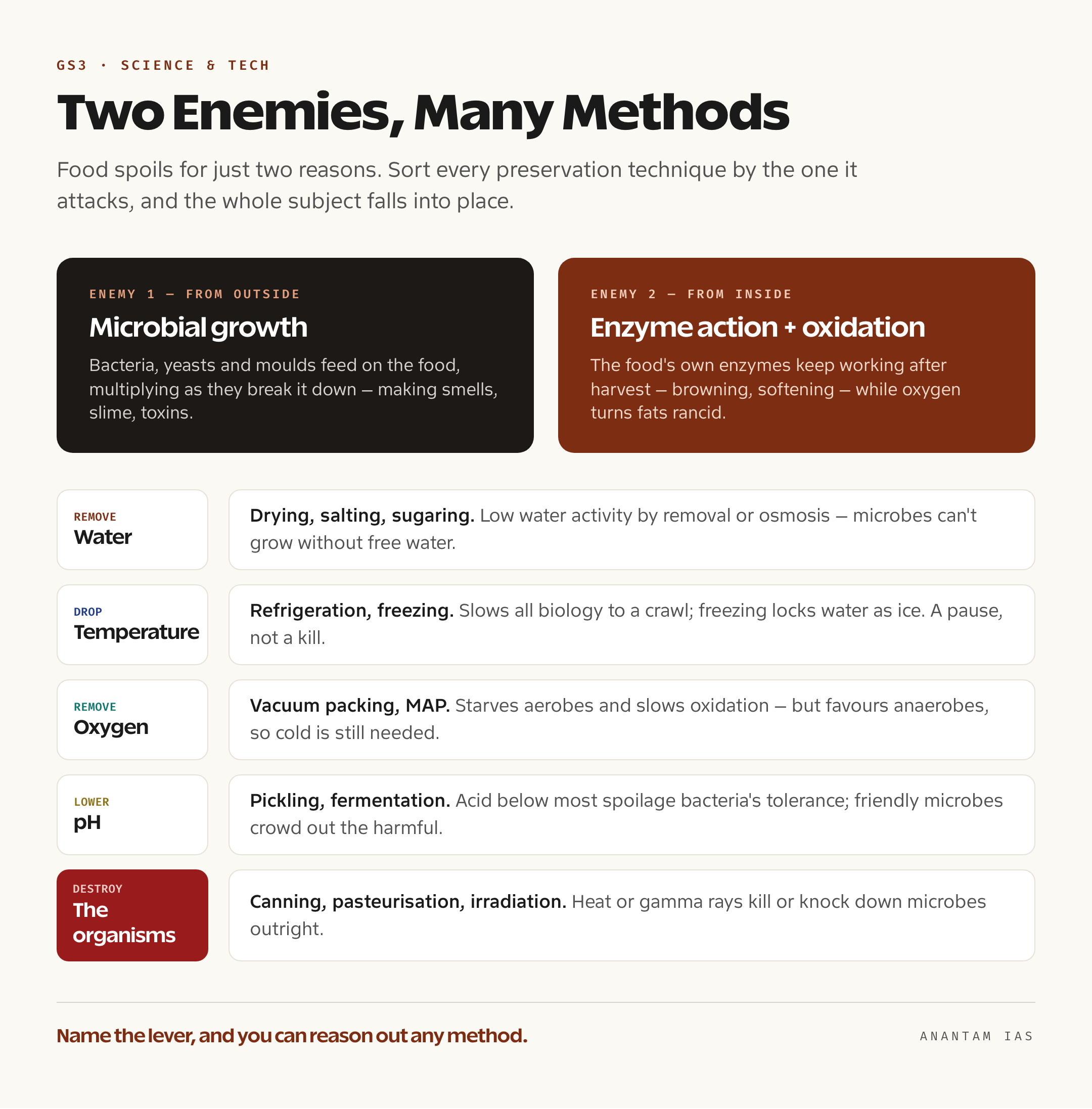
Before any technique makes sense, you have to know what you are fighting. Food spoils for two reasons, and almost every preservation method is aimed at one or both. The first enemy is microbial growth — bacteria, yeasts and moulds that land on food and treat it as a meal, multiplying as they break down sugars, proteins and fats. As they feed, they produce the sour smells, slime, discolouration and, in the worst cases, the toxins that make spoiled food dangerous. The second enemy is enzyme action — and this one is subtler, because it comes from inside the food itself. Fruits, vegetables and meat are made of living cells, and those cells carry enzymes, the biological catalysts that ran the organism’s chemistry while it was alive. After harvest or slaughter, the enzymes keep working, quietly catalysing reactions that brown a cut apple, soften a ripe banana into mush and turn fresh produce limp. A third, quieter process rides alongside them: oxidation, where oxygen in the air reacts with fats to turn them rancid and with pigments to dull colour.
So spoilage is really a race — between you and the microbes feeding on the food, and between you and the food’s own chemistry digesting itself. Every preservation technique is an attempt to win that race by changing the conditions microbes and enzymes need. And what microbes and enzymes need is surprisingly short: water to dissolve and move nutrients, a comfortable temperature, oxygen for many of them, and a pH that isn’t too acidic. Take away even one of those, and life slows down. Take away several, and it nearly stops. That single sentence is the master key to the whole subject — preservation is the art of making food an inhospitable place to live.
This is why the methods group so neatly once you see the logic. Some attack water, some attack temperature, some attack oxygen, some attack pH, and some simply kill the microbes outright with heat or radiation. Drying and salting remove or lock up water. Refrigeration and freezing slow everything by dropping the temperature. Pickling and fermentation drop the pH. Vacuum packing and modified-atmosphere packing change the gases around the food. Canning, pasteurisation and irradiation are kill or knock-down steps that destroy the organisms directly. Knowing which lever each method pulls lets you reason about any preservation question, even one you have never seen, instead of memorising a list.
The Classic Toolkit: From Salt and Sun to the Sterile Can
The oldest methods all attack water, because water is the one thing every microbe must have. Scientists capture this with a single number — water activity, written a_w — which measures how much of a food’s water is actually “free” and available to organisms rather than bound up in salt, sugar or solids. Bring water activity low enough and microbes simply cannot grow. Drying and dehydration do this the obvious way, by removing the water itself: sun-dried mango, dehydrated onion flakes, milk powder and dried fish all keep for months because there is barely any free water left for microbes to use. Salting and sugaring reach the same destination by a cleverer route — osmosis. Pack salt around fish or sugar around fruit, and water flows out of both the food’s cells and any microbial cells by osmosis, toward the high concentration outside. The food dries from within and the microbes are dehydrated to death. That is the science under a salted fish, a jar of jam and the candied peel in a sweet shop: not poison, just thirst.
A second family attacks pH. Pickling drowns food in an acidic medium — vinegar, or the lactic acid produced when bacteria ferment the food’s own sugars — pulling the pH below the level most spoilage bacteria can tolerate. India’s mango and lime pickles add a third defence on top, a layer of oil that seals out air, while the salt does its osmotic work; acid, salt and an oxygen barrier in one jar. Fermentation deserves a special note here, because it is preservation that turns spoilage on its head: instead of stopping all microbes, you deliberately encourage friendly ones — the lactic-acid bacteria in idli batter, dosa, dahi and kimchi — which acidify the food and crowd out the harmful organisms, while adding flavour and nutrients along the way.
Then comes heat, the most decisive weapon of all, because enough of it does not just slow microbes — it kills them. Canning, the breakthrough of the French confectioner Nicolas Appert around 1809, seals food in an airtight container and heats it hard enough to destroy the microbes inside, after which the sealed can keeps air and new organisms out; that is why an unopened tin of beans lasts years on a shelf. Pasteurisation, named for Louis Pasteur, is the gentler cousin: heat food just enough to kill the disease-causing and spoilage organisms without cooking it, then cool it fast. Milk pasteurised at around 72°C for a few seconds stays safe and fresh for days under refrigeration. Push the heat much higher — UHT, or Ultra-High Temperature, at roughly 135-140°C for two to five seconds — and you achieve commercial sterility, which is why UHT milk in a sealed carton survives weeks at room temperature without a fridge. Heat is the line between “slowing life down” and “ending it,” and canning, pasteurisation and UHT sit at different points along that line.
Cold, Vacuum and Atmosphere: Slowing Life Without Killing It
The modern kitchen leans heavily on a different strategy — not killing microbes but putting them to sleep. Refrigeration and freezing attack temperature, the dial that controls how fast all biology runs. Chill food to around 0-5°C and microbial growth and enzyme reactions slow to a crawl, which buys days; freeze it below 0°C and the free water turns to ice, becoming unavailable to microbes while the cold nearly halts enzyme activity, which buys months. But this is a pause, not a kill — thaw the food and the same microbes wake up and resume feeding, which is why refrozen food spoils so quickly. The line worth carrying into any answer is that cold suspends spoilage; it does not end it.
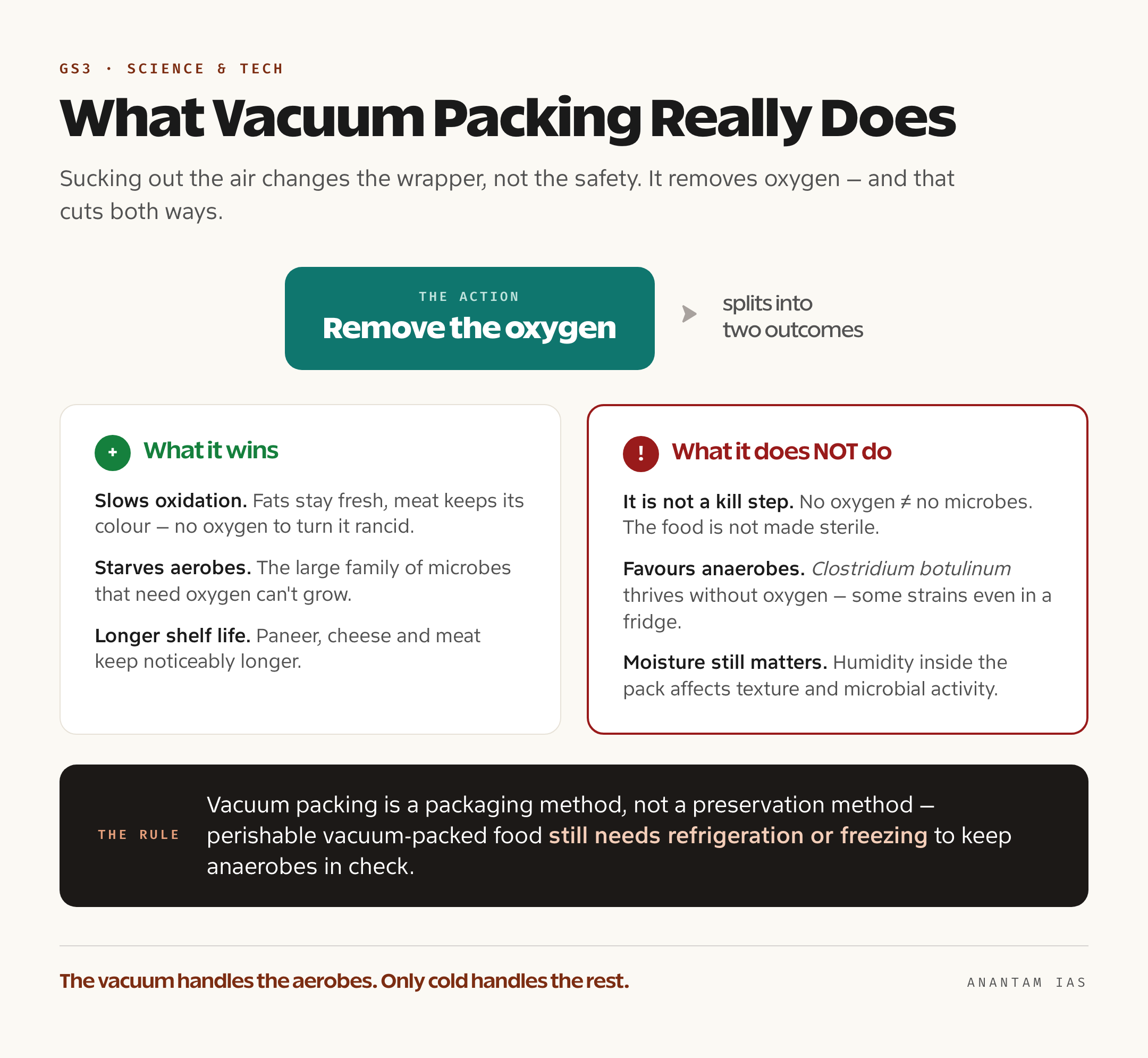
Vacuum packing is the method most people misunderstand, and it is worth getting exactly right because the misunderstanding is dangerous. Sealing food in a pouch and sucking out the air removes oxygen, and that does two genuinely useful things: it slows oxidation, so fats stay fresh longer and meat keeps its colour, and it starves the large family of aerobic microbes that need oxygen to grow. So vacuum-packed paneer, cheese or meat does last longer on the shelf. But — and this is the heart of it — removing oxygen is not a kill step. It changes the packaging, not the safety of the food. Two things still threaten it. First, humidity and moisture inside the pack still matter, affecting texture and feeding microbial activity, so the food is not magically inert. Second, and more seriously, taking away oxygen actively favours anaerobic microbes — organisms that grow without oxygen — and the most feared of these is Clostridium botulinum, whose toxin causes botulism. Some strains can even grow slowly at refrigerator temperatures. That is the whole reason food-safety authorities insist that vacuum packing must be paired with refrigeration or freezing: the vacuum handles the aerobes, but only cold keeps the anaerobes in check. Vacuum packing is a better wrapper, not a substitute for preservation.
A close relative is Modified Atmosphere Packaging, or MAP, which does not just remove air but replaces it with a designed gas mix — typically more carbon dioxide and nitrogen and less oxygen. The carbon dioxide actively suppresses bacteria and moulds while the low oxygen slows oxidation, which is how a bag of fresh salad leaves, a pack of meat or a tray of bakery items stays good for days longer than it would in plain air. Where vacuum packing simply takes oxygen away, MAP engineers the whole atmosphere around the food — the same principle, taken one step further.
The High-Tech Edge and India’s Cold-Chain Push
The frontier of preservation moves beyond heat and cold into radiation and chemistry. Food irradiation exposes food to controlled doses of ionising radiation — usually gamma rays from a Cobalt-60 source — which damages the DNA of microbes, insects and sprouting cells without significantly heating the food, so it kills or sterilises contaminants while the food stays raw and largely unchanged in taste. It is a cold pasteurisation, in effect. In India this technology has a distinctly national flavour: the Bhabha Atomic Research Centre and the Department of Atomic Energy have built it into the food system, using irradiation to stop potatoes and onions from sprouting, to disinfest spices and pulses, and to extend the shelf life of mangoes for export. As the government highlighted through PIB in December 2025, BARC has gone further, combining irradiation with onion-specific cold storage to keep rabi onions fresh for up to seven and a half months — a direct attack on the price spikes that hit Indian households whenever the onion crop is held back. The Board of Radiation and Isotope Technology supplies the Cobalt-60, and FSSAI regulates the practice, so a uniquely Indian chain of atomic-energy institutions sits behind the humble goal of a non-sprouting onion.
The oldest high-tech trick of all is simply adding chemical preservatives — substances that inhibit microbes or slow oxidation. The common ones each have a clear job: sodium benzoate and benzoic acid suppress moulds and yeasts in acidic foods like soft drinks, jams and pickles, working best below a pH of about 4.5; sorbic acid and sorbates guard cheese and baked goods against mould; sodium nitrite cures and colours processed meats while blocking the very Clostridium botulinum that vacuum packing can encourage; and antioxidants such as BHA and ascorbic acid (vitamin C) slow the oxidation that turns fats rancid. In India their use is policed by the Food Safety and Standards Authority of India, FSSAI, which sets the permitted additives and maximum limits — the line between a legal preservative at a safe dose and an adulterant. This is where preservation meets food safety as a governance question, not just a chemistry one.
Tie it all together and you arrive at the cold chain — the unbroken sequence of refrigerated storage and transport that carries perishable food from farm to fork without ever letting the temperature rise. This is preservation as infrastructure rather than technique, and it is where India’s biggest gains lie. Through the Ministry of Food Processing Industries’ Integrated Cold Chain scheme and allied missions, the country has been building reefer trucks, pack-houses, ripening chambers and cold stores to shrink those huge post-harvest losses, raise farmer incomes and steady the supply of fruit, vegetables, milk and meat. No single clever method matters as much as keeping the whole chain cold and intact — because a mango irradiated in a perfect facility still rots if it then bakes in an unrefrigerated truck for two days.
For Your Mains Answer
This is a versatile topic for GS Paper 3, which covers science and technology, the indigenisation and application of technology, and issues of food processing, food security and farmer incomes. The food-irradiation angle connects directly to India’s atomic-energy programme and BARC; the cold-chain angle connects to post-harvest losses and the food-processing sector; and the FSSAI angle connects to food safety and regulation. It also surfaces in the Prelims as straightforward science — the principle behind drying, pasteurisation or vacuum packing — and the same material can sharpen an essay on food security or appropriate technology. The skill that earns marks is the one this article is built on: explain the mechanism, then attach an Indian application.
How to Build the Answer
Lead with the principle, not a list. State that all preservation works by slowing or stopping microbial growth and enzyme action, then sort the methods by the lever each one pulls — water (drying, salting), temperature (refrigeration, freezing), pH (pickling, fermentation), oxygen (vacuum, MAP) and direct destruction (canning, pasteurisation, irradiation). End with the Indian frame: post-harvest losses, the cold chain, BARC and FSSAI. That arc — principle, classification by mechanism, national application — turns a memory dump into a structured, examiner-friendly answer.
Common Mistakes to Avoid
Don’t call vacuum packing a method of killing microbes — it removes oxygen, which slows aerobes and oxidation but favours anaerobes like Clostridium botulinum, so it still needs refrigeration. Don’t confuse pasteurisation with sterilisation; pasteurisation kills only the dangerous and spoilage organisms, while canning and UHT aim for commercial sterility. Don’t say freezing kills microbes — it suspends them. And don’t forget enzymes: spoilage is not only microbial, and methods like blanching exist specifically to deactivate the food’s own enzymes.
A Compact Answer Spine
Spoilage = microbial growth + enzyme action (+ oxidation) → remove water (drying, salting via osmosis, low a_w) → drop temperature (refrigeration slows, freezing locks water as ice — a pause, not a kill) → drop pH (pickling, fermentation) → remove/replace gases (vacuum slows aerobes but favours anaerobes, needs cold; MAP adds CO₂) → destroy organisms (canning/Appert, pasteurisation/Pasteur, UHT, irradiation via gamma rays damaging DNA) → chemical preservatives (sodium benzoate, nitrite, antioxidants) under FSSAI limits → India: BARC irradiation for onions/potatoes/spices/mangoes, cold chain to cut post-harvest losses.
Diagram or Flowchart Idea
Draw a simple two-branch tree: “Why food spoils” splitting into microbial growth and enzyme action, with each preservation method hung under the factor it removes — water, temperature, oxygen, pH, or “direct kill.” A clean classification diagram like this shows the examiner you understand the underlying logic, not just the vocabulary, and it doubles as your revision map.
A Balanced-Conclusion Line
A line that lands the marks: “Food preservation is, at heart, a single idea — make food an inhospitable home for microbes and a quiet place for its own enzymes — and India’s real frontier lies less in any one technique than in building the cold chain and indigenous irradiation capacity to stop a quarter of its harvest from rotting before it is eaten.”
How to Use Data Without Cramming
You need only a few anchors, not a catalogue: post-harvest losses of roughly a quarter to a third of fruits and vegetables; pasteurisation at about 72°C for a few seconds versus UHT at around 135°C; BARC’s irradiation-plus-cold-storage keeping rabi onions fresh up to seven and a half months; and Cobalt-60 as the gamma source. Attribute them plainly — “as PIB noted in December 2025” — and let the mechanism, not the numbers, carry the answer.
FAQ
What is the basic principle behind all food preservation? Every method works by slowing or stopping the two processes that spoil food — the growth of microbes (bacteria, yeasts, moulds) and the action of the food’s own enzymes, helped along by oxidation. Techniques achieve this by removing water (drying, salting), lowering temperature (refrigeration, freezing), changing pH (pickling, fermentation), removing or replacing oxygen (vacuum packing, MAP), or destroying microbes directly (canning, pasteurisation, irradiation). Make the food an inhospitable place to live, and it keeps.
Does vacuum packing kill bacteria or make food safe by itself? No. Vacuum packing only removes oxygen. That slows oxidation and starves aerobic microbes, so food lasts longer, but it is a packaging method, not a kill step. Removing oxygen actually favours anaerobic bacteria such as Clostridium botulinum, some of which can grow even at fridge temperatures, so vacuum-packed perishable food must still be refrigerated or frozen to stay safe.
What is the difference between pasteurisation, UHT and sterilisation? Pasteurisation uses mild heat (around 72°C for a few seconds for milk) to kill disease-causing and spoilage organisms without cooking the food, so the product still needs refrigeration and lasts days. UHT (Ultra-High Temperature, roughly 135°C for a few seconds) and full sterilisation aim for commercial sterility, destroying virtually all microbes so that sealed UHT milk or canned food keeps for weeks or years at room temperature.
How is food irradiation used in India, and is it safe? Food irradiation exposes food to controlled gamma rays, usually from Cobalt-60, which damage the DNA of microbes, insects and sprouting cells without significantly heating the food. In India, BARC and the Department of Atomic Energy use it to stop potatoes and onions from sprouting, disinfest spices and pulses, and extend mango shelf life for export; FSSAI regulates it and approves permitted doses, and the food does not become radioactive.
Practice Questions
Prelims MCQs
- The basic principle common to most food-preservation methods is to:
(a) Add nutrients that strengthen the food’s cells
(b) Slow or stop microbial growth and enzyme action
(c) Increase the oxygen content around the food
(d) Raise the water activity of the food
Answer: (b) Preservation works by making food inhospitable to spoilage microbes and by deactivating its own enzymes; many methods also slow oxidation. - Salting and sugaring preserve food mainly through which process?
(a) Killing microbes with heat
(b) Lowering the pH below 4.5
(c) Osmosis, which draws water out of food and microbial cells
(d) Replacing oxygen with carbon dioxide
Answer: (c) High salt or sugar concentrations pull water out by osmosis, dehydrating both the food and any microbes and lowering water activity. - With reference to vacuum packing, consider the following statements:
1. Humidity and moisture have no effect on vacuum-packed food.
2. Reduced oxygen slows oxidation reactions that cause spoilage and rancidity.
3. Some anaerobic microorganisms can still grow under vacuum conditions. Which statements are correct?
(a) 1 and 2 only
(b) 2 and 3 only
(c) 1 and 3 only
(d) 1, 2 and 3
Answer: (b) Moisture does affect vacuum-packed food; removing oxygen does slow oxidation; and anaerobes such as Clostridium can still grow, which is why refrigeration is needed. - Which statement about pasteurisation is correct?
(a) It sterilises food completely so it needs no refrigeration
(b) It uses mild heat to kill pathogenic and spoilage organisms without cooking the food
(c) It preserves food by removing all of its water
(d) It uses gamma radiation to kill microbes
Answer: (b) Pasteurisation applies just enough heat (e.g. about 72°C for a few seconds for milk) to kill harmful organisms, after which the product is cooled and usually refrigerated. - Food irradiation in India, used to prevent sprouting in onions and potatoes and to disinfest spices, primarily relies on which source and works by what mechanism?
(a) Ultraviolet light that heats the food to sterilise it
(b) Microwaves that boil off the food’s water
(c) Gamma rays from Cobalt-60 that damage the DNA of microbes and sprouting cells
(d) X-rays that add preservatives to the food
Answer: (c) Gamma rays from a Cobalt-60 source damage microbial and cellular DNA without significantly heating the food; in India this is led by BARC and regulated by FSSAI.
Mains Practice Questions
- “All food preservation reduces to a single principle.” Explain this statement and classify the major preservation techniques by the spoilage factor each one targets. (15 marks, 250 words)
- Vacuum packing is widely believed to make food safe by itself. Critically examine the science of vacuum packing, its benefits and its limitations, with reference to anaerobic microorganisms and the need for refrigeration. (15 marks, 250 words)
- Discuss the role of food irradiation in strengthening India’s food security. How do institutions such as BARC and FSSAI contribute to its safe and effective use? (15 marks, 250 words)
- Distinguish between pasteurisation, UHT processing and sterilisation, and explain how each determines the shelf life and storage requirements of the food. (10 marks, 150 words)
- India loses a large share of its harvest to post-harvest spoilage. Evaluate how an integrated cold chain, combined with appropriate preservation technologies, can address this challenge. (15 marks, 250 words)