Functions of Emotions: How Emotions Drive Action, Decisions and Survival (UPSC GS IV)
Functions of emotions for UPSC GS IV — motivation, performance, survival, decision-making, social understanding; with Indian civil service case studies.
Emotions are easy to dismiss as soft. They are not. From an evolutionary standpoint, emotions are among the most efficient information-processing systems the human animal has — fast, cheap, and surprisingly accurate. From an administrative standpoint, emotions are doing work all the time: motivating action, calibrating performance, signalling danger, sharpening decisions, knitting social bonds. The civil servant who treats emotion as noise loses a primary channel of useful information.
This article walks through the five major functions of emotions — motivation, performance regulation, survival, decision-making, social understanding — and shows what each looks like in Indian civil-service practice.
Why emotions evolved
Modern affective neuroscience treats emotions as adaptive functions — biological mechanisms that solved recurring problems for our ancestors. Fear avoided predators; disgust avoided contaminated food; anger defended boundaries; love bonded mating pairs and parents to children; gratitude sustained reciprocal cooperation. The functions persist into modern life, even when the original triggers no longer dominate.
This is the framework in which the GS IV functions of emotion are best understood. They are not arbitrary conveniences. They are doing important work.
Function 1 — emotions motivate action
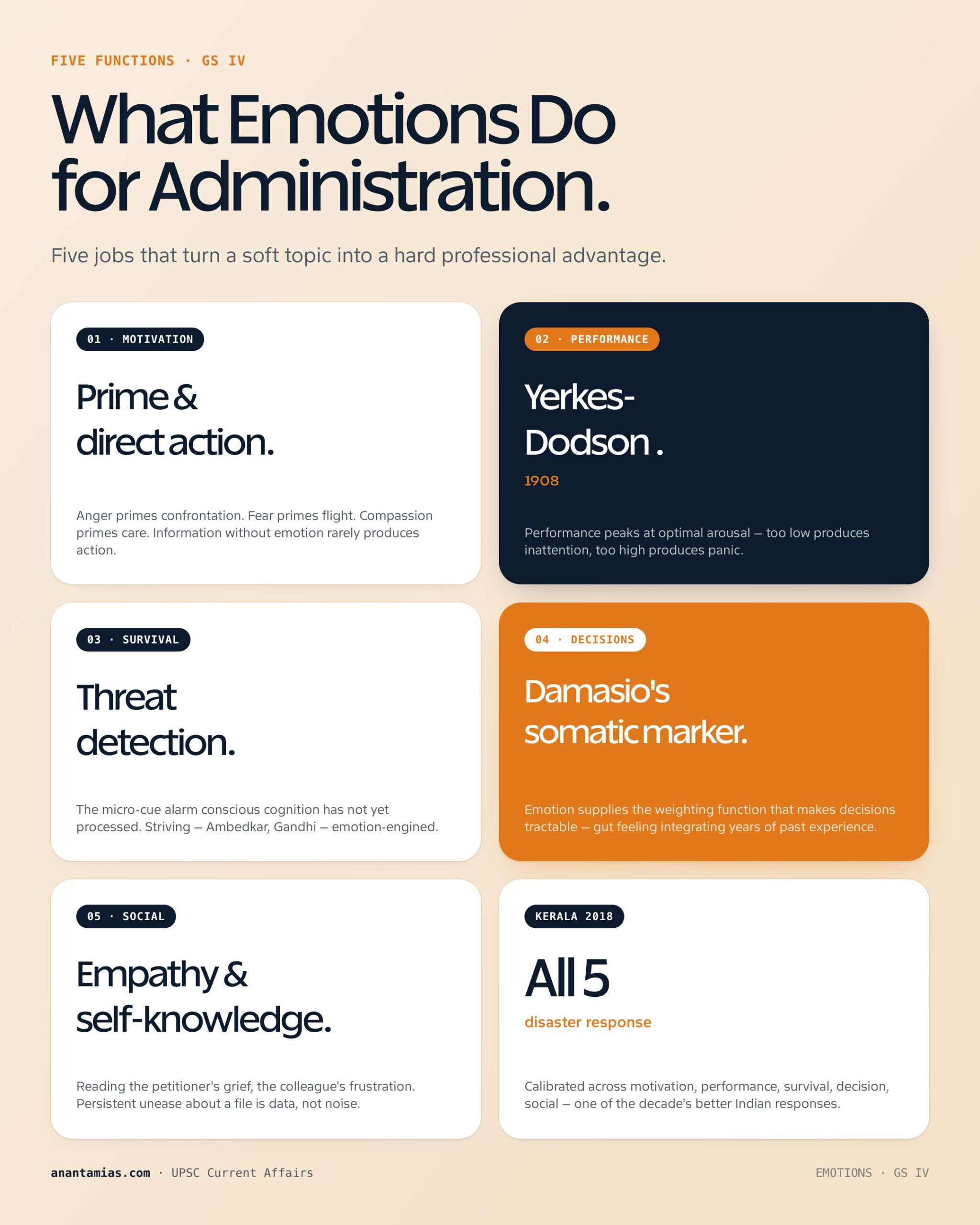
The first and oldest function of emotion is to prime and direct action.
- Anger primes the body for confrontation; the heart speeds up, blood flows to the limbs, attention narrows.
- Fear primes for flight or freezing; the same physiological pattern oriented away from the threat.
- Disgust primes for rejection; the body recoils, the face wrinkles.
- Love and compassion prime for approach, care, protection.
In modern life, the action need not be physical. Charity is an action emotion drives — sympathy at the sight of suffering produces the impulse to give. Civic engagement is emotion-driven — anger at corruption produces protest, gratitude for kindness produces volunteer work. Nothing important gets done in human life without emotional motivation.
The civil servant who wants citizens to act — register a child, install a meter, attend a vaccination — must engage emotion. Pure information rarely produces action; information married to the right emotion does.
Function 2 — emotions regulate performance
The second function is to regulate the level and quality of performance.
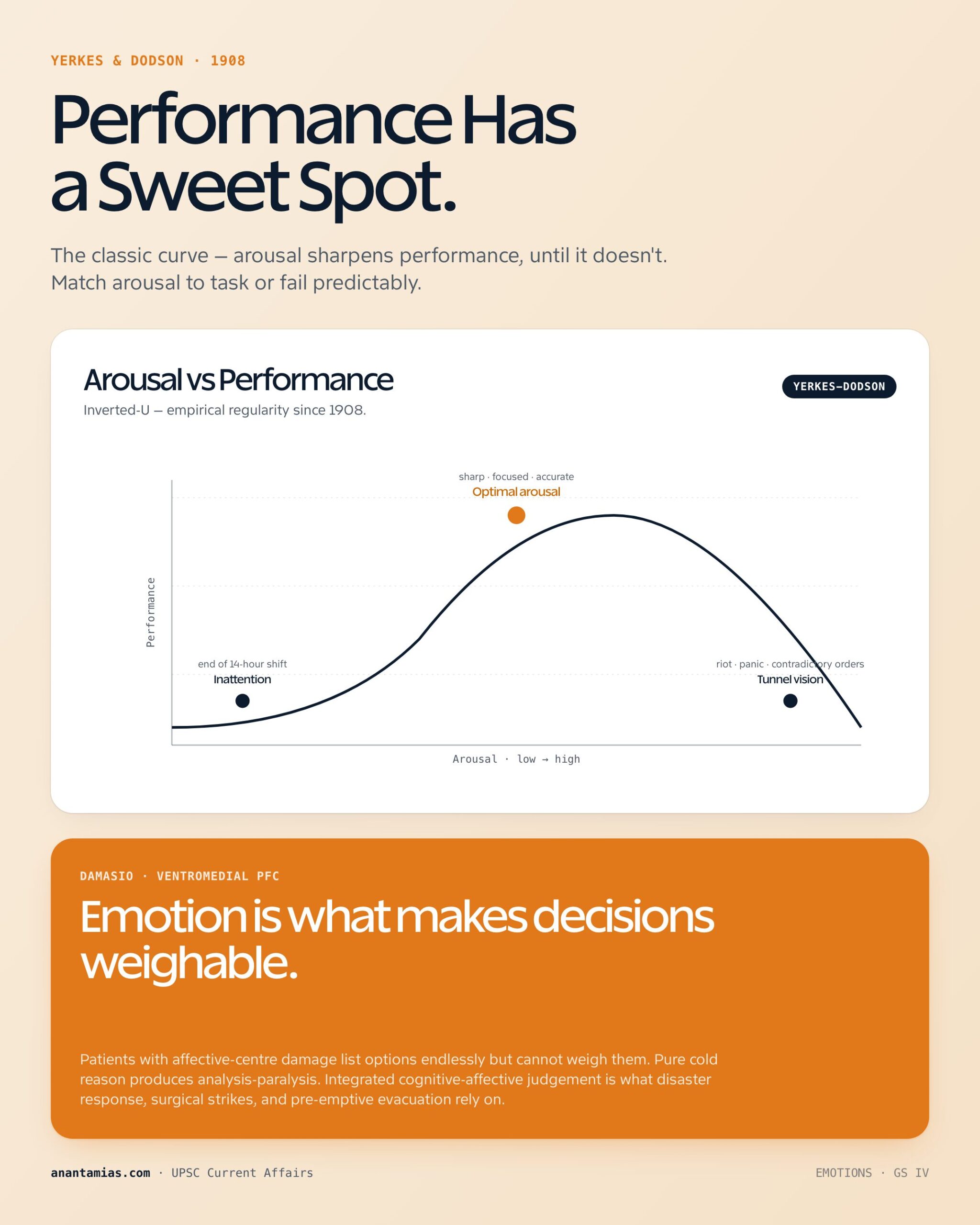
This is captured by the Yerkes-Dodson curve — the empirical regularity, dating to a 1908 study by Robert Yerkes and John Dillingham Dodson, that performance improves with arousal up to a point, then degrades.
| Arousal | Performance | Civil-service example |
|---|---|---|
| Too low | Inattention, errors of omission | Officer at the end of a 14-hour shift missing details on a file |
| Optimal | Sharp, focused, accurate | Officer with a stake in the outcome, alert but composed |
| Too high | Tunnel vision, errors of commission, panic | Officer in a riot situation issuing contradictory orders |
The optimal arousal level depends on task complexity. Simple tasks tolerate higher arousal; complex tasks need lower. A police officer in a fight needs high arousal; a finance officer drafting a budget memorandum needs low. Mismatching task and arousal produces predictable failure.
Negative emotions can serve performance. Receiving a poor result on an examination produces frustration — and frustration directs energy into harder preparation for the next test. The civil servant who gets a bad ACR review can either spiral into demoralisation or convert the affect into focused improvement. Same emotion, different functional outcome.
Function 3 — emotions help us survive, strive or avoid danger
The third function is the protective one. Emotions evolved as threat-detection and goal-pursuit systems.
Fear detects threat. The officer who walks into a crowd and feels a sudden uneasy alertness is reading micro-cues her conscious mind has not yet processed. Trusting that emotional alarm has saved many lives.
But emotions also drive striving. The historical examples are striking.
- Ambedkar's striving — the lifelong determination to lift the Dalit community from caste oppression rested on a sustained emotional substrate, an integration of righteous anger at injustice and constructive love for the community.
- Gandhi's striving — the freedom struggle rested on emotional integration of truth (satya) and non-injury (ahimsa), each with its own affective signature.
- Tulsidas and Kabir — the bhakti tradition channelled emotion (love for the divine, despair at human folly) into sustained creative and reformist work.
Strivings are emotion-driven. Without the affective engine, the cognitive content alone does not move the person — or the country.
Function 4 — emotions improve decision-making
A common misconception treats emotion and decision-making as opposites — that good decisions are made coldly, free of feeling. The neuroscience disagrees.
Antonio Damasio's research on patients with damage to the emotional centres of the brain (the ventromedial prefrontal cortex) showed that, while their cognitive abilities remained intact, they became worse at decisions, not better. They could list options endlessly but could not weigh them. Damasio's somatic marker hypothesis holds that emotion supplies the weighting function that makes decisions tractable — the gut feeling that an option is better integrates years of past experience.
In administration, the principle is direct.
- The post-Pulwama decision to conduct surgical strikes was a high-stakes choice integrating intelligence, strategic calculation and the emotional reading of national mood, deterrence and proportionality.
- A district magistrate's call to evacuate a flood-prone village before official orders — relying partly on the felt sense that the situation is worsening faster than reports suggest — has saved countless lives.
This is not "going with your gut" as the opposite of analysis. It is integrated cognitive-affective decision-making, in which emotion contributes information that analysis alone cannot supply.
Function 5 — emotions help us understand self and others
The fifth function is social and self-cognition.
- Empathy — the recognition of another's emotional state — is itself a function of emotional capacity. The officer who can read a petitioner's grief, a colleague's frustration or a citizen's quiet desperation provides better service than one blind to these signals.
- Self-knowledge — emotions give us information about ourselves. The persistent unease about a particular file is data about either an ethical concern or a competence gap; the persistent satisfaction in a particular kind of work points to vocation.
Emotional support is one of the most consequential uses of social emotion. When a colleague has lost a family member, the right emotional response — sustained, undemonstrative care — does more than any procedural support. The officer who shows up with food, sits in silence, attends the funeral has performed a function that no policy can substitute for.
Two Indian case studies
Case study 1 — Kiran Bedi and emotional reform of Tihar Jail
Kiran Bedi's reforms at Tihar (1993–95) explicitly engaged the functions of emotion. She used emotion to motivate inmates (yoga, meditation, family meetings produced calmer, more cooperative populations); used Yerkes-Dodson principles in staff training (calibrated stress drove sharper performance, panic-level stress caused failures); used empathy to understand grievances; and used positive affect to drive collective striving (the Magsaysay-recognised "Vipassana in prisons" programme). Emotion was not an extra; it was the policy lever.
Case study 2 — disaster response after the 2018 Kerala floods
The Kerala administration's response combined calibrated emotion across all five functions. Motivation — fear and solidarity drove mass volunteering. Performance — emergency-response teams operated near the optimal arousal point under sustained stress. Survival — communities used affective alarm to evacuate ahead of official orders in some cases. Decision-making — the chief minister's daily briefings integrated data with the emotional climate of the state. Social understanding — the recovery effort consciously engaged grief, anger and hope as legitimate feelings the state had to address. Outcome: one of the more successful Indian disaster responses of the decade.
Civil services application
Each of the five functions has a routine administrative application.
- Motivate citizens to act with information married to emotion — pride, hope, fear, gratitude — chosen to fit the action.
- Manage personal arousal to keep performance near the optimum; neither apathetic nor panicked.
- Trust felt alarms as data about situations that conscious analysis has not caught up with — and verify before acting.
- Use integrated cognitive-affective judgement for high-stakes decisions; pure spreadsheets are insufficient when human consequences dominate.
- Practise empathy as a daily discipline — naming the emotional state of every petitioner you meet, even silently.
UPSC past-year question references
- 2014 GS IV: "Emotional intelligence is helpful in decision making." Discuss.
- 2017 GS IV: case study where the officer's emotional state shapes a sensitive decision.
- 2018 GS IV: components of emotional intelligence and their administrative use.
- 2020 GS IV: empathy and compassion as emotional capabilities of public servants.
Mains answer hook
Emotions are not the opposite of reason but a complementary information system. Five functions stand out — motivation of action, regulation of performance via the Yerkes-Dodson curve, support of survival and striving, integration with decision-making (per Damasio's somatic marker hypothesis), and the building of social and self-knowledge through empathy. Each function carries direct administrative implications. The civil servant who treats emotions as noise loses one of the most efficient information channels in human cognition; the civil servant who integrates them with reason has a substantial professional advantage over peers who do not.
Prelims pointers
- Yerkes-Dodson curve — Robert Yerkes and John Dillingham Dodson, 1908.
- Antonio Damasio — somatic marker hypothesis; Descartes' Error.
- Empathy as a component of emotional intelligence (Daniel Goleman).
- Five functions: motivate action, regulate performance, aid survival/striving, support decision-making, build social and self-understanding.
FAQ
Are emotions a help or a hindrance to decision-making?
Both, depending on calibration. Without emotion, decisions become weightless and analysis-paralysis sets in. With excessive or miscalibrated emotion, decisions become impulsive. The competent decision-maker integrates both.
What does the Yerkes-Dodson curve tell a civil servant?
That arousal — emotional intensity — has an optimum for any task, and that more is not always better. Match arousal to task; recognise when stress has crossed the peak and is degrading performance.
Can emotional skills be learnt?
Yes. Emotional intelligence has been repeatedly shown to be trainable — through reflection, feedback, mindfulness practice, and structured exposure to emotionally demanding situations.
Why is empathy a function of emotion rather than cognition?
Cognitive perspective-taking is part of empathy, but the felt resonance with another's state is fundamentally affective. Patients with affective deficits can describe another's situation but not feel with them.
Should civil servants suppress emotions in difficult situations?
Suppression often backfires. Better is regulation — recognise the emotion, modulate its expression, use its information, decide deliberately. Suppression is brittle; regulation is durable.
The functions of emotion are why GS IV insists that emotional intelligence is administrative competence. Knowing what emotions do is the first step toward putting them to work for the public, instead of letting them work the public against the administrator.