Fundamental Rights and Duties of Indian Constitution — Articles 12–35 (Rights) + Article 51A (Duties), Comparison, Significance (UPSC Polity)
The fundamental rights and duties of india are taught in school as a balanced pair — rights on one page, duties on the next.
The fundamental rights and duties of india are taught in school as a balanced pair — rights on one page, duties on the next. But the Constitution didn’t create them as a pair. Rights came in 1950. Duties came in 1976. That 26-year gap explains every confusion you’ll see in coaching notes today. Most aspirants bullet-point the 11 duties, name-drop the 86th Amendment, and move on… and lose 4-5 marks every time the examiner asks why duties were added at all. This article fixes the relationship — what came when, what each does, why the framers bet on rights-only originally, and how the Verma Committee tried to make duties enforceable. Read once, and the FR-vs-FD question stops being a memory test.
What are the fundamental rights and duties of india?
The fundamental rights and duties of india form the two-part civic compact of the Constitution: six justiciable rights in Part III (Articles 12–35) that protect individuals from State excess, and eleven non-justiciable duties in Part IV-A (Article 51A) that bind every citizen to the nation. Rights are enforceable in court. Duties are enforceable mostly through citizenship, education, and conscience.
- Fundamental rights — Part III — Articles 12 to 35 — six categories — justiciable.
- Fundamental duties — Part IV-A — Article 51A — eleven duties — non-justiciable.
- Duties added by — 42nd Amendment, 1976 (10 duties) + 86th Amendment, 2002 (11th duty).
- Rights borrowed from — US Bill of Rights model.
- Duties borrowed from — USSR Constitution (former).
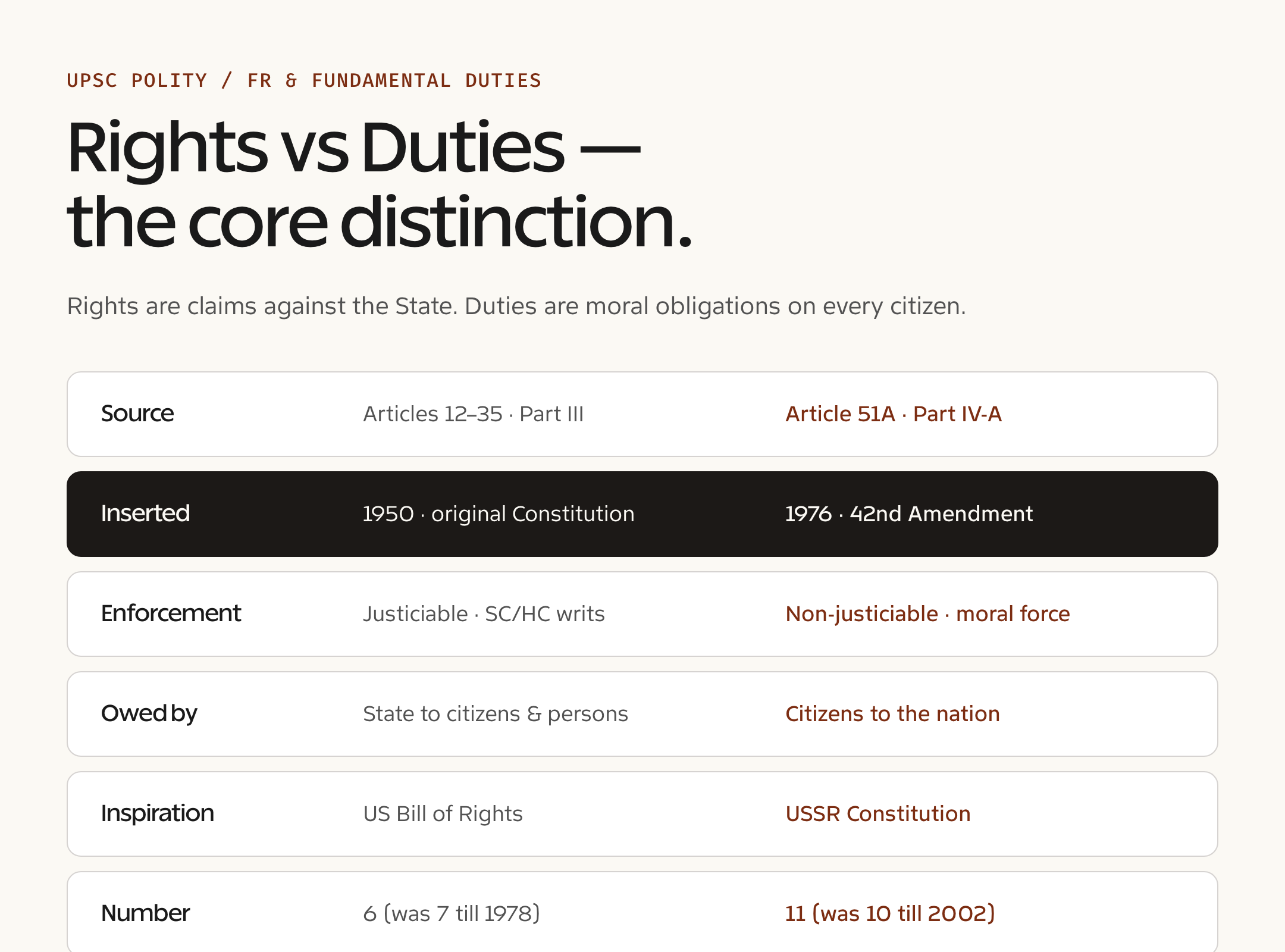
Why rights came first and duties came late
The original Constitution of 1950 had no chapter on duties. Look, the framers were sceptical. Dr Ambedkar argued that listing duties in a constitution that emerged from colonial control would feel coercive — Indians had just won the right to not be ordered around by the State. So Part III was placed at the top of the Constitution and Part IV (Directive Principles) immediately after as policy guidance. Duties were assumed to flow from rights.
That changed in 1976. During the Emergency, the Sardar Swaran Singh Committee was set up to suggest amendments aligning the Constitution with the government’s vision. The committee recommended adding fundamental duties. The 42nd Amendment Act, 1976 — often called the “Mini-Constitution” — added Part IV-A (Article 51A) with 10 duties, drawing from the (then) USSR Constitution.
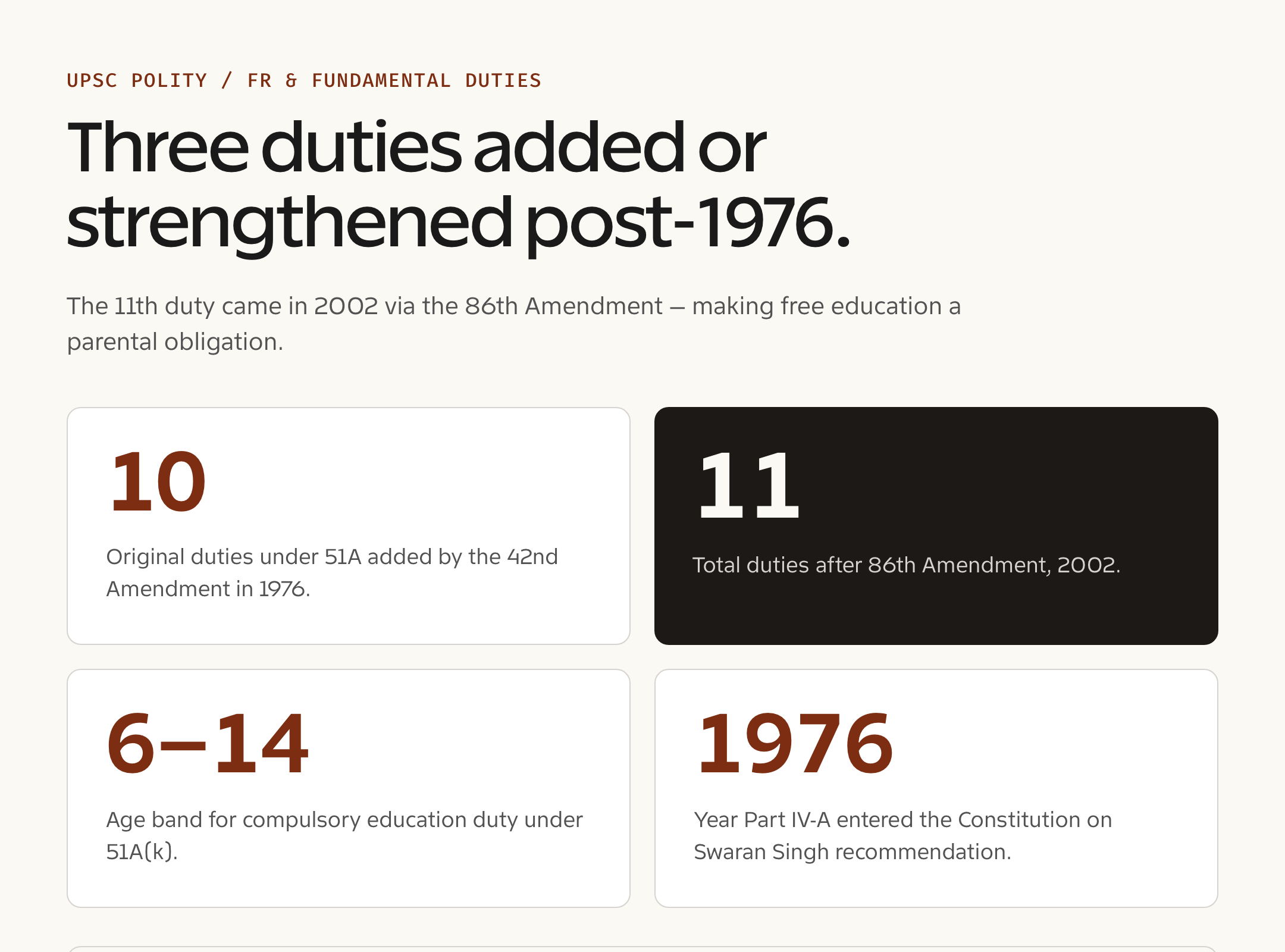
The 11th duty came much later. The 86th Amendment Act, 2002 — Year + Subject + Effect: 2002 — Right to Education + added Article 51A(k) — required parents and guardians to provide opportunities for education to children aged 6 to 14.
For the Preamble’s role in framing this constitutional bargain, see Preamble of the Indian Constitution.
The six fundamental rights — quick map
Articles 12–35 organise the fundamental rights and duties of india into six categories. Each anchor article is the one most likely to appear in Prelims.
- Right to Equality — Articles 14 to 18.
- Right to Freedom — Articles 19 to 22.
- Right against Exploitation — Articles 23 to 24.
- Right to Freedom of Religion — Articles 25 to 28.
- Cultural and Educational Rights — Articles 29 to 30.
- Right to Constitutional Remedies — Articles 32 to 35.
For the encyclopedic version of each category, read Fundamental Rights in India — Part III, Articles 12-35, Landmark Cases and Article 21 of the Indian Constitution: Right to Life and Personal Liberty.
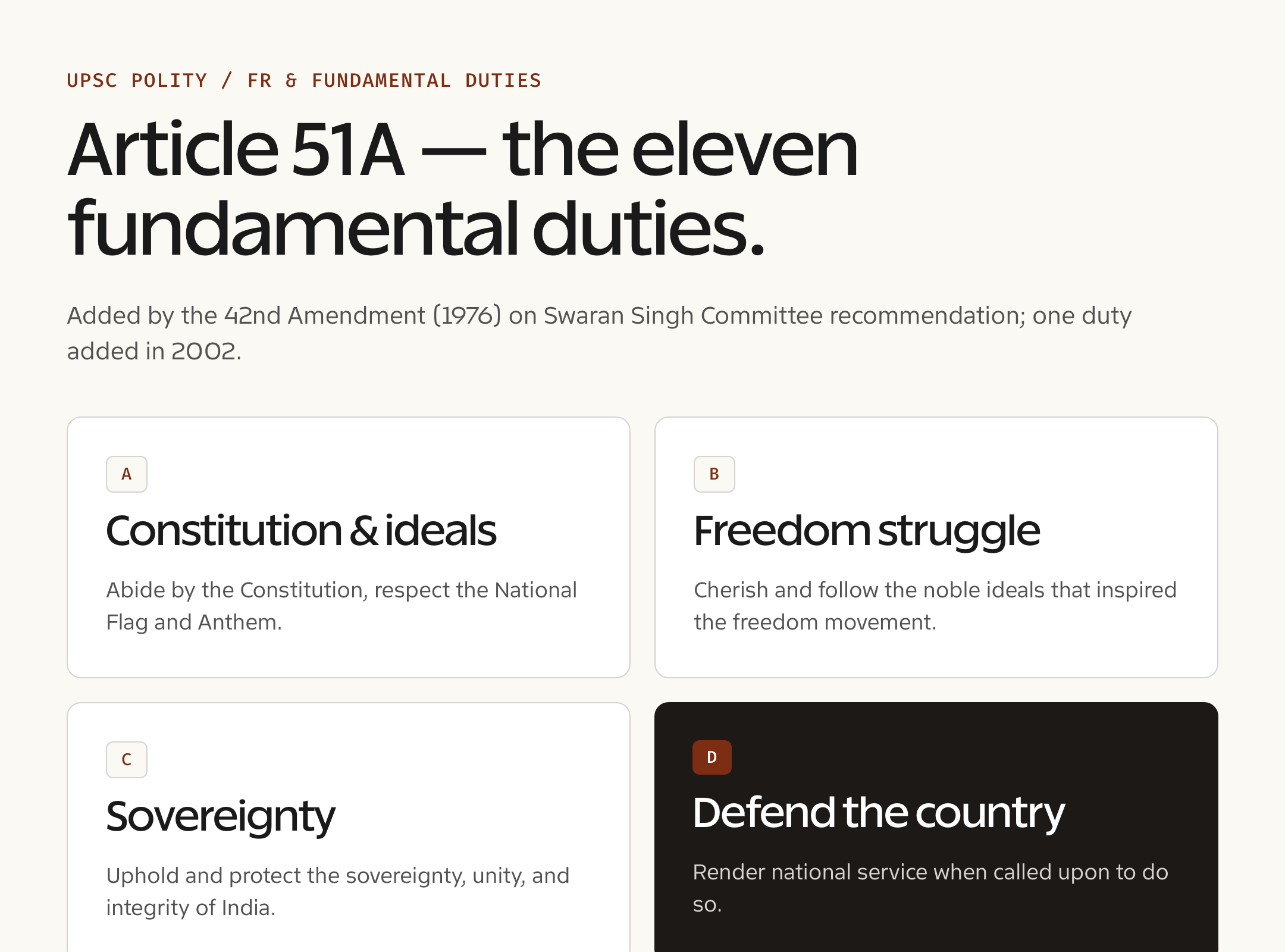
The eleven fundamental duties — Article 51A
Number every list. Aspirants memorise lists.
It shall be the duty of every citizen of India:
- (a) To abide by the Constitution and respect its ideals, the National Flag, and National Anthem.
- (b) To cherish the noble ideals which inspired the freedom struggle.
- (c) To uphold and protect the sovereignty, unity, and integrity of India.
- (d) To defend the country and render national service when called upon.
- (e) To promote harmony and the spirit of common brotherhood; to renounce practices derogatory to the dignity of women.
- (f) To value and preserve the rich heritage of India’s composite culture.
- (g) To protect and improve the natural environment — forests, lakes, rivers, wildlife — and have compassion for living creatures.
- (h) To develop scientific temper, humanism, and the spirit of inquiry and reform.
- (i) To safeguard public property and abjure violence.
- (j) To strive towards excellence in all spheres of individual and collective activity.
- (k) To provide opportunities for education to children aged 6 to 14 — added by 86th Amendment, 2002.
The deep dive on duties lives at Fundamental Duties of India: Article 51A Explained.
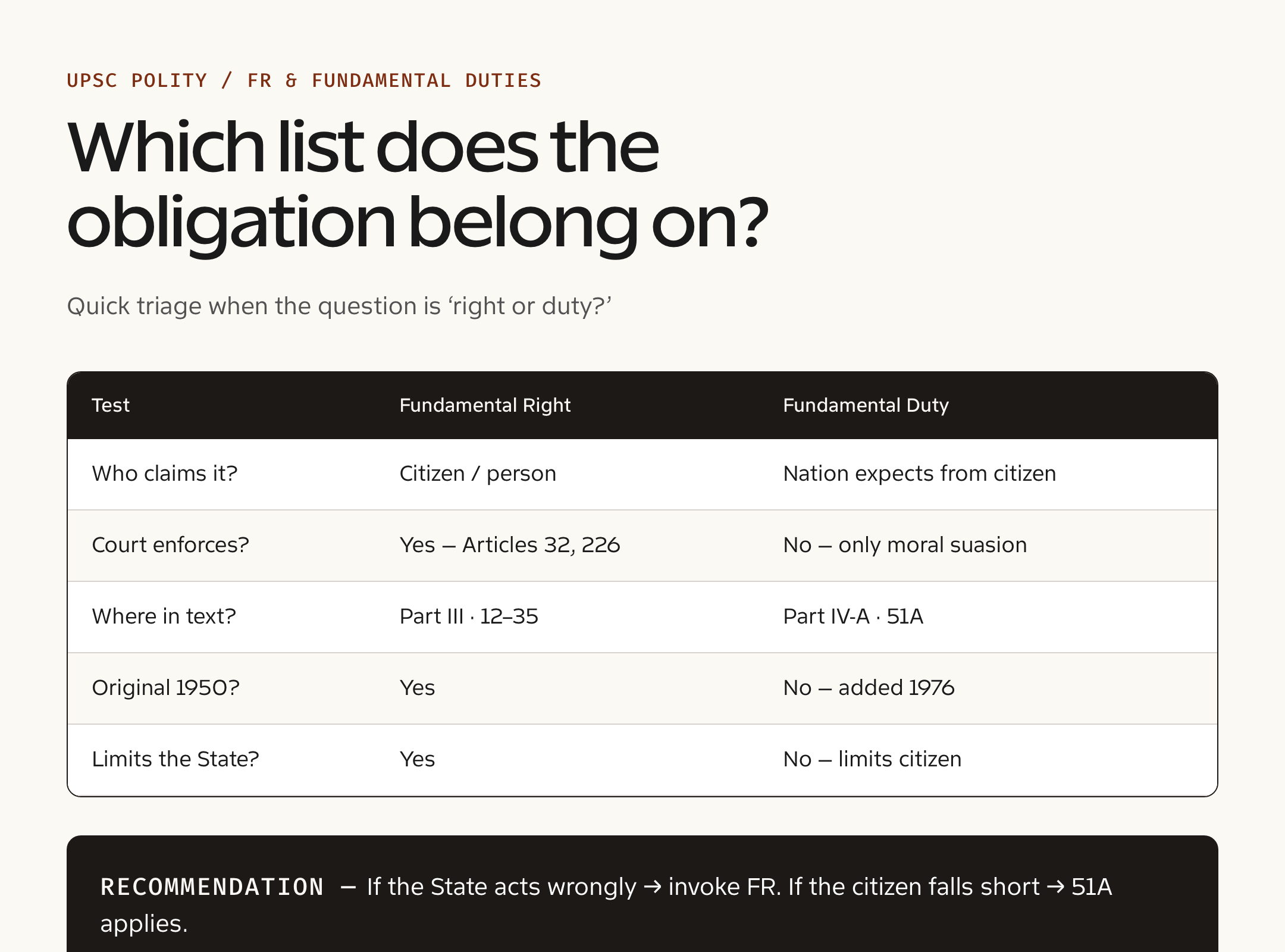
Difference between fundamental rights and fundamental duties
The cleanest way to remember the contrast is in five rows. This table answers the most common Mains 5-marker on the topic.
| Feature | Fundamental Rights | Fundamental Duties |
|---|---|---|
| Constitutional location | Part III, Articles 12–35 | Part IV-A, Article 51A |
| Number | Six categories | Eleven duties |
| Year added | 1950 (original) | 1976 (10) + 2002 (1) |
| Justiciable? | Yes — enforceable via Article 32, 226 | No — not directly enforceable |
| Inspiration | US Bill of Rights | USSR Constitution |
| Whom they bind | Mostly the State; some private parties (Articles 17, 23, 24) | Every citizen |
| Examples of breach consequence | Writ remedies, compensation | Educative, social pressure, indirect statutory penalties |
The honest answer to “are duties enforceable?” — partly. Duties are not directly enforceable, but Parliament can pass laws to give them effect. The Prevention of Insults to National Honour Act, 1971 (covering 51A(a)), the Wildlife Protection Act, 1972 (covering 51A(g)), and the Right to Education Act, 2009 (covering 51A(k)) are statutory enforcements of duties. Courts have also used 51A as an interpretive aid — AIIMS Students’ Union v. AIIMS (2002) is the textbook example.
Verma Committee, 1999 — the missing piece in most coaching notes
In 1998, the Supreme Court asked the Centre how it planned to make fundamental duties operational. The Union Government responded by setting up the Justice J.S. Verma Committee. The committee submitted its report in 1999.
Three Verma Committee recommendations to remember:
- Education — fundamental duties must be taught in schools and colleges as part of civics curricula.
- Public servants — duties must guide the conduct of public office holders; integrity, accountability, openness should be the norm.
- Statutory backing — duties should be reinforced through existing legislation (Wildlife Protection Act, Civil Rights Protection Act, Representation of the People Act).
Examiners love this exact framing — they’ve asked variants in 2019 and 2022 (“How can fundamental duties be operationalised?”). If you cite Verma Committee with the year 1999, you’re already ahead of 80% of candidates.
Importance of fundamental rights and duties — for citizens, for the State, for UPSC
For citizens. Rights guarantee dignity, equality, freedom of conscience, and judicial protection. Duties remind us that liberty is not licence — that environmental protection, harmony, and excellence are obligations, not options.
For the State. Rights set the boundaries of legitimate State action. Duties give the State a moral charter to invoke when passing laws on civic conduct, environmental protection, or education.
For UPSC. This pair appears in three syllabus zones:
- GS Paper II — “Indian Constitution, historical underpinnings, evolution, features, amendments, significant provisions and basic structure.”
- Essay — duties of citizens, civic ethos, constitutional morality.
- Ethics (GS-IV) — fundamental duties intersect heavily with case studies on environmental ethics, public service, and integrity.
For the related contrast with directive principles, study Fundamental Rights vs Directive Principles: Key Differences and Directive Principles of State Policy: Complete Guide.
Common misconceptions
- “Rights and duties were created together.” No. Rights came in 1950. Duties came in 1976 via the 42nd Amendment. The 11th duty came in 2002.
- “Duties are only moral, with no legal weight.” Partially true. Duties are non-justiciable, but Parliament has passed at least four statutes giving them direct effect — Wildlife Protection Act, RTE Act, Prevention of Insults to National Honour Act, Civil Rights Protection Act.
- “There are 10 fundamental duties.” Outdated. Originally yes — the 42nd Amendment added 10. The 86th Amendment in 2002 added the 11th. Current count: 11.
- “Only citizens have fundamental rights.” Incorrect. Most fundamental rights extend to all persons. Only Articles 15, 16, 19, 29, and 30 are citizen-only. Duties under Article 51A, however, apply only to citizens.
How to revise this in 30 minutes
- Laxmikanth, Chapter 7 (Rights) + Chapter 9 (Duties) — read article-numbers and lists. 12 minutes.
- One-page chart — the comparison table above. Reproduce it from memory. 8 minutes.
- Verma Committee + 86th Amendment — three bullet points each. 5 minutes.
- Skim a 2024 SC ruling that invoked Article 51A — In Re: Right to Clean Air (2024) is current. 5 minutes.
Frequently Asked Questions
How many fundamental rights and duties are there in the Indian Constitution in 2026?
Six fundamental rights (Articles 12–35) and 11 fundamental duties (Article 51A).
Which amendment added fundamental duties?
The 42nd Amendment Act, 1976, on the recommendation of the Sardar Swaran Singh Committee.
Which amendment added the 11th fundamental duty?
The 86th Amendment Act, 2002 — added Article 51A(k) on parental duty to provide education to children aged 6 to 14.
Are fundamental duties justiciable?
No. They are not directly enforceable in court. But Parliament can — and has — passed laws to give them effect.
What did the Verma Committee recommend?
Education on duties, public-servant integrity, and statutory reinforcement through existing laws like the Wildlife Protection Act and the RTE Act.
Which fundamental right is the most important?
Ambedkar called Article 32 the u0022heart and soulu0022 of the Constitution. It allows every person to approach the Supreme Court directly to enforce their fundamental rights.
Can fundamental rights be amended?
Yes — but Parliament cannot destroy the basic structure of the Constitution. The 1973 Kesavananda Bharati judgment settled this. See Kesavananda Bharati Case (1973): Basic Structure Doctrine Explained.