Furlough vs Parole: Prisoner Rights, BNSS Section 473 and the Supreme Court’s Reformative Logic
Furlough vs parole in India explained: Prisons Act 1894, BNSS Section 473, Asfaq v. State of Rajasthan, State of Gujarat v. Narayan Sai, eligibility, granting authority and 2020 MHA guidelines.
Furlough and parole sound similar but operate on different constitutional and statutory wavelengths. Both let a convict step out of prison, briefly and on conditions. One is a privilege, the other approaches the status of a right. One pauses the running clock of the sentence, the other lets it run. One needs a specific reason, the other does not. The Supreme Court has spent the last fifteen years drawing those lines clearly, often in cases involving high-profile convicts whose repeated releases have set off public controversy.
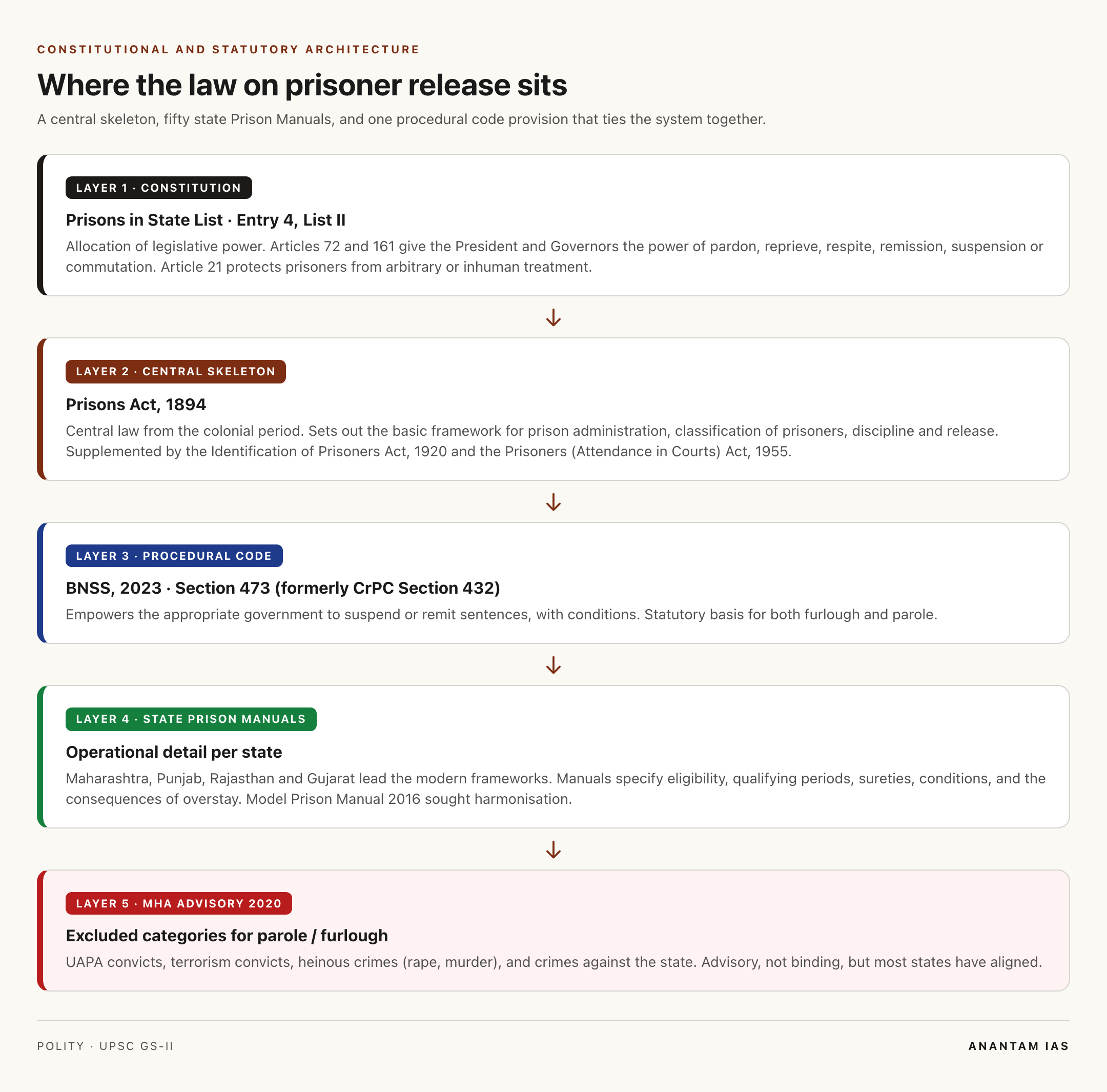
The legal architecture sits in an awkward space. Prisons are a state subject under Entry 4 of the State List. The Prisons Act, 1894 is the central skeleton that each state fills out through its own Prison Manual. The procedural code, now the Bharatiya Nagarik Suraksha Sanhita, 2023, provides under Section 473 the executive power to suspend or remit sentences, which is the statutory ground for both furlough and parole. The Constitution itself adds a further layer through Article 21, which the Supreme Court has read to include reformative humane treatment of convicts, and Articles 72 and 161 which give the President and Governors the power of pardon.
This guide walks through the precise distinction between furlough and parole, the constitutional and statutory framework, the leading judgments, eligibility and exclusions, and the broader debate about prisoner rights and the reformative theory of punishment.
Quick Facts on Furlough vs Parole
Prisons in India are a state subject under Entry 4 of List II of the Seventh Schedule. The Prisons Act, 1894 is the central law, supplemented by state prison manuals. Section 473 of the Bharatiya Nagarik Suraksha Sanhita, 2023, replacing Section 432 of the Code of Criminal Procedure, 1973, empowers the appropriate government to suspend or remit sentences. Furlough is a conditional right granted to long-term convicts to break the monotony of jail life and maintain family ties; the period is counted as time served. Parole is a privilege granted in specific exigencies such as a death in the family, a marriage, or serious illness; the period is not counted as time served. The Supreme Court drew the distinction clearly in Asfaq v. State of Rajasthan (2017) and State of Gujarat v. Narayan Sai (2021). The Ministry of Home Affairs in 2020 advised states to deny parole and furlough to prisoners convicted under UAPA, for terrorism, for heinous crimes, and for crimes against the state.
What Furlough and Parole Actually Are
Furlough is a temporary release from prison granted to long-term convicts at periodic intervals, typically once a year, without requiring any specific reason. It is treated as a tool of reform: the convict steps back into the family and community for a short period, which softens the dehumanising effect of long incarceration and reduces the risk of recidivism on eventual release. Because it does not need a specific reason, it cannot be denied merely because the convict has nothing exceptional going on outside; it can however be denied for poor conduct or security concerns. The period spent on furlough is treated as part of the sentence already served.
Parole is a temporary release granted in response to a specific exigency. The most common grounds are the death of an immediate family member, the marriage of a son or daughter or sibling, the serious illness of an immediate family member, the birth of a child, a natural calamity affecting the family, or the convict’s own serious illness needing specialised treatment. Parole is a privilege rather than a right; the granting authority can refuse it even when the underlying reason is genuine, on grounds of security, flight risk, or the convict’s prior conduct on parole. The period on parole is not counted as time served; the sentence is suspended during the parole period and resumes from where it had paused.
Background and Historical Context
The Indian prison system is organised on a colonial template. The Prisons Act, 1894, the Identification of Prisoners Act, 1920, and the Prisoners (Attendance in Courts) Act, 1955 form the central spine. After the Government of India Act, 1935 placed prisons in the provincial list, and the Constitution of India in 1950 retained that allocation through Entry 4 of List II of the Seventh Schedule, each state developed its own Prison Manual to fill out the working detail.
The concept of furlough as a separate institution from parole emerged through state prison manuals in the post-independence period, drawing on the British prison tradition of “home leave” for long-term inmates. Bombay (now Maharashtra) and Gujarat formalised the distinction earliest, and other states followed. The concept of parole, in contrast, has older roots in eighteenth and nineteenth-century European penology and was imported into Indian practice through the original Prisons Act and the early CrPC.
The Supreme Court began articulating the constitutional dimension of prisoner rights in the late 1970s. In Sunil Batra v. Delhi Administration (1978 and 1980), the Court held that prisoners do not surrender their fundamental rights at the prison gate, and that Article 21 protects them against arbitrary or inhuman treatment. The reformative theory of punishment, articulated in cases like Mohammad Giasuddin v. State of Andhra Pradesh, gave intellectual support to the institutionalisation of furlough and parole. The 2017 Asfaq judgment is the cleanest crystallisation of the doctrine; the 2021 Narayan Sai ruling refined the practical rules.
The Statutory Framework: Section 473 of BNSS and the Prisons Act
The basic statutory power to release a convict before completion of sentence sits in Section 473 of the Bharatiya Nagarik Suraksha Sanhita, 2023. The provision tracks Section 432 of the old Code of Criminal Procedure, 1973. It allows the appropriate government, defined in the section itself, to suspend the execution of any sentence or remit the whole or any part of the punishment. The appropriate government is the central government for offences against central laws and for cases where the executive power of the Union extends, and the state government for state offences. Conditions can be imposed, and breach of conditions can lead to recall.
The Prisons Act, 1894, taken with the state Prison Manuals, supplies the operational detail. Each state’s Prison Manual specifies the procedure for granting furlough and parole, the categories of prisoners eligible, the periods for which release can be granted, the sureties required, and the consequences of overstay. The Maharashtra Prisons (Furlough and Parole) Rules, 1959, the Punjab Good Conduct Prisoners (Temporary Release) Act, 1962, and the Rajasthan Prisoners Release on Probation Rules, 1958 are illustrative state instruments.
The Constitutional layer sits on top of this. Article 72 gives the President the power to grant pardons, reprieves, respites, remissions, or to suspend, remit or commute sentences in respect of central offences and offences carrying the death sentence. Article 161 gives Governors the same power for offences against state laws. These constitutional powers do not directly govern furlough and parole, but they form the broader penological framework within which the executive operates.
The Definitive Distinction: Six Axes
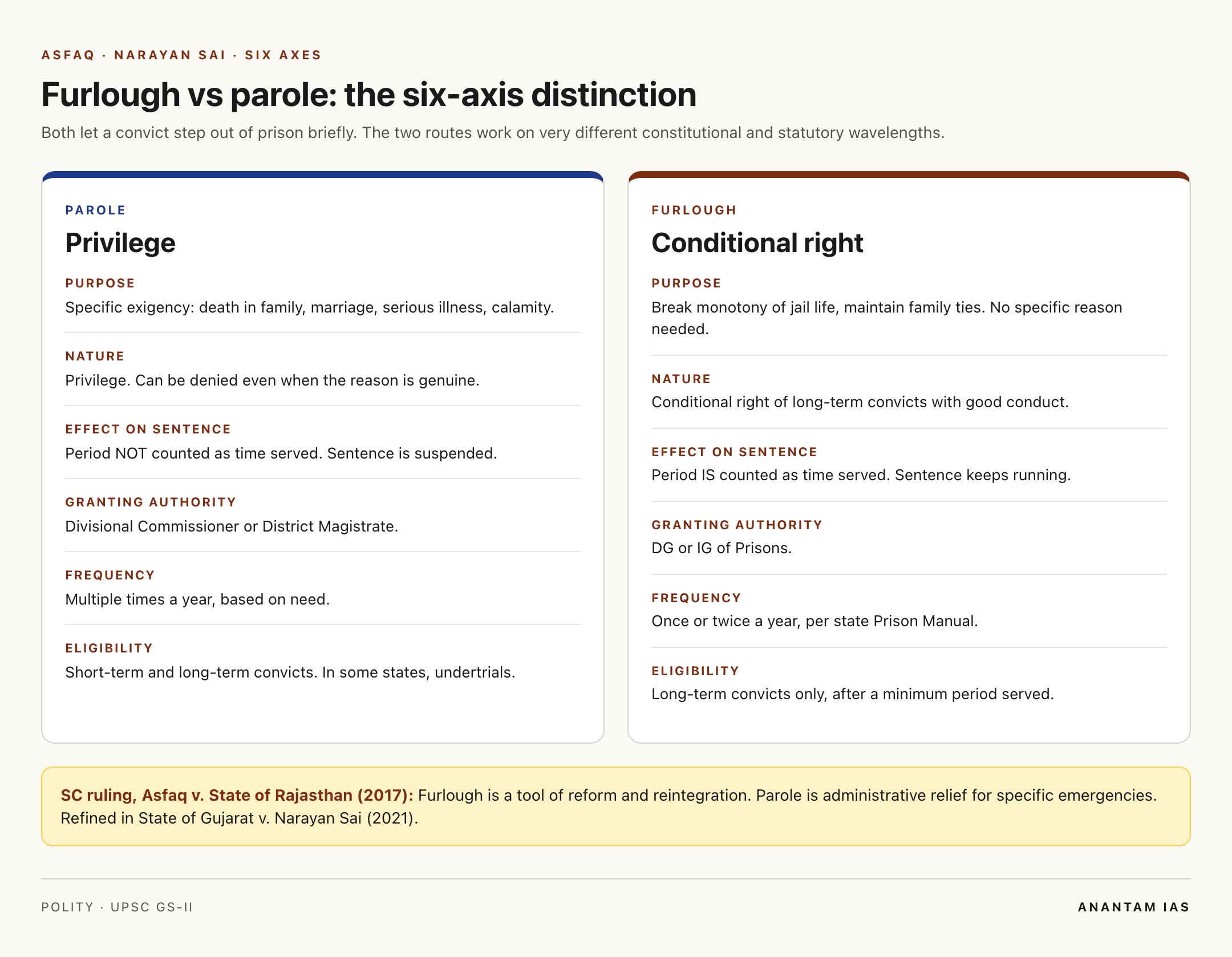
The Supreme Court has summarised the difference between furlough and parole on six axes.
The first axis is purpose. Parole is for a specific exigency. Furlough is for the maintenance of family ties and the reformation of the prisoner.
The second axis is the nature of the entitlement. Parole is a privilege; the appropriate authority can refuse it even on a genuine ground. Furlough has been described by the Court as approaching a conditional right for a long-term convict who satisfies the prescribed conduct and period requirements.
The third axis is the effect on the sentence. The period of parole is not counted as time served; the sentence is suspended for the duration of the parole. The period of furlough is counted as time served; the sentence continues to run.
The fourth axis is the granting authority. Parole is usually granted by the Divisional Commissioner or the District Magistrate, depending on the state’s framework. Furlough is usually granted by the Director General or the Inspector General of Prisons.
The fifth axis is frequency. Parole can be granted multiple times in a year, depending on the recurrence of qualifying exigencies. Furlough is limited to once or twice a year, as prescribed in the state Prison Manual.
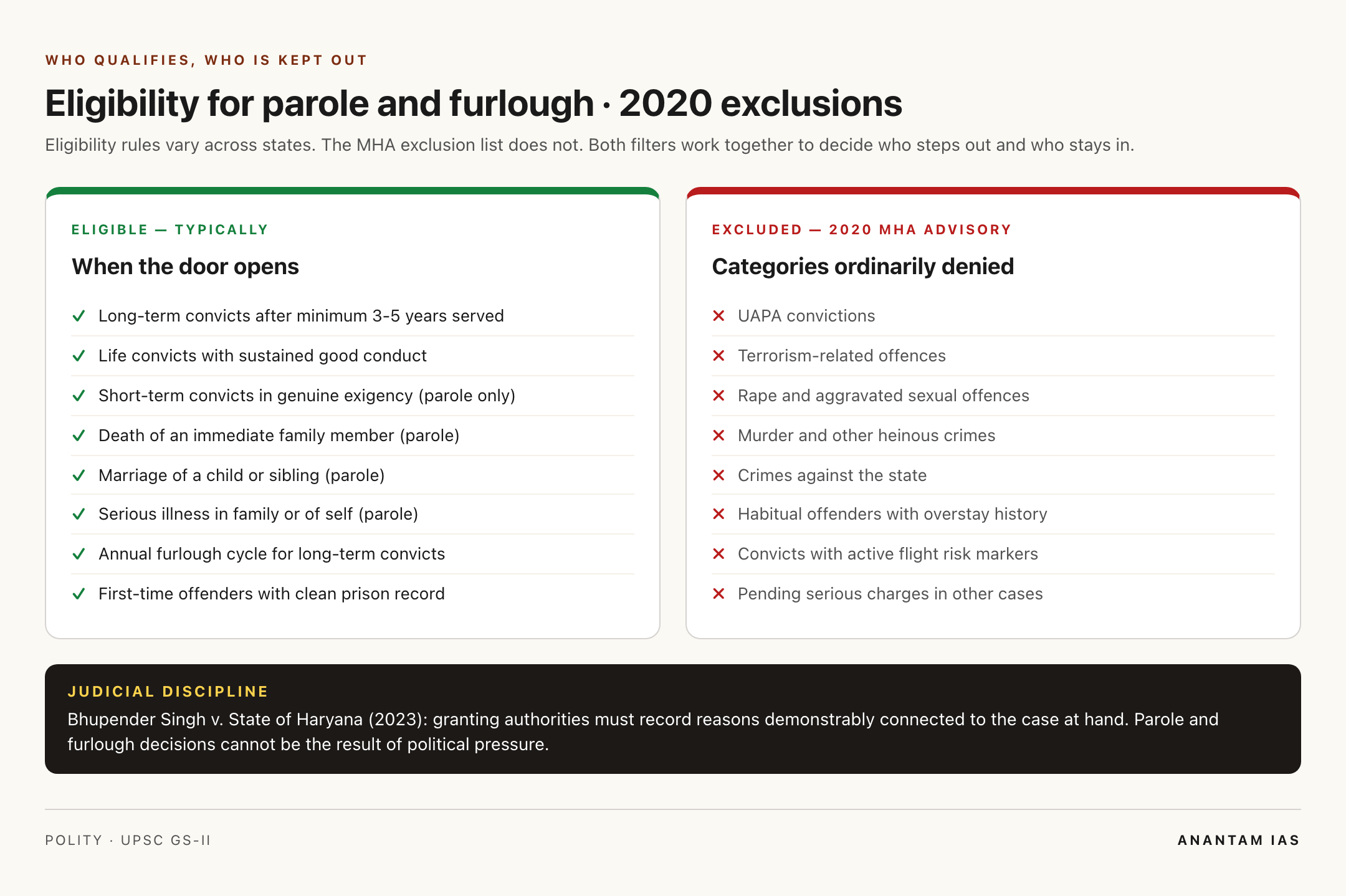
The sixth axis is eligibility. Parole is available to short-term and long-term convicts and, in some states, even to undertrials in narrowly defined situations. Furlough is generally available only to long-term convicts, typically those serving life sentences or sentences of seven years or more, and only after a minimum period of imprisonment has been served, usually three to five years depending on the state.
Why the Distinction Matters
The distinction is not academic. It has at least four practical consequences.
First, it determines whether a convict’s overall time in custody includes or excludes the days spent outside. A life convict who is granted four weeks of furlough each year for ten years will have served those four weeks each year as part of the sentence. The same convict granted four weeks of parole each year over the same period will have those weeks excluded from the count, effectively extending the sentence.
Second, it affects the standard of judicial review. Courts apply a more searching scrutiny when an authority refuses furlough, treating it close to a right of a long-term convict subject to conduct conditions. Refusal of parole, by contrast, attracts a more deferential standard, since the privilege framing leaves the authority more discretion.
Third, it shapes how the public perceives controversial releases. Repeated parole granted to a high-profile convict is sometimes attacked as a misuse of executive discretion. The same number of days as furlough would attract less attention because it would be transparently a part of the sentence.
Fourth, it influences prison reform conversations. The reformative theory underlying furlough is closer to international best practice on long-term incarceration. The exigency-based logic of parole is older and serves a narrower humanitarian role. Reformers often argue that furlough rules should be liberalised and parole rules tightened, to push the system toward systematic reformation rather than ad hoc release.
Detailed Analysis: Landmark Judgments
State of Maharashtra v. Suresh Pandurang Darvkar (2006) was an early Supreme Court ruling that emphasised the difference between the two and refused to treat them as interchangeable. The Court held that a state’s Prison Manual must clearly distinguish the two and apply the relevant criteria correctly.
Asfaq v. State of Rajasthan (2017) is the doctrinal centrepiece. A bench of Justices A.K. Sikri and Ashok Bhushan articulated the reformative purpose of furlough, located it within the broader Article 21 jurisprudence on prisoner rights, and laid down the six-axis distinction in a structured way. The Court held that furlough was a means of reform and reintegration and that arbitrary refusal of furlough to a deserving convict could attract judicial intervention.
State of Gujarat v. Narayan Sai (2021) refined the practical rules. The Court held that furlough is not an unconditional right and can be refused on objective grounds, including the gravity of the offence, the conduct of the convict, security risks, and the antecedents of the prisoner. The judgment also emphasised that the granting authority must apply mind to each application individually rather than mechanically apply state rules.
In Bhupender Singh v. State of Haryana (2023), the Supreme Court reiterated that parole and furlough decisions cannot be the result of political pressure, and that the appropriate government must record reasons that are demonstrably connected to the case at hand.
The 2020 MHA Guidelines, issued through an advisory to states, recommended that prisoners convicted under the Unlawful Activities (Prevention) Act, those convicted of terrorism-related offences, those convicted of heinous crimes such as rape and murder, and those convicted of crimes against the state should ordinarily not be granted parole or furlough. The advisory is not binding on states because prisons are a state subject, but most states have aligned their practice with the advisory.
Comparative Frame: Remission and Probation
Furlough and parole are easy to confuse with two adjacent concepts: remission and probation.
Remission is the reduction of the sentence, in whole or in part, by the appropriate government under Section 473 of the BNSS or by the President or Governor under Articles 72 or 161. Remission is not a temporary release; it shortens the sentence permanently. Once remission is granted, the convict is released for good. Remission policies vary across states and are typically tied to good conduct, age, illness or category of offence.
Probation is a sentencing alternative under the Probation of Offenders Act, 1958. Probation is granted at the time of sentencing rather than during incarceration. The convict is released on probation for good conduct instead of serving the prison term, subject to supervision and conditions. If the convict breaches the conditions, the original sentence can be enforced. Probation is conceptually closer to a sentencing decision than a prison administration decision.
Both remission and probation are independent of furlough and parole, though they share the broader framework of executive discretion in punishment.
Challenges and Open Questions
The furlough-parole framework faces five chronic challenges. The first is inter-state inconsistency. Each state Prison Manual has its own eligibility rules, qualifying periods, sureties and exclusions. The same convict may be eligible in one state and ineligible in another for the same reason. The Model Prison Manual of 2016 sought to harmonise practice but adoption has been uneven.
The second is the use of parole and furlough for high-profile convicts in ways that erode public confidence. The repeated parole granted to convicts in cases like the Bilkis Bano matter and the Dera Sacha Sauda case have provoked sharp criticism and litigation, and the Supreme Court has responded by tightening the standard of executive justification.
The third is the lack of transparency in granting and refusing applications. Many states do not publish data on furlough and parole grants, refusals and overstays. Where data exists, it shows wide regional variation that cannot be explained on objective grounds alone.
The fourth is the problem of overstay and absconding. A non-trivial proportion of convicts released on parole do not return on time, requiring re-arrest and creating pressure on prison administrations to grow more conservative in granting parole even to deserving applicants.
The fifth is the post-DPDP and post-Puttaswamy environment, where the right to privacy of the convict’s family members and the rehabilitation logic of furlough create tensions with the surveillance and tracking measures that some states have introduced as a condition of release.
Prelims Pointers
Prisons are a state subject under Entry 4 of List II of the Seventh Schedule of the Constitution. The Prisons Act, 1894 is the central skeleton; state Prison Manuals fill out the operational detail. Section 473 of the BNSS, 2023 provides the executive power to suspend or remit sentences. Furlough is a conditional right granted to long-term convicts to break monotony and maintain family ties. Parole is a privilege granted for specific exigencies. The period of furlough is counted as time served. The period of parole is not counted as time served. The granting authority for parole is usually the Divisional Commissioner or DM. The granting authority for furlough is usually the DG or IG of Prisons. Asfaq v. State of Rajasthan (2017) is the leading judgment on the distinction. State of Gujarat v. Narayan Sai (2021) refined the practical rules. The 2020 MHA Guidelines advised states to deny parole and furlough to UAPA convicts, terrorism convicts, heinous crime convicts, and convicts of crimes against the state.
Mains Practice Questions
Distinguish between furlough and parole and discuss their role in the reformative theory of punishment.
Critically examine the inter-state variation in furlough and parole rules in India and suggest reforms to harmonise prisoner rights.
Discuss the constitutional and statutory framework governing the rights of prisoners in India with reference to landmark Supreme Court judgments.
Analyse the 2020 Ministry of Home Affairs guidelines on parole and furlough for high-risk convicts in light of the federal allocation of subjects on prisons.
Way Forward
A coherent reform agenda would do four things. First, the Model Prison Manual of 2016, recently revised by the Ministry of Home Affairs, should be adopted by all states with as little variation as possible, especially on eligibility, qualifying periods and exclusions. Standardisation would reduce arbitrary inter-state differences and make judicial review more predictable.
Second, transparent publication of furlough and parole data should be made mandatory. The Bureau of Police Research and Development already collates Prison Statistics India, but disaggregated data on furlough and parole grants, refusals, overstays and re-arrests is patchy. A standard data template, published quarterly, would tighten executive discipline.
Third, reformative furlough should be expanded for non-violent and non-heinous offences with a clean conduct record, while parole rules should be tightened with structured criteria and recorded reasons. The aim is to push the system toward systematic reformation rather than ad hoc release.
Fourth, the broader agenda of prison reform, including overcrowding, undertrial population, mental health support, vocational training and post-release rehabilitation, should be linked to the furlough and parole regime so that release is not merely a pause from prison but a step in a structured reintegration process. The deeper fundamental rights deep dive tradition that anchors prisoner rights in Article 21 already provides the constitutional headroom for such reform.
Frequently Asked Questions
What is the difference between furlough and parole in India?
Furlough is a temporary release from prison granted to long-term convicts to break the monotony of jail life and maintain family ties, without requiring any specific reason. Parole is a temporary release granted in response to a specific exigency such as a death in the family, a marriage or serious illness. Furlough is treated as time served; parole is not.
Is parole a right or a privilege in India?
Parole is a privilege, not a right. The granting authority can refuse parole even when the underlying reason is genuine, on grounds of security, flight risk, the gravity of the offence or the convict’s prior conduct.
Is furlough a right or a privilege?
The Supreme Court has described furlough as approaching a conditional right of a long-term convict who satisfies the prescribed conduct and qualifying-period requirements. It is closer to a right than parole, but it is not unconditional and can be refused on objective grounds.
Who grants furlough and parole?
Parole is usually granted by the Divisional Commissioner or the District Magistrate, depending on the state’s Prison Manual. Furlough is usually granted by the Director General or the Inspector General of Prisons. The exact authority varies across states.
Is the period of parole counted as part of the sentence?
No. The period of parole is not counted as time served. The sentence is suspended during the parole period and resumes when the convict returns to prison.
Is the period of furlough counted as part of the sentence?
Yes. The period of furlough is counted as time served. The sentence continues to run during the furlough period.
What is the legal basis for furlough and parole in India?
Prisons are a state subject under Entry 4 of the State List. The Prisons Act, 1894 is the central skeleton. Each state has its own Prison Manual that prescribes the detailed rules for furlough and parole. Section 473 of the Bharatiya Nagarik Suraksha Sanhita, 2023 provides the executive power to suspend or remit sentences, which is the statutory ground for both.
Which Supreme Court cases have shaped the law on furlough and parole?
The most important rulings are Sunil Batra v. Delhi Administration (1978 and 1980) on prisoner rights generally, Asfaq v. State of Rajasthan (2017) on the distinction between furlough and parole, and State of Gujarat v. Narayan Sai (2021) on the practical rules for refusal of furlough. Bhupender Singh v. State of Haryana (2023) reinforced the requirement of recorded reasons.
What did the 2020 MHA Guidelines on parole and furlough say?
The 2020 advisory recommended that prisoners convicted under the Unlawful Activities (Prevention) Act, those convicted of terrorism-related offences, those convicted of heinous crimes such as rape and murder, and those convicted of crimes against the state should ordinarily not be granted parole or furlough. The advisory is not binding because prisons are a state subject, but most states have aligned with it.
Can furlough or parole be denied to convicts of heinous crimes?
Yes. Convicts of heinous crimes, including UAPA offences, terrorism, rape, and murder, are ordinarily denied parole and furlough as per the 2020 MHA advisory and parallel state Prison Manual provisions. Courts have generally upheld such denials when the granting authority has recorded reasons connected to the gravity of the offence and the security risk.