Geographical Indications Explained: India’s Origin Tag, the GI Act 1999, and Why Communities Own Them
A complete UPSC GS-III explainer on Geographical Indications. Covers the GI Act 1999, the TRIPS Agreement, the role of DPIIT and the Chennai GI Registry, the difference between a GI and a trademark, and landmark Indian GI tags from Darjeeling Tea to Similipal Kai Chutney.
A Darjeeling Tea garden, a Banarasi sari loom, a basket of Nagpur oranges, and a packet of Bikaneri bhujia all share something that a casual buyer rarely notices. None of them belongs to a single company. Each belongs to a community of producers tied to a specific geography, working under shared traditional knowledge that the wider world has agreed to recognize. The legal device that protects this kind of community-owned reputation is the Geographical Indication, usually shortened to GI. It is the most distinctly Indian corner of the intellectual property regime, and its growth over the last twenty years has reshaped the way India tells the world about its products.
A Geographical Indication is a sign used on goods that have a specific geographical origin and possess qualities, a reputation, or characteristics essentially attributable to that origin. The word essentially is the legal pivot. A Banarasi sari woven in Tamil Nadu using a Banaras pattern is not a Banarasi sari for GI purposes, because the link to the Varanasi region, the looms, and the tradition of weaving there is what gives the product its identity. A GI is therefore a community right rooted in geography, not a private property right held by a single producer.
For UPSC purposes, the topic sits at the intersection of intellectual property law, rural development, traditional knowledge, and trade. The 1995 TRIPS Agreement of the World Trade Organization made GIs an international obligation. India’s Geographical Indications of Goods Act of 1999 implemented that obligation domestically. The Department for Promotion of Industry and Internal Trade administers the regime, and the GI Registry sits in Chennai. This article walks through what a GI is, how it differs from a trademark, how it is registered, and why it matters for India.
Quick Facts on Geographical Indications
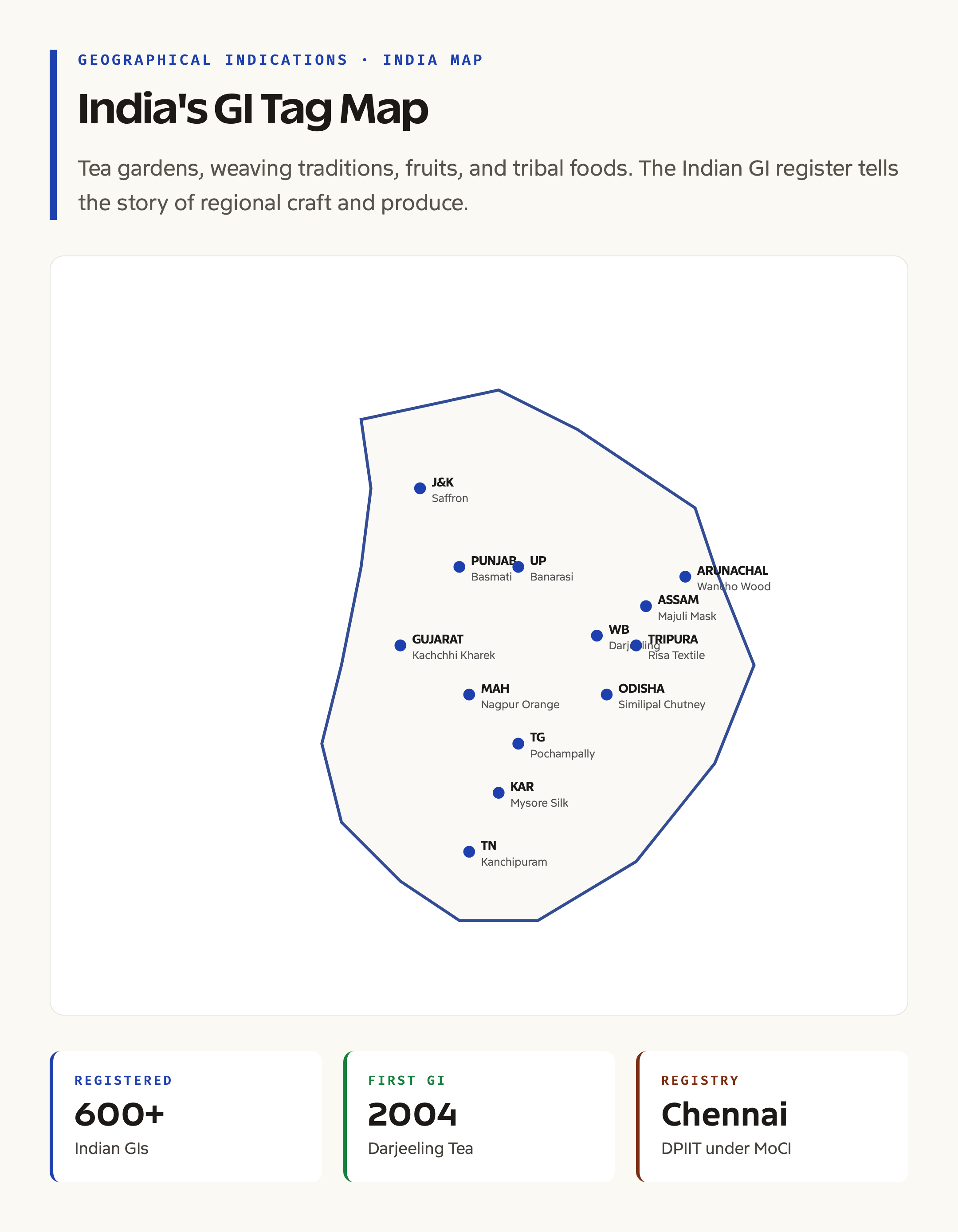
A Geographical Indication is governed in India by the Geographical Indications of Goods (Registration and Protection) Act, 1999, which came into force on September 15, 2003. The administering ministry is the Ministry of Commerce and Industry, through the Department for Promotion of Industry and Internal Trade, abbreviated DPIIT. The GI Registry is located in Chennai and is headed by the Registrar of Geographical Indications.
Registration is valid for ten years, and a registration can be renewed indefinitely in further ten-year blocks. The right to register a GI lies with any association of producers, organisation, or authority established by law that represents the interests of producers in the region concerned. A GI is not owned by a single individual or company. Once registered, the GI must be used in trade by authorized users, who register separately with the Registry as users of the protected GI.
The first GI registered in India was Darjeeling Tea, in 2004. Since then more than six hundred Indian GIs have been registered, covering tea, coffee, agricultural produce, handicrafts, textiles, and food preparations. The category continues to expand into newer products such as the Similipal Kai Chutney made from red weaver ants in Odisha and the Wancho Wooden Craft from Arunachal Pradesh.
What a GI Actually Is
A GI is a sign of origin. It tells a buyer, with the legal weight of a registered intellectual property right, that the product comes from a specific place and possesses qualities that are essentially due to that place. The qualities can be linked to natural factors such as climate, soil, and altitude, or to human factors such as traditional weaving techniques, craft skills, or recipes that have evolved in the region.
Background and Historical Context
The international history of GIs begins in late nineteenth-century Europe. French wine producers, frustrated by foreign imitators selling sparkling wines under the Champagne label, pushed for an international regime. The Paris Convention of 1883 included an early form of protection. The Lisbon Agreement of 1958 created a registration system for what it called appellations of origin, but the Lisbon system attracted only a small number of signatories.
The breakthrough was the TRIPS Agreement, signed in 1994 as part of the Marrakesh Agreement that established the World Trade Organization, and brought into force in 1995. TRIPS is a binding international treaty that obliges all WTO members to protect GIs in their domestic law. Articles 22 to 24 of TRIPS lay down the standard. Article 22 provides general protection for all GIs against misleading use. Article 23 provides additional protection for wines and spirits, with no requirement to show actual misleading. Article 24 contains exceptions that protect existing generic uses, such as parmesan cheese in some markets.
India, as a founding WTO member, was obliged to bring its law into conformity. The GI Act was passed in 1999 and notified in 2003. The first registration, Darjeeling Tea, came in 2004. Over the next two decades, the regime grew steadily, with periodic surges driven by state-level cultural and craft initiatives.
Key Features of the Indian GI Regime
The Indian framework has six features worth knowing in detail. The first is the definition of subject matter. Section 2(1)(e) of the GI Act defines a GI to include agricultural goods, natural goods, manufactured goods, and even handicrafts and foodstuffs. This is broader than the European model, which centres heavily on agricultural produce, and it reflects the importance of intellectual property protection for India’s craft economy.
The second is producer-community ownership. Only an association of producers, an organisation, or a statutory authority representing producers can apply. A single private company cannot own a GI. This separates GIs sharply from trademarks, which can be held by a single corporate owner.
The third is the two-tier registration system. The Registry first registers the GI itself, with the relevant association as the registered proprietor. Individual producers from the region can then separately register as authorized users. Only authorized users can affix the registered GI sign on their goods.
The fourth is the prohibition on assignment and licensing. A registered GI cannot be assigned, transmitted, licensed, mortgaged, or pledged. This prevents commercial dilution of the geographical link.
The fifth is the duration and renewal regime. Registration is valid for ten years and is renewable indefinitely. There is no maximum term, in contrast to patents, which expire after twenty years.
The sixth is the higher protection regime. Although TRIPS reserves higher protection for wines and spirits, India has, since 2009, allowed certain Indian goods to receive higher-tier protection on a case-by-case basis. India has also been one of the most vocal WTO members pushing for the extension of higher protection to all GIs, a position that has not yet succeeded at the WTO level.
Why GIs Matter
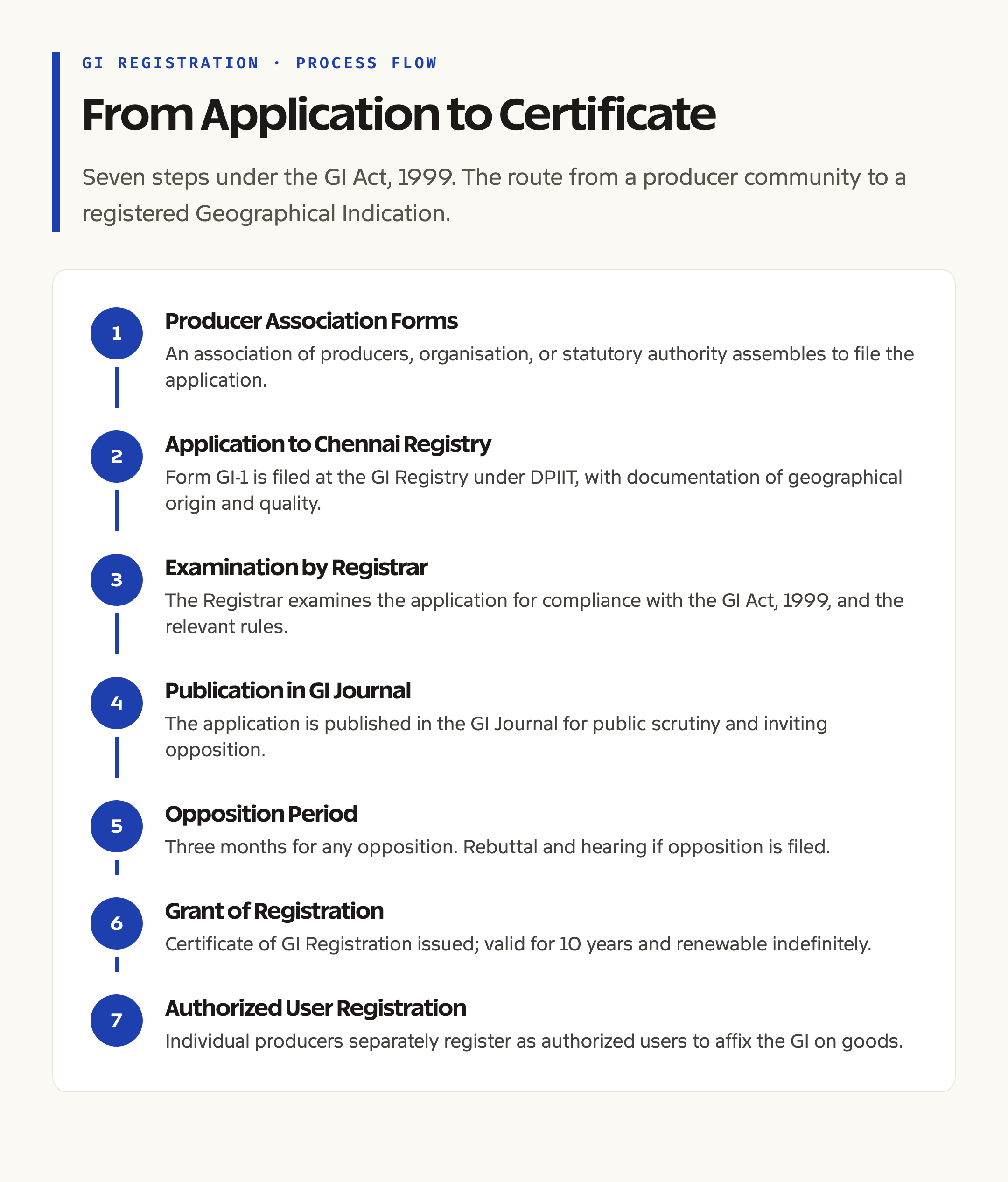
GIs matter because they convert geographical reputation into legal rights and economic value. Three benefits dominate.
The first is producer income. Studies of registered Indian GIs, including Darjeeling Tea, Pochampally Ikat, and Banarasi sari, show that GI registration is associated with a measurable price premium, although the size of the premium varies. The premium is highest where the GI is well marketed, where the producer association is well organized, and where the export market values the geographical link.
The second is rural and tribal livelihoods. A large share of Indian GIs cover handicrafts and food preparations made by artisanal communities. Examples include the Risa textile of Tripura, the Majuli mask of Assam, the Wancho wooden craft of Arunachal Pradesh, the Pochampally Ikat of Telangana, and the Similipal Kai Chutney of Odisha. For these communities, GI registration provides legal recognition, marketing leverage, and a defence against imitation.
The third is the protection of traditional knowledge. A GI registers the knowledge held by a community as a form of legal property without requiring the kind of disclosure that a patent demands. This complements the National Intellectual Property Rights policy and India’s broader stand on biopiracy and traditional knowledge protection.
Detailed Analysis: GI Versus Trademark Versus Patent
The three categories of intellectual property are often confused. The differences matter for prelims and for any mains question on the IP regime.
| Feature | GI | Trademark | Patent |
|---|---|---|---|
| What it protects | Geographical reputation of a community of producers | Brand of a single owner | A new technical invention |
| Owner | Association of producers, organisation, or statutory authority | Individual or company | Individual or company |
| Duration | 10 years, renewable indefinitely | 10 years, renewable indefinitely | 20 years, no renewal |
| Subject matter | Goods with a geographical link | Any sign used in trade | A novel, non-obvious, useful invention |
| Assignable | No | Yes | Yes |
| Indian statute | GI Act, 1999 | Trade Marks Act, 1999 | Patents Act, 1970 |
A Tata trademark belongs to the Tata company. The Darjeeling Tea GI belongs to the community of tea growers in the Darjeeling region. A trademark for a particular tea brand can coexist with the Darjeeling Tea GI, provided the brand uses the GI honestly and in line with the rules.
Comparative Snapshot: India, the European Union, and the United States
The three major intellectual property regimes treat GIs very differently. India’s framework, with the GI Act 1999, fits the broad European model. The European Union has the most developed GI regime in the world, with two main schemes: Protected Designation of Origin and Protected Geographical Indication, covering tens of thousands of products from Champagne wines to Parmigiano Reggiano cheese. The EU also negotiates GI protection aggressively in its trade agreements with other countries.
The United States, in contrast, treats GIs largely as a sub-category of trademarks, through certification marks. American producers of products such as Idaho Potatoes register them as certification marks under regular trademark law. The United States is broadly suspicious of GI extension at the WTO and has resisted the EU position on extending higher protection to all GIs.
India sits closer to the EU on the philosophy of GIs as a distinct category but has had less success in negotiating mutual recognition with major export markets. Securing recognition for Indian GIs in the EU and other markets is a continuing diplomatic agenda.
Notable Indian GI Tags
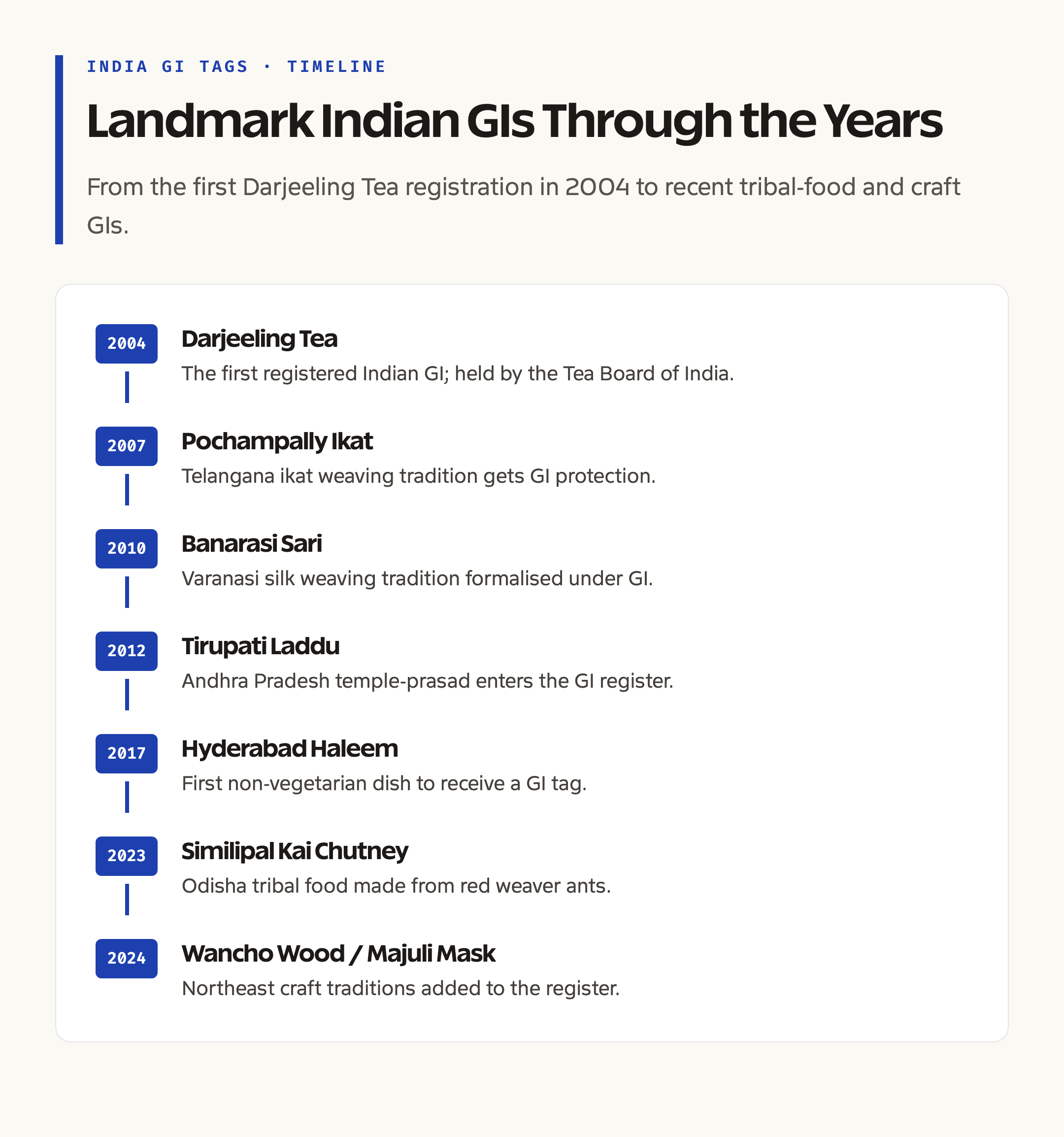
The list of registered Indian GIs is long. Some entries are widely known, such as Darjeeling Tea (the first Indian GI), Banarasi Sari (UP), Pochampally Ikat (Telangana), Mysore Silk (Karnataka), Tirupati Laddu (Andhra Pradesh), Nagpur Orange (Maharashtra), Bikaneri Bhujia (Rajasthan), Bhalia Wheat (Gujarat), and Hyderabad Haleem (Telangana, the first non-vegetarian dish to get a GI).
Recent entries broaden the range. The Similipal Kai Chutney from Odisha, made from red weaver ants gathered in the Similipal forest, brings tribal food traditions into the GI fold. The Kachchhi Kharek from Gujarat, an indigenous date variety from the Kutch region, recognizes a traditional fruit. The Hanuman Garhi Besan Laddoo from Ayodhya in Uttar Pradesh extends the temple-prasad model. The Risa textile of Tripura recognizes a handwoven cloth that women in the region wear as an upper garment. The Majuli Mask of Assam covers the traditional mask-making tradition of the Majuli river island. The Wancho Wooden Craft of Arunachal Pradesh recognizes the woodwork tradition of the Wancho community.
Challenges in the Indian GI Ecosystem
The first challenge is enforcement. Registration alone does not stop imitation. Enforcement requires sustained legal action by producer associations, which are often under-resourced. The Darjeeling Tea Board has fought multiple international cases, including against the term Darjeeling being used by foreign tea sellers, but smaller GIs lack the institutional capacity to enforce their rights.
The second challenge is the producer-association model. Many registered GIs have weak or inactive producer associations, which limits their ability to monitor authorized use, to negotiate marketing partnerships, and to fight misuse.
The third challenge is consumer awareness. The GI logo is not widely recognized by Indian consumers. Without consumer demand for the registered sign, the price premium that producers can charge stays low.
The fourth challenge is the international recognition gap. Several Indian GIs are still misappropriated abroad, especially in markets where bilateral recognition has not been negotiated. The Basmati case, which dragged through US courts in the late 1990s, exposed the cost of weak international protection.
Prelims Pointers
- A Geographical Indication is a sign used on goods that have a specific geographical origin and qualities essentially attributable to that origin.
- The Indian statute is the Geographical Indications of Goods (Registration and Protection) Act, 1999, in force since September 15, 2003.
- The administering ministry is the Department for Promotion of Industry and Internal Trade, under the Ministry of Commerce and Industry.
- The GI Registry is located in Chennai.
- A registered GI is valid for ten years and can be renewed indefinitely.
- The international framework is the TRIPS Agreement of the World Trade Organization, which entered into force in 1995.
- A GI cannot be assigned, transmitted, licensed, mortgaged, or pledged.
- Darjeeling Tea was the first Indian GI, registered in 2004.
- The Similipal Kai Chutney from Odisha is made from red weaver ants and is one of the more recent tribal-food GIs.
- The Risa textile is a handwoven cloth from Tripura that has been registered as a GI.
Mains Practice Questions
- Examine the role of Geographical Indications in protecting community-owned traditional knowledge in India. Discuss the strengths and weaknesses of the Geographical Indications Act, 1999, in delivering economic value to producer communities.
- Compare the Indian GI regime with the European Union and United States approaches. What lessons can India draw from the European model, and where should India hold its current position in international negotiations on GI extension?
- The list of registered Indian GIs has grown rapidly, but the economic gains for producer communities have been uneven. Critically analyse the reasons for this gap and suggest reforms in the institutional framework around GIs.
Way Forward
The next decade of Indian GI policy needs four reforms. First, an institutional support system for producer associations, with a national-level facility that helps them with legal enforcement, branding, and marketing. Without strong producer institutions, registration is a paper right. Second, a sustained consumer-awareness campaign for the GI logo, modelled on the success of the Khadi and Geographical Indications joint promotional efforts, to make the logo a recognized signal of authenticity in Indian retail. Third, a programme of bilateral GI recognition agreements, particularly with the European Union, the United Kingdom, Japan, and key markets in West Asia, to extend the legal protection of Indian GIs into their main export destinations. Fourth, integration of the GI regime with the broader GI tags policy and rural cluster development effort, so that registration leads to actual market growth on the ground. The GI is not the destination. It is the start of a marketing and legal journey that has to be sustained over decades.
Frequently Asked Questions
What is a Geographical Indication?
A Geographical Indication is a sign used on goods that have a specific geographical origin and possess qualities, a reputation, or characteristics essentially attributable to that origin. The qualities can come from natural factors like climate and soil or from human factors like traditional craft skills and recipes that have evolved in the region.
What is the Indian law on GI?
The Indian law is the Geographical Indications of Goods (Registration and Protection) Act, 1999, which came into force on September 15, 2003. It is administered by the Department for Promotion of Industry and Internal Trade under the Ministry of Commerce and Industry, and the Registry is located in Chennai.
How is a GI different from a trademark?
A trademark belongs to a single individual or company and protects a brand. A GI belongs to a community of producers in a specific geographical region and protects the link between a product and its origin. A trademark can be assigned and licensed; a GI cannot. The Indian statute for trademarks is the Trade Marks Act, 1999, while GIs are governed by the GI Act, 1999.
How long does a GI registration last?
A GI registration is valid for ten years from the date of registration. It can be renewed indefinitely in further ten-year blocks, so a well-managed GI can remain protected for as long as the producer association continues to renew it.
Who can apply for a GI registration?
Any association of producers, organisation, or authority established by law that represents the interests of the producers of the goods concerned can apply. A single private company cannot apply for a GI in its own name.
What was the first GI registered in India?
Darjeeling Tea was the first GI registered in India, in 2004. The Tea Board of India holds the registration on behalf of the Darjeeling tea producers.
What is the link between a GI and the TRIPS Agreement?
The TRIPS Agreement, signed in 1994 as part of the Marrakesh Agreement that established the World Trade Organization, requires all WTO members to protect GIs in their domestic law. Articles 22 to 24 of TRIPS set out the international standard. India’s GI Act of 1999 was passed to comply with this obligation.
Where is the GI Registry located in India?
The GI Registry is located in Chennai. It is headed by the Registrar of Geographical Indications and operates under the Department for Promotion of Industry and Internal Trade.
Can a GI be sold or licensed?
No. Under the GI Act, 1999, a registered Geographical Indication cannot be assigned, transmitted, licensed, mortgaged, or pledged. This is to prevent commercial dilution of the link between the product and its geographical origin.
What is the difference between a registered proprietor and an authorized user of a GI?
The registered proprietor is the producer association or other body that holds the GI registration on behalf of the community. An authorized user is an individual producer who has separately registered with the GI Registry to use the protected sign on goods they make. Only authorized users can affix the registered GI on their products.