Best Geography Books for UPSC: GC Leong & More
Best geography books for UPSC Prelims and Mains — GC Leong, Majid Husain, NCERT, and optional geography books with chapter-wise reading strategy.
Best Geography Books for UPSC: GC Leong & More
Geography is one of the most consistently tested subjects across UPSC Prelims, Mains GS Paper I, and as an optional subject. The right set of geography books can cover physical geography, Indian geography, world geography, and environmental topics in a structured manner. GC Leong’s Certificate Physical and Human Geography remains the most recommended text, but it’s not the only book candidates need. This guide covers the complete geography book list with a reading strategy.
GC Leong: The Gold Standard
Certificate Physical and Human Geography by Goh Cheng Leong is the single most recommended geography book for UPSC. Published originally for the Cambridge GCE examinations, its concise treatment of physical geography concepts makes it ideal for competitive exam preparation.
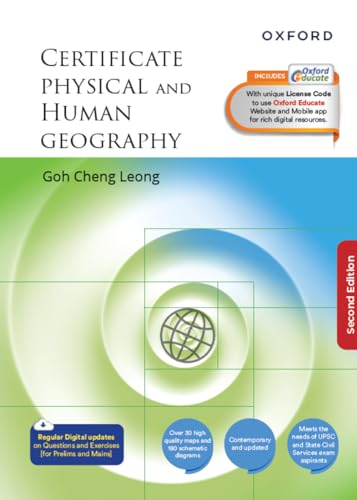
Certificate Physical and Human Geography — G.C. Leong
- 200 pages, concept-led physical geography
- Diagrams that explain rather than decorate
- The base layer under every other geography book
Why GC Leong Works for UPSC
| Strength | Detail |
|---|---|
| Concise | Covers physical geography in approximately 300 pages |
| Diagram-Rich | Excellent illustrations of geomorphological processes |
| Concept Clarity | Explains complex processes in simple language |
| UPSC Aligned | Maps directly to the physical geography syllabus |
| Widely Available | Easy to find, affordable, multiple editions |
Important Chapters in GC Leong
Not every chapter needs equal attention. Here’s a priority breakdown:
| Priority | Chapters | UPSC Relevance |
|---|---|---|
| High | Weathering, Mass Movement, Running Water, Glaciation | Geomorphology questions |
| High | Atmosphere, Pressure Belts, Wind Systems | Climatology — very frequently tested |
| High | Soils, Natural Vegetation, Biomes | Environment + Geography overlap |
| Medium | Limestone and Karst, Waves and Coasts | Occasional questions |
| Medium | Volcanoes, Earthquakes | Disaster Management overlap |
| Low | Map-making, Statistical Diagrams | Rarely tested directly |
Limitations of GC Leong
GC Leong covers physical and human geography from a global perspective. It doesn’t cover:
- Indian geography specifically
- Economic geography of India
- Current geographical developments
- Human geography in Indian context
These gaps need to be filled with supplementary books.
Which Geography Books Should You Actually Buy?
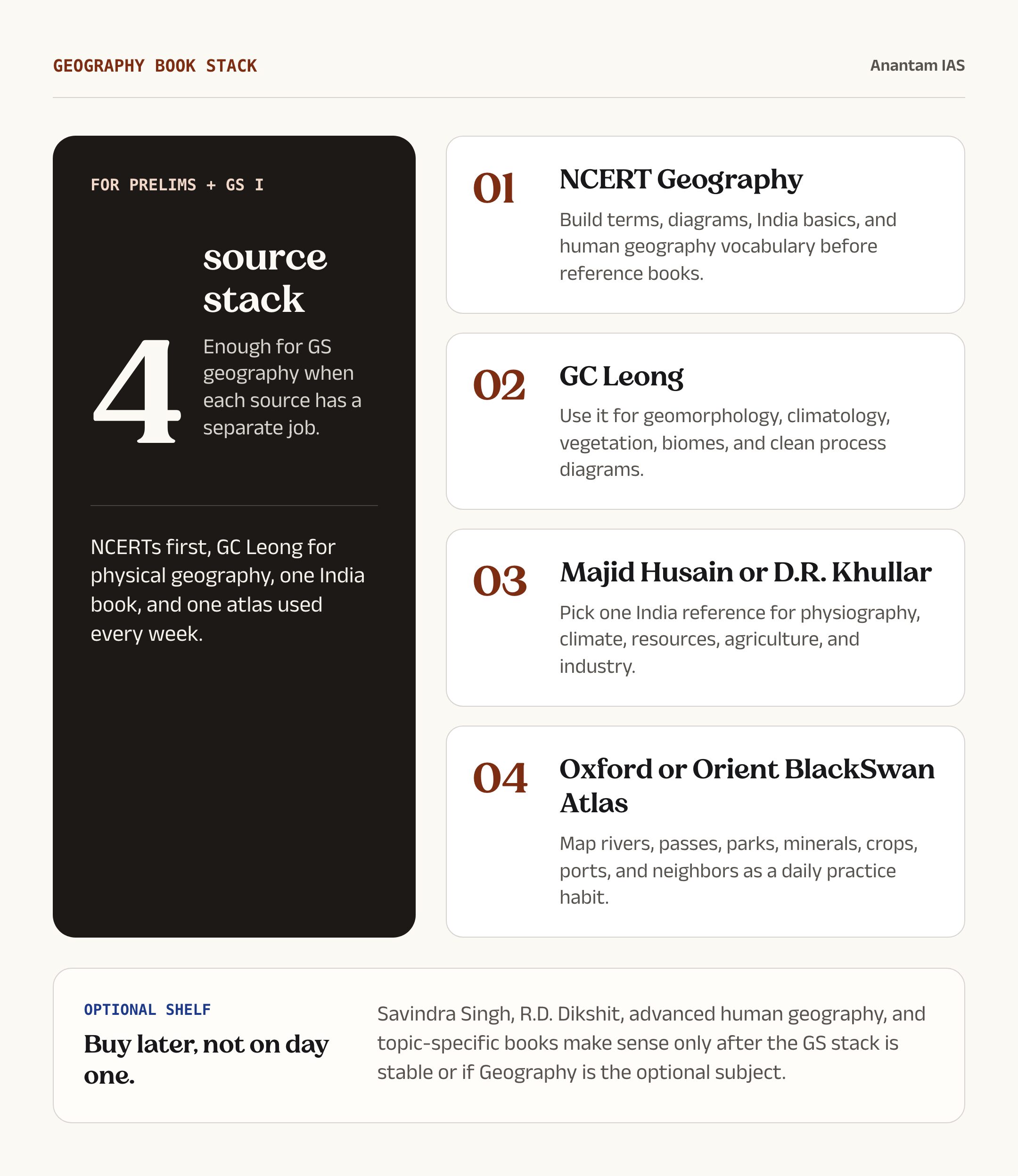
For General Studies, the best geography stack is simple: NCERT Class 11 and 12, GC Leong, one Indian geography reference, and one atlas. Add Shankar IAS Environment only for the GS III environment and disaster-management overlap. Do not begin with optional-level books unless Geography is your optional subject.
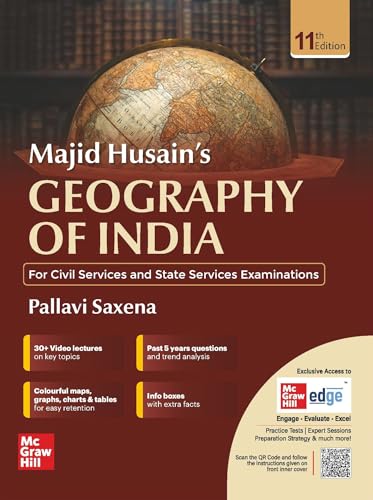
Geography of India — Majid Husain (11th Edition)
- 848 pages with colour maps and graphs
- Regional and thematic coverage of Indian geography
- Solved PYQs included in this edition
| Candidate Need | Best Recommendation | Why It Works |
|---|---|---|
| First-time GS preparation | Class 11-12 NCERT + GC Leong | Builds concepts, vocabulary and diagrams without over-reading |
| Weak Indian geography | Majid Husain; D.R. Khullar for deeper reference | Covers physiography, climate, resources, agriculture, industry and regions |
| Map recall is poor | Oxford Student Atlas or Orient BlackSwan atlas | Supports daily practice for rivers, passes, parks, crops, minerals and neighbors |
| Environment overlap | Shankar IAS Environment | Useful for GS III, ecology, biodiversity and disaster-management links |
| Geography optional | Savindra Singh, R.D. Dikshit, Majid Husain and D.R. Khullar | Optional answers need theory, models, thought and India-specific depth |
Complete Geography Book List for UPSC
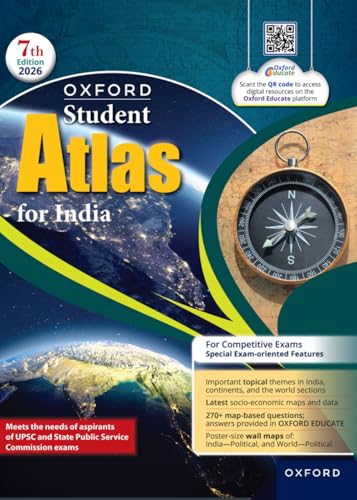
Oxford Student Atlas for India
- 160 pages, built for Indian competitive exams
- Physical, political and thematic maps in one volume
- The map work Prelims quietly rewards
Physical Geography
| Book | Author | Best For | Use It When |
|---|---|---|---|
| Certificate Physical & Human Geography | G.C. Leong | Core physical geography | You need GS-level concepts, diagrams, climate and vegetation coverage |
| Fundamentals of Physical Geography (Class 11) | NCERT | Starting point | You are beginning geography or returning after a long gap |
| NCERT Geography (Class 6-12) | NCERT | Foundation and Indian context | You need school-level clarity before reference books |
| Physical Geography | Savindra Singh | Advanced concepts | You have Geography optional or want deeper Paper I coverage |
| Climatology | D.S. Lal | Advanced climatology | You need optional-level depth; GS candidates can skip it |
Indian Geography
| Book | Author / Publisher | Best For | Use It When |
|---|---|---|---|
| Geography of India | Majid Husain | Single India reference for most candidates | You want one readable source for physiography, climate, soils, resources, agriculture and industry |
| India: A Comprehensive Geography | D.R. Khullar | Deeper India reference | You need fuller detail for Geography optional Paper II or advanced revision |
| India: Physical Environment (Class 11 NCERT) | NCERT | Physical geography of India | You need a clean base before Majid Husain or Khullar |
| India: People and Economy (Class 12 NCERT) | NCERT | Human and economic geography | You need agriculture, population, transport and planning basics |
| Oxford Student Atlas for India | Oxford | Map-based learning and revision | You want a standard school atlas for daily map work |
| Orient BlackSwan School Atlas or competitive-exam atlas | Orient BlackSwan | Atlas alternative | You prefer exam-oriented map plates and a second atlas option |
Majid Husain’s Geography of India is the better single India reference for most GS candidates. D.R. Khullar’s India: A Comprehensive Geography is useful when you want a fuller reference, especially for Geography optional Paper II, but it is slower for a first GS pass. Do not buy both at the start unless you have already chosen Geography optional.
Human Geography
| Book | Author | Best For | Use It When |
|---|---|---|---|
| Human Geography (Class 12 NCERT) | NCERT | Foundation | You need population, settlements, migration and transport basics |
| Fundamentals of Human Geography | NCERT (Class 12) | GS-level human geography | You are preparing for GS I and Prelims |
| Human Geography | Majid Husain | Optional Paper I | You need systematic optional-level human geography |
| Models in Geography | Majid Husain | Theoretical frameworks | You are covering models, theories and optional answer enrichment |
| Population Geography | R.C. Chandna | Population concepts | You need selective optional depth; it is not required for GS |
For Geography Optional
| Book | Author | Paper | Priority |
|---|---|---|---|
| Physical Geography | Savindra Singh | Paper I | High |
| Geomorphology | Savindra Singh | Paper I | High for landform depth |
| Climatology | D.S. Lal | Paper I | Selective advanced reading |
| Human Geography | Majid Husain | Paper I | High |
| Models in Geography | Majid Husain | Paper I | High for theories and answer structure |
| Geographical Thought | R.D. Dikshit | Paper I | High for thought section |
| Geography of India | Majid Husain | Paper II | High |
| India: A Comprehensive Geography | D.R. Khullar | Paper II | High as a deeper reference |
| Economic and Commercial Geography | R.N. Tiwari | Paper II | Selective |
UPSC Optional Subjects: Complete Guide
NCERT Geography Books: The Foundation
NCERTs deserve special mention. They provide the conceptual base that advanced books build upon.
Which NCERTs to Read for Geography
| Class | Book Title | Key Topics |
|---|---|---|
| Class 6 | The Earth: Our Habitat | Basic geography — globe, maps, landforms |
| Class 7 | Our Environment | Natural vegetation, human environment |
| Class 8 | Resources and Development | Agriculture, industries, human resources |
| Class 9 | Contemporary India I | India’s physical features, climate, drainage |
| Class 10 | Contemporary India II | Resources, agriculture, manufacturing |
| Class 11 | Fundamentals of Physical Geography | Geomorphology, climate, oceans |
| Class 11 | India: Physical Environment | India’s physical setting |
| Class 12 | Fundamentals of Human Geography | Population, migration, settlements |
| Class 12 | India: People and Economy | Agriculture, transport, planning |
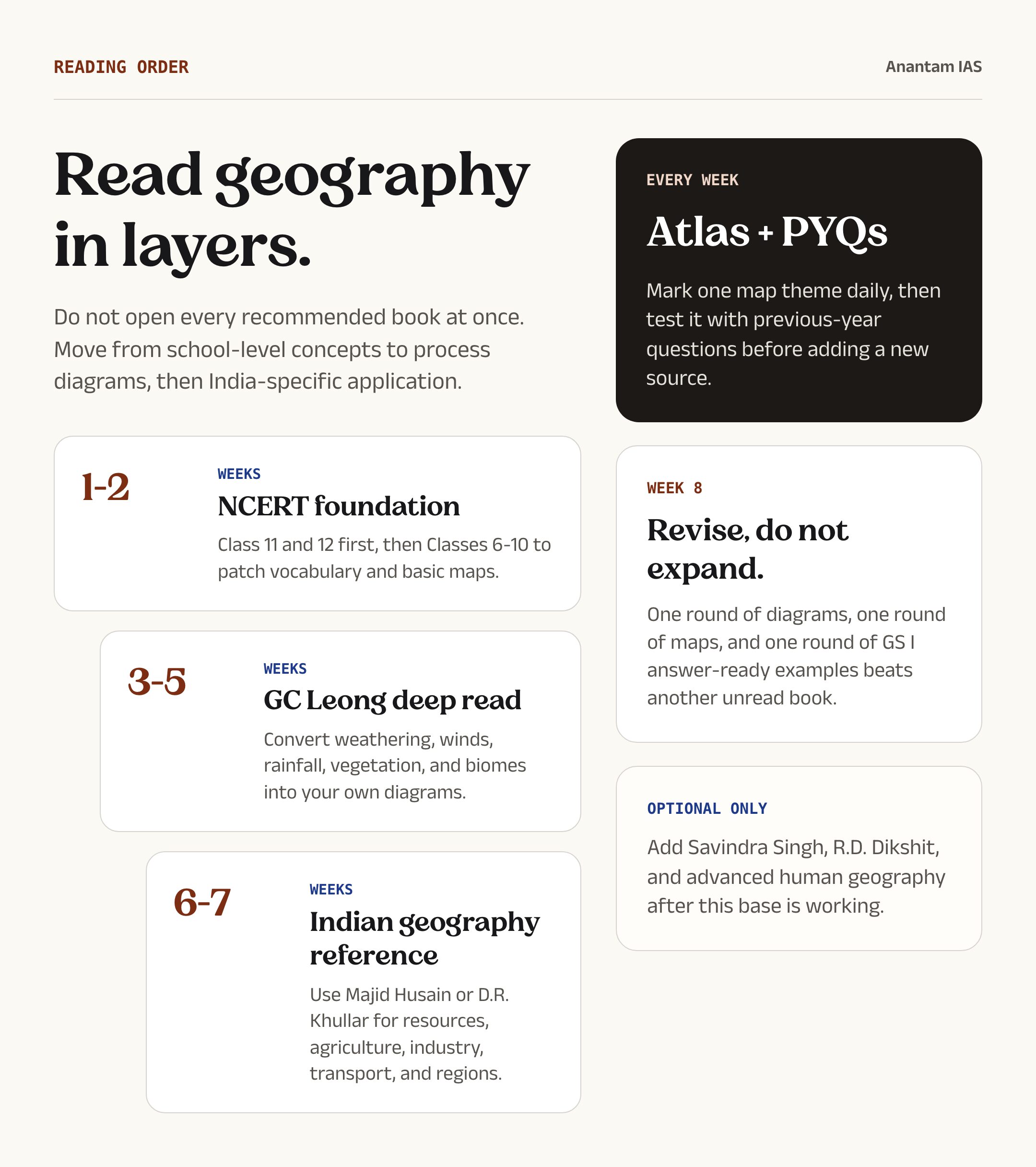
Reading order: Start with Class 11 and 12 NCERTs. These cover the most UPSC-relevant content. Then go back to Class 6–10 for filling gaps.
NCERT Books for UPSC: Complete Guide
How to Read Geography Books for UPSC
Step 1: NCERT Foundation (2–3 weeks)
Read all geography NCERTs from Class 6 to 12. Make brief notes on key concepts, diagrams, and India-specific data. This builds the vocabulary and conceptual framework needed for advanced books.
Step 2: GC Leong Deep Read (3–4 weeks)
Read GC Leong chapter by chapter, focusing on high-priority topics. Pay special attention to:
- Diagrams and cross-sections
- Process descriptions (erosion, deposition, weathering)
- Climate classification systems
- Global wind and pressure patterns
Note-making tip: Create your own diagrams. Redrawing GC Leong’s illustrations builds understanding and exam-ready recall.
Step 3: Majid Husain for Indian Geography (2–3 weeks)
Cover Indian geography systematically — physiography, drainage, climate, soils, vegetation, agriculture, minerals, industry, and transport. Link each topic to current developments.
Step 4: Map Practice (Ongoing)
Geography without maps is incomplete. Practice locating:
- Mountain passes, rivers, national parks
- International boundaries and disputed territories
- Mineral belts, industrial regions, crop zones
- Important cities, ports, and transport corridors
The Oxford School Atlas should be a constant companion throughout preparation.
Geography for Different UPSC Papers
| UPSC Paper | Geography Focus | Primary Sources |
|---|---|---|
| Prelims | Physical geography, Indian geography facts | GC Leong, NCERT, Majid Husain |
| GS I Mains | Geomorphology, oceanography, climate, Indian geography | GC Leong, Majid Husain |
| GS III Mains | Environmental geography, disaster management | Shankar IAS Environment |
| Geography Optional | Full syllabus depth | Savindra Singh, Majid Husain, Dikshit |
GC Leong vs Other Physical Geography Books
| Parameter | GC Leong | Savindra Singh | NCERT Class 11 |
|---|---|---|---|
| Depth | Moderate | Very High | Basic |
| Length | ~300 pages | ~800+ pages | ~200 pages |
| Diagrams | Excellent | Good | Good |
| UPSC Sufficiency (GS) | Yes | Overkill for GS | Insufficient alone |
| Best For | GS Prelims + Mains | Geography Optional | Starting point |
| Language | Simple, clear | Academic, detailed | Student-friendly |
For GS preparation, GC Leong + NCERTs is the winning combination. Savindra Singh is recommended only for Geography optional candidates who need deeper theoretical coverage.
Common Geography Preparation Mistakes
- Reading GC Leong without NCERTs first. GC Leong assumes basic knowledge. Without NCERT foundation, many concepts feel disconnected.
- Ignoring Indian Geography. UPSC asks more questions on Indian geography than world geography. Majid Husain or equivalent coverage is essential.
- Not practicing with maps. Map-based questions appear in both Prelims and Mains. Regular atlas practice is non-negotiable.
- Skipping human geography. Population, migration, urbanization, and settlement patterns are increasingly tested. Don’t focus exclusively on physical geography.
- Not linking geography to current affairs. Monsoon patterns, cyclone events, earthquake zones, river interlinking — current events provide exam-relevant context for static geography concepts.
UPSC Syllabus 2026: Complete Guide
Frequently Asked Questions
Is GC Leong enough for UPSC geography?
GC Leong is enough only for the physical geography part of GS preparation. It does not cover Indian geography, economic geography, map practice, or human geography in enough depth. Combine it with NCERTs, one Indian geography reference such as Majid Husain or D.R. Khullar, and a good atlas.
Which edition of GC Leong should one buy?
Buy the latest available edition with clear diagrams and updated terminology. The core physical geography concepts have not changed much, so an older clean copy can still work, but avoid badly printed or pirated copies because diagrams matter in geography.
How to make notes from GC Leong?
Make topic-wise notes, not chapter summaries. Redraw the important diagrams for weathering, winds, rainfall, vegetation and landforms. Geography rewards process recall, so write how a phenomenon happens and where it can be mapped in India or the world.
Is Savindra Singh necessary for GS preparation?
No. Savindra Singh is an optional-level source. For GS, NCERTs plus GC Leong plus one Indian geography reference are enough. Use Savindra Singh only if Geography is your optional subject or you need deeper theory after finishing the core stack.
Should I buy both Majid Husain and D.R. Khullar?
For General Studies, no. Pick one Indian geography reference and revise it well. Majid Husain is usually easier for a GS pass, while D.R. Khullar is better when you want a fuller reference for Geography optional Paper II.
Which atlas is best for UPSC geography?
Oxford Student Atlas for India and Orient BlackSwan atlases are both useful. Choose the one with clear India maps, physical maps, political maps and updated thematic plates. The atlas matters less than the habit of marking locations daily.