GI Tags in India 2026: Official Register, State Leaders & UPSC Guide
The official May 2026 register lists 822 GI entries. Check the latest source, leading states, GI categories, registration rules, and UPSC facts.
GI tags in India are recorded by the Geographical Indications Registry under the Geographical Indications of Goods (Registration and Protection) Act, 1999. The official register published on 2 May 2026 contains 822 registered entries, up from older lists that are still widely quoted online.
Treat 822 as the number of entries in that official register, not automatically as 822 unique products. Word marks, logos and some shared registrations can appear separately. Uttar Pradesh has the most state associations in the current list, followed by Tamil Nadu and West Bengal.
Use the official May 2026 GI register for the current count and product-to-state mapping. This guide explains the legal idea, leading states, product categories, registration process and the facts most useful for UPSC.
What Is a GI Tag?
A Geographical Indication (GI) is a name or sign used on products that identifies them as originating from a specific geographical location, where a given quality, reputation, or characteristic is attributable to that origin.
Legal basis in India: The Geographical Indications of Goods (Registration and Protection) Act, 1999 — came into force on September 15, 2003. Administered by the GI Registry at Chennai, under the Office of the Controller General of Patents, Designs and Trademarks.
International Framework
GI protection globally operates under:
- TRIPS Agreement (1994) — Agreement on Trade-Related Aspects of Intellectual Property Rights; India became a signatory as a WTO member (1995)
- Paris Convention (1883) — for protection of industrial property
- Madrid Agreement (1891) — for false indications of source
- Lisbon Agreement (1958) — for appellations of origin (India is not a signatory)
Two Registration Options
- Class I — GI: For the first registration of a geographical indication
- Class II — Authorized User: For manufacturers/traders authorised to use the GI
Validity: GI registration is valid for 10 years, renewable indefinitely.
Which State Has the Most GI Tags in India?
Uttar Pradesh leads the official state-wise register released on 2 May 2026. The figures below count entries associated with each state in that document; a multi-state GI may be associated with more than one jurisdiction.
| Rank | State | Entries in official register |
|---|---|---|
| 1 | Uttar Pradesh | 79 |
| 2 | Tamil Nadu | 74 |
| 3 | West Bengal | 58 |
| 4 | Maharashtra | 52 |
| 5 | Madhya Pradesh | 50 |
Main Categories of GI-Tagged Goods
A GI can protect an agricultural, natural or manufactured good when its quality, reputation or other characteristic is essentially attributable to its geographical origin. Handicrafts and foodstuffs are recorded within the appropriate goods classes rather than under a separate constitutional category.
| Type | Examples in India | What geography contributes |
|---|---|---|
| Agricultural | Darjeeling Tea, Basmati, Kashmir Saffron | Climate, soil, local variety and cultivation practice |
| Handicraft | Kanchipuram Silk, Banarasi Brocades, Bidriware | Regional skill, materials and inherited production method |
| Manufactured | Mysore Sandal Soap, Coimbatore Wet Grinder | Specified origin-linked process or reputation |
| Foodstuff | Hyderabadi Haleem, Tirupati Laddu, Bikaneri Bhujia | Recipe, method and regional reputation |
| Natural | Makrana Marble | Place-specific natural deposit |
How to Check New GI Registrations
Do not memorise a static “latest additions” list without checking its publication date. The register changed materially in 2026, including registrations such as Sailana Balam Kakadi in Madhya Pradesh, Bishnupur Dashavatar Tash in West Bengal and Sirsa Kinnow in Haryana.
- Use the registered GI list for confirmed registrations.
- Use the GI Registry public search for an individual application and its current status.
- Distinguish a new application from a registered GI. Filing alone does not confer protection.
Key Famous GI Products (UPSC Must-Know)
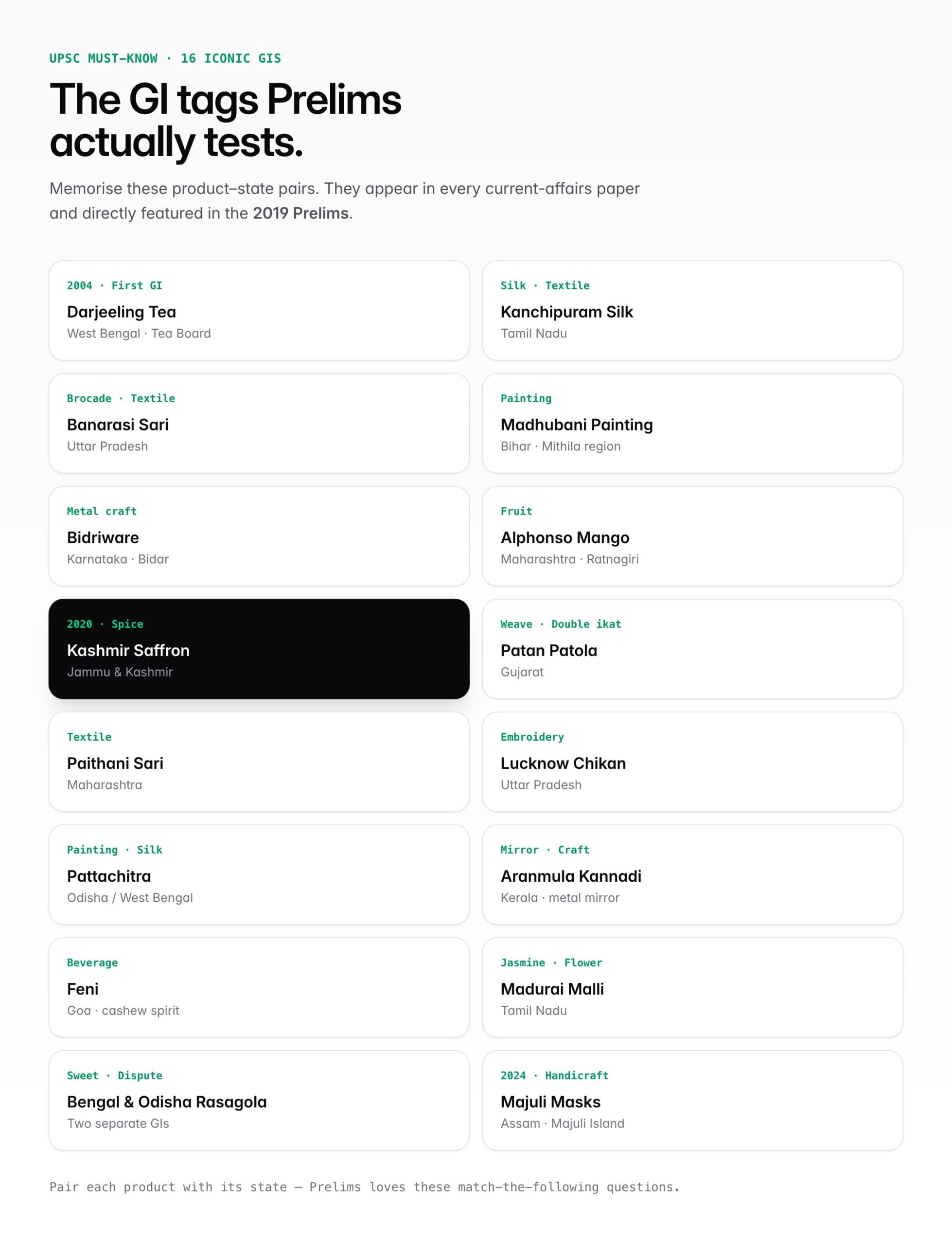
Geographical Indications with Protected Disputes
Basmati Rice:
- Registered: 2008 (jointly for 7 states: Punjab, Haryana, UP, Uttarakhand, HP, J&K, Delhi)
- Disputes: Pakistan's competing claim; USA's generic use attempts; EU registration
- Export value: India exports Basmati worth ~$5 billion annually — largest agricultural export
Darjeeling Tea:
- India's first GI (2004)
- Exports: ~80% goes to EU, UK, Japan
- Controversy: Nepali Ilam tea tries to pass as Darjeeling
Kashmir Saffron:
- Granted 2020
- Unique: Only saffron grown at high altitude (1,600-1,800m)
- Volume: India produces only 6-7 tonnes annually vs Iran's ~430 tonnes
Tirupathi Laddu:
- Granted 2009 — to Tirumala Tirupati Devasthanams
- Controversy: 2024 quality and ingredient disputes
- Annual sales: Over 3 million laddus daily
Key Crafts with Cultural Significance
| Product | State | Significance |
|---|---|---|
| Madhubani Painting | Bihar | Traditional Maithili art; women-dominated |
| Kanchipuram Silk | Tamil Nadu | Wedding sari standard |
| Mysore Silk | Karnataka | Royal patronage heritage |
| Pashmina | J&K | Made from Changthangi goat wool |
| Ajrakh | Gujarat | 500-year-old block-printing tradition |
| Warli Painting | Maharashtra | Tribal art, geometric forms |
Process of GI Registration
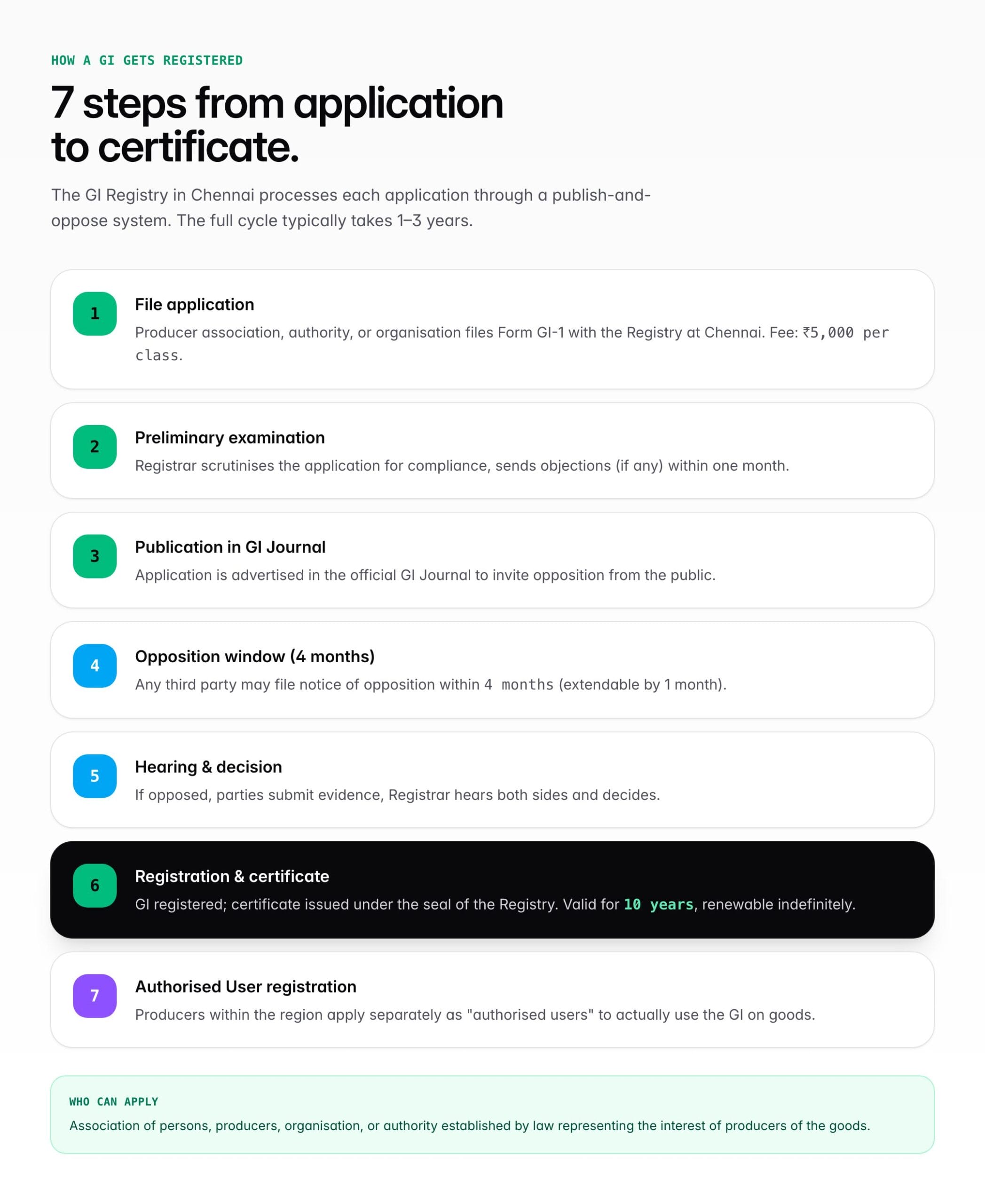
The registration process is rigorous:
Step-by-Step Process
| Step | Action | Typical Duration |
|---|---|---|
| 1 | Application filed with GI Registry, Chennai | Day 0 |
| 2 | Preliminary examination — formality check | ~3 months |
| 3 | Examination by Registrar on merits | ~6-12 months |
| 4 | Consultation with expert group (if needed) | — |
| 5 | Publication in GI Journal | — |
| 6 | Opposition period (3 months) | 3 months |
| 7 | Hearing (if opposition filed) | As needed |
| 8 | Registration certificate issued | — |
| Total | 2-4 years typically |
Who Can Apply?
- Association of persons, producers, or organisations representing producers of the goods
- Government departments
- Statutory authorities
Note: Individual applicants generally cannot apply. This is to ensure collective community benefit.
Economic Impact
Value Creation for Indian GIs
| GI Product | Economic Impact |
|---|---|
| Basmati Rice | ~$5 billion export annually |
| Darjeeling Tea | ~8.5 million kg/year; premium prices |
| Pashmina | ~₹5,000-50,000 per shawl; Kashmir economy |
| Kashmir Saffron | ₹1-2 lakh per kg; highest-priced spice |
| Alphonso Mango | Premium export crop; ~₹500-1,500/dozen |
| Handicraft GIs combined | Millions of artisans employed |
Rural Livelihood
GI tags directly benefit approximately 3-4 crore rural artisans and producers across India — particularly in:
- Textile-producing regions
- Agricultural heartlands
- Tribal and indigenous communities
- Traditional craft clusters
India’s GI Timeline
- 1999: Parliament enacted the Geographical Indications of Goods (Registration and Protection) Act.
- 15 September 2003: the Act came into force.
- 2004-05: Darjeeling Tea word and logo became the first entries in the Indian register.
- 2 May 2026: IP India published an updated register containing 822 entries.
GI vs Trademark vs Patent vs Copyright
GI is often confused with other forms of intellectual property. UPSC questions frequently ask you to distinguish between them. Here is how they compare:
| Feature | Geographical Indication | Trademark | Patent | Copyright |
|---|---|---|---|---|
| Governs | Origin-linked quality | Brand identity | Invention/technology | Creative expression |
| Owner | Community of producers | Individual/company | Inventor/assignee | Author/creator |
| Validity | 10 yrs, renewable forever | 10 yrs, renewable forever | 20 yrs, non-renewable | Life + 60 yrs |
| Transferable | No (collective right) | Yes | Yes | Yes |
| Law in India | GI Act, 1999 | Trade Marks Act, 1999 | Patents Act, 1970 | Copyright Act, 1957 |
| Indian example | Darjeeling Tea | Amul | CSIR turmeric cases | Tagore’s writings |
Key distinction: a trademark identifies who made the product; a GI identifies where it was made and the traditional quality tied to that place. A GI cannot be sold or licensed away — it belongs to the community of producers in the defined region.
Global GI Benchmarks
India’s GI register is smaller than the European Union’s combined origin-protection system, which treats GIs as a pillar of agri-export policy. These are the global GI icons UPSC loves to cite in Mains answers:
| Product | Country/Region | Category | Protection Since |
|---|---|---|---|
| Champagne | France (Champagne region) | Sparkling wine | 1936 (AOC) |
| Roquefort | France (Aveyron) | Blue cheese | 1925 — world’s first PDO |
| Parma Ham (Prosciutto di Parma) | Italy | Cured meat | 1963 |
| Parmigiano-Reggiano | Italy | Hard cheese | 1955 |
| Scotch Whisky | Scotland, UK | Spirit | 1933 / 2008 (PGI) |
| Tequila | Mexico (Jalisco) | Spirit | 1974 (Lisbon) |
| Darjeeling Tea | India (West Bengal) | Tea | 2004 |
| Kobe Beef | Japan (Hyogo) | Beef | 2007 |
| Café de Colombia | Colombia | Coffee | 2007 (EU PGI) |
The EU alone has over 3,500 GI-protected products, collectively worth €75+ billion annually. India’s GI economy is still a fraction of that potential.
Landmark IP Cases That Shaped India’s GI Law
India’s GI regime was sharpened by a series of biopiracy disputes in the 1990s, in which US companies obtained patents on products derived from Indian traditional knowledge. These cases directly motivated Parliament to enact the GI Act, 1999.
1. Turmeric Patent Case (1995–1997)
The US Patent and Trademark Office granted Patent No. 5,401,504 to University of Mississippi Medical Center researchers for “use of turmeric in wound healing” — a knowledge used in Indian households for millennia. CSIR, led by Dr R.A. Mashelkar, filed a re-examination petition with 32 references from ancient Sanskrit texts. The patent was revoked in 1997 — the first successful challenge by a developing country to a US patent on traditional knowledge.
2. Neem Patent Case (1995–2005)
The US company W.R. Grace and the USDA patented a fungicide derived from neem oil. India challenged it at the European Patent Office, arguing neem’s anti-fungal properties were ancient traditional knowledge. After a 10-year battle, the EPO revoked the patent in 2005.
3. Basmati Rice Case (1997–2001)
RiceTec Inc. of Texas obtained a US patent (5,663,484) for “Basmati rice lines and grains” — effectively the right to call American-grown rice Basmati. India’s objection led to 15 of the 20 claims being struck down by 2001. The case was decisive in pushing India to enact the GI Act and register Basmati as a GI (granted 2016 for 7 northern states).
4. Darjeeling Tea vs France (2003)
French cosmetics company Jean-Claude Dupuis tried to register “Darjeeling” as a trademark for lingerie and women’s clothing. The Tea Board of India objected and successfully blocked the registration — demonstrating how GI protection extends beyond the food category when reputation spillover is at stake.
5. Rasagola Dispute — Odisha vs West Bengal (2017–2018)
A rare intra-India GI battle. West Bengal was granted GI for “Banglar Rasogolla” in 2017; Odisha followed with “Odisha Rasagola” in 2018. The registry accepted that both states had distinct recipes and traditions — setting a precedent that two overlapping GIs can co-exist when origin traditions are demonstrably different.
State-wise Quick Index
Use this condensed reference to place any GI-tagged product with its state — essential for Prelims match-the-following questions:
| State | Signature GIs (Prelims favourites) |
|---|---|
| Tamil Nadu | Kanchipuram Silk, Thanjavur Painting, Madurai Malli, Nilgiri Tea, Eathomozhy Coconut |
| Uttar Pradesh | Banarasi Sari, Lucknow Chikan, Agra Petha, Moradabad Brass, Khurja Pottery, Kala Namak Rice |
| Maharashtra | Paithani, Alphonso Mango, Nagpur Orange, Kolhapur Chappal, Warli Painting |
| Karnataka | Mysore Silk, Bidriware, Mysore Sandal Soap, Coorg Orange, Dharwad Pedha |
| Odisha | Pattachitra, Konark Stone Carving, Odisha Rasagola, Lanjia Saura Painting |
| Andhra Pradesh & Telangana | Pochampally Ikat, Tirupathi Laddu, Hyderabadi Haleem, Kalamkari, Cheriyal Scrolls |
| West Bengal | Darjeeling Tea, Nakshi Kantha, Bengal Rasagola |
| Kerala | Aranmula Kannadi, Palakkadan Matta Rice, Vazhakulam Pineapple, Pokkali Rice |
| Rajasthan | Molela Clay, Bikaneri Bhujia, Blue Pottery, Kathputlis |
| Gujarat | Ajrakh, Patan Patola, Kachchh Embroidery, Gir Kesar, Bhalia Wheat, Pithora Painting |
| Bihar | Madhubani Painting, Shahi Litchi, Katarni Rice, Bhagalpuri Silk |
| Jammu & Kashmir | Kashmir Saffron, Pashmina, Kani Shawl, Walnut Wood Carving |
| Madhya Pradesh | Chanderi Sari, Gond Painting, Ratlami Sev, Balaghat Chinnor Rice |
| Assam | Muga Silk, Majuli Masks, Kaji Nemu, Boka Chaul, Bodo Textiles |
| Himachal Pradesh | Kangra Tea, Kullu Shawl, Chamba Rumal |
| Goa | Feni, Khaja |
| Chhattisgarh | Dhokra Metal Casting, Jeeraphool Rice, Bastar Iron Craft |
Challenges and Issues
Implementation Gaps
Low awareness:
- Many producers unaware of GI benefits
- Buyers often don't know the "GI" label is protected
- Generic market competition affects GI products
Weak enforcement:
- Counterfeit products flood the market
- Limited legal infrastructure at local level
- Customs enforcement against fake exports weak
Benefit distribution:
- Often middlemen capture most GI premium
- Direct producer access to markets limited
- Inter-state disputes (e.g., Bengal vs Odisha Rasagola)
International Disputes
Pakistan's Basmati claim:
- Pakistan applied for GI recognition of Basmati in EU
- Dispute with India over shared heritage
- Ongoing WTO-level complications
Generic use internationally:
- "Darjeeling" sold as generic term in some countries
- EU has relatively strong GI protection; US weak
- Legal battles in foreign jurisdictions expensive
Legal Gaps
Inter-state GIs:
- Rasagola dispute: Bengal Rasagola (2017) vs Odisha Rasagola (2019) — both awarded
- Sets precedent for shared heritage protection
- Suggests registry accepts parallel regional GIs
Government Initiatives
Schemes Supporting GI Products
| Scheme | Focus |
|---|---|
| GI Registration Fee Waiver | For artisan groups |
| One District One Product (ODOP) | Promoting local GI-eligible products |
| MSME GI Promotion | Financial support for branding |
| GeM (Government e-Marketplace) | GI products prioritised |
| Digital India | Online marketplace for GIs |
| Trade Infrastructure for Export Scheme (TIES) | GI export promotion |
Target for Keeping the GI Register Current
The Ministry of Commerce has set an ambitious target:
- Official register: 822 entries in the list published on 2 May 2026
- Revision rule: verify new applications against confirmed registrations before using them in an answer
A larger register is useful only when producer groups can enforce it, maintain product standards and convert origin-linked reputation into sustainable income.
TRIPS Agreement and GI Protection
What TRIPS Provides
The TRIPS Agreement (1994) sets minimum standards for intellectual property protection globally:
- Article 22: Basic GI protection
- Article 23: Enhanced protection for wines and spirits
- Article 24: Exceptions for generic terms
Criticism: TRIPS gives higher protection to wines and spirits (Champagne, Cognac) than to other GIs. India has demanded "equal treatment" — extending wine-level protection to products like Basmati, Darjeeling, and handicrafts.
India's Position
At the WTO, India has consistently advocated:
- Extension of Article 23 protection to all GIs (not just wines)
- Multilateral GI register for all products
- Disclosure requirements to prevent biopiracy
- Geographical-origin labeling on patents
These demands are part of the broader Doha Development Round discussions.
UPSC Preparation Guide
Prelims-Level Facts to Memorise
| Category | Key Facts |
|---|---|
| Official register | 822 entries (2 May 2026) |
| First GI entries | Darjeeling Tea word and logo (2004-05) |
| Leading state | Uttar Pradesh (79 state associations in the May 2026 list) |
| GI Registry Location | Chennai |
| Main Act | Geographical Indications of Goods (Registration and Protection) Act, 1999 |
| Effective From | September 15, 2003 |
| Validity | 10 years, renewable indefinitely |
| International framework | TRIPS Agreement, 1994 (WTO) |
Famous Pairings for Prelims
| Product | State | Category |
|---|---|---|
| Darjeeling Tea | West Bengal | Agricultural |
| Basmati Rice | Multiple northern states | Agricultural |
| Kanchipuram Silk | Tamil Nadu | Handicraft |
| Banarasi Sari | Uttar Pradesh | Handicraft |
| Mysore Silk | Karnataka | Handicraft |
| Alphonso Mango | Maharashtra | Agricultural |
| Kashmir Saffron | J&K | Agricultural (2020) |
| Pashmina | J&K | Handicraft |
| Pattachitra | Odisha, WB | Handicraft |
| Madhubani Painting | Bihar | Handicraft |
| Feni | Goa | Manufactured |
| Nagpur Orange | Maharashtra | Agricultural |
| Coorg Cardamom | Karnataka | Agricultural |
| Paithani | Maharashtra | Handicraft |
| Thanjavur Painting | Tamil Nadu | Handicraft |
Mains-Level Themes
- GI tags and rural economy empowerment
- Traditional knowledge protection
- GI vs branded/trademarked products
- Inter-state GI disputes
- International GI negotiations (TRIPS)
- GIs and cultural heritage
- GI enforcement challenges
Essay Themes
- "Intellectual property and cultural heritage: A delicate balance"
- "Traditional knowledge in a globalised marketplace"
- "GI tags as instruments of rural economic empowerment"
Recent UPSC Questions on GI Tags
UPSC Prelims 2019: Which of the following is/are famously associated with GI tags? (Options included — Kangra Tea, Phulkari, etc.)
UPSC Prelims 2017: Which of the following protected areas are located in the Cauvery basin? (Variations on GI-related questions)
UPSC Mains — GS3: "Intellectual property rights as an instrument of economic empowerment in rural India."
Frequently Asked Questions
What is the difference between GI and trademark?
A trademark identifies a specific business/company. A GI identifies products from a specific geographic origin and can be used by multiple producers from that region meeting the standards.
Can GI protection be revoked?
Yes — if the product loses its distinctiveness or the conditions of origin are not maintained, registration can be cancelled after due process.
Does GI grant monopoly?
No. It grants exclusive right to use the name to producers from the geographic area meeting the quality standards. Anyone from the area meeting standards can register as authorised user.
What happens when two states claim the same GI?
The GI Registry examines evidence of historical origin. In the Rasagola case, both Bengal and Odisha received separate GIs — recognising parallel traditions.
How many countries have GI systems?
Over 170 WTO members have some form of GI protection. EU has the strongest system. The US uses trademarks/certification marks instead.