How to Change Attitude: Theories, Techniques and Civil Service Applications (UPSC GS IV)
A complete UPSC GS IV guide to attitude change — learning theory, Elaboration Likelihood Model, cognitive dissonance, persuasion, and Indian civil service case studies.
Attitudes look stubborn from the outside but they are surprisingly mobile. A person who refused to wear a seat belt for thirty years buckles up the day a friend dies in an accident. A village that resisted girls' schooling for a generation queues up at the gate when one local girl cracks the UPSC. A senior officer who dismissed a junior's idea on Monday champions it on Friday. Attitudes change — sometimes slowly, sometimes overnight — and the GS IV syllabus expects an aspirant to know exactly how.
This article works through the major theories of attitude change, the techniques that flow from each, and the Indian public-administration cases where these techniques have either succeeded brilliantly or failed instructively. The aim is not just to list theories but to give you the conceptual machinery to write a Mains answer that distinguishes a surface compliance from a genuine internal shift, and to recognise which technique a real-world case actually used.
What attitude change means
An attitude is a learnt evaluative disposition toward an object, person, group or idea, with cognitive, affective and behavioural components. Attitude change occurs when any of these components is modified — when a person moves from positive to negative, from indifferent to engaged, from mildly approving to strongly committed, or simply when the affective intensity shifts.
Three things must be distinguished at the outset.
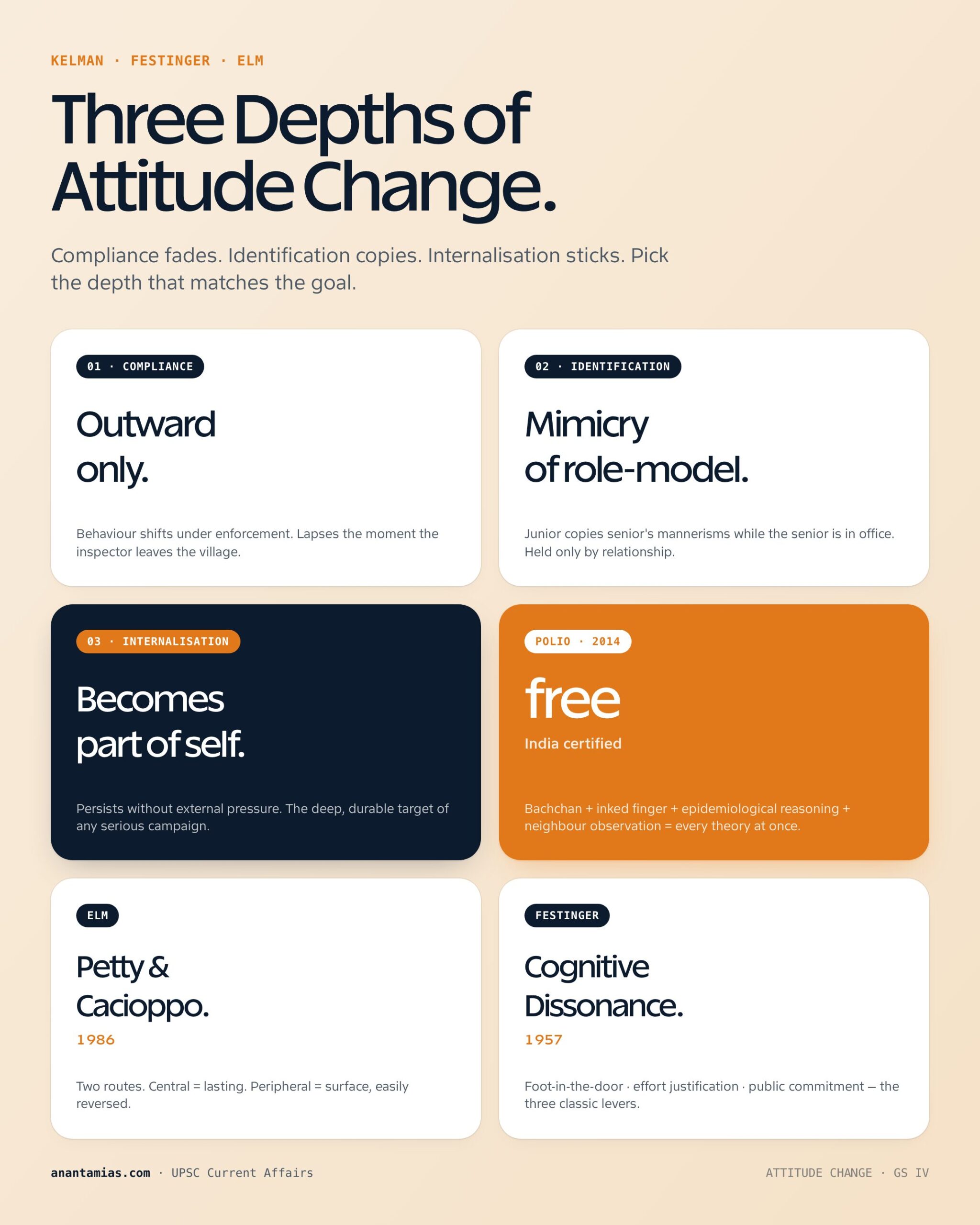
- Compliance — outward behaviour change without internal acceptance. The villager pays the fine and stops open defecation, but the moment enforcement lapses he goes back to the field.
- Identification — change driven by the desire to be like a respected source. The junior officer copies the senior's mannerisms while the senior is in office.
- Internalisation — the new attitude becomes part of the person's value system and persists without external pressure. This is the deepest and most durable form of change, articulated most clearly by social psychologist Herbert Kelman.
Effective civil-service interventions aim at internalisation. Compliance produces backsliding the moment the inspector leaves the village.
Learning theory of attitude change
The first family of explanations treats attitudes as learnt and therefore as relearnable. Three mechanisms operate.
Classical conditioning
A neutral stimulus is repeatedly paired with a stimulus that already evokes a positive or negative response, and over time the neutral stimulus inherits the response. Advertising relies on this — a soap is shown beside a smiling celebrity until the soap itself evokes warmth. The Swachh Bharat Mission used this when it paired toilets with images of dignity, marriage prospects and the safety of women, so that the toilet — a previously neutral object — acquired positive emotional connotations.
Operant conditioning
Behaviours followed by reward grow stronger; behaviours followed by punishment grow weaker. The attitudes that produced those behaviours follow suit. The PM Ujjwala Yojana operated partly through operant conditioning — the LPG connection rewarded the woman who chose clean fuel, and after enough cycles of cooking quickly without smoke in the eyes, the underlying attitude toward LPG shifted from suspicion to preference.
Observational learning
Bandura's social learning theory holds that we acquire attitudes by watching others — especially high-status others — and noting which behaviours are rewarded. When a popular Bollywood actor is seen wearing a helmet, helmet-wearing acquires a positive valence among the actor's admirers. The choice of brand ambassadors for public-health campaigns is an applied corollary of this principle.
Elaboration Likelihood Model — the theory of persuasion
Richard Petty and John Cacioppo's Elaboration Likelihood Model (ELM) is the most influential modern theory of persuasive attitude change. It identifies two routes by which a persuasive message can shift attitudes.
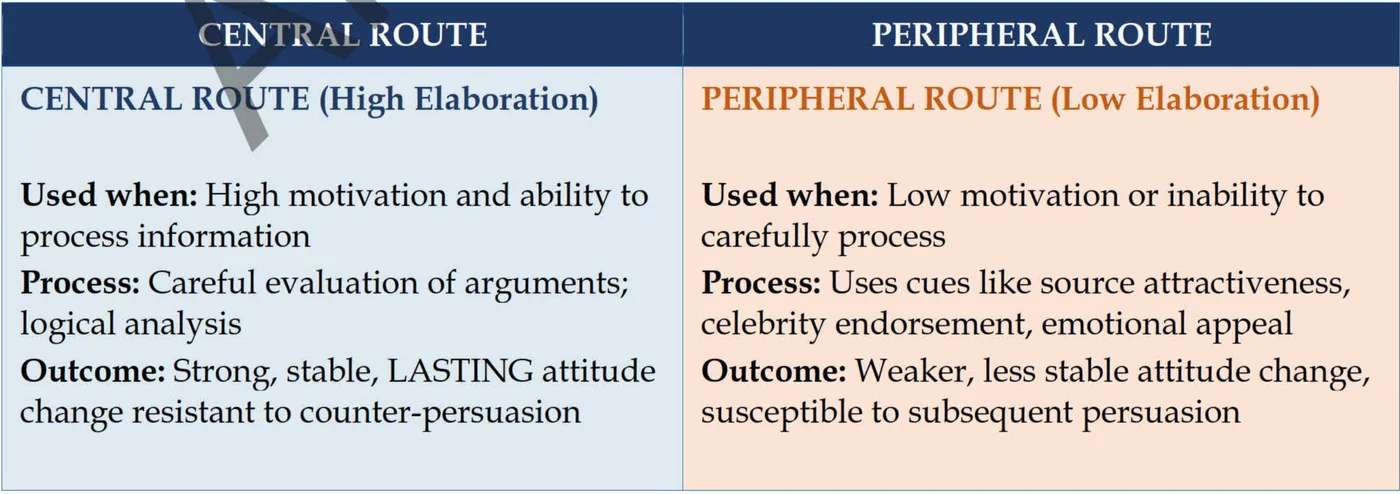
| Route | What happens | Conditions favouring it | Durability of change |
|---|---|---|---|
| Central route | Receiver thinks carefully about message content, weighs arguments, evaluates evidence | High motivation, ability, personal relevance | Strong, lasting, resistant to counter-persuasion |
| Peripheral route | Receiver responds to surface cues — speaker's attractiveness, authority, music, slogan length | Low motivation, low ability, distraction | Weak, surface-level, easily reversed |
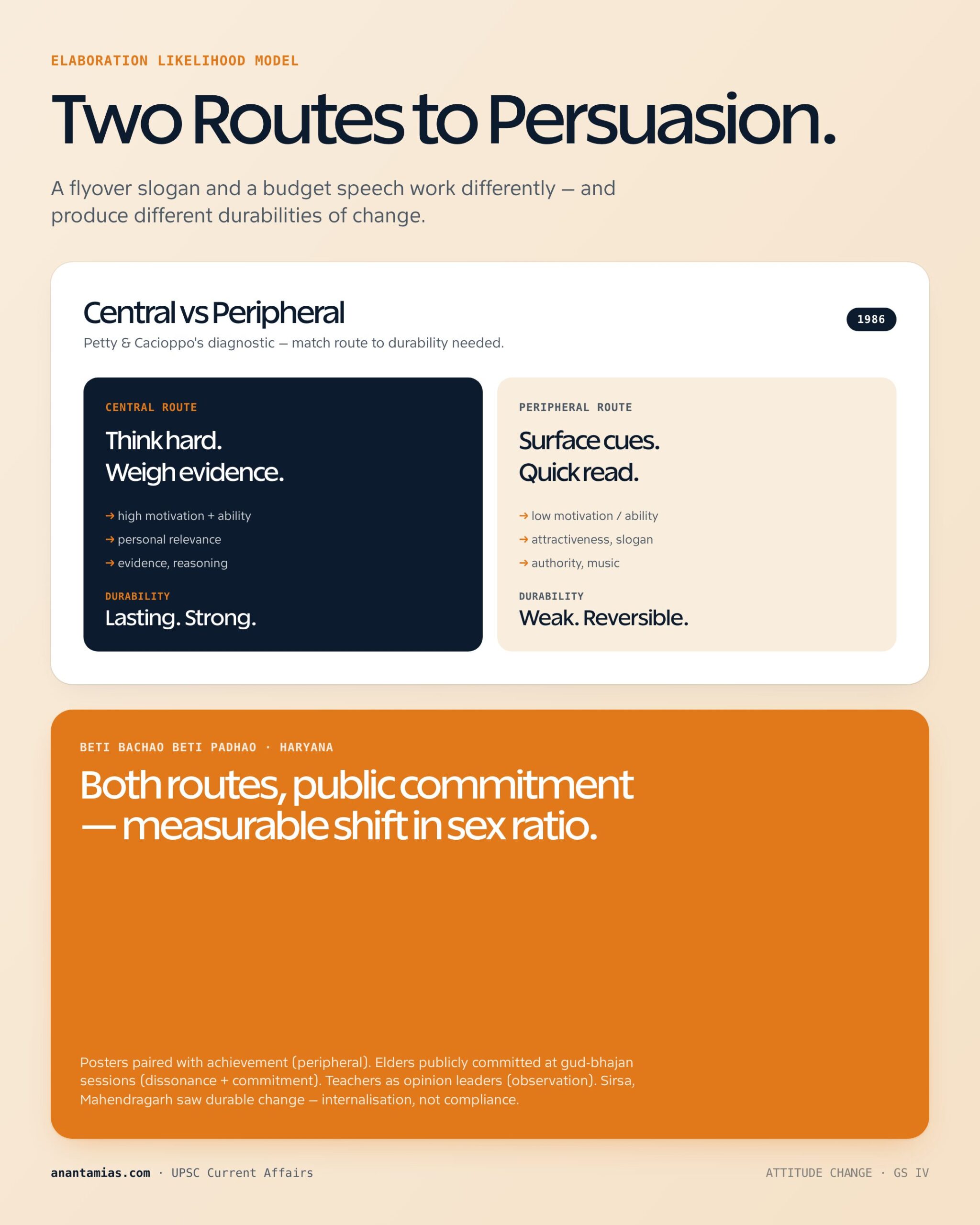
The ELM is the theoretical basis for the distinction between deep persuasion and shallow nudging. A budget speech that walks the citizen through the fiscal logic of a tax decision is a central-route message; a slogan plastered on a flyover is peripheral. Both can shift attitudes, but only the first produces durable internal change.
For the civil servant, ELM offers a critical diagnostic question: do I want behaviour to persist when I leave this district, or only while I am here? If durability matters, design for the central route — give the citizen reasons, evidence, time to reflect, and an opportunity to question.
Cognitive dissonance theory
Leon Festinger's theory of cognitive dissonance holds that humans experience psychic discomfort when they hold two inconsistent cognitions, and that they will modify one of those cognitions to relieve the discomfort. This is one of the most powerful engines of attitude change.
"When people are induced to behave in ways that contradict their attitudes, they often change their attitudes to match their behaviour rather than the other way around." — Leon Festinger
Three classic strategies for inducing constructive dissonance.
- Foot-in-the-door: secure agreement to a small request first; the person now has a self-image as a cooperative agent and is more likely to agree to a larger request that fits that self-image.
- Effort justification: when people invest effort in a goal, they overvalue it to make the effort feel worthwhile. NCC and NSS service requirements use this.
- Public commitment: a publicly declared attitude is harder to abandon than a private one. The Gram Sabha resolution against open defecation works partly through this mechanism.
Two Indian case studies
Case study 1 — Pulse Polio Abhiyan
The Pulse Polio campaign succeeded in shifting Indian attitudes toward childhood vaccination from suspicion to demand. The campaign used every theory above. Classical conditioning paired polio drops with the trusted figure of Amitabh Bachchan ("Do boond zindagi ki"). Operant conditioning rewarded the parent who brought the child — community recognition, the visible health of vaccinated children. Observational learning let parents see neighbours' children getting vaccinated without harm. Central-route messaging walked educated parents through epidemiological logic. Public commitment — the inked finger — locked in the new attitude. India was certified polio-free in 2014.
Case study 2 — Beti Bachao Beti Padhao in Haryana
Haryana, a state with one of the country's worst child sex ratios, used multi-route attitude change. Posters and short videos paired daughters with achievement (peripheral); the local administration ran gud-bhajan sessions where elders publicly committed to ending female foeticide (cognitive dissonance plus public commitment); teachers were used as local opinion leaders for observational learning. The Sirsa and Mahendragarh districts saw measurable improvement in sex ratio at birth — durable, internalised change rather than mere compliance.
Civil services application
Attitude change is the daily work of administration. The collector who wants citizens to segregate waste, the SP who wants villagers to stop child marriage, the DM who wants tribals to accept evening literacy classes — all face the same problem: how to move a settled disposition.
Five principles flow from the theories above.
- Diagnose first. Is the existing attitude held with high or low elaboration? A deeply held attitude resists peripheral persuasion; a casual attitude can be shifted with a slogan.
- Match technique to depth required. Compliance for a one-time event tolerates peripheral cues; durable change requires central-route arguments and dissonance.
- Use credible local sources. Observational learning works best when the model is similar to the audience. The female sarpanch persuades better than the urban poster.
- Engineer public commitment. A community resolution, signed pledge or village board functions as a dissonance-reducing anchor.
- Allow time. Attitudes built over years rarely change in weeks. Design interventions for cohort-level change measured in election cycles, not news cycles.
UPSC past-year question references
UPSC has tested attitude change directly and through case studies.
- "Distinguish between attitude change and behavioural change. Which is more durable and why?" — illustrative GS IV framing.
- 2018 GS IV: "Attitude is an important component that goes as input in human personality." Discuss with reference to attitude formation and change.
- 2020 GS IV case study: a young IAS officer faces resistance from a community deeply attached to a harmful traditional practice. Candidates were expected to draw on attitude-change theory.
- 2014 GS IV: ethical issues involved in resistance to anti-corruption legislation.
Mains answer hook
Use this opening for any attitude-change question.
Attitudes are learnt, and what is learnt can be relearnt. Attitude change is the process by which a person's evaluative disposition toward an object is modified — at the level of belief, feeling, behaviour, or all three. Festinger's cognitive dissonance and Petty and Cacioppo's Elaboration Likelihood Model together explain why the most durable changes come not from external pressure but from internal reorganisation. For the civil servant, the question is rarely whether to attempt attitude change — it is which mechanism to use, and how to ensure that compliance ripens into internalisation.
Prelims pointers
- Cognitive dissonance theory — Leon Festinger, 1957.
- Elaboration Likelihood Model — Petty & Cacioppo, 1986; central vs peripheral routes.
- Classical conditioning — Ivan Pavlov.
- Operant conditioning — B. F. Skinner.
- Social learning / observational learning — Albert Bandura.
- Three levels of attitude change — compliance, identification, internalisation (Kelman).
FAQ
What is the difference between attitude change and behaviour change?
Behaviour change is observable action; attitude change is the underlying evaluative disposition. Behaviour can change without attitude change (compliance under threat) and attitude can change without immediate behaviour change (latent shift waiting for opportunity).
Which is the most durable form of attitude change?
Internalisation through central-route persuasion. The person accepts the new attitude because of the strength of the reasons, not because of who delivered the message.
Can fear appeals change attitudes?
Moderate fear paired with a clear, achievable action shifts attitudes. Excessive fear with no actionable response produces denial and avoidance. The optimal recipe is fear plus efficacy.
Why does cognitive dissonance produce attitude change?
Because humans cannot tolerate sustained inconsistency between belief and action. Faced with the inconsistency, the easier cognition to modify is usually the attitude.
Is attitude change always ethical?
No. The same techniques used to change harmful attitudes can be used to manipulate. The ethical line lies in transparency, the use of accurate information, respect for autonomy, and the absence of coercion.
Attitude change is one of the GS IV topics that rewards conceptual precision. Memorise the theories, but more importantly, learn to spot which mechanism is doing the work in any case study you encounter — that is what an examiner notices in a strong answer.