Human Nutrition: Macronutrients, Vitamins and Health (UPSC Science & Tech)
Why does fibre lower a food's glycemic index while refining raises it? What do vitamins A, D and B12 actually do, and why does India still carry one of the world's heaviest burdens of anaemia and stunting? This is human nutrition — macronutrients, micronutrients, balanced diet and the schemes built to fix the gaps — explained for UPSC Science & Technology.
Eat two bowls of the same weight of carbohydrate — one of boiled whole dal-and-rice, one of finely milled white bread — and your blood sugar will behave in two completely different ways. The bread spikes it fast; the whole grain releases it slow. Nothing about the calorie count explains that gap. What explains it is the structure of the food: how much fibre it carries, how heavily it has been processed, and what else is eaten alongside it. That single observation is the doorway into human nutrition, the science of what the body needs from food and what happens when it doesn’t get it.
And it matters far beyond the dining table. Nutrition sits at the meeting point of biology, public health and policy — it decides whether a child grows to her full height and brain capacity, whether a worker has the iron to stay productive, whether a country pays a hidden tax in lost potential. India carries one of the heaviest nutrition burdens on Earth even as obesity rises in the same households, a paradox that the government is spending tens of thousands of crores to fix. For anyone preparing for the Science and Technology paper, nutrition is one of those rare topics that rewards clear fundamentals — get the macronutrients, vitamins and deficiency diseases right, attach a few real Indian numbers, and you can answer almost anything the subject throws at you.
What the Body Needs: Macronutrients and the Glycemic Index
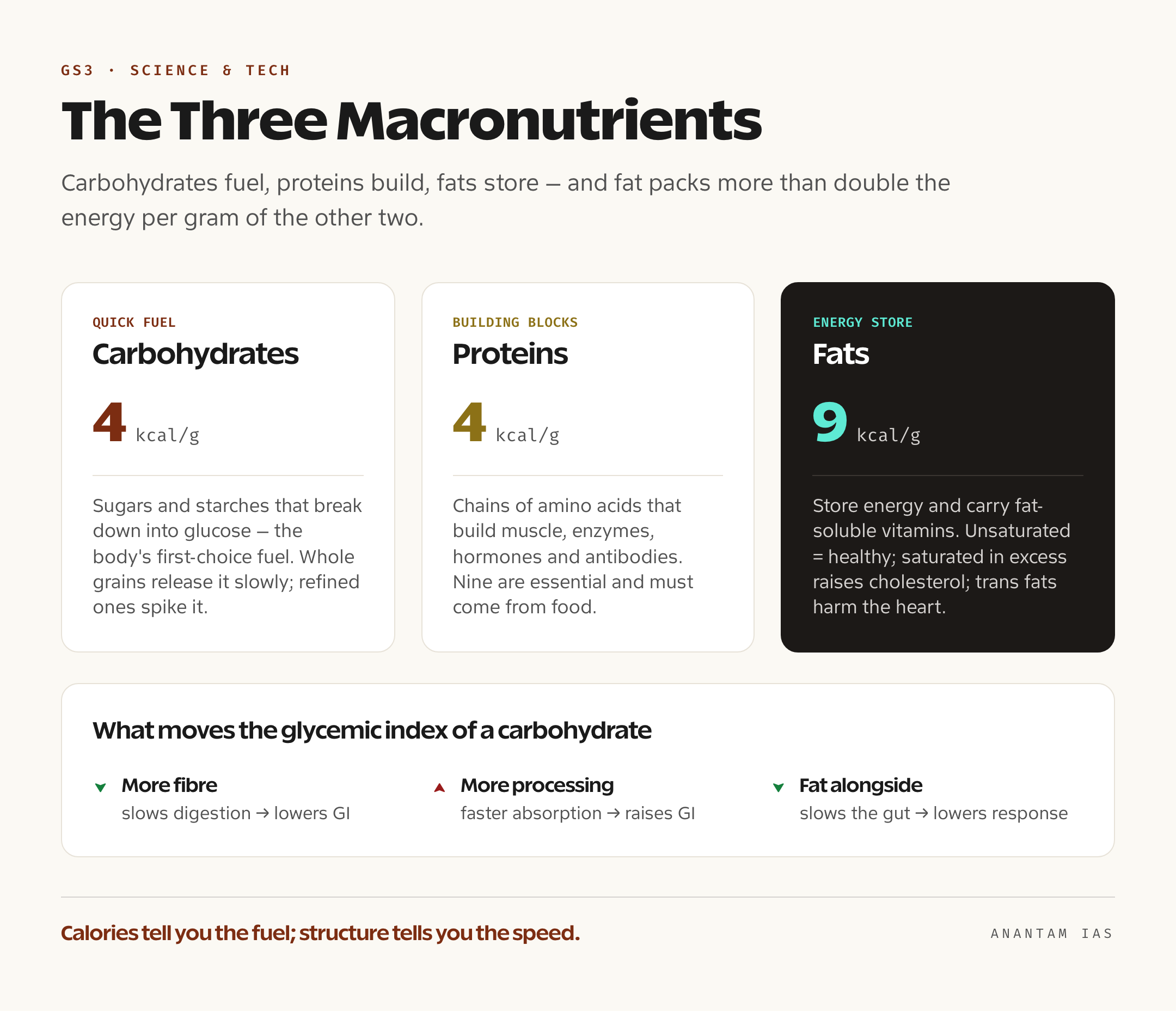
Start with the fuel. The body draws everything it needs from a handful of nutrient classes, and the three it needs in large amounts — measured in grams, not milligrams — are called macronutrients: carbohydrates, proteins and fats. Each does a distinct job, and each releases a different amount of energy when the body burns it. Carbohydrates and proteins yield about 4 kilocalories per gram; fat yields about 9, more than double, which is why fatty foods are so energy-dense. A fourth substance, water, isn’t a nutrient in the energy sense but is just as essential, making up roughly 60 per cent of body weight and the medium in which every reaction happens.
Carbohydrates are the body’s preferred quick fuel — sugars and starches that break down into glucose, the molecule cells burn first. But not all carbohydrates behave alike, and this is where the glycemic index earns its place. The glycemic index, or GI, ranks a carbohydrate food on a scale of 0 to 100 by how fast and how high it pushes blood glucose after you eat it. A high-GI food — white bread, refined sugar, polished rice — is digested and absorbed quickly, sending sugar surging into the blood. A low-GI food releases its glucose slowly and steadily. Three factors decide where a food lands. First, fibre: the more dietary fibre a food carries, the slower it digests, because fibre thickens the contents of the gut and slows the release of sugar — so higher fibre lowers the glycemic index. Second, processing: the more heavily a food is milled, refined or cooked into a soft, broken-down form, the easier it is to digest, which pushes the glycemic index up — whole wheat has a lower GI than white flour made from the same grain. Third, the company the carbohydrate keeps: fat and protein eaten alongside it slow gastric emptying and the absorption of glucose, so they tend to lower the overall glycemic response rather than raise it. That last point trips people up — the instinct is to assume fat speeds everything along, but in the gut it does the opposite, slowing things down. Low-GI eating is now a mainstream tool against type-2 diabetes, a disease India carries in enormous and growing numbers.
Proteins are the body’s building material rather than its fuel of choice. Made of amino acids, they build and repair muscle, skin, enzymes, hormones and the antibodies of the immune system. Of the twenty amino acids the body uses, nine are “essential” — the body can’t make them, so they must come from food. Animal sources such as eggs, milk, fish and meat supply all nine in one package and are called complete proteins; most plant sources are individually incomplete, which is why a vegetarian diet leans on combinations — dal with rice, or rajma with roti — that together cover the full set. Fats, the third macronutrient, are not the villain popular diets make them out to be: they store energy, cushion organs, build cell membranes and carry the fat-soluble vitamins. What matters is the type. Unsaturated fats, found in vegetable oils, nuts and fish, are the healthy kind. Saturated fats, common in ghee, butter and red meat, raise blood cholesterol when eaten in excess. And trans fats — the artificial fats created by hydrogenating oils, long used in vanaspati and bakery products — are the genuinely dangerous ones, so harmful to the heart that India’s food regulator has capped them at 2 per cent in all fats and oils.
The Small but Mighty: Vitamins and Minerals
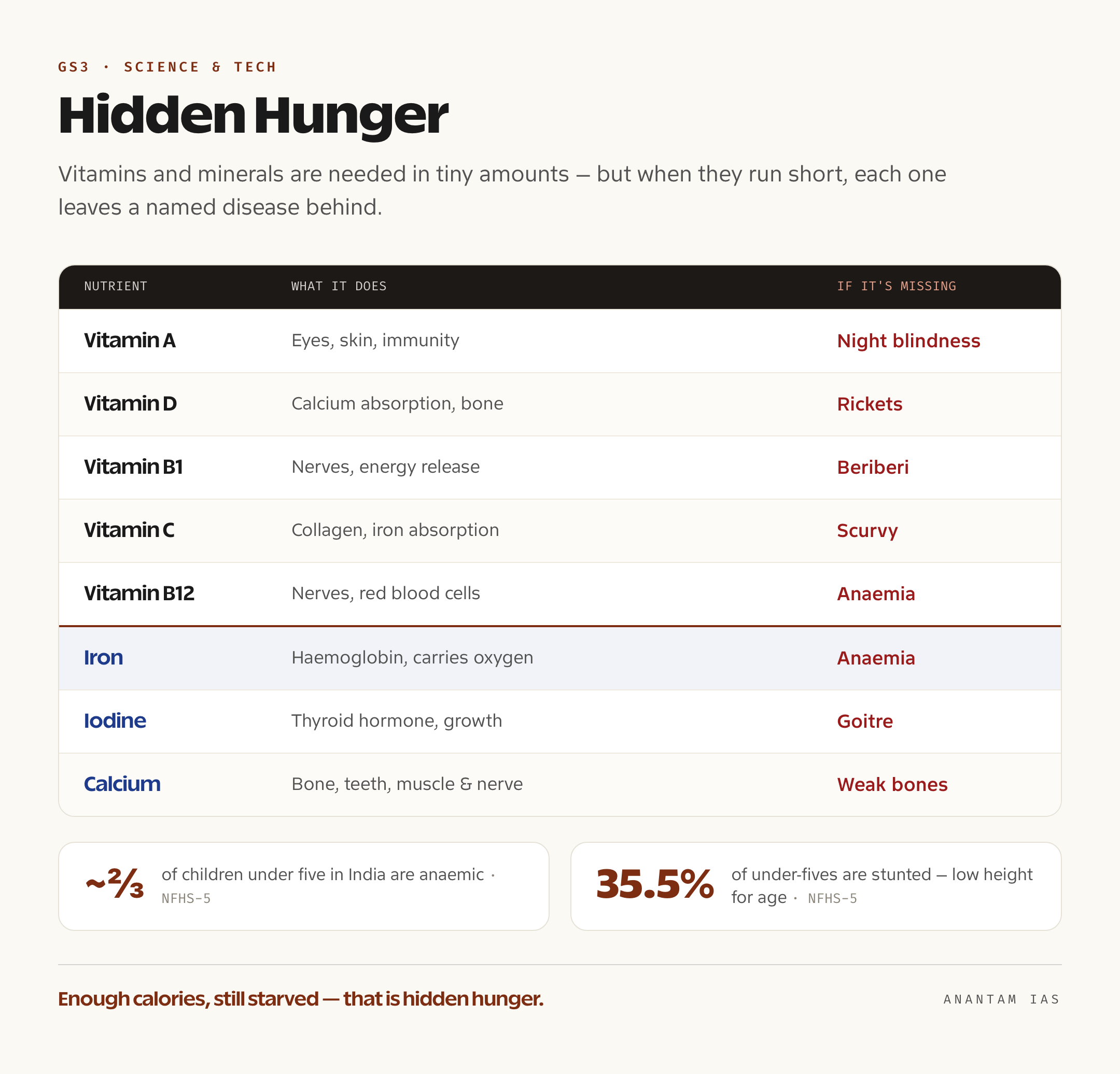
If macronutrients are the bricks and fuel, micronutrients are the tools and catalysts — vitamins and minerals the body needs in tiny amounts, milligrams or even micrograms, but cannot function without. They don’t supply energy themselves. They make the reactions that release energy possible, build bone and blood, run the nervous system, and defend against disease. Their absence does not cause hunger in the ordinary sense, which is exactly why micronutrient shortfalls are called “hidden hunger” — a person can eat enough calories to feel full and still be quietly starved of what keeps the body working.
Vitamins split into two families by what they dissolve in. The fat-soluble vitamins — A, D, E and K — are stored in the body’s fat and liver, so they don’t need daily topping up but can build to toxic levels if massively overdosed. Vitamin A keeps the eyes, skin and immune system healthy; its deficiency causes night blindness and, in severe childhood cases, permanent blindness, which is why India runs a national vitamin-A supplementation programme for young children. Vitamin D, made in the skin under sunlight and also taken from food, lets the body absorb calcium; without it, children develop rickets — soft, bowed bones — and adults develop osteomalacia. Vitamin E is an antioxidant that protects cells, and vitamin K is essential for blood clotting. The water-soluble vitamins — the B-complex group and vitamin C — dissolve in water, aren’t stored well and must be eaten regularly. Among the B vitamins, B1 (thiamine) deficiency causes beriberi, a disease of the nerves and heart historically tied to diets of polished white rice stripped of its vitamin-rich bran; B3 (niacin) deficiency causes pellagra; B12, found almost only in animal foods, is essential for nerves and red blood cells, and its shortage — common among strict vegetarians — causes a form of anaemia. Vitamin C, from citrus fruits and vegetables, builds collagen and aids iron absorption; its classic deficiency, scurvy, once killed sailors on long voyages with bleeding gums and failing wounds.
Minerals are inorganic elements the body draws from food and water, and three deserve special attention in the Indian context because their deficiencies are widespread. Iron is the core of haemoglobin, the molecule that carries oxygen in the blood; too little iron causes iron-deficiency anaemia, which leaves people tired, breathless and unable to concentrate, and which India carries on a staggering scale — well over half of women and young children are anaemic. Iodine is needed to make thyroid hormone, which controls growth and metabolism; its deficiency causes goitre, a swollen thyroid gland, and in pregnancy can cause irreversible mental impairment in the child — a problem India tackled head-on by making the iodisation of edible salt effectively universal, one of the great quiet public-health victories of recent decades. Calcium, with vitamin D and phosphorus, builds and maintains bone and teeth and lets muscles and nerves fire; chronic shortage weakens bones and contributes to osteoporosis in later life. Get these few micronutrients right in an answer — vitamin A and night blindness, vitamin D and rickets, iron and anaemia, iodine and goitre — and you have covered the deficiency diseases examiners reach for most.
Eating Right: The Balanced Diet
Knowing the nutrients is only half the story; the other half is putting them together in the right proportions, which is what a balanced diet means. A balanced diet supplies all the macronutrients and micronutrients in amounts that match a person’s age, sex, activity level and physical state, with no major nutrient in excess or short supply. The rough architecture is familiar: carbohydrates form the bulk of the energy, around half to sixty per cent of calories; fats a smaller share, ideally weighted toward unsaturated kinds; proteins enough to build and repair, with the rest filled by the protective foods — fruits, vegetables, milk and pulses — that carry the vitamins, minerals and fibre. The Indian Council of Medical Research, through its National Institute of Nutrition, issues dietary guidelines that translate this into practical advice for Indian kitchens, recommending a varied plate built on cereals, pulses, plenty of vegetables and fruit, modest oil, and limited salt and sugar.
Two ideas sharpen the concept. The first is that no single food is complete — diversity is the whole point. A diet of only rice fills the stomach but starves the body of protein and micronutrients; a diet of only one food group, however generous, will always leave a gap. This is why nutritionists push the “rainbow plate,” a spread of differently coloured foods, because the colours roughly track the different vitamins and antioxidants they carry. The second idea is that needs change with the person and the moment. A growing child, a pregnant woman, a manual labourer and a sedentary office worker have genuinely different requirements, and the most vulnerable window of all is the first 1,000 days — from conception to a child’s second birthday — when the brain and body are built and when nutritional damage is largely irreversible. That is the scientific reason every serious nutrition programme targets pregnant women, infants and toddlers first: a rupee spent there buys far more lifelong health than the same rupee spent later.
Energy balance is the quieter discipline underneath all of this. The body needs a certain number of calories to keep its basic processes running — the basal metabolic rate — plus more for movement and work. Eat persistently less than you spend and the body wastes; eat persistently more and it stores the surplus as fat, which over years brings obesity, type-2 diabetes and heart disease. The modern Indian table increasingly serves up both problems at once — undernutrition and overnutrition coexisting, sometimes in the same family — which is why “balance” today means guarding against too much as carefully as too little.
When Nutrition Fails: Malnutrition and Its Many Faces
Malnutrition is the umbrella term for what happens when the diet goes wrong, and the World Health Organization uses it to mean deficiencies, excesses or imbalances of nutrients — so it covers both the underfed and the overfed. The starkest form is protein-energy malnutrition, or PEM, where a child simply doesn’t get enough calories and protein. PEM has two severe clinical faces that aspirants should be able to tell apart. Kwashiorkor strikes children who get some calories but far too little protein; the tell-tale sign is swelling, especially a distended belly, caused by fluid leaking from the blood, along with a thin, reddish discolouration of the hair. Marasmus comes from a severe shortage of both calories and protein; the child becomes extremely thin and wasted, “skin and bones,” with the body consuming its own muscle to survive. Both are medical emergencies, and both are measured in the field through standard indicators.
Those indicators are worth knowing because they appear in every official report. Stunting is low height for age — the slow, cumulative damage of chronic undernutrition over months and years, and the hardest to reverse. Wasting is low weight for height — the sharp, recent damage of acute hunger or illness, which can be fatal but can also be treated. Underweight is low weight for age, a composite of the two. India’s most recent National Family Health Survey, NFHS-5, found about 35.5 per cent of children under five stunted, 19.3 per cent wasted and 32.1 per cent underweight — better than a decade earlier, but still among the highest burdens in the world. Running alongside this is hidden hunger, the micronutrient deficiency that doesn’t show on a weighing scale: the same survey found anaemia had actually worsened, affecting roughly two-thirds of children under five and well over half of women of reproductive age, making iron-deficiency anaemia perhaps India’s single most stubborn nutritional problem. And at the other end sits a fast-rising overnutrition burden, with obesity climbing in both men and women — the “double burden” of malnutrition, where a country fights starvation and excess at the same time.
The costs are not abstract. A stunted child is more likely to fall ill, to do worse in school, and to earn less as an adult; an anaemic workforce is a less productive one; a population sliding into obesity and diabetes loads the health system for decades. Economists estimate that malnutrition shaves a measurable slice off national income every year through lost productivity and higher health spending. This is why nutrition is treated not as a welfare nicety but as core economic infrastructure — fixing it is one of the highest-return investments a developing country can make.
How India Is Fighting Back: POSHAN, Mid-Day Meals and Fortification
India’s response is one of the largest nutrition efforts anywhere, and it runs on a few flagship pillars worth naming precisely. The centrepiece is POSHAN Abhiyaan — POSHAN stands for Prime Minister’s Overarching Scheme for Holistic Nourishment — launched in 2018 as a “Jan Andolan,” a people’s movement, to attack stunting, wasting, underweight and anaemia together. It was later folded into a consolidated programme called Saksham Anganwadi and POSHAN 2.0, run by the Ministry of Women and Child Development, which upgrades the country’s network of anganwadi (child-care) centres and uses technology — a mobile tracking app for real-time monitoring of every beneficiary — to deliver supplementary nutrition, health check-ups and counselling. In the 2025-26 budget the government earmarked roughly ₹21,960 crore for Saksham Anganwadi and POSHAN 2.0, part of a Women and Child Development allocation of around ₹26,900 crore, and the programme reaches well over 8 crore children along with pregnant and lactating women and adolescent girls.
The second great pillar is the mid-day meal, now branded PM POSHAN — Pradhan Mantri Poshan Shakti Nirman. It is the world’s largest school-feeding programme, serving a free cooked lunch to around 11.8 crore children in roughly 11.2 lakh government and government-aided schools from pre-primary through class eight. Its genius is that it does two jobs with one meal: it adds nutrition to growing bodies and it pulls children into classrooms and keeps them there, lifting attendance and easing the classroom hunger that wrecks learning. Run by the Ministry of Education, it carries a central outlay in the tens of thousands of crores over the current five-year cycle, and recent updates have nudged states to use fortified ingredients and trim cooking-oil use in line with healthier-eating advice.
Behind both schemes sits a quieter, cheaper and remarkably effective strategy: food fortification — adding micronutrients to staple foods that people already eat. India’s universal salt iodisation, which turned goitre from a mass affliction into a rarity, is the textbook success. The current frontier is fortified rice: the government is distributing rice fortified with iron, folic acid and vitamin B12 through the public distribution system and the school and anganwadi programmes, aiming squarely at the anaemia that supplementation alone has failed to budge. Mandatory fortification standards now cover salt, edible oil, milk, wheat flour and rice with a recognisable “+F” logo. None of this is a finished job — the persistence of anaemia, patchy delivery, leakage and the new pressure of obesity all remain real challenges. But the architecture is sound: target the first 1,000 days, feed children at school, fortify the staples everyone eats, and track delivery with data. The science of nutrition and the policy to apply it have, for once, lined up — and the task now is execution at scale.
For Your Mains Answer
Human nutrition is primarily a General Studies Paper 3 topic under Science and Technology — its everyday applications and developments in health, food and biotechnology — and it overlaps heavily with GS Paper 2 on health, hunger and the schemes that deliver welfare. Questions can come at it from either side: the pure science of nutrients and deficiency diseases, or the policy of tackling malnutrition through POSHAN, PM POSHAN and fortification. It also feeds the Essay paper on themes of hunger, human capital and inclusive development. The skill that scores is the one this article models — explain the biology cleanly, then anchor it with a few exact Indian figures and a named scheme.
How to Build the Answer
Move from the body to the policy in a clear chain. Define nutrition and split it into macronutrients (energy and building blocks) and micronutrients (the catalysts), using one sharp example each — the glycemic index for carbohydrates, anaemia for iron. Then turn to what goes wrong: malnutrition as both under- and overnutrition, with PEM, stunting, wasting and hidden hunger named precisely. Close on India’s response — POSHAN 2.0, PM POSHAN, fortification — and finish with a forward-looking judgement on the gap between sound design and uneven delivery. That arc — nutrients, balance, failure, response, verdict — fits almost any nutrition or hunger question.
Common Mistakes to Avoid
Don’t say fat speeds up glucose absorption — it slows gastric emptying and lowers the glycemic response; that is the precise, examinable point. Don’t muddle kwashiorkor (protein deficiency, swelling) with marasmus (calorie-and-protein deficiency, wasting). Don’t treat malnutrition as only undernutrition — name the double burden with obesity rising. And don’t list schemes without their ministries: POSHAN 2.0 sits under Women and Child Development, PM POSHAN under Education.
A Compact Answer Spine
Nutrition = macronutrients (carbs 4 kcal/g, protein 4, fat 9) + micronutrients (vitamins, minerals) → glycemic index: fibre lowers it, processing raises it, fat slows absorption → deficiency diseases: vitamin A/night blindness, D/rickets, B1/beriberi, C/scurvy, iron/anaemia, iodine/goitre → malnutrition: PEM (kwashiorkor vs marasmus), stunting 35.5%, wasting 19.3%, anaemia ~two-thirds of under-fives, plus rising obesity (double burden) → response: POSHAN 2.0 (₹21,960 cr, WCD), PM POSHAN (11.8 cr children, Education), fortification (iodised salt, fortified rice) → verdict: sound design, delivery is the test.
Diagram or Flowchart Idea
Sketch a simple plate divided into its food groups beside a small two-column box pairing each major vitamin/mineral with its deficiency disease. Or draw a “double burden” diagram — an undernutrition arm (stunting, anaemia) and an overnutrition arm (obesity, diabetes) branching from a single malnutrition root. Either communicates the whole idea at a glance and is fast to draw.
A Balanced-Conclusion Line
A line that lands the marks: “India’s nutrition challenge is no longer only about putting enough food on the plate but about putting the right nutrients there — and its mission, from fortified rice to the mid-day meal, will be judged not on its budgets but on whether it reaches the first 1,000 days where the damage is done.”
How to Use Data Without Cramming
You need only a handful of anchors: 4-4-9 kilocalories for carbs-protein-fat; stunting ~35.5 per cent and anaemia ~two-thirds of under-fives from NFHS-5; PM POSHAN’s 11.8 crore children; and POSHAN 2.0’s roughly ₹21,960 crore. Attribute them plainly — “as NFHS-5 found” — rather than scattering numbers loose.
FAQ
What is the glycemic index, and what raises or lowers it? The glycemic index ranks a carbohydrate food from 0 to 100 by how fast and how high it pushes blood glucose after eating. Higher dietary fibre lowers a food’s glycemic index because fibre slows digestion; heavier processing or refining raises it, because broken-down food is absorbed faster; and fat or protein eaten alongside lowers the overall response by slowing how quickly the stomach empties. Low-GI eating helps manage type-2 diabetes.
What is the difference between macronutrients and micronutrients? Macronutrients — carbohydrates, proteins and fats — are needed in large amounts (grams) and supply energy and building material; carbs and protein give about 4 kilocalories per gram, fat about 9. Micronutrients — vitamins and minerals — are needed in tiny amounts (milligrams or micrograms) and don’t supply energy but enable the reactions that do. A shortage of micronutrients despite enough calories is called hidden hunger.
What are the main vitamin and mineral deficiency diseases? Vitamin A deficiency causes night blindness; vitamin D, rickets in children; vitamin B1 (thiamine), beriberi; vitamin B3, pellagra; vitamin C, scurvy; and vitamin B12, a form of anaemia. Among minerals, iron deficiency causes anaemia, iodine deficiency causes goitre, and chronic calcium shortage weakens bones. These are the deficiency diseases asked about most often.
What are India’s main schemes against malnutrition? The flagship is POSHAN Abhiyaan, now run as Saksham Anganwadi and POSHAN 2.0 under the Ministry of Women and Child Development, which delivers supplementary nutrition and counselling through anganwadi centres. PM POSHAN, the mid-day meal scheme under the Ministry of Education, feeds around 11.8 crore schoolchildren a free cooked lunch. Food fortification — universal iodised salt and now fortified rice with iron and B12 — is the third major pillar.
Practice Questions
Prelims MCQs
- With reference to the glycemic index of foods, which of the following statements is correct?
(a) Higher fibre content lowers the glycemic index
(b) Heavy processing of a food lowers its glycemic index
(c) Fat always speeds up the absorption of glucose
(d) The glycemic index measures total calories in a food
Answer: (a) Fibre slows digestion and lowers the glycemic index; processing raises it; fat slows gastric emptying and glucose absorption rather than speeding it. - Which of the following correctly pairs a vitamin with the deficiency disease it causes?
(a) Vitamin A — scurvy
(b) Vitamin C — rickets
(c) Vitamin D — rickets
(d) Vitamin B1 — night blindness
Answer: (c) Vitamin D deficiency causes rickets in children; vitamin A causes night blindness, vitamin C causes scurvy, and vitamin B1 (thiamine) causes beriberi. - Consider the following about energy from macronutrients. Which statement is correct?
(a) Fat yields about the same energy per gram as carbohydrate
(b) Fat yields about 9 kcal per gram, more than double that of carbohydrate or protein
(c) Protein yields the most energy per gram
(d) Carbohydrate yields about 9 kcal per gram
Answer: (b) Carbohydrates and proteins yield about 4 kilocalories per gram each, while fat yields about 9, making fatty foods far more energy-dense. - Which of the following best distinguishes kwashiorkor from marasmus?
(a) Kwashiorkor results from severe deficiency of both calories and protein, marasmus from protein alone
(b) Kwashiorkor results from protein deficiency with some calories and shows swelling, while marasmus results from severe calorie-and-protein deficiency and shows extreme wasting
(c) Both are forms of overnutrition
(d) Marasmus is caused only by vitamin deficiency
Answer: (b) Kwashiorkor (protein deficiency, oedema/swelling) and marasmus (severe calorie-and-protein deficiency, wasting) are the two severe faces of protein-energy malnutrition. - Which Indian scheme is the world’s largest school-feeding programme and is administered by the Ministry of Education?
(a) POSHAN Abhiyaan 2.0
(b) PM POSHAN (mid-day meal scheme)
(c) Integrated Child Development Services only
(d) National Food Security Mission
Answer: (b) PM POSHAN (Pradhan Mantri Poshan Shakti Nirman), the mid-day meal scheme run by the Ministry of Education, serves about 11.8 crore children; POSHAN 2.0 sits under Women and Child Development.
Mains Practice Questions
- Distinguish between macronutrients and micronutrients, and explain why micronutrient deficiencies are described as “hidden hunger.” Illustrate with India’s anaemia burden. (15 marks, 250 words)
- “Fibre lowers the glycemic index of a food while processing raises it.” Explain the concept of the glycemic index and discuss its relevance to the management of type-2 diabetes in India. (10 marks, 150 words)
- Examine the concept of the “double burden of malnutrition” in India, and discuss why undernutrition and obesity increasingly coexist. (15 marks, 250 words)
- Critically evaluate India’s flagship nutrition interventions — POSHAN Abhiyaan 2.0, PM POSHAN and food fortification — in tackling stunting and anaemia. (15 marks, 250 words)
- “A balanced diet is less about quantity than about proportion and timing.” Discuss with reference to the importance of the first 1,000 days of a child’s life for lifelong health. (15 marks, 250 words)