Human-Wildlife Conflict in India: Causes, Impacts and Solutions (UPSC)
UPSC guide to human-wildlife conflict: causes, elephant-leopard-tiger conflict, National Wildlife Action Plan 2017-31, solutions and 2024-26 updates.
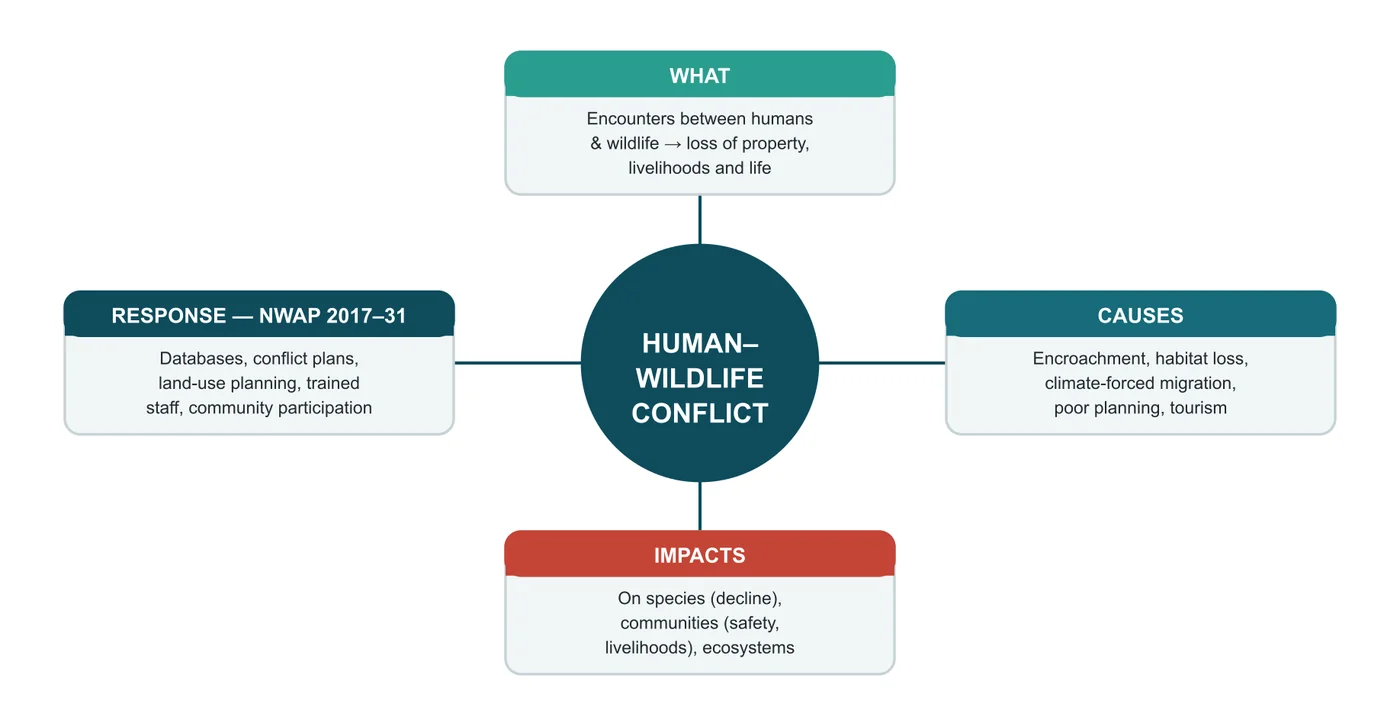
Human-wildlife conflict (HWC) refers to any interaction between people and wild animals that results in negative outcomes — loss of human life, livestock, crops, property or wildlife itself. In India, around 500 people are killed by elephants every year, over 100 by tigers and leopards combined, and tens of thousands of hectares of standing crops are lost. Over 100 elephants die annually due to train hits, electrocution, poisoning and retaliation. HWC has become one of the most pressing conservation and governance challenges of the 21st century.
The problem is no longer confined to forest fringe villages. Leopards roam Mumbai's Sanjay Gandhi National Park fringe, Bengaluru suburbs and Pune housing societies. Elephants break into paddy fields in Odisha, Jharkhand and West Bengal. Tigers cross state borders into human-dominated mosaics in the Terai and central India.
Why Conflict Is Rising
Human Population and Settlement Pressure
Settlements continue to spring up at the edges of protected areas. People encroach forest land for farming, fuel wood and cattle grazing, depleting scarce natural resources inside and around forests.
Agricultural Expansion
When farms push right up to forest boundaries, wildlife finds easy, calorie-rich food — paddy, sugarcane, maize, banana — just outside the forest. Elephants in particular are drawn to cultivated crops.
Limited Protected Area Coverage
Only about 10% of the world's land surface is under formal protection. In India, roughly 35% of tiger ranges lie outside protected areas, in reserved forest, revenue land and community forest. Large carnivores are forced to share landscapes with people.
Rapid and Unplanned Urbanisation
Forest diversion for highways, transmission lines, industrial parks and townships has fragmented wildlife habitat.
Infrastructure in Forest Areas
Electrified fences, rail lines, mines and roads cut through forest mosaics. Kerala, Assam, Odisha, West Bengal and Uttarakhand see regular elephant deaths on rail tracks.
Destruction of Corridors
Elephants, tigers and gaur need functional corridors between source habitats. Of the 101 elephant corridors identified in India, a majority are under pressure from development.
Invasive Alien Species
Forests overrun by Lantana camara, Prosopis juliflora and Mikania micrantha lose native forage. Herbivores exit forest edges in search of food and enter villages.
Climate Change
Changing rainfall patterns, longer dry spells and shifting vegetation alter prey availability. Predators and livestock increase their spatial overlap. Droughts push wildlife out of forests; floods concentrate them in smaller patches.
India's Most Conflicted Species
| Species | Main conflict zones | Primary issue |
|---|---|---|
| Asian elephant | Odisha, Jharkhand, WB, Assam, Karnataka, Kerala | Crop raiding, human deaths, train hits |
| Tiger | Central India, Terai, Sundarbans | Cattle lifting, rare human deaths |
| Leopard | Near-urban landscapes across India | Livestock, occasional attacks on humans |
| Sloth bear | Karnataka, Madhya Pradesh, Odisha | Attacks on forest-dependent people |
| Wild boar | Entire country | Crop damage |
| Nilgai | North and central India | Crop damage |
| Monkey (Rhesus, Bonnet) | Urban and peri-urban | Property, food, occasional aggression |
Why India Sees More Conflict Than Other Democracies
- In most developed countries, wildlife populations are actively managed, including regulated culling. Hunting is legal and functions as population control.
- In developing countries, people often take matters into their own hands when the state is absent — retaliatory killing, poisoning, electrocution.
- The old informal rule — "boars eat crops, people eat boars" — gave farmers tolerance. India's Wildlife Protection Act bars local hunting, while the state does not systematically cull problem animals either.
- India's Section 11 of the Wildlife Protection Act permits the Chief Wildlife Warden to authorise killing a "dangerous animal" — but this is rare and reactive.
- The result: a tolerance vacuum that breeds resentment and illegal action.
Economic and Social Costs
- Crop losses estimated at thousands of crores annually; wild boar and elephant together top the list.
- Livestock predation causes recurring losses for rural pastoralists.
- Compensation schemes exist but are often slow, inadequate and bureaucratic.
- Psychological stress and out-migration from affected villages.
- Retaliatory killing undermines conservation gains.
Policy Framework
National Wildlife Action Plan 2017–2031
The third National Wildlife Action Plan places HWC mitigation at the centre of Indian conservation strategy. Key directions:
- Document all conflict ranges — create national, regional and state HWC databases on conflict frequency, damage, fatalities and wildlife deaths.
- Species-specific and region-specific mitigation plans drafted jointly by forest managers, scientists, community leaders and communication experts.
- Trained, equipped rapid-response teams in State Forest Departments for dangerous animal situations.
- Centre of Excellence for HWC mitigation under MoEFCC.
- Education and awareness campaigns to reduce hostility.
- Community participation in mitigation, including training and conflict-area communication.
MoEFCC Advisory 2021
Declared HWC a "disaster" for compensation purposes, allowing use of SDRF/NDRF funds.
Project Elephant (1992), Project Tiger (1973)
Provide the institutional backbone for large-mammal landscapes.
Wildlife Protection Act 1972
Schedule I species receive highest protection. Section 11 allows exceptional lethal removal.
Mitigation Approaches
- Physical barriers: solar fences, elephant-proof trenches, stone walls.
- Early warning systems: SMS-based alerts, camera traps, AI-enabled cameras on trains, thermal drones.
- Habitat restoration inside reserves — invasive removal, water holes, prey augmentation.
- Corridor securement — underpasses, overpasses, land acquisition.
- Compensation reforms — quick, mobile-based claims, ex-gratia for human deaths.
- Livestock insurance to reduce retaliation.
- Crop insurance and decoy crops to deflect elephants and wild boars.
- Translocation for problem leopards and tigers — carefully.
- Behavioural research to understand specific problem animals.
- Community guardians — local youth trained as rapid response.
Way Forward
- Landscape approach replacing protected-area-only thinking.
- Statutory backing for corridor protection via a Conservation Reserve / Community Reserve framework.
- Integrate HWC into rural development schemes (MGNREGA for trenches, PM Awas for elephant-proof housing).
- Nationwide HWC dashboard with real-time data.
- Permit regulated culling of wild boar in declared problem areas — already done by some states under Section 62.
- Insurance and compensation reforms — direct transfer within 30 days.
- Research on climate and HWC — a growing frontier.
Latest Developments (2024–26)
Updated context:
- National Human-Wildlife Conflict Mitigation Strategy and Action Plan (2021) is being updated with a 2025 revision focused on AI-based early warning and community guardians.
- MoEFCC advisory 2024 directs states to update digital compensation portals.
- Tiger census 2022 (published 2023) recorded 3,682 tigers — a record; but also a signal of rising outside-PA populations and conflict potential.
- Elephant census 2023–24 reports ~27,000 Asian elephants in India, down slightly from 2017.
- AI-enabled elephant intrusion alerts using camera traps on rail tracks have been expanded in Odisha and Assam since 2024.
- Supreme Court in 2024 directed states to strengthen corridor protection in central India.
- Kerala's rubber plantations have emerged as new hot spots for elephant conflict; state moved in 2024–25 to declare specific zones as conflict management areas.
- Wayanad human deaths (2024) triggered national debate on wild elephant management.
UPSC Relevance
Paper mapping: GS Paper III — Environment, Biodiversity, Conservation; Disaster Management.
Prelims pointers:
- National Wildlife Action Plan 2017–2031 is the third such plan.
- Section 11 of Wildlife Protection Act 1972 permits exceptional lethal removal.
- India has ~101 elephant corridors identified.
- Tiger census 2022: 3,682 tigers.
- India hosts around 60% of the world's wild Asian elephants.
- Project Tiger launched 1973; Project Elephant launched 1992.
- 35% of tiger range in India lies outside PAs.
- MoEFCC declared HWC a disaster for compensation in 2021.
Mains angles:
- "Discuss the causes of rising human-wildlife conflict in India and evaluate mitigation strategies."
- "Critically examine the National Wildlife Action Plan 2017–31 in the context of conflict management."