Important Articles of the Indian Constitution: UPSC Guide
The important articles of the Indian Constitution cover rights, duties, Parliament, states, judiciary, emergency and amendments — a focused UPSC guide.
Introduction
Knowing the important articles of the Indian Constitution is non-negotiable for the UPSC Civil Services examination. Adopted on 26 November 1949 and enforced from 26 January 1950, the Constitution originally contained 395 articles in 22 parts and 8 schedules; today it stands at over 470 articles in 25 parts and 12 schedules after decades of amendments. Rather than memorising every provision, aspirants need a working map of the most frequently tested articles — those covering fundamental rights, state policy, Parliament, the judiciary, federal relations, elections, emergencies and amendment procedures. This guide organises those articles by theme for both prelims recall and mains analysis.
Structure of the Constitution
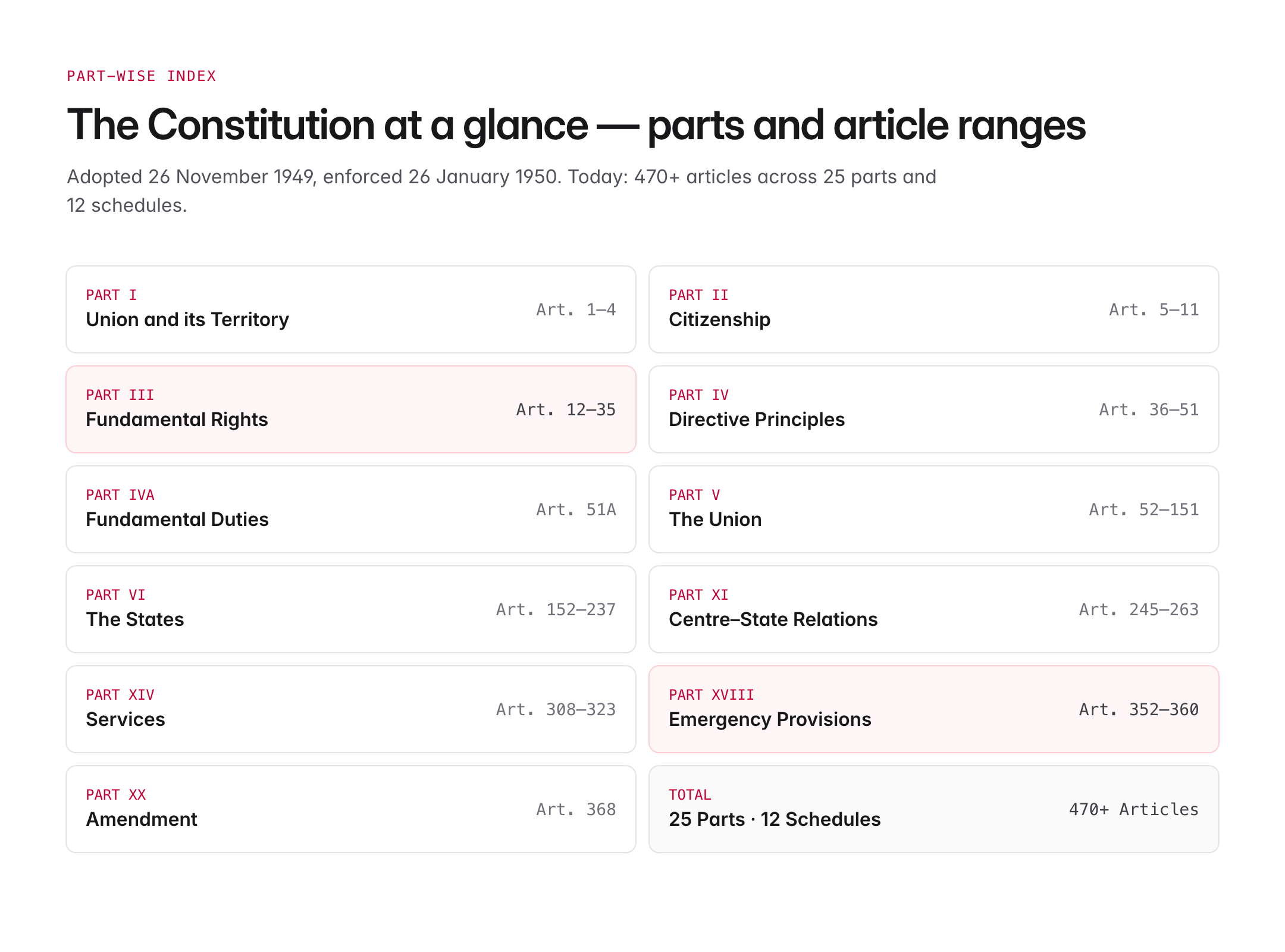
The Constitution is organised into parts, each dealing with a broad theme:
| Part | Subject | Article Range |
|---|---|---|
| I | Union and its Territory | 1–4 |
| II | Citizenship | 5–11 |
| III | Fundamental Rights | 12–35 |
| IV | Directive Principles | 36–51 |
| IVA | Fundamental Duties | 51A |
| V | The Union | 52–151 |
| VI | The States | 152–237 |
| XI | Centre-State Relations | 245–263 |
| XIV | Services | 308–323 |
| XVIII | Emergency Provisions | 352–360 |
| XX | Amendment | 368 |
Treat this part-wise table as your first-level index; specific articles hang from each part.
Fundamental Rights (Articles 12–35)
Part III contains the Fundamental Rights, enforceable against the state. Core articles include:
- Article 14 — Equality before law and equal protection of laws
- Article 15 — Prohibition of discrimination on grounds of religion, race, caste, sex, place of birth
- Article 16 — Equality of opportunity in public employment
- Article 17 — Abolition of untouchability
- Article 19 — Six freedoms including speech, assembly, association, movement, residence, profession
- Article 21 — Protection of life and personal liberty (the source of many derived rights)
- Article 21A — Right to free and compulsory education for children aged 6–14
- Article 22 — Protection against arrest and detention
- Article 23 — Prohibition of human trafficking and forced labour
- Article 24 — Prohibition of child labour in hazardous employment
- Article 25–28 — Freedom of religion
- Article 29–30 — Cultural and educational rights of minorities
- Article 32 — Right to constitutional remedies, called the heart and soul of the Constitution by Ambedkar
Directive Principles and Duties (Articles 36–51, 51A)
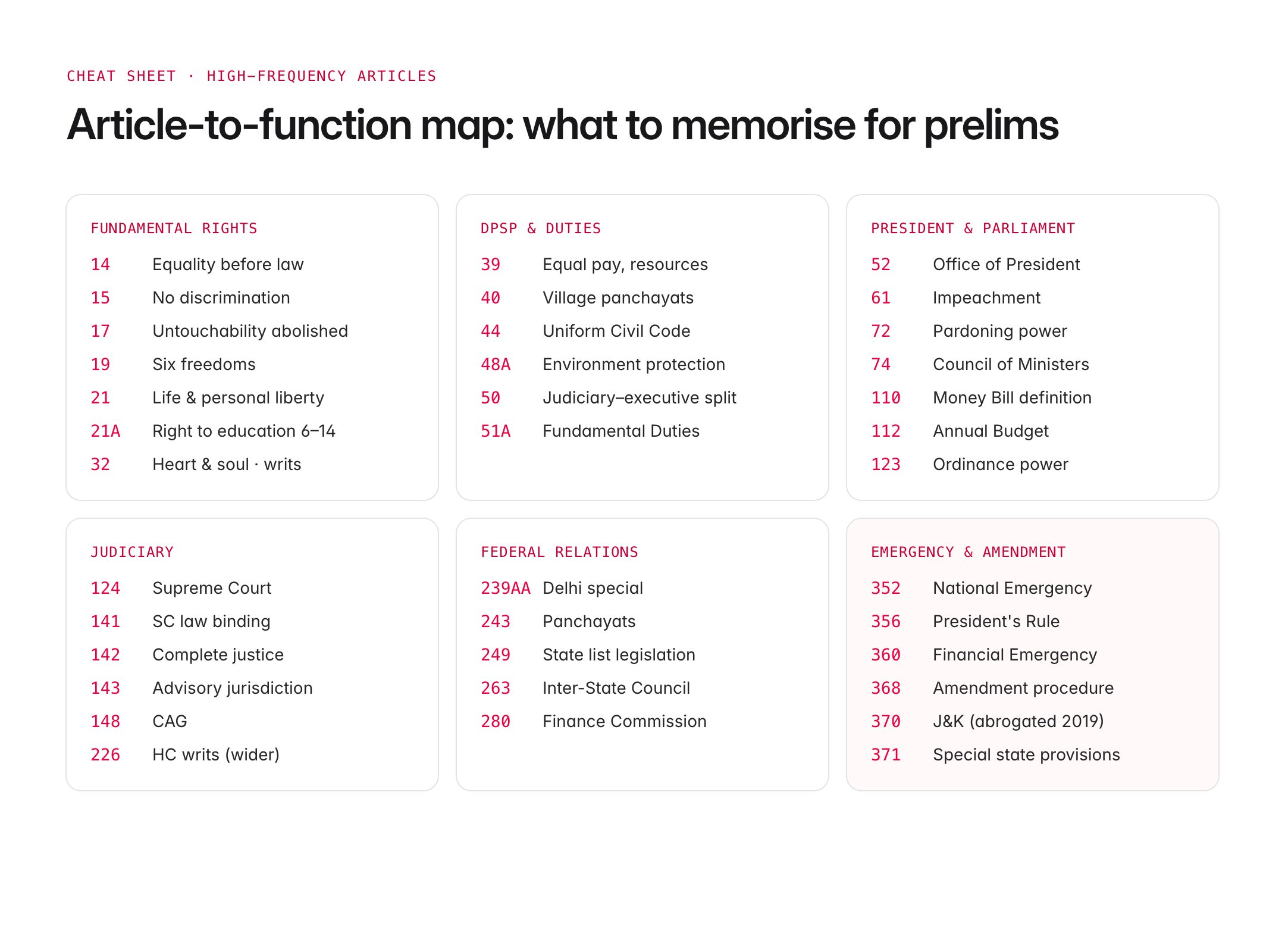
Part IV lists non-justiciable guidelines for governance:
- Article 39 — Principles of policy including equal pay, distribution of resources
- Article 40 — Organisation of village panchayats
- Article 41–43 — Right to work, living wage, humane conditions
- Article 44 — Uniform Civil Code
- Article 45 — Early childhood care
- Article 48A — Protection of environment and wildlife
- Article 50 — Separation of judiciary from executive
- Article 51 — Promotion of international peace
The Fundamental Duties (Article 51A) were added by the 42nd Amendment in 1976 based on the Swaran Singh Committee's recommendations.
Union Government and Parliament (Articles 52–151)
Key articles for prelims and mains:
- Article 52 — Office of the President
- Article 61 — Impeachment of the President
- Article 72 — Pardoning powers of the President
- Article 74 — Council of Ministers to aid and advise
- Article 79 — Constitution of Parliament
- Article 80 — Composition of Rajya Sabha
- Article 81 — Composition of Lok Sabha
- Article 110 — Definition of Money Bill
- Article 112 — Annual Financial Statement (Budget)
- Article 123 — Presidential Ordinance power
- Article 143 — Advisory jurisdiction of the Supreme Court
- Article 148 — Comptroller and Auditor General
- Article 149 — Duties of the CAG
States, Federalism and Centre-State Relations
- Article 153–167 — Governor and state executive
- Article 168–212 — State legislatures
- Article 213 — Governor's ordinance power
- Article 239AA — Special provisions for Delhi
- Article 243 to Article 243ZG — Panchayats and municipalities
- Article 245–255 — Distribution of legislative powers
- Article 249 — Parliament's power to legislate on State List in national interest
- Article 263 — Inter-State Council
- Article 280 — Finance Commission
Judiciary, Emergency and Amendment
- Article 124 — Establishment of the Supreme Court
- Article 141 — Law declared by Supreme Court binding on all courts
- Article 142 — Supreme Court's power to do complete justice
- Article 226 — High Court's writ jurisdiction (wider than Article 32)
- Article 352 — National Emergency
- Article 356 — President's Rule in states
- Article 360 — Financial Emergency
- Article 368 — Amendment procedure
- Article 370 — Special status provisions (effectively abrogated in 2019)
- Article 371 — Special provisions for several states
Why These Articles Matter
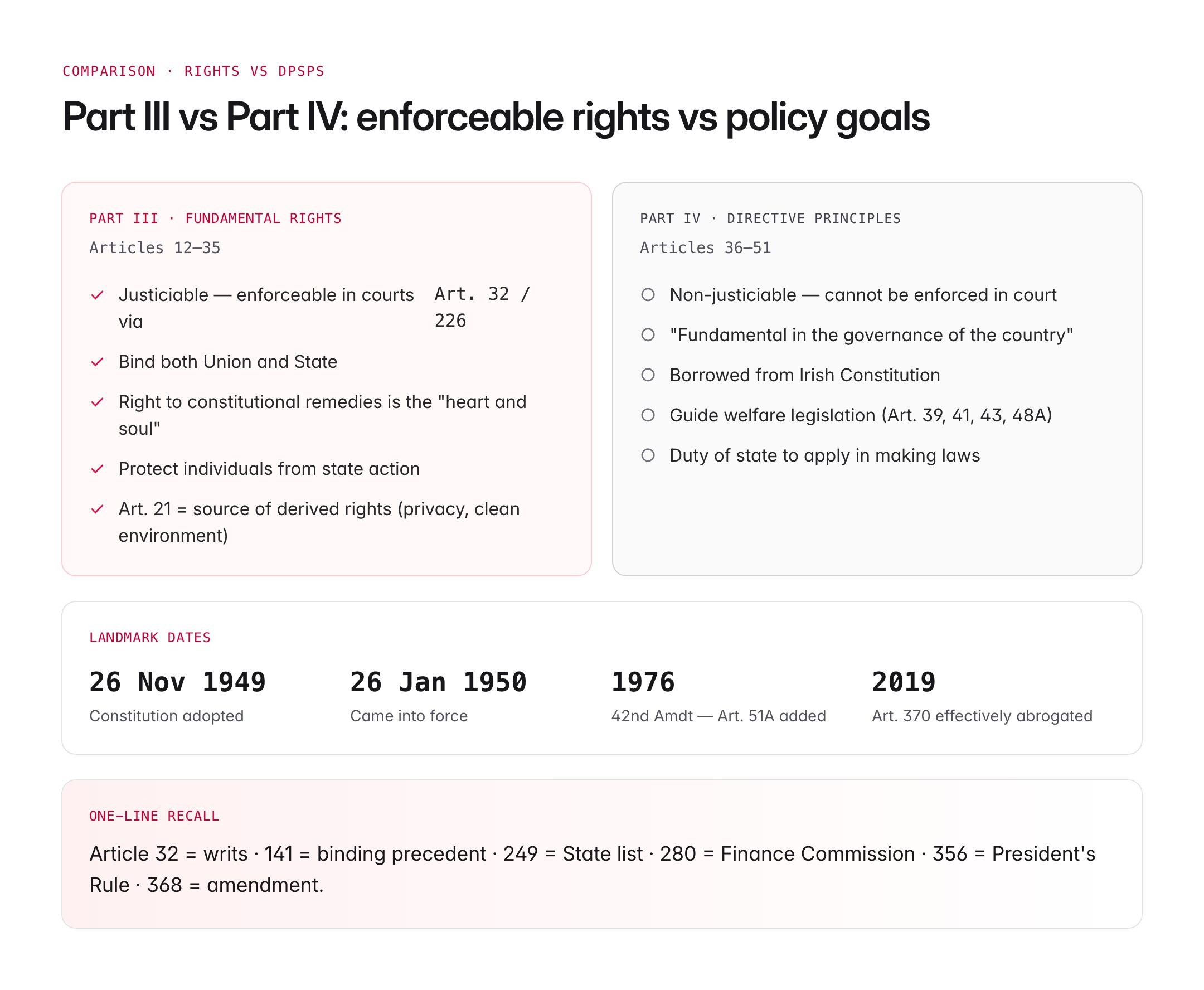
The listed articles together define how power is distributed, how rights are protected, and how change is managed. They recur in prelims not as abstract numbers but as functional identifiers — Article 32 means writs, Article 356 means President's Rule, Article 368 means amendment.
UPSC Relevance
Prelims focus: Expect direct match-the-article questions — e.g., which article deals with CAG (148), which with Finance Commission (280), which with Money Bill definition (110). Also expect date and part-based questions.
Mains GS-II angle: Articles underpin essays on separation of powers, judicial activism (Articles 32, 141, 142), centre-state relations (249, 356), federalism, and rights-based governance. Link DPSPs to welfare state discussions.
Sample PYQ angle: UPSC has asked which article of the Constitution was called its heart and soul (32), which articles deal with emergency (352, 356, 360), and conceptual questions linking Article 21 to derived rights such as privacy and clean environment. A crisp article-to-function map is the most efficient way to prepare.