India–EU Free Trade Agreement: Stakes, Sticking Points and Significance (UPSC IR)
After nearly two decades of stop-start talks, India and the European Union concluded their Free Trade Agreement on 27 January 2026. Here is what's actually in it, what India held firm on, and why it matters for trade policy and strategic autonomy.
On Republic Day weekend in 2026, in front of the cameras at Hyderabad House in New Delhi, Prime Minister Narendra Modi and European Commission President Ursula von der Leyen finally said the word everyone in trade policy had stopped expecting to hear: done. On 27 January 2026, after talks that began in 2007, collapsed in 2013, and were painstakingly relaunched in 2022, India and the 27-nation European Union concluded their Free Trade Agreement. The European Commission called it the largest such deal either side had ever signed. For a negotiation that had become a byword for missed deadlines, that was no small thing.
But a concluded deal is not yet a deal in force, and that gap is exactly where the interesting part sits. The FTA still has to be ratified — a year-long process on the EU side — and a companion Investment Protection Agreement is still being negotiated. So this is a finished treaty with an unfinished frame around it. For India, the agreement matters because the EU is one of its largest trading partners, because it locks in market access for the labour-intensive exports that actually create jobs, and because it is the clearest test yet of whether India can liberalise on its own terms — opening up where it gains, holding firm where it is vulnerable. That balance is the whole story.
Two Decades to the Signing Table
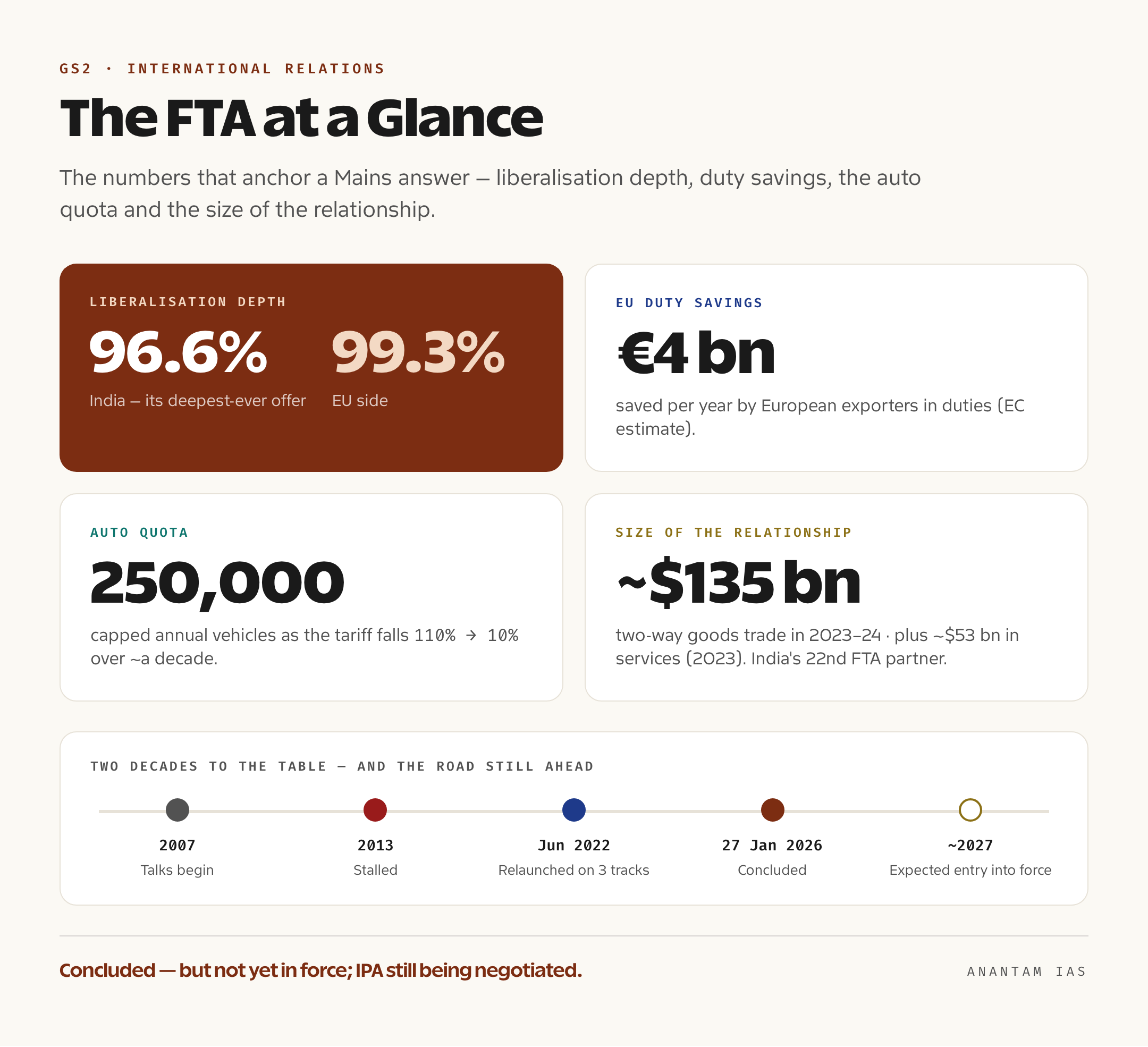
To understand what was achieved, you have to understand how hard it was to achieve. India and the EU first sat down in 2007 to negotiate what was then called a Broad-based Trade and Investment Agreement. By 2013 the talks had simply stopped — stuck on the same fault lines that would dog every later round: India’s high tariffs on cars and wine, the EU’s demands on agriculture and data, and a deep disagreement over how far each side would open its markets. The file gathered dust for nearly a decade.
It came back to life on 17 June 2022, when the two sides relaunched negotiations — but smartly split the problem into three parallel tracks rather than one unwieldy package. The first is the Trade and Investment Agreement, the FTA proper, covering goods, services and the rulebook around them. The second is a separate Investment Protection Agreement (IPA), which governs how each side treats the other’s investors and how disputes get settled. The third is an agreement on Geographical Indications (GIs) — the legal protection that ties a product name to its place of origin, so that “Darjeeling tea” or “Champagne” can’t be slapped on an imitation. Splitting the talks this way meant a deadlock on investment arbitration wouldn’t hold the entire goods deal hostage.
In February 2025 the political leadership did what political leadership does when negotiators are circling: it set a hard deadline. Modi and von der Leyen committed to concluding the FTA by the end of 2025, and the College of Commissioners — the EU’s full cabinet of commissioners — made an unusual collective visit to New Delhi early that year to signal how serious Brussels was. The end-2025 target slipped by a few weeks, but only just. The deal landed on 27 January 2026. The lesson, for anyone studying how big trade deals actually get done, is that the technical work happens in the rooms but the closing happens at the top — a deadline set by leaders is what forces the final compromises.
What’s in the Deal — and What India Kept Out
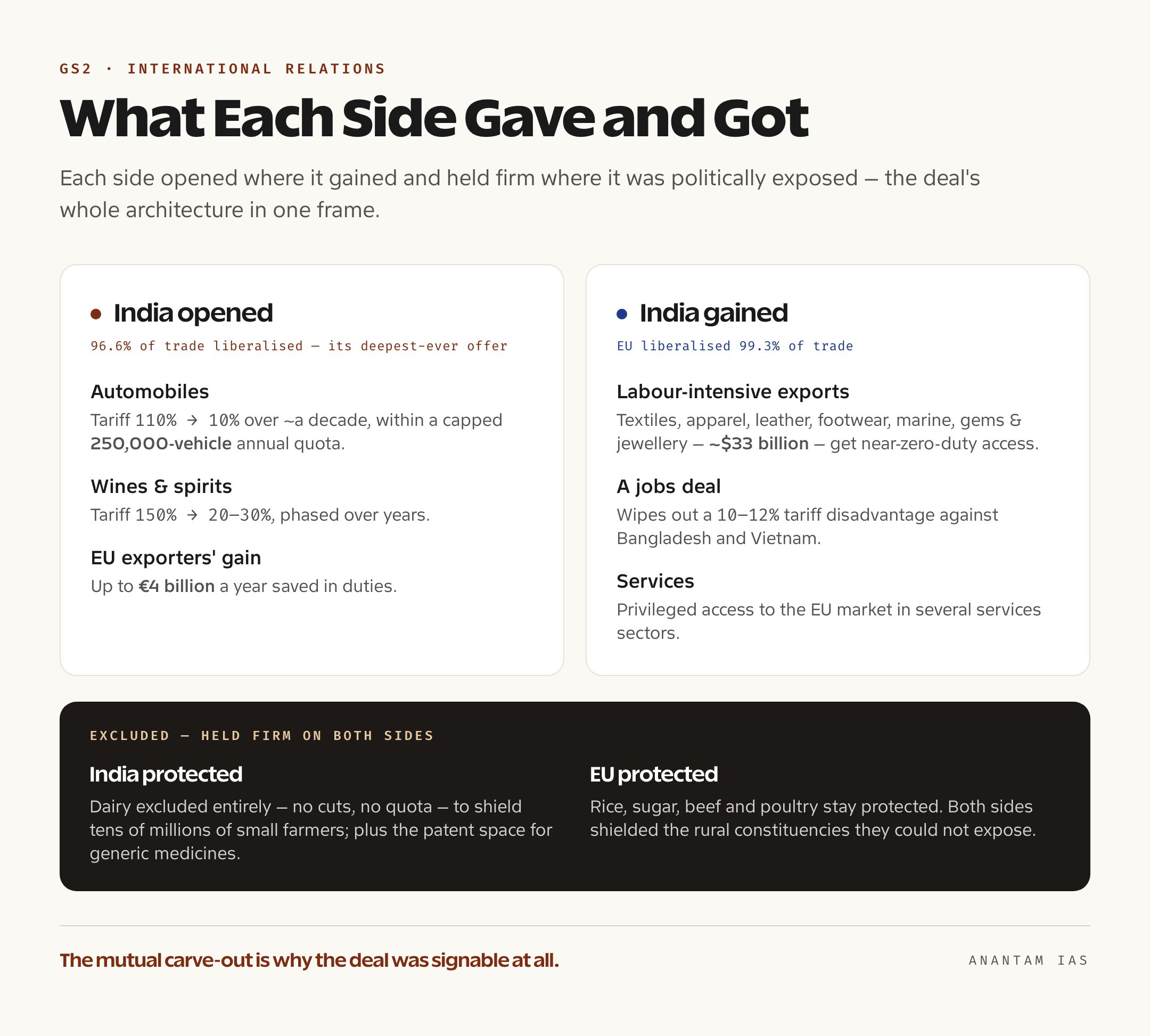
So what did each side actually agree to? Start with the headline numbers, because they frame everything else. India committed to liberalise tariffs on 96.6% of its trade with the EU — the most ambitious opening it has ever offered any trading partner — while the EU went further still, to 99.3%. The European Commission estimates the deal will save European exporters up to €4 billion a year in duties. This is genuine liberalisation, not a cosmetic exchange of token lines.
Now the sectors, because that’s where the real bargaining shows. On automobiles — for years the single most contentious item — India agreed to bring its punishing tariff of up to 110% on imported cars down to 10%, but only over roughly a decade and only within a capped annual quota of 250,000 vehicles. That phased, quota-limited cut is the textbook example of a “calibrated compromise”: it gives European carmakers a real opening without flooding the Indian market overnight, protecting the domestic auto industry that sits at the heart of India’s manufacturing ambitions. On wines and spirits, India slashed tariffs from as much as 150% down to 20-30%, again phased over years — a clear win for European producers and, the argument goes, for Indian consumers too.
In the other direction, the EU eliminated or cut tariffs that had quietly throttled India’s most employment-heavy exports. Textiles, apparel, leather, footwear, marine products, gems and jewellery, toys and sports goods — collectively worth around $33 billion — get near-zero-duty access to the European market. That matters enormously, because Indian garment and leather exporters had been carrying a 10-12% tariff disadvantage against rivals like Bangladesh and Vietnam. Wiping that out is, in plain terms, a jobs deal for India’s small factories.
And here is the line India would not cross. The agreement excludes dairy entirely — no tariff cuts, no quota, nothing — because dairy supports tens of millions of small and marginal farmers and is politically untouchable. On the EU side, sensitive items like rice, sugar, beef and poultry stay protected too. Both sides, in other words, walked away protecting the rural constituencies they could not afford to expose. That mutual carve-out is not a flaw in the deal; it is the reason the deal was signable at all.
Why the EU Matters So Much to India
Step back from the clauses for a moment, because the stakes only make sense against the size of the relationship. The European Union, taken as a bloc, is India’s largest trading partner in goods — two-way merchandise trade stood at roughly $135 billion in 2023-24, and services trade hit a record of about $53 billion in 2023. This is not a marginal market India is courting; it is one of the two or three relationships that shape India’s external economy.
The EU is also exactly the kind of market India needs. It buys the things India is good at making with its people — textiles and garments, pharmaceuticals and generic medicines, leather goods, engineering products — and the things India is increasingly good at delivering with its talent, above all IT and business services. A trade deal that lowers European barriers on these is a deal aimed squarely at India’s comparative advantage. And it cuts the other way too: a richer, more open Indian market is attractive to European firms looking to diversify away from an over-concentration on China.
That last point is the strategic heart of it. For Europe, India is the most credible “China-plus-one” partner — a large, growing, democratic economy to which supply chains can be shifted as Brussels tries to de-risk its dependence on Beijing. For India, the EU deal is one more pillar in a deliberate trade-diplomacy push that has, in just a few years, produced the UAE CEPA in 2022, the Australia ECTA, the EFTA TEPA signed in 2024 (with its $100-billion investment pledge from the European Free Trade Association bloc), and a Free Trade Agreement with the United Kingdom. The EU is now, by India’s own count, its 22nd FTA partner. Layered on top is the India-Middle East-Europe Economic Corridor (IMEC), the planned rail-and-shipping link announced at the G20 in 2023 that would physically connect Indian ports to European markets through the Gulf. Trade rules and trade routes, in other words, are being built in tandem.
The Sticking Points That Nearly Sank It
A deal this hard-won is best understood through the fights that almost prevented it. The biggest, by a distance, was carbon. The EU’s Carbon Border Adjustment Mechanism (CBAM) is a levy on the embedded carbon in imports like steel, aluminium, cement and fertiliser — a “carbon tariff” designed to stop European industry being undercut by dirtier foreign producers. For India, whose steel and aluminium exports could face an effective tax of 20-35% under CBAM, it looked like a non-tariff barrier that would cancel out the tariff cuts the FTA was meant to deliver. India pushed hard for a carve-out and did not get one. What it got instead was a most-favoured-nation clause on carbon — meaning any future CBAM concession the EU grants to any other partner automatically extends to India — plus a reported €500 million in green-transition grants to help Indian micro, small and medium enterprises upgrade their technology. It is a managed disagreement, not a resolved one, and CBAM remains the issue to watch.
The EU’s Deforestation Regulation (EUDR), which requires importers to prove that products like coffee, leather and rubber were not grown on recently deforested land, is the same kind of problem in miniature — a green rule that lands as a compliance burden on Indian exporters. Then there is data. The EU wanted strong commitments on cross-border data flows and was wary of India’s instinct toward data localisation (the rule that certain data must be stored on Indian soil); India, in turn, has long sought “data adequacy” status — a formal EU recognition that India’s data-protection regime is strong enough to allow free data transfer. The two views had to be reconciled without either side surrendering its digital-governance autonomy.
The list of near-misses runs on. India pressed for easier movement of professionals — what trade negotiators call Mode 4, the temporary movement of skilled workers to deliver services — and for a social-security totalisation arrangement so Indian techies posted to Europe don’t pay into pension systems they’ll never draw from. The EU wanted access to India’s government procurement market, the huge business of public contracts. There were tussles over intellectual property and patents, where India guards the policy space that keeps its generic-medicine industry — the “pharmacy of the world” — viable. And the trade-and-sustainable-development chapter, covering labour and environmental standards, was a recurring flashpoint; the version that made it into the final text is widely seen as weaker than the EU’s usual template, a concession to Indian sensitivities about standards being used as disguised protectionism.
Significance, Risks and What to Watch
So what does it all add up to? On significance, three things stand out. First, this is the largest trade agreement either side has concluded, binding the world’s third-largest economy by purchasing power to the world’s largest single market — a serious counterweight in a world drifting toward protectionism and tariff wars. Second, it is a vindication of India’s “strategic autonomy” applied to economics: India liberalised deeply where it stood to gain, in textiles and services, while holding the line on dairy and pharma patents, proving you can open up without simply being opened up. Third, it knits India more tightly into the de-risking architecture that the West is building around its dependence on China.
The risks are real and worth naming honestly. The deal is concluded but not in force — ratification will take about a year on the EU side, where the European Parliament must give its consent and the Council its approval, while India’s side moves faster through Cabinet approval rather than a parliamentary vote. Realistically, the FTA is expected to enter into force in early 2027, and treaties can still slip between signing and implementation. The Investment Protection Agreement, which European firms care about deeply, is still being negotiated — so the investment half of the relationship remains an open question. CBAM has been managed, not solved, and could yet erode the gains for India’s metals exporters. And the standard FTA worry applies: a flood of cheaper European goods could squeeze Indian producers in sectors that weren’t adequately shielded.
What should you watch from here? The ratification timeline through 2026 and into 2027; the separate IPA talks and whether they conclude or stall; how CBAM’s MFN clause actually plays out when the levy bites; whether the textiles and leather sectors deliver the export and jobs surge the deal promises; and whether IMEC turns from a G20 announcement into actual steel and track. The signing on 27 January 2026 was the headline. The real test is everything that comes after it.
For Your Mains Answer
This topic is a clean fit for GS Paper 2 (India and the world — bilateral and regional groupings and agreements involving India and affecting India’s interests) and equally for GS Paper 3 (effects of liberalisation on the economy, and India’s trade and external sector). The smartest answers treat it as a case study in the central dilemma of trade policy — liberalisation versus protection — rather than a news summary of who signed what.
How to Build the Answer
Open with the fact and the frame in two lines: the FTA was concluded on 27 January 2026 after nearly two decades, and it tests whether India can liberalise on its own terms. Then structure the body around the bargain itself — what India opened (autos, wines, services), what it protected (dairy, pharma patents), what it gained (zero-duty textiles and leather), and what was left unresolved (CBAM, the pending IPA). Close on significance and strategic autonomy. That what-was-given, what-was-kept, what’s-pending arc reads as analysis, not reportage.
Common Mistakes to Avoid
Don’t claim the deal is “in force” — it is concluded and awaiting ratification, with entry expected around early 2027, and the IPA is still being negotiated. Getting the status wrong is the easiest way to lose credibility. Don’t list tariff lines without an argument tying them to jobs, farmers or strategy. Don’t treat CBAM as solved; it was managed through an MFN clause and grants, not exempted. And don’t reduce the EU to “a market” — explain the China-plus-one and de-risking logic that makes it strategic, not just commercial.
A Compact Answer Spine
Two decades of stalled talks → relaunch in 2022 on three tracks (FTA, IPA, GI) → concluded 27 January 2026, India’s deepest-ever liberalisation (96.6%) → India opens autos and wines but excludes dairy → EU grants near-zero duty to Indian textiles, leather, services worth ~$33 billion → sticking points (CBAM, EUDR, data adequacy, Mode 4, procurement, patents) → significance (largest EU FTA, strategic autonomy, de-risking from China) → caveats (not yet ratified, IPA pending, CBAM only managed).
Diagram or Flowchart Idea
Draw a simple balance-scale or two-column “give and take” table: one column for India’s concessions (auto tariff 110%→10% with a 250k quota; wines 150%→20-30%), the other for India’s gains (zero-duty textiles, leather, services ~$33 bn), with “EXCLUDED: dairy, pharma patent space” boxed underneath. A clean give-and-take visual signals balanced analysis instantly.
A Balanced-Conclusion Line
Something like: “The India-EU FTA shows that strategic autonomy in trade is not about staying closed — it is about choosing, deliberately, where to open and where to hold firm; its real success will be measured not at the signing table in 2026 but in the factories and ports it is meant to energise by 2027 and beyond.”
How to Use Data Without Cramming
Pick three or four anchors and deploy them with purpose: ~$135 billion two-way goods trade (why the EU matters); 96.6% Indian liberalisation (the depth of the opening); the auto tariff cut from 110% to 10% with a 250,000-vehicle quota (the calibrated compromise); and the ~$33 billion of labour-intensive exports getting duty-free access (the jobs angle). One figure per argument beats a paragraph of statistics.
FAQ
Has the India-EU Free Trade Agreement come into force? Not yet. Negotiations were concluded on 27 January 2026 at the India-EU summit in New Delhi, but the agreement still has to be ratified — the European Parliament must consent and the EU Council must approve, a process that takes about a year, while India ratifies through Cabinet approval. The FTA is expected to enter into force around early 2027.
What did India agree to open up, and what did it protect? India agreed to cut tariffs on European cars from up to 110% to 10% over about a decade within a 250,000-vehicle annual quota, and on wines and spirits from as much as 150% to 20-30%. It firmly excluded dairy from any liberalisation to protect small farmers, and guarded the patent space that keeps its generic-medicine industry viable.
What does India gain from the deal? The EU eliminated or cut tariffs on India’s most employment-heavy exports — textiles, apparel, leather, footwear, marine products, gems and jewellery — worth around $33 billion, removing a 10-12% disadvantage against rivals like Bangladesh and Vietnam. India also secured privileged access to the EU market in several services sectors.
Why is CBAM still a problem despite the FTA? The EU’s Carbon Border Adjustment Mechanism taxes the carbon embedded in imports like steel and aluminium, and could impose an effective burden of 20-35% on those Indian exports — potentially cancelling out the FTA’s tariff cuts. India did not win an exemption; it secured a most-favoured-nation clause on carbon plus around €500 million in green-transition grants, so CBAM is managed, not resolved.
Practice Questions
Prelims MCQs
- With reference to the India-European Union Free Trade Agreement concluded in 2026, consider the following statements. Which is correct?
(a) It was concluded in 2013 and is already in force
(b) Negotiations were relaunched in 2022 along three tracks — trade, investment protection and geographical indications
(c) It eliminated all of India’s agricultural tariffs including dairy
(d) It was signed by India and individual EU member states separately.
Answer: (b) The relaunch on 17 June 2022 split the talks into the FTA, a separate Investment Protection Agreement, and a Geographical Indications agreement. - Under the India-EU FTA, India agreed to reduce its tariff on imported European automobiles to which level, and under what condition?
(a) Zero immediately
(b) 40% with no quota
(c) 10% over about a decade within a capped annual quota of 250,000 vehicles
(d) 110% retained with no change.
Answer: (c) The auto tariff falls from up to 110% to 10% phased over roughly ten years, within a 250,000-vehicle annual quota. - The EU’s Carbon Border Adjustment Mechanism (CBAM) is best described as:
(a) A subsidy for EU exporters
(b) A levy on the carbon embedded in imports such as steel and aluminium
(c) A ban on Indian textile imports
(d) A data-localisation requirement.
Answer: (b) CBAM is a carbon tariff on emission-intensive imports, which India sees as a non-tariff barrier to its metals exports. - Which of the following did India exclude or protect in the FTA?
(a) Textiles and leather
(b) IT services
(c) Dairy products
(d) Gems and jewellery.
Answer: (c) Dairy was excluded entirely from liberalisation to protect India’s small and marginal farmers. - Consider the following Indian trade agreements:
1. UAE CEPA 2. EFTA TEPA 3. Australia ECTA. Which involve a European partner?
(a) 1 and 3 only
(b) 2 only
(c) 1, 2 and 3
(d) 3 only.
Answer: (b) EFTA (the European Free Trade Association — Iceland, Liechtenstein, Norway, Switzerland) is the European partner; the UAE and Australia are not.
Mains Practice Questions
- “Strategic autonomy in trade is not about staying closed, but about choosing where to open and where to hold firm.” Critically examine this proposition with reference to the India-EU Free Trade Agreement. (15 marks, 250 words)
- Non-tariff barriers such as the Carbon Border Adjustment Mechanism and the Deforestation Regulation can blunt the gains of a free trade agreement. Discuss in the context of India’s trade relationship with the European Union. (15 marks, 250 words)
- Examine the strategic significance of the India-EU Free Trade Agreement in the context of India’s “China-plus-one” positioning and the broader de-risking of global supply chains. (10 marks, 150 words)
- Free trade agreements involve a trade-off between consumer benefit and producer protection. Evaluate this trade-off using India’s concessions and exclusions in the India-EU FTA. (15 marks, 250 words)
- “A concluded trade agreement is only as good as its implementation.” In light of the pending ratification and the still-unresolved Investment Protection Agreement, discuss the challenges that lie between the conclusion of the India-EU FTA and its full operation. (10 marks, 150 words)