India and the US–China–Russia Triangle: Strategic Autonomy in a Realigning Order
A UPSC Mains GS2 editorial on whether India can sustain strategic autonomy and multialignment as Beijing emerges as the hub of a realigning US–China–Russia triangle.
The India–US–China–Russia strategic triangle describes how India protects its interests among the three great powers — the United States, China and Russia — without joining any one camp. That posture is called strategic autonomy, and India pursues it through multialignment: holding strong bilateral ties with many powers at once so none can dictate terms. The strategy is under fresh strain in 2026 because the other three corners have begun coordinating with one another, most visibly when Beijing hosted both the US and Russian presidents within a single week in May 2026.
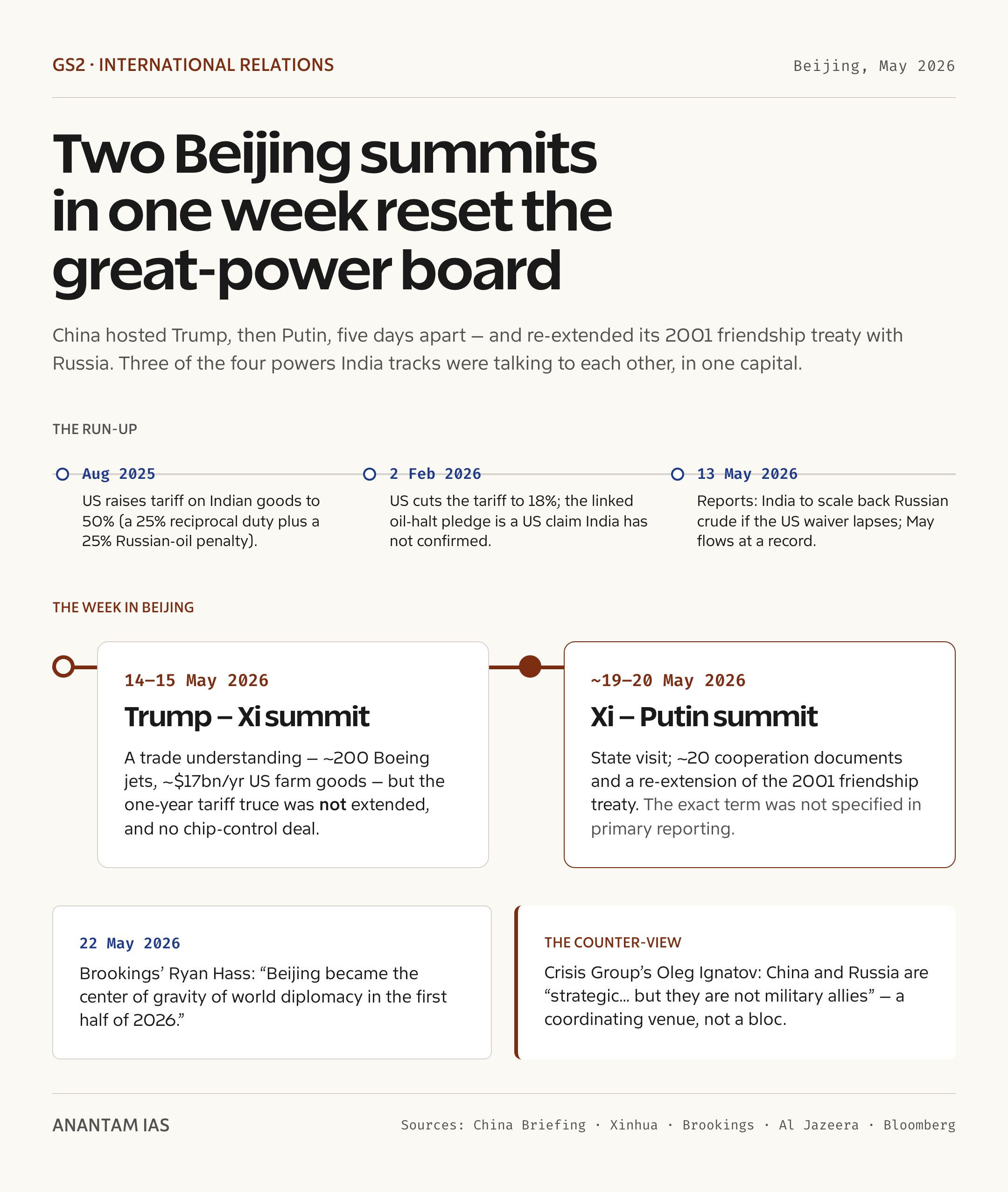
In one week in May 2026, Beijing did something New Delhi has spent two decades trying to avoid: it put itself at the centre of the room. China hosted US President Donald Trump on 14-15 May, then welcomed Russian President Vladimir Putin around 19-20 May, and in that second visit the two sides agreed to re-extend their 2001 friendship treaty. Three of the four great powers India tracks were now talking to each other, in one capital, on one calendar. And the fourth corner, the one that calls itself the swing vote of the new order, wasn’t in the room. So the question that should worry every serious aspirant isn’t whether India has friends. It’s whether India’s freedom to choose still buys it anything when the other three are busy choosing each other.
That’s the whole topic, and it’s a genuinely hard one. India’s posture rests on two ideas that sound simple and aren’t. The first is the freedom to act on its own interest without joining anyone’s camp. The second is keeping many strong friendships at once so no single power can dictate terms. Both worked beautifully in a world where Washington, Moscow and Beijing were pulling apart. The mark-scoring question is what happens to that strategy when they start, even partially, pulling together.
The Issue, Framed
The argument here isn’t whether India should have a foreign policy of independence. Of course it should. The argument is whether the specific method India uses to stay independent still delivers independence when the geometry around it shifts.
Let’s fix the vocabulary first, because most of the confusion on this topic comes from people throwing these terms around loosely. Strategic autonomy is New Delhi’s long-standing posture of keeping cooperative ties with many power centres while refusing permanent alignment with any single bloc. It’s not neutrality, and it’s definitely not non-alignment from the 1960s. It’s the deliberate preservation of choice. Multialignment is the working method that delivers it. The Quincy Institute’s Sarang Shidore defines it as “seeking strong bilateral relationships with as many major powers in the international system as possible,” a strategy “rooted in self-interest more than idealism”. So autonomy is the goal; multialignment is the toolkit. Keep that distinction clean and half the topic falls into place.
Two more terms you’ll need. Balance of power is the old realist idea that states protect themselves by stopping any one power from dominating, usually by aligning against the strongest. The RIC is the Russia-India-China trilateral dialogue, dormant since the 2020 Galwan clash, which Russia is now pushing to revive, China supports, and India is, at best, “tentatively open” to. Hold on to that word “tentatively.” No RIC summit has been confirmed in the public record, and treating India as a committed partner there would be a factual error.
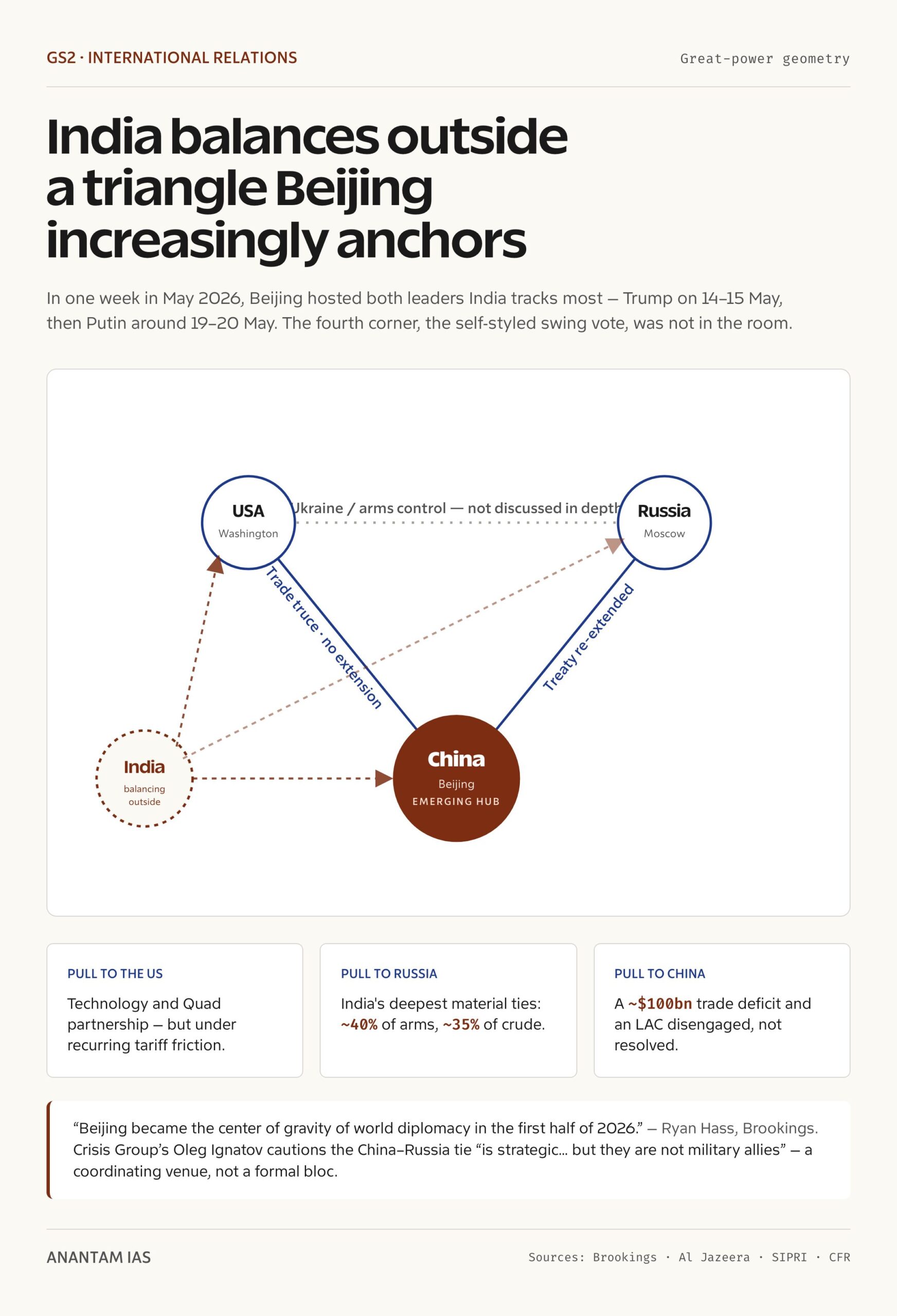
Now the geometry. For most of the post-Cold-War period, India played a triangle that was pulling apart. Washington and Beijing competed. Moscow drifted from both. India sat outside, courted by all three, free to take tech from America, arms and oil from Russia, and trade with China while contesting it on the border. That worked because the corners didn’t coordinate. The May 2026 sequencing suggests the corners are starting to coordinate, or at least to route their business through one of them. As Brookings China scholar Ryan Hass put it, “Beijing became the center of gravity of world diplomacy in the first half of 2026”. If that read holds, the venue where great-power business gets transacted is a venue India doesn’t control. And a country that doesn’t sit at the table risks becoming a rule-taker at it.
A balancing act works when you’re the swing. It stops working the moment the others realise they can do business without swinging your way.
What the Data Says
The numbers tell two stories at once, and a good answer holds both. The first is that India’s options have genuinely widened over a decade. The second is that the dependencies haven’t gone away. Start with defence, because that’s where the Russia question is sharpest.
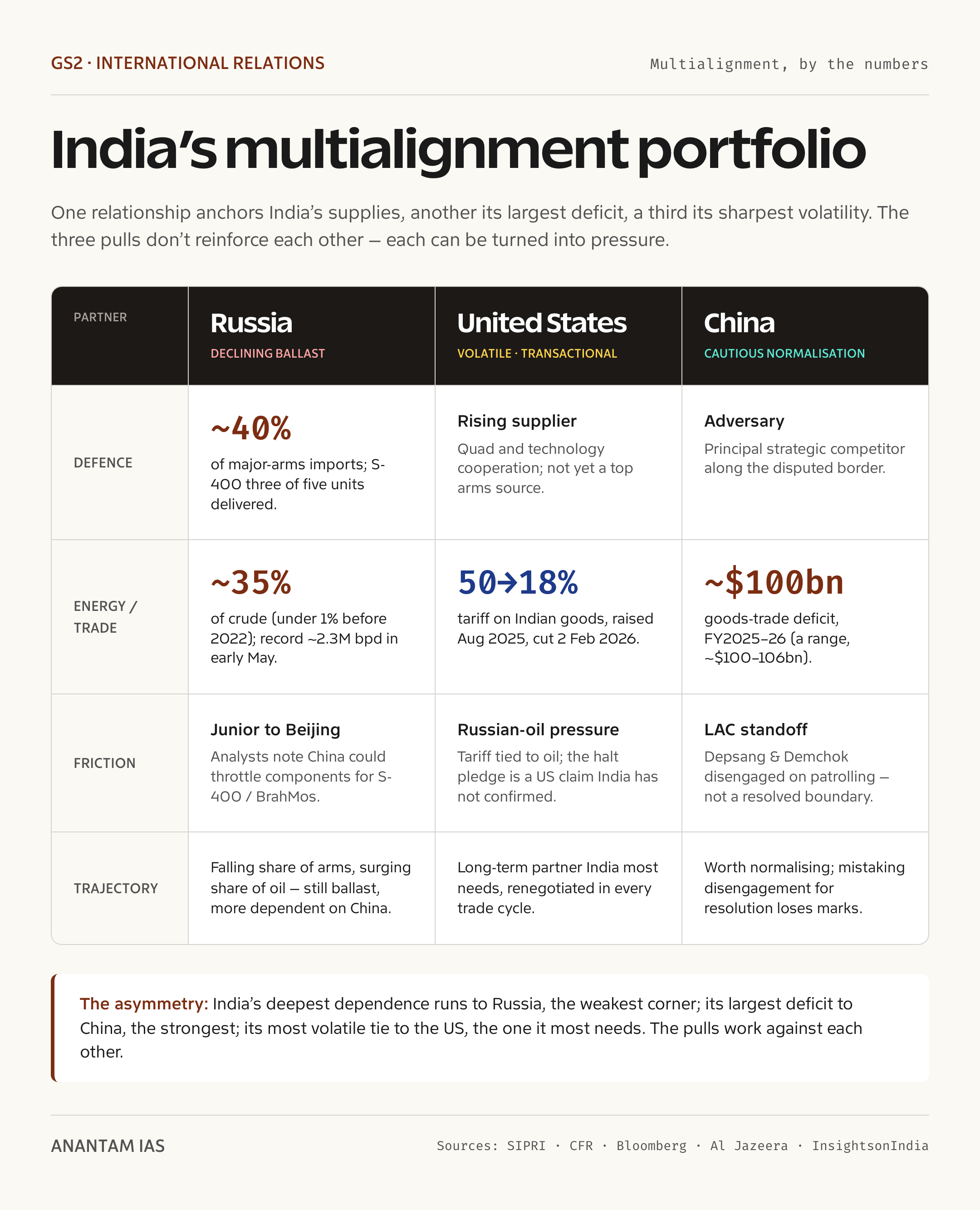
Russia’s share of India’s major-arms imports has fallen from 70% in 2011-15 to 51% in 2016-20 to about 40% in 2021-25, per the Stockholm International Peace Research Institute. That’s a real, measured diversification, not a talking point, with France (around 29%) and Israel (around 15%) picking up the slack in the latest window. But read the same data the other way. India is still the world’s second-largest arms importer at roughly 8.2% of global imports (2021-25), and Russia is still its single biggest supplier at 40%. A 40% dependence is down from 70%, yes. It’s also large enough that a forced, sudden rupture would leave real holes in India’s order of battle. On the S-400 air-defence system, India contracted for five units in 2018 and has taken delivery of three, with the last two delayed by the strain of the Russia-Ukraine war.
Energy runs the same way, only sharper. Russia was under 1% of India’s crude imports before the 2022 invasion of Ukraine. It’s now the top supplier at around 35%, and flows actually hit a record near 2.3 million barrels per day in the first half of May 2026. That isn’t loyalty. It’s arithmetic. Discounted Russian crude saved India real money on its largest import bill, and no government walks away from that without a substitute lined up.
The China column is where the discomfort lives. India’s goods-trade deficit with China reached roughly US$100-106 billion in FY2025-26. So the country India contests on its border is also the country it can’t stop buying from. On that border, the picture is better than 2020 but not solved. On 21 October 2024, India and China agreed on patrolling arrangements at Depsang and Demchok, the last two friction points in eastern Ladakh, and disengagement followed. Read that carefully, because aspirants lose marks here constantly: this is disengagement on patrolling, not a resolved boundary. The larger force build-up on both sides persists. The word is “disengaged,” never “settled.”
The United States column shows the volatility most clearly. In August 2025, Washington raised duties on Indian goods to 50% (a 25% reciprocal tariff plus a 25% penalty tied to India’s Russian-oil purchases). On 2 February 2026, it cut the rate to 18% alongside a trade understanding, with Trump claiming India had agreed to stop buying Russian oil. Here’s the part to attribute precisely: India has not officially confirmed any such pledge, and flows stayed high right through. So the headline number swung 50 down to 18, the supposed condition behind it is contested, and the leverage didn’t disappear. It just got renegotiated. That’s not autonomy operating freely. That’s autonomy operating under recurring pressure.
The Case For
The case that India can keep sustaining multialignment is strong, and writing the topic as if autonomy is already dead would be lazy analysis. So let’s state the optimistic read at full strength.
Multialignment is durable by design, not improvisation. Shidore’s point is that it’s “rooted in self-interest” and “likely to remain India’s preferred strategy for the foreseeable future”. India runs many strong bilateral relationships at the same time, with the US, Russia, France, Israel and the Gulf, so no single power holds a veto over its choices. When one relationship tightens, another loosens, and the portfolio rebalances. That’s the whole point of holding many cards instead of betting one.
A less confrontational US-China relationship can actually widen India’s room, not shrink it. This is the counter-intuitive part that examiners reward when you spot it. If the risk of an outright US-China conflict drops, India gets more diplomatic space and time to build its economy, military and tech base without being forced to pick a side in someone else’s war. A calmer triangle isn’t automatically a worse one for New Delhi.
Issue-based coalitions let India pick its lanes. The Quad and I2U2 cover technology, supply chains and Indo-Pacific maritime awareness. BRICS and the SCO cover multipolarity and the Global South. RIC, if revived, is a dialogue room, not a bloc. So India can lean into each forum for the specific thing it offers, without signing up to any of their wider agendas. Foreign Minister S. Jaishankar has framed exactly this as “issue-based partnerships,” keeping multiple options open.
India holds leverage even inside a tightening China-Russia bond. The Observer Research Foundation’s Antara Ghosal Singh argues that China has to tolerate deepening India-Russia ties, because pushing India away from Moscow would only drive New Delhi toward more US and Western arms, which is the worst outcome for Beijing. So India isn’t purely a passenger in the triangle. It shapes incentives for the bigger players too.
And India has already demonstrated defiance under pressure. It absorbed a 50% tariff, kept buying Russian crude, and then negotiated the rate down to 18% without a confirmed oil-halt pledge. That’s evidence the strategy holds even under direct economic coercion. As the world’s largest democracy, a top-five economy, the second-largest arms market and a convenor of the Global South, India is a partner the others compete to keep. So isolating it is expensive for everyone who tries.
The Case Against
Here’s what the optimistic case walks past. Multialignment is judged not by how many friends you have, but by what your freedom actually costs you when those friends start coordinating. On that test, the autonomy India enjoys is getting more expensive to exercise.
The pressure from Washington is increasingly binary. A tariff that swings from 50% to 18% and is openly tied to a Russian-oil demand turns “autonomy” into a standing negotiation rather than a settled fact. India held the line this round. But a posture you have to defend in every trade cycle, against a partner willing to use market access as a lever, is autonomy on a shorter leash than the brochure suggests.
If the US starts treating China as its main Asian interlocutor rather than its main challenger, India’s value as a counterweight erodes. That’s the real anxiety behind the “triangle” framing. New Delhi worries that a Trump-Xi bargain could quietly diminish its role in the Indo-Pacific. Hass noted that, on this trip, “up until this trip it was typically the United States that had the initiative … That’s not the case anymore”. If America is reaching for stability with Beijing, the partner it courted as a hedge against Beijing matters a little less.
The Sino-Russian tightening squeezes the Russia hedge from the other side. The treaty got re-extended, and the relationship is lopsided, with Chatham House’s Timothy Ash putting it bluntly: “China has all the cards … Putin needs this more than Xi”. A Russia growing more dependent on China is a less autonomous arms and energy partner for India, and analysts note that Beijing can, in principle, throttle the supply of components for systems like the BrahMos missile and the S-400. The hedge works only as long as Moscow can act independently of Beijing. That independence is shrinking.
Then there’s the venue problem. If competing great-power interests increasingly get managed through Beijing, a non-aligned India risks being a rule-taker in rooms it doesn’t sit in. Hold the counter-view, though: Crisis Group’s Oleg Ignatov cautions that the China-Russia relationship “is strategic … but they are not military allies”. So the triangle is a coordinating venue, not a formal alliance. The honest read sits between the “Beijing as hub” thesis and the “merely a partnership” caution, and your answer should say so rather than pick a side it can’t defend.
Two India-specific irritants make the point concrete, and the dates matter here. In June 2025, Trump hosted Pakistan army chief Gen. Asim Munir for lunch at the White House, the first such hosting of a Pakistani military chief who wasn’t also head of state. Separately, after the four-day India-Pakistan military clash in May 2025, Trump has repeatedly claimed he “stopped the war.” India rejects any mediation, with Foreign Secretary Vikram Misri stating that Prime Minister Modi told Trump by phone there was no US-led mediation and the ceasefire was bilateral. Note the discipline: that’s a claim by Washington, formally rejected by the MEA, not an established fact, and you must attribute it that way.
The Deeper Structural Read
Step back from the May summits and the real fault line shows up. The debate isn’t “alignment versus autonomy.” It’s about the difference between holding options and holding leverage, and India’s strategy has been better at the first than the second.
Multialignment, as practised, has mostly been a balancing strategy. India keeps doors open so it can shift weight when one relationship turns costly. That’s defensive, and it’s smart in a world that’s pulling apart. But balancing depends on being the swing vote, the corner everyone needs. The instant the other corners can transact without you, balancing stops generating influence and starts generating exposure. So the structural problem the triangle exposes is that India has optimised for flexibility in a system that’s quietly rewarding leverage.
Look at where the dependencies actually point and the asymmetry is stark. India’s two deepest material dependencies, around 40% of arms and around 35% of crude, both run to Russia, the weakest and most China-dependent corner of the triangle. Its largest trade deficit, around US$100 billion, runs to China, the strongest corner and its principal strategic competitor. And its most volatile relationship, swinging from a 50% tariff to 18% in six months, runs to the United States, the corner it most needs as a long-term partner. So India’s structural ties don’t reinforce each other. They pull in three directions, and each can be turned into pressure by the partner on the other end.
Here’s the part that should sharpen any answer. A balancing power converts indispensability into safety: others can’t afford to corner it. A leverage power converts indispensability into terms: others have to come to it. India has plenty of the first kind of indispensability, as a market, a talent pool, a manufacturing destination and a Global South convenor. It has been slower to convert that into the second. The triangle thesis, if it holds, is really a warning that the era of being safely courted by a divided set of giants may be ending, and the era of having to actively build cards is beginning.
And there’s a deeper point that’s easy to miss. India’s autonomy isn’t only a function of diplomacy. It’s a function of capacity, the indigenous defence base, the energy mix, the manufacturing depth that decides whether a “choice” is real or notional. The moment a foreign-policy choice depends on someone else’s supply chain, it stops being fully India’s to make. So the deepest read isn’t pro-West or pro-Russia. It’s that autonomy is downstream of capability, and diplomacy can only spend the leverage that economic and military capacity has already earned.
What Should Be Done
So what does a workable response to the triangle actually look like? Not a vague plea for “balance,” but a set of moves an analyst could defend in front of a panel. Six of them, and none requires India to abandon autonomy.
- Keep diversifying defence, and accelerate the indigenous base. The shift already visible in SIPRI’s data from Russia toward France, Israel, the US and domestic production should be sustained and sped up, especially for air defence and missiles, precisely to blunt any Chinese component leverage over Russian-origin systems. Diversification isn’t disloyalty to Moscow. It’s how you keep the Russia tie a hedge instead of a chokepoint.
- Deepen the Quad selectively, not formally. Lean into technology, supply chains and maritime-domain awareness, while declining a formal alliance that would forfeit autonomy and hand Beijing a propaganda line. The value of the Quad to India is functional, not symbolic, and the moment it becomes a bloc, it costs India more than it pays.
- Keep the Russia channel open while de-risking it. Preserve the energy and defence ties, but keep building optionality, US and Gulf crude, the Russian-oil waiver mechanism, alternative component sources, so the relationship stays a hedge rather than a vulnerability. The test is simple: can India absorb a disruption from any one supplier without a crisis? Right now, on oil and on some defence lines, the honest answer is “not comfortably.”
- Manage China at the margin, with eyes open. Continue the LAC patrolling and disengagement diplomacy, push hard for market access to cut the roughly US$100 billion deficit, and use RIC as a dialogue room without endorsing any anti-US bloc. Normalisation with Beijing is worth pursuing. Mistaking disengagement for resolution is not.
- Build cards, not just balance. Convert India’s market size, talent base, manufacturing push and Global South leadership into structural leverage, so India shapes the triangle rather than reacting to it. This is the long game, and it’s the only one that ends with India at the table instead of outside it.
- State the objective plainly. The goal, as one analyst frames it, is to stop the Trump-Xi-Putin triangle from solidifying into an exclusive arrangement that constrains New Delhi. Not to break it up, which India can’t do, but to keep it open enough that India’s interests still have to be accommodated inside it.
Every one of these strengthens autonomy rather than spending it. Autonomy that rests on capability, diversified ties and real leverage is autonomy that survives a realigning order. Autonomy that rests only on staying friends with everyone is autonomy that lasts exactly as long as everyone stays apart.
For Your Mains Answer
This is a high-value GS2 topic. It maps to bilateral and global groupings, the effect of developed-country policies on India, the neighbourhood, and the architecture of the international order in one frame.
GS paper mapping: GS2: India and the world; bilateral, regional and global groupings; effect of policies of developed and developing countries on India’s interests; India and its neighbourhood.
Likely question frames:
- Strategic autonomy and multialignment have served India well in a divided great-power system. Examine whether they remain viable as the US-China-Russia triangle realigns.
- “Balancing works only while you are the swing vote.” Critically analyse India’s strategic options as Beijing emerges as the hub of great-power diplomacy.
- Distinguish strategic autonomy from non-alignment, and assess how far India can sustain the former amid US pressure and a tightening Sino-Russian partnership.
Quotable data points:
- Russia’s share of India’s major-arms imports: ~70% (2011-15) → 51% (2016-20) → ~40% (2021-25).
- ~35% – Russia’s share of India’s crude imports, up from under 1% before 2022; record near 2.3 million bpd in early May 2026.
- 50% → 18% – US tariff on Indian goods, raised Aug 2025, cut 2 Feb 2026; the linked Russian-oil pledge is contested, not confirmed by India.
- ~US$100-106 billion – India’s goods-trade deficit with China, FY2025-26 (cite as a range).
- 8.2% – India’s share of global arms imports, world’s 2nd-largest importer, 2021-25.
- 21 Oct 2024 – Depsang-Demchok patrolling agreement; disengagement, not boundary resolution.
- “Beijing became the center of gravity of world diplomacy in the first half of 2026” – Ryan Hass, Brookings.
- “China has all the cards … Putin needs this more than Xi” – Timothy Ash, Chatham House.
Keywords to use: strategic autonomy, multialignment, balance of power, issue-based partnerships, multipolarity, Quad, BRICS, SCO, RIC, LAC disengagement, indispensability.
Syllabus linkages: bilateral and global groupings involving India; effect of developed-country policies on India; India and its neighbourhood; important international institutions and the balance of power; national interest versus value-based foreign policy.
Balanced conclusion line: Multialignment kept India safe while the giants pulled apart; the realigning triangle is the moment India has to convert being courted into having leverage, because autonomy that rests only on others staying divided is autonomy living on borrowed time.
How to Build the Answer
Open with the geometry, not a definition. The strongest first line names the shift: for two decades India balanced a triangle that was pulling apart, and the May 2026 Beijing summits hint it may be pulling together. That sentence tells the examiner you’ve grasped both the news and the structural stakes. The definition of strategic autonomy can follow in the second sentence, not the first. Lead with the problem; explain the term once you’ve earned the reader’s attention.
Bring data in early, but ration it. A strong first body paragraph can carry three figures: 40% arms dependence on Russia, 35% crude, and the 50%-to-18% tariff swing. Then say what they prove. Numbers are the anchor; “this means India’s autonomy operates under standing pressure” is the mark. UPSC rewards the move from fact to inference, not the fact alone.
The second body paragraph should steelman the optimistic case. If your stance is that autonomy is under strain, first state honestly why multialignment is durable, the diversification, the issue-based forums, the demonstrated defiance under the tariff. An answer that only argues one direction reads like advocacy, not analysis.
Group the way forward, never scatter it. Cluster the moves: defence diversification, selective Quad, de-risked Russia channel, China at the margin, building leverage. Use the topic’s own vocabulary, balance of power, indispensability, issue-based partnerships, so the answer sounds like strategic analysis rather than a news recap.
Close on judgment, not summary. The reliable pattern here is “the goal is not X alone, but X plus Y”, balancing flexibility with leverage, autonomy with capability. The last line should not echo the introduction. It should show you know what the topic is really about.
Common Mistakes to Avoid
- Don’t confuse strategic autonomy with non-alignment. Non-alignment was Cold-War distance from both blocs; strategic autonomy is active engagement with all of them on India’s terms. Mixing them up signals you don’t understand the topic.
- Don’t call the LAC “resolved.” It’s disengaged on patrolling at Depsang and Demchok. The force build-up persists. This is a common and costly slip.
- Don’t assert Trump “mediated” the India-Pakistan ceasefire. It’s a US claim that the MEA formally rejects. Attribute it; never state it as fact.
- Don’t misdate the irritants. The Munir White House lunch was June 2025; the India-Pakistan clash was May 2025. Wrong dates undercut the whole answer.
- Don’t go jingoistic. This is a balance-of-power analysis. Triumphalism about India or hostility toward any country reads as immature and loses marks.
A Compact Answer Spine
- Introduction: Open with the realigning triangle and the May 2026 Beijing summits; define strategic autonomy and multialignment in one line each.
- Evidence: Two or three attributed figures, each tied to an implication (Russia dependence, the tariff swing, the China deficit).
- Arguments: The case that multialignment endures, then the case that autonomy is under strain. Keep both fair and attributed.
- Structural diagnosis: Balancing works only while India is the swing vote; the deeper issue is options versus leverage, and autonomy is downstream of capability.
- Way forward: Four to five grouped moves, each with a clear actor and instrument.
- Conclusion: Adapt the balanced conclusion line to the exact question wording.
Diagram or Flowchart Idea
For a 15-marker, draw the triangle: three nodes, US-China-Russia, with India as an external fourth point and arrows showing its pulls, tech and Quad to the US, 40% arms and 35% oil to Russia, the ~US$100 billion deficit and LAC friction to China. Label India “balancing outside the triangle.” One clean figure communicates the whole geometry in five seconds.
For a 10-marker, skip the diagram and use a three-column table instead, Russia, US, China, with rows for defence, energy or trade, friction point, and trajectory. Faster to draw, faster to evaluate, and it forces you to be specific.
Ethics and Governance Angle
Even a GS2 answer benefits from one line on the value question underneath the strategy. Foreign policy isn’t only about power; it’s about whether a state’s external choices serve its citizens, its development, its security. Frame the tension as national interest versus a purely values-based foreign policy: India buys discounted Russian crude because it lowers costs for ordinary households, even as Western partners press it to stop. Naming that trade-off, the citizen’s fuel bill against the diplomatic cost, shows maturity.
Then convert the value into design. Don’t just say “India should be principled.” Say how autonomy is exercised responsibly: transparent diversification, refusing to be coerced, refusing to coerce smaller neighbours in turn. That’s the move from moral language to statecraft, and it travels to almost any IR question.
A useful sentence pattern: “The pursuit of national interest is legitimate, but its legitimacy depends on consistency, credibility and capacity.” It accepts realism without endorsing opportunism, which is exactly the register a panel rewards on a foreign-policy question.
How to Use Data Without Sounding Mechanical
Use fewer numbers than you know. Three well-explained figures beat ten dumped on the page. Lead with one structural number (40% arms dependence on Russia), use a second for the pressure point (the 50%-to-18% tariff swing), and use a third for the competitor relationship (the ~US$100 billion China deficit). One dependence, one pressure, one rivalry is usually enough to carry an answer.
Never leave a statistic standing alone. Follow it with “this means…” or “the strategic implication is…”. That single move turns a fact sheet into analysis. In Mains, data is raw material; judgment is the finished product.
Attribute contested figures, and flag what’s disputed. The Russian-oil pledge, the exact treaty-extension term, the precise China deficit, these are contested or unconfirmed, and an answer that hedges them correctly looks more credible than one that asserts a clean number it can’t defend. Write “around US$100 billion,” not a false-precision figure. Write “India has not confirmed” the oil pledge, not “India agreed.”
One last sweep: cut any sentence that sounds grand but does no work, and replace it with a fact, a cause, a consequence or a recommendation. That habit is the difference between an answer that feels informed and one that feels memorised. Write for marks, not for noise. Always be specific, always attribute, never overclaim.
FAQ
What is the difference between strategic autonomy and non-alignment?
Non-alignment was the Cold-War posture of keeping distance from both the US and Soviet blocs. Strategic autonomy is the opposite of distance: it’s active engagement with all major powers, the US, Russia, China, France, the Gulf, while refusing permanent membership in any single camp. Multialignment is the working method that delivers it, by holding many strong bilateral ties so no one power can dictate terms.
Why is Beijing being called the “hub” of the US-China-Russia triangle?
Because in one week in May 2026, China hosted both Trump (14-15 May) and Putin (around 19-20 May), and re-extended its 2001 friendship treaty with Russia. Analysts like Brookings’ Ryan Hass argue “Beijing became the center of gravity of world diplomacy” in early 2026. The counter-view, from Crisis Group’s Oleg Ignatov, is that China and Russia are strategic partners but “not military allies”, so the triangle is a coordinating venue, not a formal bloc.
Is India’s dependence on Russia actually falling?
On arms, yes, measurably: Russia’s share of India’s major-arms imports fell from about 70% in 2011-15 to roughly 40% in 2021-25, per SIPRI, with France and Israel rising. On energy, it’s the reverse: Russia went from under 1% of India’s crude before 2022 to around 35% now. So defence dependence is declining while energy dependence has surged, which is exactly why the Russia tie is hard to characterise in a single sentence.
Did the US really cut tariffs on India, and did India agree to stop buying Russian oil?
The US raised tariffs on Indian goods to 50% in August 2025, then cut them to 18% on 2 February 2026 alongside a trade understanding. Trump claimed India agreed to stop buying Russian oil and shift to US crude. India has not officially confirmed any such pledge, and Russian-oil flows stayed high through early 2026. So the tariff cut is confirmed; the oil commitment is a US claim that India has not endorsed, and it should be attributed, not stated as fact.