Indian History (hindi): Periods, Events, Key Personalities (UPSC History)
You opened a search for "indian history in hindi" because the existing material feels split.
You opened a search for “indian history in hindi” because the existing material feels split. English-medium aspirants get Bipan Chandra, Spectrum, Tamil Nadu Class 11 textbook — well-organised, deep, exam-tested. Hindi-medium material? Often feels patchy — incomplete translations, outdated data, ten different sources for ten different periods. I’ve watched Hindi-medium aspirants lose Mains marks not on content but on terminology — they couldn’t recall whether Vishti meant forced labour or a tax, or whether Iqta was a unit of land or administrative office. This article fixes that. Indian history in hindi content here stays in English (because Anantamias is English-medium), but every key term, ruler, and movement carries its Hindi equivalent. The closing section maps you to Hindi-medium books that actually work — Bharat Ka Itihas (Bipan Chandra Hindi), Rajiv Ahir, NCERT Hindi.
Note for Hindi-medium aspirants — यह लेख अंग्रेज़ी में है, लेकिन सभी प्रमुख ऐतिहासिक शब्दों, राजवंशों और घटनाओं के हिंदी अनुवाद और transliteration दिए गए हैं। अंत में हिंदी माध्यम के स्रोत और किताबें भी सूचीबद्ध हैं।
What is Indian history (Bharat ka Itihas)?
Indian history (Bharat ka Itihas — भारत का इतिहास) is the chronological study of the Indian subcontinent from prehistoric times to 1947 — covering the Indus Valley Civilisation (3300–1300 BCE), the Vedic period, ancient empires, medieval sultanates and Mughals, colonial rule, and the freedom struggle. UPSC History (GS-I + GS-IV ethics overlap + Optional) tests three broad periods: Ancient (Pracheen Kaal), Medieval (Madhyakaal), Modern (Adhunik Kaal).
Three quick facts:
- Earliest known civilisation — Indus Valley / Harappan — 3300 BCE. Saraswati-Sindhu Sabhyata (सरस्वती-सिंधु सभ्यता).
- First major empire — Mauryan — 322 BCE under Chandragupta Maurya. Capital Pataliputra.
- Independence — 15 August 1947 — Swatantrata Diwas (स्वतंत्रता दिवस).
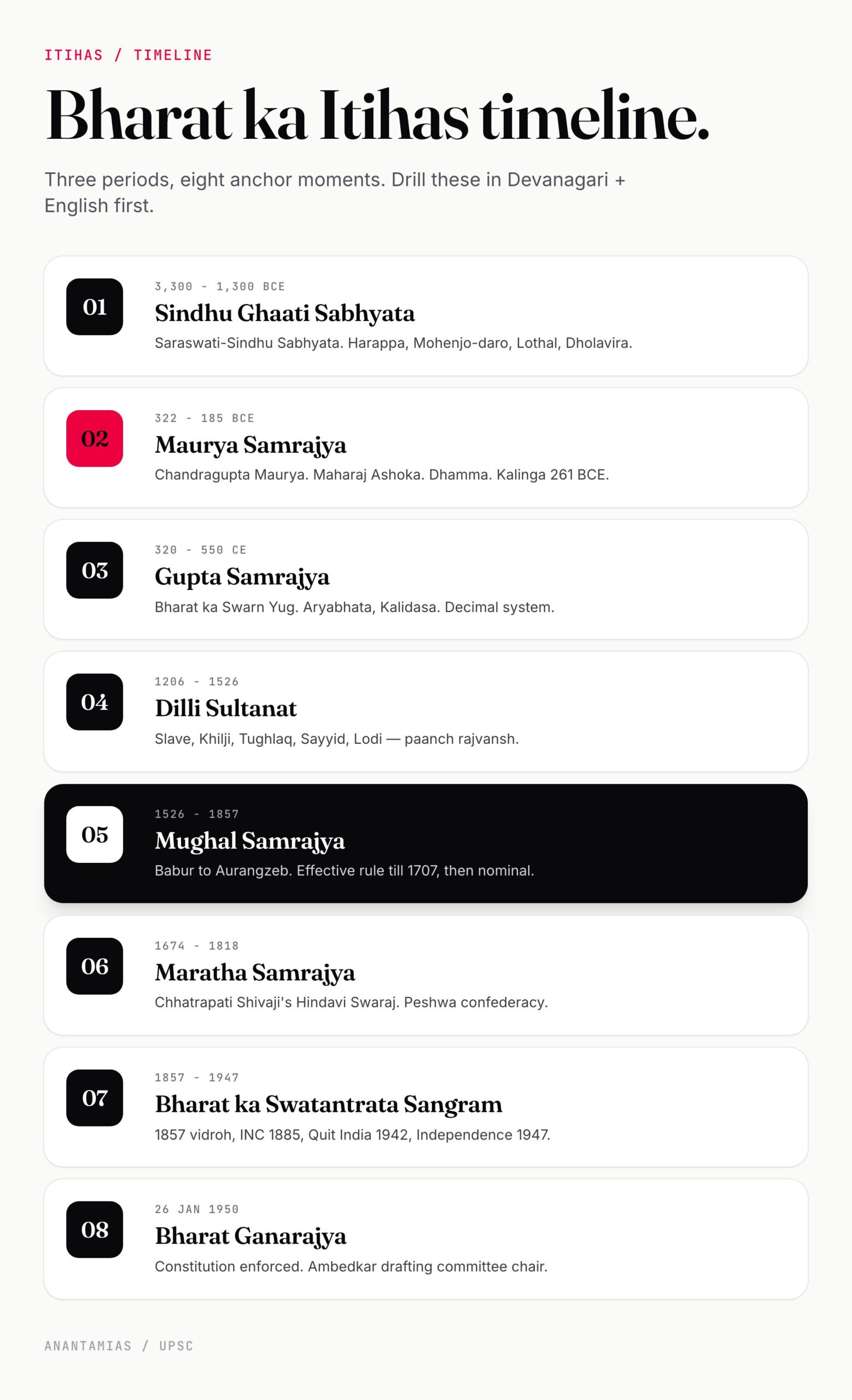
The three periods of Indian history (Teen Kaal)
UPSC’s syllabus follows the conventional periodisation. Hindi-medium textbooks use the same labels.
1. Ancient India (Pracheen Bharat) — pre-history to ~700 CE
Subdivisions:
- Prehistoric — Itihaas-poorv Kaal (इतिहास-पूर्व काल). Stone Age (Palaeolithic, Mesolithic, Neolithic), Chalcolithic.
- Indus Valley Civilisation — Sindhu Ghaati Sabhyata (सिंधु घाटी सभ्यता). 3300–1300 BCE. Major sites: Harappa, Mohenjo-daro, Dholavira, Lothal, Kalibangan. See Harappan civilisation.
- Vedic period — Vaidik Kaal (वैदिक काल). 1500–600 BCE. Rigveda, Samaveda, Yajurveda, Atharvaveda.
- Mahajanapadas + Buddhist/Jain era — 600–321 BCE. 16 Mahajanapadas (Solah Mahajanapad). Gautama Buddha. Mahavira.
- Mauryan Empire — Maurya Samrajya (मौर्य साम्राज्य). 322–185 BCE. Chandragupta, Bindusara, Ashoka (the Great — Maharaj Ashoka). See Mauryan Empire.
- Post-Mauryan period — Shungas, Kanvas, Satavahanas, Indo-Greeks, Kushanas. 185 BCE – 320 CE.
- Gupta Empire — Gupta Samrajya (गुप्त साम्राज्य). 320–550 CE. Often called “Golden Age of India” — Bharat ka Swarn Yug (भारत का स्वर्ण युग). See Gupta Dynasty.
- Post-Gupta / Early Medieval — Harshavardhana (Vardhana dynasty), Pallavas, Chalukyas, Cholas, Rashtrakutas.
2. Medieval India (Madhyakaleen Bharat) — ~700 CE to 1757
Subdivisions:
- Early Medieval — Aarambhik Madhyakaal (आरंभिक मध्यकाल). Rajputs, Cholas at peak. 700–1200 CE.
- Delhi Sultanate — Dilli Sultanat (दिल्ली सल्तनत). 1206–1526. Five dynasties: Slave (Mamluk), Khilji, Tughlaq, Sayyid, Lodi.
- Vijayanagara and Bahmani — south India parallel power, 1336–1646.
- Mughal Empire — Mughal Samrajya (मुग़ल साम्राज्य). 1526–1857 (effective rule till 1707). Babur → Humayun → Akbar → Jahangir → Shah Jahan → Aurangzeb → later Mughals.
- Maratha Empire — Maratha Samrajya (मराठा साम्राज्य). Chhatrapati Shivaji (1674) → Peshwas → fall 1818. See Maratha Empire.
- Regional kingdoms — Sikhs (Maharaja Ranjit Singh), Mysore (Hyder Ali, Tipu Sultan), Hyderabad (Nizams), Awadh, Bengal Nawabs.
3. Modern India (Adhunik Bharat) — 1757 to 1947
Subdivisions:
- British conquest — Battle of Plassey (1757), Battle of Buxar (1764). EIC consolidation.
- Crown Rule — 1858 onwards, post-1857 revolt.
- Reform movements — Brahmo Samaj (Raja Ram Mohan Roy), Arya Samaj (Dayanand Saraswati), Aligarh Movement, Ramakrishna Mission.
- Indian National Congress — Bharatiya Rashtriya Congress (भारतीय राष्ट्रीय कांग्रेस). Founded 1885 by A.O. Hume.
- Freedom Struggle phases — Moderate (1885–1905), Extremist (1905–1919), Gandhian (1919–1947).
- Key Gandhian movements — Champaran (1917), Kheda (1918), Non-Cooperation (1920–22), Civil Disobedience / Salt March (1930–34), Quit India (1942).
- Partition and Independence — 14–15 August 1947.
The full sweep of modern history is covered in our Modern History of India article.
Key personalities (Pramukh Vyaktitva)
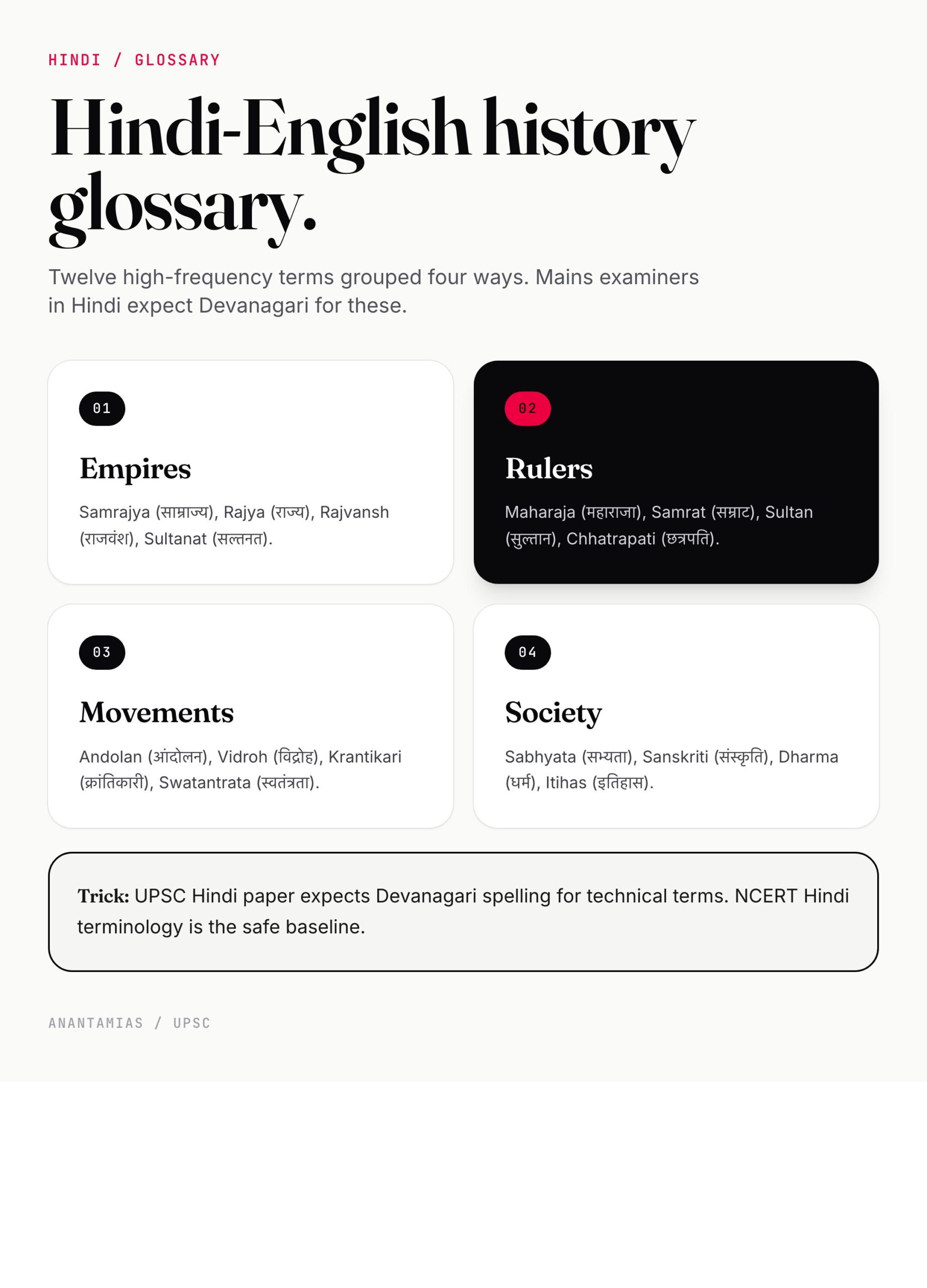
Twelve personalities recur across UPSC papers. Hindi labels matter because Mains essays in Hindi medium use them directly.
| # | Name | Hindi | Era | Why famous |
|---|---|---|---|---|
| 1 | Ashoka | अशोक | 268–232 BCE | Mauryan emperor, Buddhism propagator, Edicts. See Samrat Ashoka |
| 2 | Chandragupta Maurya | चंद्रगुप्त मौर्य | 322–298 BCE | Mauryan founder, Chanakya as advisor |
| 3 | Samudragupta | समुद्रगुप्त | 335–375 CE | Gupta “Napoleon of India” |
| 4 | Harshavardhana | हर्षवर्धन | 606–647 CE | Last great ancient north Indian emperor |
| 5 | Akbar | अकबर | 1556–1605 | Mughal liberal ruler, Din-i-Ilahi |
| 6 | Aurangzeb | औरंगज़ेब | 1658–1707 | Last great Mughal, conservative reign |
| 7 | Shivaji | शिवाजी | 1630–1680 | Maratha founder, Hindavi Swarajya |
| 8 | Tipu Sultan | टीपू सुल्तान | 1782–1799 | Mysore tiger, anti-British |
| 9 | Raja Ram Mohan Roy | राजा राम मोहन राय | 1772–1833 | Reformer, Brahmo Samaj, abolition of Sati |
| 10 | Mahatma Gandhi | महात्मा गांधी | 1869–1948 | Father of the nation, Satyagraha |
| 11 | Subhas Chandra Bose | सुभाष चंद्र बोस | 1897–1945 | INA, Azad Hind Fauj |
| 12 | B.R. Ambedkar | भीमराव अंबेडकर | 1891–1956 | Constitution architect, Dalit leader |
Hindi-English history glossary (essential terms)
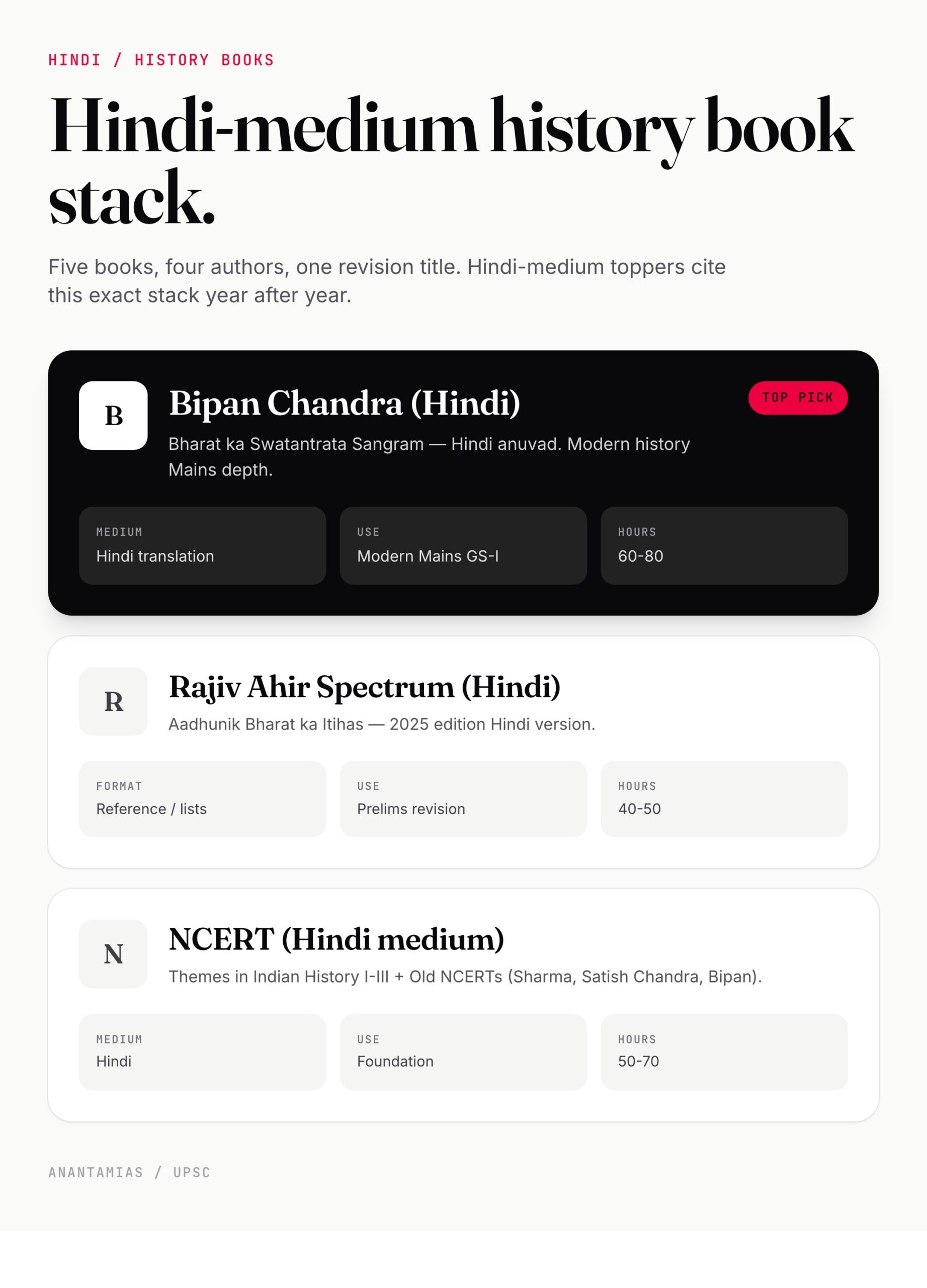
| English | Hindi (Devanagari) | Transliteration | Meaning |
|---|---|---|---|
| History | इतिहास | Itihaas | Study of past |
| Civilisation | सभ्यता | Sabhyata | Settled urban society |
| Empire | साम्राज्य | Samrajya | Large multi-state polity |
| Dynasty | राजवंश | Rajvansh | Ruling family line |
| Era / Period | काल / युग | Kaal / Yug | Time period |
| Coin | सिक्का | Sikka | Currency unit |
| Edict | शिलालेख | Shilalekh | Inscription |
| Inscription | अभिलेख | Abhilekh | Carved record |
| Manuscript | पांडुलिपि | Pandulipi | Handwritten text |
| Temple | मंदिर | Mandir | Hindu/Jain place of worship |
| Mosque | मस्जिद | Masjid | Islamic place of worship |
| Fort | किला / दुर्ग | Kila / Durg | Fortified structure |
| War | युद्ध | Yuddh | Armed conflict |
| Battle | लड़ाई | Larai | Single engagement |
| Treaty | संधि | Sandhi | Agreement |
| Revolt | विद्रोह | Vidroh | Armed rebellion |
| Movement | आंदोलन | Andolan | Political/social campaign |
| Reform | सुधार | Sudhar | Improvement initiative |
| Freedom | स्वतंत्रता | Swatantrata | Independence |
| Independence | आज़ादी | Aazadi | Freedom, liberation |
| Constitution | संविधान | Samvidhan | Founding legal document |
| Partition | विभाजन | Vibhajan | 1947 partition |
| Religion | धर्म | Dharm | Faith / duty |
| Caste | जाति | Jaati | Social classification |
| Land revenue | भू राजस्व | Bhu Rajasv | Tax on land |
| Trade | व्यापार | Vyapar | Commerce |
| Pilgrimage | तीर्थ यात्रा | Teerth Yatra | Religious journey |
| Architecture | वास्तुकला | Vastukala | Building design |
| Sculpture | मूर्तिकला | Murtikala | Statuary |
| Painting | चित्रकला | Chitrakala | Art form |
High-yield events for UPSC
Memorise these dates. Both English and Hindi-medium UPSC exams test them.
- Indus Valley peak — 2500–1900 BCE.
- Buddha’s birth and Mahaparinirvana — 563 BCE / 483 BCE (traditional dates).
- Mauryan Empire founded — 322 BCE by Chandragupta Maurya.
- Kalinga War — 261 BCE. Ashoka’s transformation.
- Gupta Empire founded — 320 CE by Chandragupta I.
- Delhi Sultanate begins — 1206 CE. Qutb-ud-din Aibak.
- First Battle of Panipat — 1526. Babur defeats Ibrahim Lodi.
- Akbar’s reign — 1556–1605.
- Battle of Plassey — 1757. EIC consolidates Bengal.
- First War of Independence (Sepoy Mutiny) — 1857.
- Indian National Congress founded — 1885.
- Partition of Bengal — 1905.
- Non-Cooperation Movement — 1920–22.
- Civil Disobedience / Dandi March — 12 March 1930.
- Quit India — 8 August 1942.
- Independence and Partition — 15 August 1947.
- Constitution adopted — 26 November 1949.
- Republic Day — 26 January 1950.
Why Indian history matters for UPSC
Prelims — 15–20 questions per year on history. Heaviest on ancient + modern. Medieval gets 3–5.
Mains GS-I — culture, history of modern India, post-independence consolidation, Indian society. Half of GS-I marks come from history-flavoured topics.
Optional — History optional has the longest syllabus but the most predictable question pattern. Hindi-medium aspirants benefit from rich Hindi-language sources (NCERT, Bipan Chandra Hindi anuvad, Rajiv Ahir Hindi).
Essay — historical perspective is welcome in almost every essay topic. Quote Gandhi, Ambedkar, Tagore.
Common misconceptions
- “Aryan invasion theory is settled science” — Wrong. Recent genetic + archaeological research challenges the “invasion” framing. Most modern scholars use “migration” instead, and the timeline + genetic flow remains contested.
- “Mughal Empire ended in 1707” — That’s when Aurangzeb died and effective rule collapsed. The empire formally lasted till 1857 when Bahadur Shah Zafar was deposed after the revolt.
- “1857 was just a sepoy mutiny” — Reductive. Most modern historians (Bipan Chandra, R.C. Majumdar, S.N. Sen) recognise it as the first organised armed challenge to British rule, with civilian and aristocratic participation.
- “Gandhi led every freedom movement” — Gandhi led the Congress wing. Revolutionary nationalism (Bhagat Singh, Chandrashekhar Azad), the INA (Subhas Bose), and the 1857 revolt happened outside the Gandhian framework.
How to study Indian history in Hindi
Source priority for Hindi-medium aspirants:
- NCERT Class 6–12 (Hindi) — Hamare Atit (हमारे अतीत) for classes 6–8, Bharat aur Aadhunik Vishwa for Class 9. Foundation, free, official.
- Bipan Chandra — India’s Struggle for Independence (Hindi anuvad) — Bharat ka Swatantrata Sangharsh. The standard for modern history.
- Rajiv Ahir — A Brief History of Modern India (Hindi) — Aadhunik Bharat ka Sankshipt Itihas. Compact, examination-focused.
- R.S. Sharma — Ancient India (Hindi) — Pracheen Bharat. NCERT-aligned.
- Satish Chandra — Medieval India (Hindi) — Two-volume, comprehensive.
- Drishti IAS Itihas Notes (Hindi) — current affairs blend.
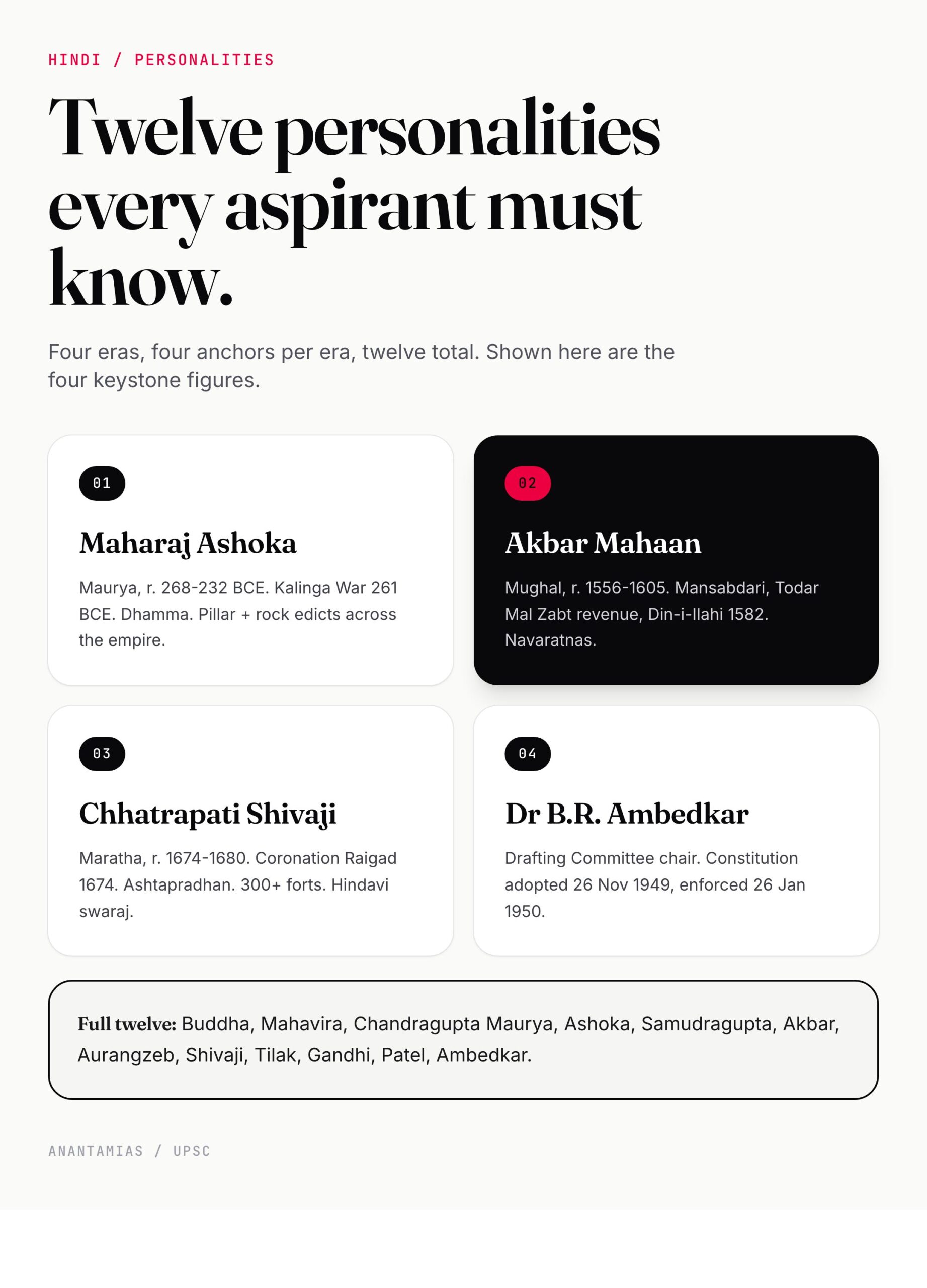
For a list of all NCERTs to order, see NCERT books for UPSC.
Look — Hindi-medium toppers exist. Pawan Kumar (AIR 50, 2019), Akshay Kumar (AIR 27, 2018), Shashank Bharadwaj (AIR 14, 2020) — all Hindi medium. The pattern: NCERT Hindi for foundation, Bipan Chandra Hindi for modern depth, Rajiv Ahir for revision, Drishti for current overlay. That’s it. Stop hunting for the perfect book.
How to revise this in 30 minutes
- Timeline — sketch the three periods with 5 dates each (10 min).
- Twelve personalities — recall name + Hindi label + claim to fame (10 min).
- NCERT Class 8 Hamare Atit III — quick chapter scan (5 min).
- Drishti monthly — historical anniversaries section (5 min).
Frequently Asked Questions
Bharat ka itihas hindi mein kaun si kitab best hai?
NCERT (Class 6–12 Hindi) + Bipan Chandra Bharat ka Swatantrata Sangharsh + Rajiv Ahir Aadhunik Bharat ka Sankshipt Itihas — this combination covers 90% of UPSC syllabus.
Indian history ke kitne kaal hote hain?
Three — Pracheen (Ancient, pre-history to 700 CE), Madhyakaal (Medieval, 700–1757), Aadhunik (Modern, 1757–1947).
Sabse pehle samrajya kaun sa tha Bharat mein?
Mauryan Empire (Maurya Samrajya) — founded 322 BCE by Chandragupta Maurya, capital Pataliputra.
Bharat kab swatantra hua?
15 August 1947 — Pandrah Agast Unnees Sau Saintalis.
Constitution kab apnaya gaya?
26 November 1949 — adopted. 26 January 1950 — implemented (Republic Day).
Hindi medium se IAS bana ja sakta hai history optional ke saath?
Bilkul. History optional ke liye Hindi mein full syllabus ka coverage hai — NCERT, Bipan Chandra, Satish Chandra, R.S. Sharma — sab Hindi anuvad mein available.
Ashoka the Great kaun the?
Maharaj Ashok (268–232 BCE) — Mauryan emperor. Kalinga yuddh ke baad Buddhism apnaaya. Edicts (shilalekh) ke liye prasiddh.
1857 ka vidroh kya tha?
First War of Independence — Pratham Swatantrata Sangram. Sepoy mutiny that turned into a wider revolt against EIC. Ended Company rule, brought direct Crown rule from 1858.