Indian Railways: History, Structure & UPSC Notes
Complete guide to Indian Railways — history, zonal structure, railway zones, reforms, modernisation, and key facts for UPSC General Knowledge.
Indian Railways: History, Structure & UPSC Notes
Indian Railways is the fourth-largest railway network in the world and the largest employer in India (excluding defence forces). Operating over 68,000 route kilometres, carrying 23 million passengers daily, and transporting 3.5 million tonnes of freight daily, the Railways is the backbone of India’s transportation system. For UPSC, Indian Railways appears in GK, Economy (infrastructure), and Governance questions — covering history, structure, reforms, and modernisation.
History of Indian Railways
Colonial Era
- 1853: First passenger train in India ran from Bombay (Bori Bunder) to Thane — 34 km, hauled by three locomotives (Sahib, Sindh, Sultan). This was on 16 April 1853 under the Great Indian Peninsula Railway (GIPR) company
- 1854: First train in eastern India — Howrah to Hooghly (Eastern Railway)
- 1856: First train in south India — Royapuram to Walajah Road (Madras Railway)
- Railways were built primarily to serve British commercial interests — transporting raw materials (cotton, jute, coal) to ports
- By 1900, India had over 24,000 miles of track — one of the world’s largest networks
- Multiple private companies operated different sections — Great Indian Peninsula Railway, East Indian Railway, Bombay, Baroda and Central India Railway (BB&CI)
- The Acworth Committee (1921) recommended separating Railway finances from general government finances — leading to the separate Railway Budget (1924–2016)
Post-Independence
- Railways were nationalised — private companies merged into Indian Railways
- Divided into zones for administrative efficiency
- 1951: Six zones initially
- Focus on expanding network and serving national integration
- Significant investment through Five Year Plans
Key Timeline
| Year | Milestone |
|---|---|
| 1853 | First passenger train (Bombay–Thane) |
| 1925 | First electric train (Bombay VT to Kurla) |
| 1951 | Zonal system established |
| 1969 | First Rajdhani Express (New Delhi–Howrah) |
| 1988 | First Shatabdi Express (New Delhi–Jhansi) |
| 2016 | Railway Budget merged with Union Budget |
| 2020 | First Vande Bharat Express commercial run |
| 2023 | 100% electrification target progress |
Organisational Structure
Ministry of Railways
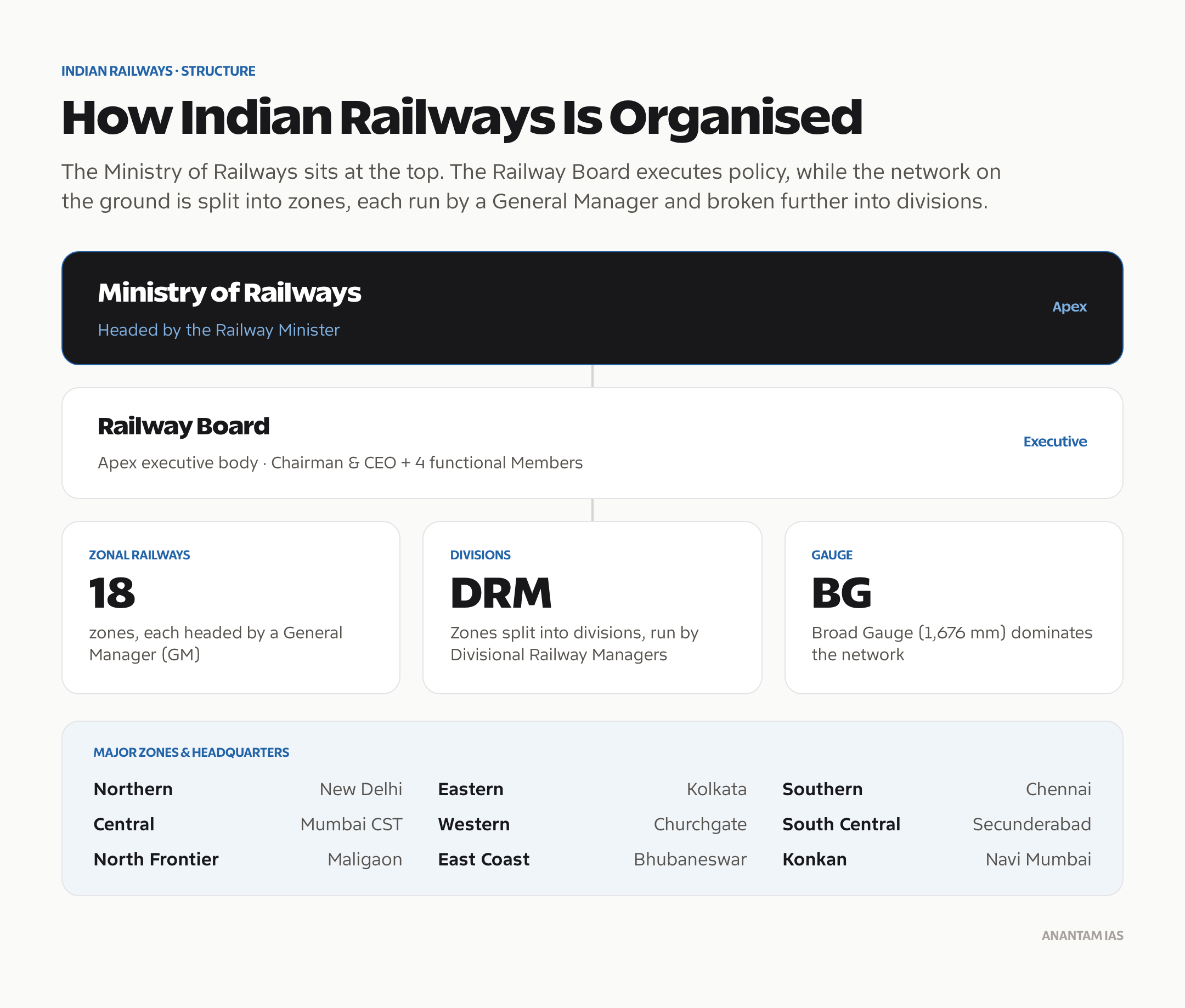
Indian Railways is managed by the Ministry of Railways, headed by the Railway Minister. The administrative head is the Chairman and CEO, Railway Board.
Railway Board
The Railway Board is the apex executive body. It comprises the Chairman & CEO and functional Members (Operations and Business Development, Infrastructure, Finance, Rolling Stock, Traction and Technology). The Board was restructured in 2020 — reducing from 8 to 4 members plus Chairman.
Zonal Railways
Indian Railways is divided into 18 zones, each headed by a General Manager. Zones are further divided into divisions, headed by Divisional Railway Managers (DRMs).
| Zone | Abbreviation | Headquarters |
|---|---|---|
| Northern Railway | NR | New Delhi |
| North Eastern Railway | NER | Gorakhpur |
| Northeast Frontier Railway | NFR | Maligaon (Guwahati) |
| Eastern Railway | ER | Kolkata |
| South Eastern Railway | SER | Kolkata |
| Southern Railway | SR | Chennai |
| Central Railway | CR | Mumbai (CST) |
| Western Railway | WR | Mumbai (Churchgate) |
| South Central Railway | SCR | Secunderabad |
| South Western Railway | SWR | Hubballi |
| North Western Railway | NWR | Jaipur |
| West Central Railway | WCR | Jabalpur |
| East Central Railway | ECR | Hajipur |
| North Central Railway | NCR | Prayagraj |
| South East Central Railway | SECR | Bilaspur |
| East Coast Railway | ECoR | Bhubaneswar |
| Metro Railway, Kolkata | MR | Kolkata |
| South Coast Railway | SCoR | Visakhapatnam |
Konkan Railway often turns up in zone lists, but it is a separate public-sector corporation, not a zonal railway. The newest zone, South Coast Railway, has worked from Visakhapatnam since 1 June 2026. For every zone with its divisions, see railway zones of India.
Key Functions and Services
Passenger Services
Indian Railways operates approximately 13,000 passenger trains daily, serving over 7,000 stations. Major categories:
- Vande Bharat Express: India’s first semi-high-speed train (up to 160 km/h), manufactured indigenously at ICF Chennai
- Rajdhani Express: Superfast trains connecting state capitals to New Delhi
- Shatabdi Express: Intercity day trains
- Duronto Express: Non-stop point-to-point trains
- Garib Rath: AC trains at subsidised fares
- Tejas Express: Premium trains with modern amenities
- Suburban trains: Mumbai, Chennai, Kolkata, Hyderabad local trains — carrying millions daily
Freight Services
Freight earnings constitute roughly 65% of Indian Railways’ total revenue. Key freight commodities:
- Coal (largest by volume — for power plants)
- Iron ore and steel
- Cement
- Petroleum products
- Foodgrains
- Fertilisers
- Containers
Revenue Mix
| Source | Approximate Share |
|---|---|
| Freight | ~65% |
| Passenger | ~25% |
| Other (parcels, sundry) | ~10% |
The cross-subsidy model means freight revenue subsidises below-cost passenger fares. This makes freight rates uncompetitive versus road transport — a structural problem.
Modernisation and Reforms
Dedicated Freight Corridors (DFC)
Two dedicated freight corridors are under construction:
- Eastern DFC: Ludhiana to Dankuni (1,875 km) — for coal and general freight
- Western DFC: Dadri to Jawaharlal Nehru Port (1,504 km) — for container traffic
- Dedicated Freight Corridor Corporation of India (DFCCIL) manages both
- These corridors will decongest existing lines, allow faster freight movement, and improve punctuality
Vande Bharat and Semi-High-Speed Rail
The Vande Bharat Express (Train 18) was designed and manufactured in India at the Integral Coach Factory (ICF), Chennai. With a top speed of 160 km/h, it represents India’s push towards indigenous semi-high-speed rail. Multiple Vande Bharat services now operate across the country.
Mumbai-Ahmedabad High-Speed Rail (Bullet Train)
India’s first high-speed rail project:
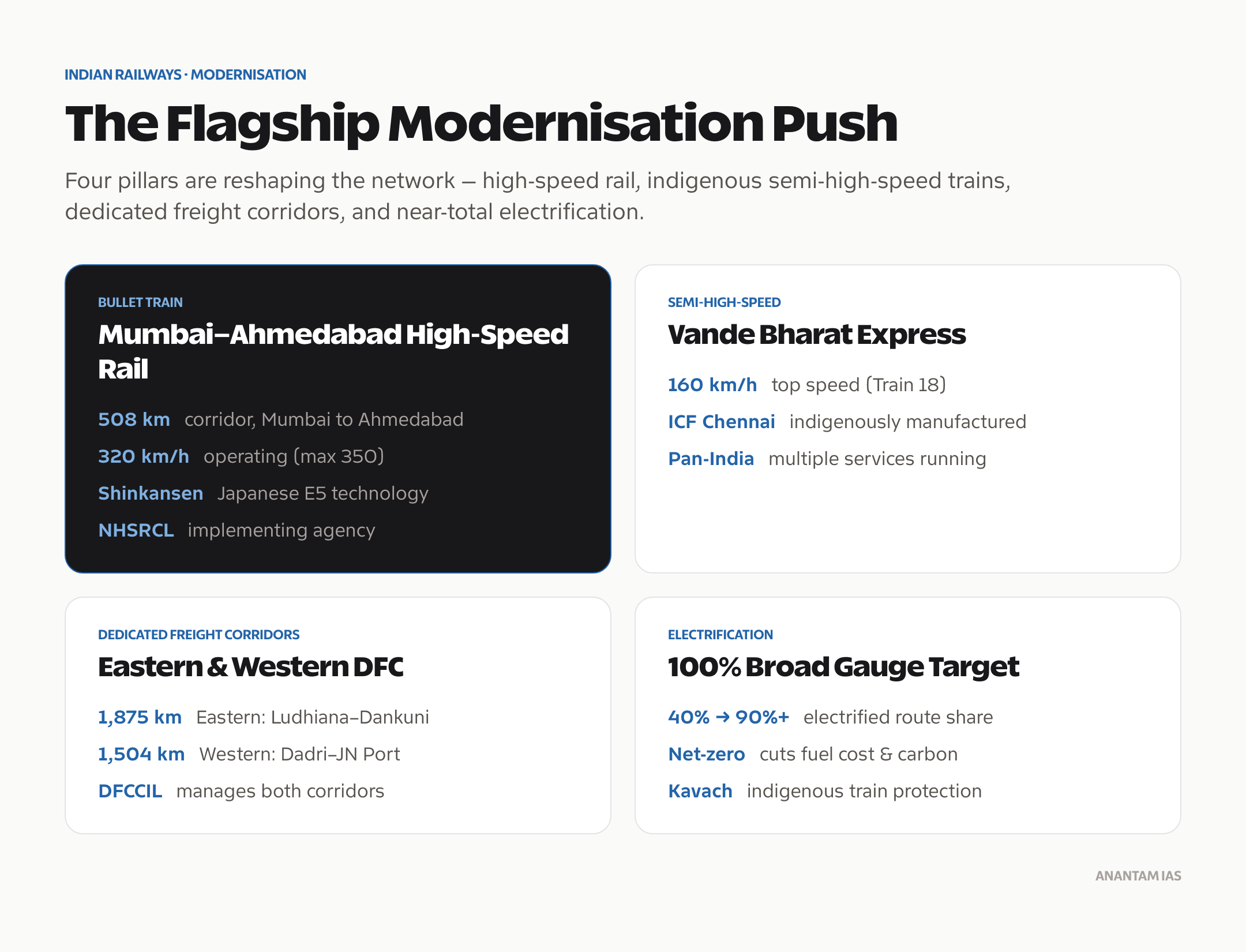
- 508 km corridor connecting Mumbai to Ahmedabad
- Technology: Japanese Shinkansen (E5 series)
- Speed: Maximum 350 km/h; operating at 320 km/h
- Funding: Largely through Japanese ODA loan (soft loan at 0.1% interest, 50-year repayment)
- National High Speed Rail Corporation Limited (NHSRCL) is the implementing agency
100% Electrification
Indian Railways has set a target for 100% broad gauge electrification (replacing diesel traction). The electrified route has increased from about 40% to over 90%. Electrification reduces fuel costs, increases speed, and cuts carbon emissions — supporting India’s net-zero commitment.
Station Redevelopment
Under the Amrit Bharat Station Scheme, over 1,300 stations are being upgraded with modern amenities, accessibility features, and improved architecture. Major stations like New Delhi, Ahmedabad, and Rani Kamlapati (Bhopal) are being redesigned as world-class transit hubs.
Kavach: Automatic Train Protection
Kavach (meaning armour) is an indigenously developed automatic train collision avoidance system:
- Uses radio frequency-based communication between train and trackside equipment
- Automatically applies brakes if driver fails to respond to danger signals
- Can prevent collisions and overspeeding
- Being deployed progressively across the network
Financial Performance
Indian Railways’ financial health is measured primarily by the Operating Ratio (OR) — the percentage of revenue spent on working expenses. An OR above 100% means the railway is spending more than it earns.
| Indicator | Significance |
|---|---|
| Operating Ratio | Revenue efficiency — lower is better (target: below 90%) |
| Internal resources | Surplus for capital investment |
| Cross-subsidy | Freight subsidises passengers |
| Capital expenditure | Investment in new lines, electrification, rolling stock |
Indian Railways’ operating ratio has hovered around 96–98% in recent years — leaving limited surplus for capital investment. The Bibek Debroy Committee (2015) recommended comprehensive reforms including corporatisation and allowing private operators.
Indian Railways and UPSC
Key UPSC-relevant themes:
- Infrastructure: Railways as a driver of economic development and connectivity
- Environment: Electrification, green railway initiatives, dedicated freight corridors reducing road transport
- Governance: Reforms — merger of services, restructured Railway Board, private participation
- Technology: Kavach, Vande Bharat, digital ticketing (IRCTC)
- Social: Railway as a social service — subsidised fares, reserved quotas, connecting remote regions
- History: Colonial railway building, national integration post-independence
Five Year Plans: History & Key Achievements
Important Facts for UPSC
- Largest employer: Over 12 lakh employees (after defence)
- Broadest gauge: Broad Gauge (1,676 mm) — dominates the network; metre and narrow gauge being converted
- Longest platform: Kharagpur (West Bengal) and Hubballi (Karnataka) — both claim records
- Highest railway station: Ghum (Darjeeling Himalayan Railway) at 2,258 m — a UNESCO World Heritage site
- UNESCO Heritage Railways: Darjeeling Himalayan Railway, Nilgiri Mountain Railway, Kalka-Shimla Railway
- IRCTC: Indian Railway Catering and Tourism Corporation — manages online ticketing, catering, and tourism
Frequently Asked Questions
When did the first train run in India?
The first passenger train in India ran on 16 April 1853 from Bombay (Bori Bunder, now CSMT) to Thane — a distance of 34 kilometres. It was operated by the Great Indian Peninsula Railway and hauled by three locomotives named Sahib, Sindh, and Sultan. This marked the beginning of the railway era in India, though railways were built primarily to serve British commercial interests.
How many railway zones are there in India?
Indian Railways has 18 zones, each headed by a General Manager. The original 6 zones were created in 1951, with subsequent additions expanding to 18 by 2003. Major zones include Northern Railway (New Delhi), Central Railway (Mumbai CST), Southern Railway (Chennai), and Eastern Railway (Kolkata). Zones are further divided into divisions for operational management.
What is the Vande Bharat Express?
Vande Bharat Express is India’s indigenously designed and manufactured semi-high-speed train, built at the Integral Coach Factory (ICF) in Chennai. It can achieve speeds up to 160 km/h and features modern amenities including automatic doors, GPS-based passenger information, and bio-vacuum toilets. Multiple Vande Bharat services now connect major cities, representing India’s push toward self-reliant manufacturing in railway technology.
What is Kavach?
Kavach is India’s indigenously developed Automatic Train Protection (ATP) system. It uses radio frequency-based communication between locomotives and trackside equipment to prevent collisions, overspeeding, and signal passing at danger. The system automatically applies brakes if the driver fails to respond. Kavach is being progressively deployed and is significantly cheaper than comparable foreign systems.