Internet Shutdowns in India: Telecommunications Act 2023, Anuradha Bhasin and the 2024 Trend Reset
Internet shutdowns in India explained: Telecommunications Act 2023, 2024 Suspension Rules, Anuradha Bhasin doctrine of proportionality, 84 shutdowns, Manipur and Haryana data.
For six straight years, from 2018 to 2023, India led the world in internet shutdowns. The Access Now and #KeepItOn coalition counted 134, 106, 109, 106, 84 and 116 incidents in those years, putting India ahead of every other country including authoritarian states. The 2024 report broke that streak, with India falling to second place behind Myanmar. India recorded 84 shutdowns under the Access Now methodology, with Manipur, Haryana and Jammu and Kashmir topping the state level table. The drop is welcome but partial. Behind the numbers sits a complex legal architecture, a still binding 2020 Supreme Court judgment, and an unresolved tension between Digital India ambitions and the executive convenience of pulling the plug.
This guide unpacks the Telecommunications Act 2023, the Telecommunications (Temporary Suspension of Services) Rules 2024, the Anuradha Bhasin doctrine of proportionality and the operational pipeline that runs from the Home Secretary to the Review Committee. It draws the line between permissible national security suspensions and impermissible exam time outages, and lays out the prelims and mains traps that recur in every cycle.
Quick Facts: Internet Shutdowns in India 2024
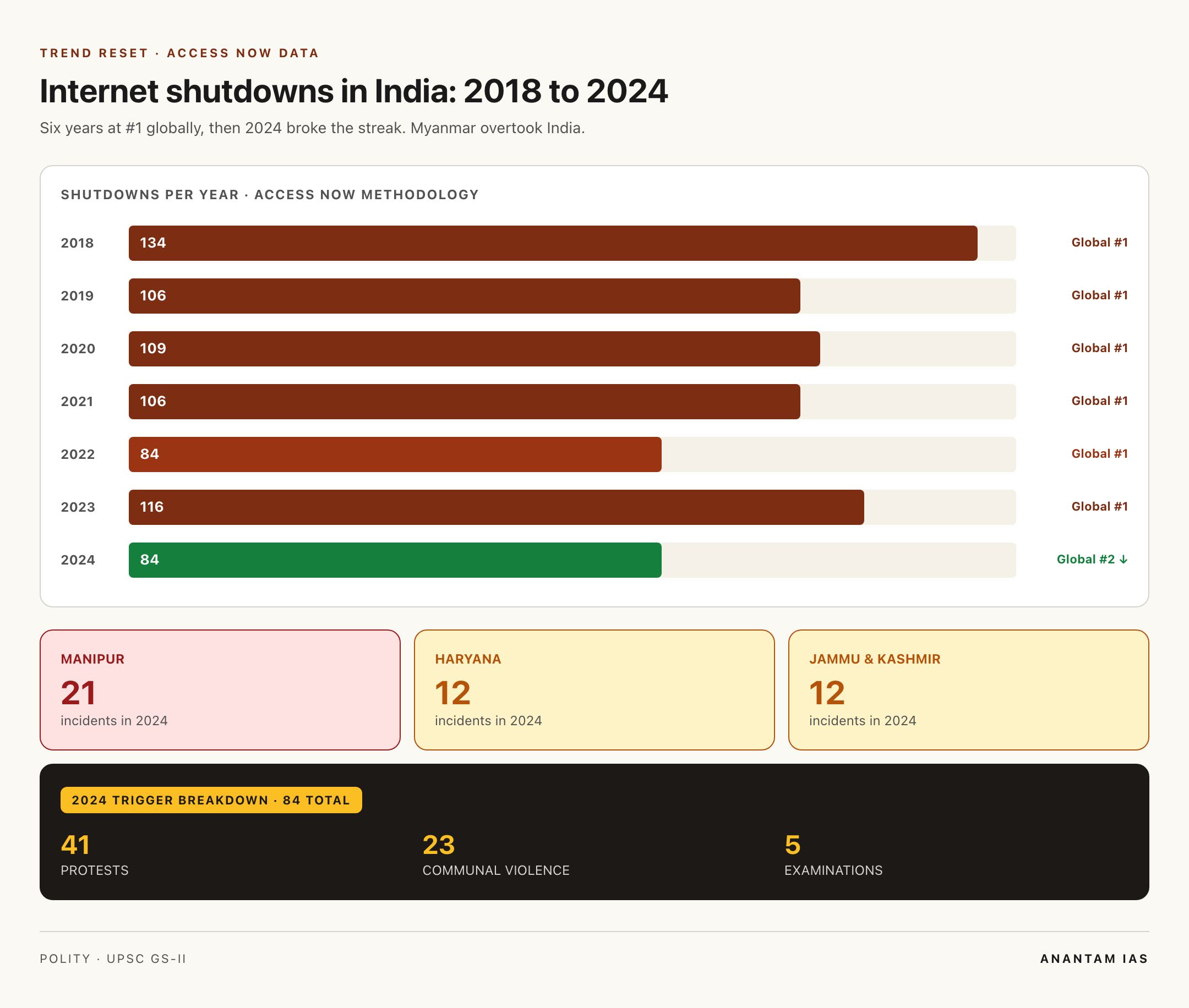
- 2024 ranking: Second globally, behind Myanmar. Breaks India’s six year streak as world’s number one.
- 2024 numbers: 84 shutdowns under Access Now methodology, 60 under SFLC.in tracking. Down from 116 in 2023.
- Top states 2024: Manipur 21 incidents, Haryana 12, Jammu and Kashmir 12.
- Primary triggers: Protests 41, communal violence 23, examinations 5.
- Parent statute: Telecommunications Act 2023, replacing the Indian Telegraph Act 1885.
- Operative rules: Telecommunications (Temporary Suspension of Services) Rules 2024, replacing the 2017 Rules.
- Authorising officer: Secretary, Ministry of Home Affairs at the Centre; Secretary, Home Department at the state level.
- Landmark precedent: Anuradha Bhasin vs Union of India, 2020.
What Is an Internet Shutdown
An internet shutdown is a deliberate disruption of internet services by a government authority for a defined period over a defined geography. It can be partial, blocking only specific platforms like X or WhatsApp, or total, blocking all data services. It can target mobile internet, fixed broadband, or both. The geography can be a single district, a state, or, in extreme cases, the entire country.
Shutdowns are distinct from speed throttling, which slows but does not block, and from content takedowns under Section 69A of the IT Act, which target specific URLs. The shutdown power is a network level intervention that affects every user inside the geography regardless of what they were trying to access.
Background and Historical Context
India’s shutdown architecture has migrated through three regimes. From colonial times until 2017, shutdowns were ordered under Section 5(2) of the Indian Telegraph Act 1885 and, in practice, often under Section 144 of the Code of Criminal Procedure 1973, which empowered District Magistrates to issue prohibitory orders for public order. The Telegraph Act route was procedurally unclear, the CrPC route was constitutionally unsound, and both regimes lacked oversight.
The Department of Telecommunications notified the Temporary Suspension of Telecom Services Rules 2017 to formalise the Telegraph Act route. These Rules created the Review Committee mechanism and required orders to be issued by Home Secretaries. Despite the Rules, District Magistrates continued to issue shutdown orders under Section 144 CrPC well into 2024, which the Supreme Court repeatedly flagged as illegal.
The Telecommunications Act 2023, which replaced the Telegraph Act, brought the shutdown power into a modern statutory frame, though most of the procedural architecture continues from the 2017 rules with minor updates in the 2024 Rules. The 2025 cycle is the first full year operating under the new Act.
Key Provisions: The Statutory and Procedural Architecture
Section 20 of the Telecommunications Act 2023 is the parent provision authorising temporary suspension of telecommunication services on grounds of public emergency or public safety, sovereignty and integrity, security of the state, friendly relations with foreign states, or to prevent incitement of an offence.
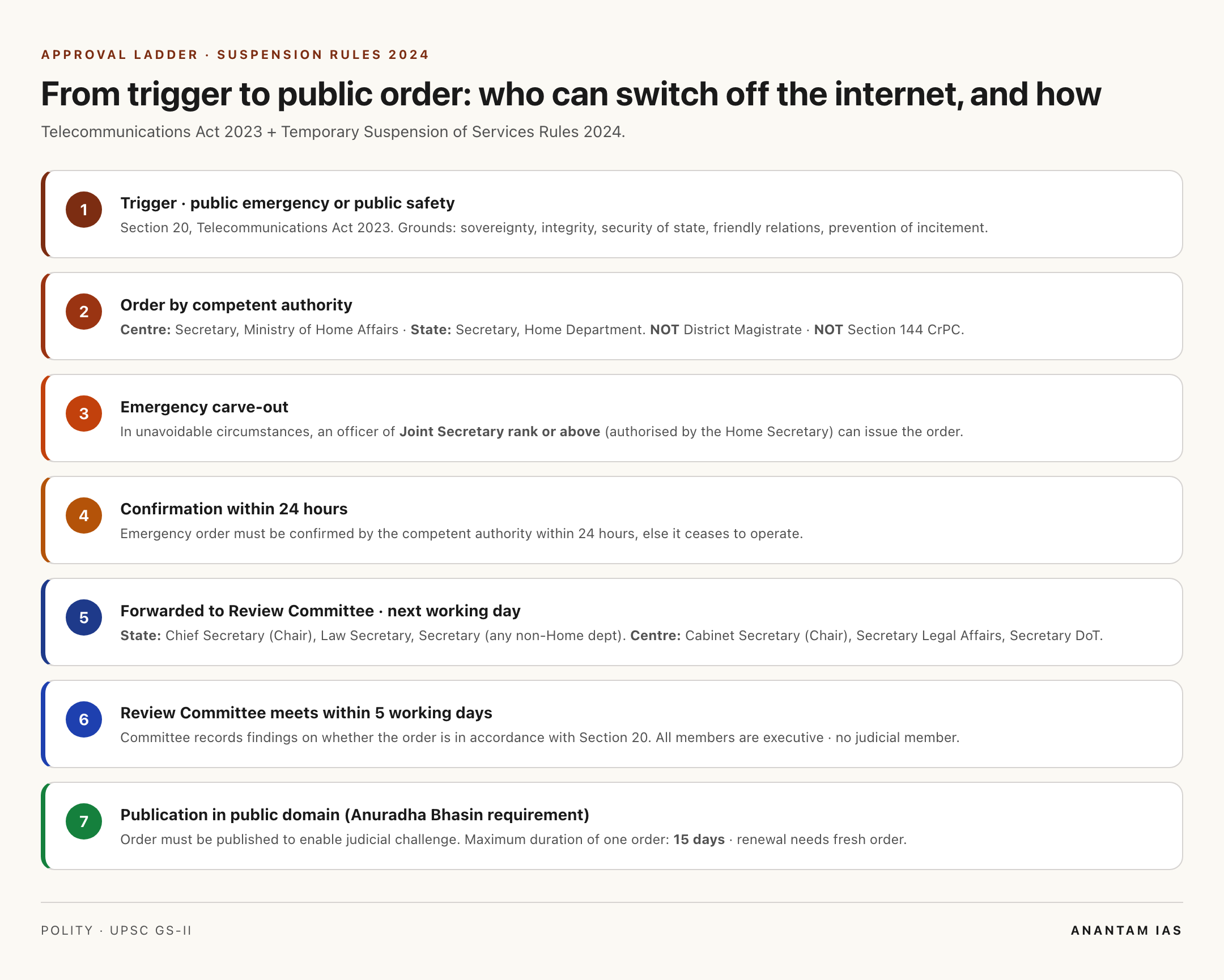
The Telecommunications (Temporary Suspension of Services) Rules 2024 lay out the procedure. The authorising officer at the Centre is the Secretary, Ministry of Home Affairs. At the state level, it is the Secretary, Home Department of the state government.
In emergency situations where the Secretary cannot be reached, an officer of Joint Secretary rank or above, specifically authorised by the Home Secretary, may issue the order. This emergency order must be confirmed by the competent authority within 24 hours. If not confirmed, the order ceases to operate.
The order must be forwarded to a Review Committee by the next working day. At the state level, the Review Committee comprises the Chief Secretary as Chairman, the Secretary in charge of the Law Department, and a Secretary from any department other than Home. At the Central level, it comprises the Cabinet Secretary as Chairman, the Secretary of the Department of Legal Affairs, and the Secretary of the Department of Telecommunications.
The Review Committee must meet within five working days to record its findings on whether the order is in accordance with Section 20 of the Act. The maximum period for which an order can remain in force is fifteen days, after which a fresh order is required. Anuradha Bhasin established that no shutdown can be indefinite.
Why Internet Shutdowns Matter
Three considerations make shutdowns a high stakes constitutional issue. The first is fundamental rights. Anuradha Bhasin held that the freedom of speech and expression under Article 19(1)(a) and the freedom to practice trade or business under Article 19(1)(g), exercised through the medium of the internet, are constitutionally protected. Note carefully that the Court did not declare a free standing right to internet, only that the internet, as a medium, attracts the same protection as the rights it carries.
The second is economic. The Indian Council for Research on International Economic Relations estimated that internet shutdowns cost the Indian economy ₹26,500 crore in 2020 alone. Gig workers lose income, small businesses lose orders, and UPI transactions stall. Each shutdown is a tax on digital adoption that runs counter to the Digital India and cyber security agenda.
The third is reputational. India is one of the most active members of the Freedom Online Coalition and a signatory to the 2016 UN Human Rights Council resolution condemning intentional internet disruption. The annual Access Now ranking puts the country in tension with this declared position.
Detailed Analysis: The Anuradha Bhasin Doctrine
The Supreme Court decision in Anuradha Bhasin vs Union of India, delivered in January 2020, remains the controlling precedent. The case arose from the August 2019 communications shutdown in Jammu and Kashmir following the abrogation of Article 370. The petitioners, including journalist Anuradha Bhasin and Congress MP Ghulam Nabi Azad, challenged the indefinite shutdown.
The Court laid down four propositions that now structure every shutdown analysis.
The first is that freedom of speech and expression and the freedom to practice trade or business through the internet are protected under Articles 19(1)(a) and 19(1)(g). Restrictions must therefore meet the reasonable restrictions test under Article 19(2) and 19(6).
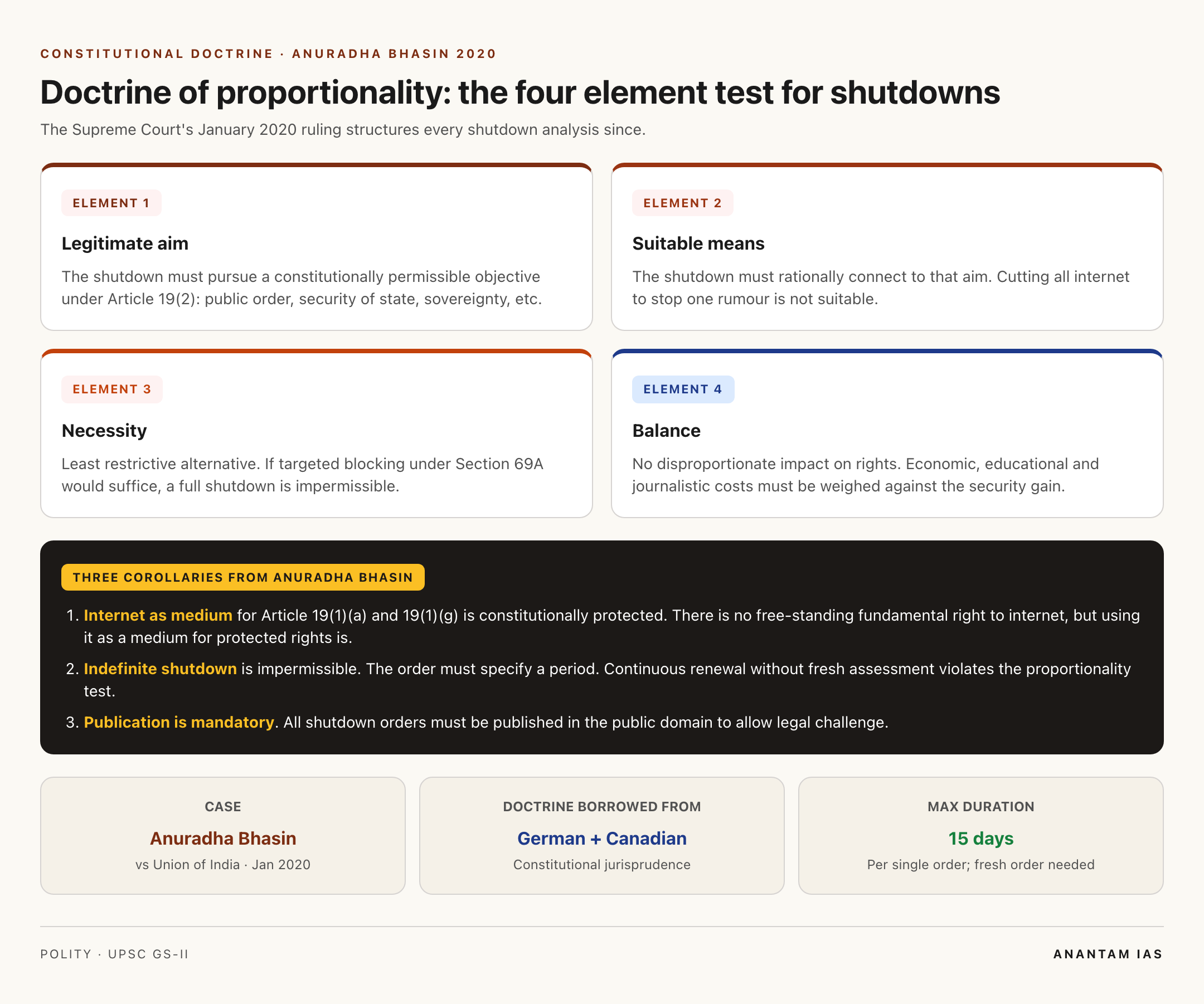
The second is the doctrine of proportionality. Any shutdown must satisfy four elements: a legitimate aim, suitable means to achieve that aim, necessity in the sense of being the least restrictive alternative, and balance with no disproportionate impact on rights. The doctrine borrows from German and Canadian constitutional jurisprudence and is now a default test for any executive restriction on Article 19 rights.
The third is that no shutdown can be indefinite. The order must specify a period. Continuous renewal without fresh assessment is impermissible.
The fourth is procedural transparency. All shutdown orders must be published in the public domain to enable legal challenge. This is the requirement that the Centre and several states have continued to flout, with a number of orders issued but never published until journalists or RTI applicants extract them.
Comparative Framework: India and Global Standards
The 2016 UN Human Rights Council resolution on the promotion, protection and enjoyment of human rights on the internet condemns measures to intentionally prevent or disrupt access to or dissemination of information online. India is a signatory but has not subscribed to the binding part of the resolution, citing the sovereign right to maintain public order.
The European Court of Human Rights has held in Yildirim vs Turkey (2012) that any restriction on internet access must be prescribed by law, pursue a legitimate aim, and be necessary in a democratic society. The Inter-American Court of Human Rights has gone further, holding in 2017 that internet access is a precondition for the exercise of free expression in the modern era.
The South African Constitutional Court has not yet ruled on shutdowns, but the African Commission on Human and Peoples’ Rights adopted a 2019 resolution treating internet shutdowns as presumptively incompatible with the African Charter. India sits behind these standards on the question of indefinite shutdowns and behind several states on the question of judicial review of shutdown orders.
Challenges and Criticism
Three substantive concerns recur. The first is exam shutdowns. States have repeatedly ordered shutdowns to prevent cheating in recruitment exams, citing public safety. The Telegraph Act and the Telecommunications Act 2023 do not list cheating in exams as a valid ground. Anuradha Bhasin specifically holds that public safety must be tied to a real threat, not administrative convenience. Despite this, Rajasthan, Haryana, Assam and Jharkhand have continued the practice.
The second is the District Magistrate problem. Section 144 CrPC orders by District Magistrates continue to be issued despite the 2017 and 2024 Rules unequivocally requiring Home Secretary level authorisation. The Supreme Court has flagged this in multiple orders. Compliance is uneven.
The third is the publication gap. Anuradha Bhasin requires every shutdown order to be published. In practice, many orders are never uploaded. RTI requests fill the gap, but the requirement of judicial review depends on prior publication, which the executive has resisted.
Prelims Pointers
- Parent statute is the Telecommunications Act 2023; operative rules are the Suspension Rules 2024.
- The 2017 Rules were the original procedural framework, replaced in 2024.
- District Magistrates cannot order shutdowns under the 2024 Rules. Home Secretary level authorisation is required.
- Emergency orders by Joint Secretary rank officers must be confirmed within 24 hours.
- Review Committee at the state level is chaired by the Chief Secretary; at the Centre by the Cabinet Secretary.
- Maximum period for a shutdown order is fifteen days; renewal requires a fresh order.
- Anuradha Bhasin (2020) holds that internet as a medium for Article 19 rights is protected.
- The doctrine of proportionality has four elements: legitimate aim, suitable means, necessity, balance.
- India ranked 2nd globally in 2024 shutdowns, after six years at number 1. Myanmar overtook India.
- Manipur led Indian states in 2024 with 21 shutdowns.
Mains Practice Questions
- The Anuradha Bhasin judgment laid down a four element doctrine of proportionality for internet shutdowns. Critically examine compliance with this doctrine over the period 2020 to 2024. (GS Paper 2, 250 words)
- India fell from first to second place in global internet shutdown rankings in 2024. Discuss the legal and policy reasons for this decline and the gaps that remain. (GS Paper 2, 250 words)
- The Telecommunications Act 2023 modernised the parent law for shutdown orders. Examine its provisions and assess whether they address the longstanding criticisms of the Telegraph Act regime. (GS Paper 2, 150 words)
- Discuss the tension between frequent internet shutdowns and the Digital India Mission. (GS Paper 2, 150 words)
Way Forward
A reform agenda would do four things. Parliament should amend the Telecommunications Act 2023 to require pre publication of shutdown orders, with a narrow exception for cases where pre publication would defeat the purpose. State and Central governments should formally direct District Magistrates that Section 144 CrPC cannot be used for telecom suspensions, with disciplinary consequences for violations. The Review Committee mechanism should be strengthened by adding at least one judicial or independent member, addressing the current concern that all members are executive officers. And the Supreme Court could take up a fresh PIL to develop Anuradha Bhasin further, particularly on the question of exam time shutdowns and on the publication requirement. The 2024 fall in shutdown numbers shows that the system can self correct under attention. The next step is to make that correction structural rather than reputational.
Frequently Asked Questions
Are internet shutdowns governed by the IT Act 2000?
No. Internet shutdowns are governed by the Telecommunications Act 2023, which replaced the Indian Telegraph Act 1885. The IT Act 2000 covers content blocking under Section 69A but not network level shutdowns.
Can a District Magistrate order an internet shutdown?
No. Under the Suspension Rules 2024, only the Secretary, Ministry of Home Affairs at the Centre or the Secretary, Home Department at the state level can authorise a shutdown. District Magistrates’ orders under Section 144 CrPC are technically incorrect.
What is the maximum duration of a shutdown?
Fifteen days under one order. A fresh order is required for any extension. Anuradha Bhasin holds that no shutdown can be indefinite.
Is the right to internet a fundamental right?
Anuradha Bhasin did not declare a free standing right to internet. It held that the internet as a medium for Article 19(1)(a) and 19(1)(g) rights is constitutionally protected.
Who is on the Review Committee at the state level?
The Chief Secretary as Chairman, the Secretary in charge of the Law Department, and a Secretary from any department other than Home.
What is the doctrine of proportionality?
A four element test: a legitimate aim, suitable means, necessity in the sense of least restrictive alternative, and balance with no disproportionate impact on rights. It applies to all executive restrictions on Article 19 freedoms.
Is preventing exam cheating a valid ground for shutdown?
No. The Telecommunications Act 2023 lists public emergency, public safety, sovereignty, integrity, security of the state, friendly relations with foreign states, and prevention of incitement to an offence. Cheating in exams is not on this list.
Did India have the most shutdowns in 2024?
No. Myanmar overtook India in 2024. India fell to second place after six consecutive years at number one.
Where can shutdown orders be challenged?
In a High Court under Article 226 or in the Supreme Court under Article 32 if a fundamental rights violation is alleged.
What is the role of the #KeepItOn coalition?
It is a global coalition of over 320 civil society organisations led by Access Now that tracks and reports internet shutdowns annually. Its data is widely cited including in Indian parliamentary debates.