Chief Ministers of Jammu and Kashmir: Complete List, Tenure and Party
Omar Abdullah is the Chief Minister of Jammu and Kashmir, in office since 16 October 2024. Here is the full list of everyone who has headed the government since 1947, including the Prime Minister era and every Governor's Rule and President's Rule spell.
Omar Abdullah of the Jammu & Kashmir National Conference is the Chief Minister of Jammu and Kashmir. He took oath on 16 October 2024, after the assembly election held that September, and he is the first Chief Minister of Jammu and Kashmir as a Union Territory. It is his second stint in the office — he had already served a full six-year term between January 2009 and January 2015.
Counting is tricky here, and the reason is a title change. Between 1947 and 1965 the head of government of Jammu and Kashmir was called the Prime Minister, not the Chief Minister. Nine people have held the office under the Chief Minister title since 1965, and thirteen individuals in all have headed the government since October 1947. Long stretches — more than sixteen years put together — had no elected government at all.
How the Office Works in Jammu and Kashmir
The Chief Minister is the real executive head of the government. Article 164 of the Constitution of India provides that the Chief Minister is appointed by the Governor and the other ministers are appointed on the Chief Minister’s advice; the council of ministers is collectively responsible to the legislative assembly. In practice the appointing authority invites the leader who can command a majority in the house, and the government survives only as long as it holds that confidence.
Jammu and Kashmir is currently a Union Territory with a legislature, so the appointment is made by the Lieutenant Governor rather than a Governor. The Jammu and Kashmir Reorganisation Act, 2019 created the Union Territories of Jammu and Kashmir and of Ladakh with effect from 31 October 2019. Ladakh has no legislature. Jammu and Kashmir has an assembly of 90 elected members, with a provision for five members to be nominated by the Lieutenant Governor.
Two labels matter when you read the list below. Until 2019, Jammu and Kashmir had its own state constitution, and Section 92 of that document allowed the Governor to assume the administration of the state — this was called Governor’s Rule, and it could run for a maximum of six months. President’s Rule under Article 356 of the Constitution of India was the separate central instrument that usually followed once the six-month Governor’s Rule window ran out. Most spells of central administration in Jammu and Kashmir therefore began as Governor’s Rule and converted into President’s Rule. The official Government of Jammu and Kashmir archive describes some of these long stretches as continuous Governor’s Rule, while standard chronologies split them at the six-month mark; the table below follows the split, because that is what the state constitution required.
Complete List of Chief Ministers of Jammu and Kashmir
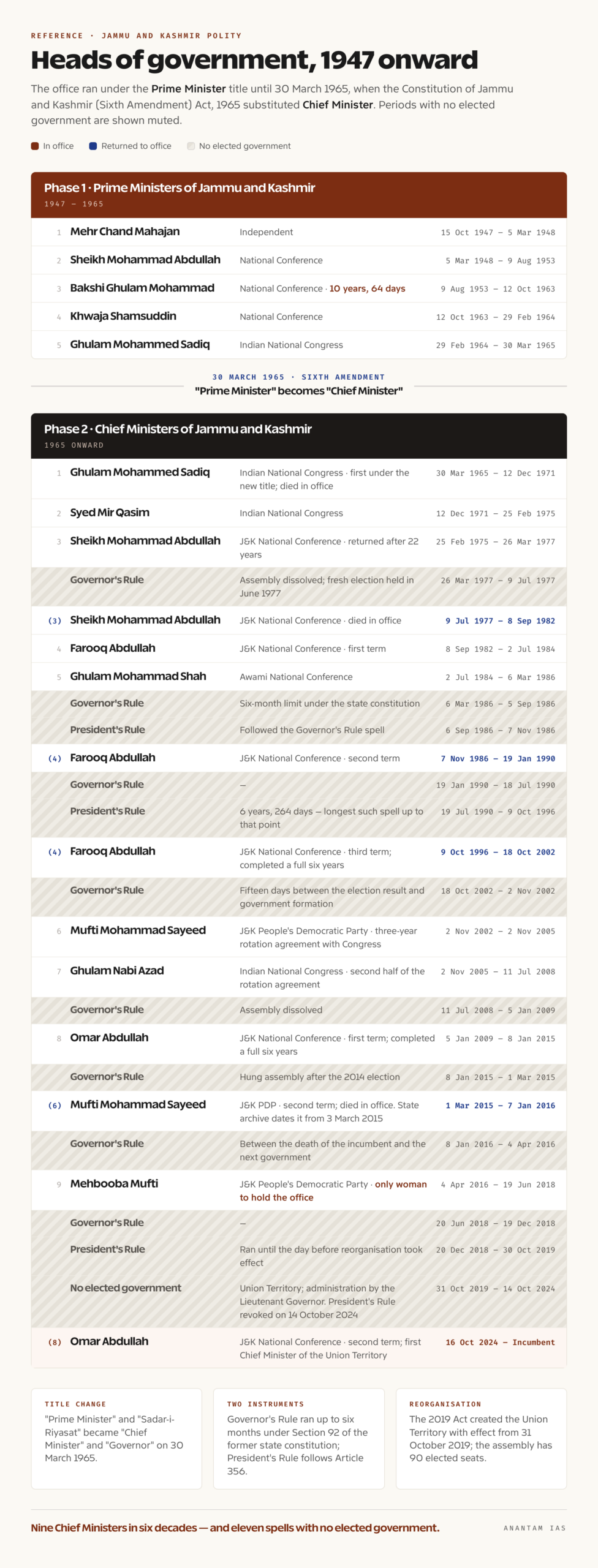
The list has two phases. The first covers the Prime Ministers of the state from 1947, and the second covers Chief Ministers from 1965 onward, after the Constitution of Jammu and Kashmir (Sixth Amendment) Act, 1965 replaced the designations “Prime Minister” and “Sadar-i-Riyasat” with “Chief Minister” and “Governor”.
Phase 1 — Prime Ministers of Jammu and Kashmir (1947-1965)
| # | Name | Term Start | Term End | Party | Notes |
|---|---|---|---|---|---|
| 1 | Mehr Chand Mahajan | 15 October 1947 | 5 March 1948 | Independent | Jurist; the official state archive dates his term from 15 October 1947, while some listings start it from 27 October 1947 |
| 2 | Sheikh Mohammad Abdullah | 5 March 1948 | 9 August 1953 | National Conference | Headed the emergency administration and then the elected government; dismissed from office in August 1953 |
| 3 | Bakshi Ghulam Mohammad | 9 August 1953 | 12 October 1963 | National Conference | Longest single unbroken tenure by any head of government of Jammu and Kashmir — 10 years, 64 days |
| 4 | Khwaja Shamsuddin | 12 October 1963 | 29 February 1964 | National Conference | Brief tenure of about four and a half months |
| 5 | Ghulam Mohammed Sadiq | 29 February 1964 | 30 March 1965 | Indian National Congress | Continued in office as Chief Minister after the title change |
Phase 2 — Chief Ministers of Jammu and Kashmir (1965 onward)
| # | Name | Term Start | Term End | Party | Notes |
|---|---|---|---|---|---|
| 1 | Ghulam Mohammed Sadiq | 30 March 1965 | 12 December 1971 | Indian National Congress | First Chief Minister under the new title; died in office |
| 2 | Syed Mir Qasim | 12 December 1971 | 25 February 1975 | Indian National Congress | — |
| 3 | Sheikh Mohammad Abdullah | 25 February 1975 | 26 March 1977 | J&K National Conference | Returned as head of government after 22 years |
| — | Governor’s Rule | 26 March 1977 | 9 July 1977 | — | Assembly dissolved; fresh election held in June 1977 |
| (3) | Sheikh Mohammad Abdullah | 9 July 1977 | 8 September 1982 | J&K National Conference | Died in office |
| 4 | Farooq Abdullah | 8 September 1982 | 2 July 1984 | J&K National Conference | First term |
| 5 | Ghulam Mohammad Shah | 2 July 1984 | 6 March 1986 | Awami National Conference | — |
| — | Governor’s Rule | 6 March 1986 | 5 September 1986 | — | Six-month limit under the state constitution |
| — | President’s Rule | 6 September 1986 | 7 November 1986 | — | Followed the Governor’s Rule spell |
| (4) | Farooq Abdullah | 7 November 1986 | 19 January 1990 | J&K National Conference | Second term |
| — | Governor’s Rule | 19 January 1990 | 18 July 1990 | — | — |
| — | President’s Rule | 19 July 1990 | 9 October 1996 | — | Longest continuous spell without an elected government up to that point — 6 years, 264 days |
| (4) | Farooq Abdullah | 9 October 1996 | 18 October 2002 | J&K National Conference | Third term; completed a full six years |
| — | Governor’s Rule | 18 October 2002 | 2 November 2002 | — | Fifteen days between the election result and government formation |
| 6 | Mufti Mohammad Sayeed | 2 November 2002 | 2 November 2005 | J&K People’s Democratic Party | First PDP Chief Minister; three-year rotation agreement with Congress |
| 7 | Ghulam Nabi Azad | 2 November 2005 | 11 July 2008 | Indian National Congress | Took the second half of the rotation agreement |
| — | Governor’s Rule | 11 July 2008 | 5 January 2009 | — | Assembly dissolved |
| 8 | Omar Abdullah | 5 January 2009 | 8 January 2015 | J&K National Conference | First term; completed a full six years |
| — | Governor’s Rule | 8 January 2015 | 1 March 2015 | — | Hung assembly after the 2014 election |
| (6) | Mufti Mohammad Sayeed | 1 March 2015 | 7 January 2016 | J&K People’s Democratic Party | Second term; died in office. The official state archive dates this term from 3 March 2015 |
| — | Governor’s Rule | 8 January 2016 | 4 April 2016 | — | Between the death of the incumbent and the next government |
| 9 | Mehbooba Mufti | 4 April 2016 | 19 June 2018 | J&K People’s Democratic Party | Only woman to hold the office |
| — | Governor’s Rule | 20 June 2018 | 19 December 2018 | — | — |
| — | President’s Rule | 20 December 2018 | 30 October 2019 | — | Ran until the day before reorganisation took effect |
| — | No elected government (Union Territory) | 31 October 2019 | 14 October 2024 | — | Administration by the Lieutenant Governor; President’s Rule revoked on 14 October 2024 |
| (8) | Omar Abdullah | 16 October 2024 | Incumbent | J&K National Conference | Second term; first Chief Minister of the Union Territory |
Two features stand out. The office has changed hands far less often than in most Indian states — nine people in six decades — but it has also stood vacant far more often, across eleven separate spells of central administration. And a single family thread runs through much of the list: Sheikh Abdullah, his son Farooq Abdullah and his grandson Omar Abdullah have together headed the government for more than thirty years.
Longest-Serving and Most Notable Chief Ministers
Longest single unbroken tenure: Bakshi Ghulam Mohammad, 10 years and 64 days as Prime Minister from August 1953 to October 1963. No one has come close since. Under the Chief Minister title, the longest single stretch is Ghulam Mohammed Sadiq’s 6 years and 257 days from March 1965 to December 1971, narrowly ahead of Farooq Abdullah’s 6 years and 9 days from 1996 to 2002 and Omar Abdullah’s 6 years and 3 days from 2009 to 2015.
Longest total service: Farooq Abdullah, with about 11 years across three separate terms — 1982-84, 1986-90 and 1996-2002. His father Sheikh Abdullah served roughly 12 years 8 months in total, but that figure spans both the Prime Minister and Chief Minister eras.
Firsts: Mehr Chand Mahajan was the first Prime Minister of the state after October 1947, and Sheikh Abdullah the first from the National Conference. Ghulam Mohammed Sadiq is counted as the first Chief Minister, since he was in office on 30 March 1965 when the designation changed. Mehbooba Mufti is the only woman to have held the post, from April 2016 to June 2018. Omar Abdullah is the first Chief Minister of the Union Territory.
A few tenures are remembered for specific institutional turns. Sheikh Abdullah’s second innings from 1975 followed an accord with the central government and returned him to office after more than two decades out of it. Mufti Mohammad Sayeed’s 2002-05 term was built on a written power-sharing arrangement with the Congress that split a six-year assembly term into two three-year halves — an unusual formal rotation in Indian state politics, and one that was repeated in reverse when Ghulam Nabi Azad took over in November 2005. Omar Abdullah’s first term, from January 2009 to January 2015, is one of only three tenures in the state’s history to have run a full six-year assembly term end to end.
How Power Has Shifted: Party Trends in Jammu and Kashmir
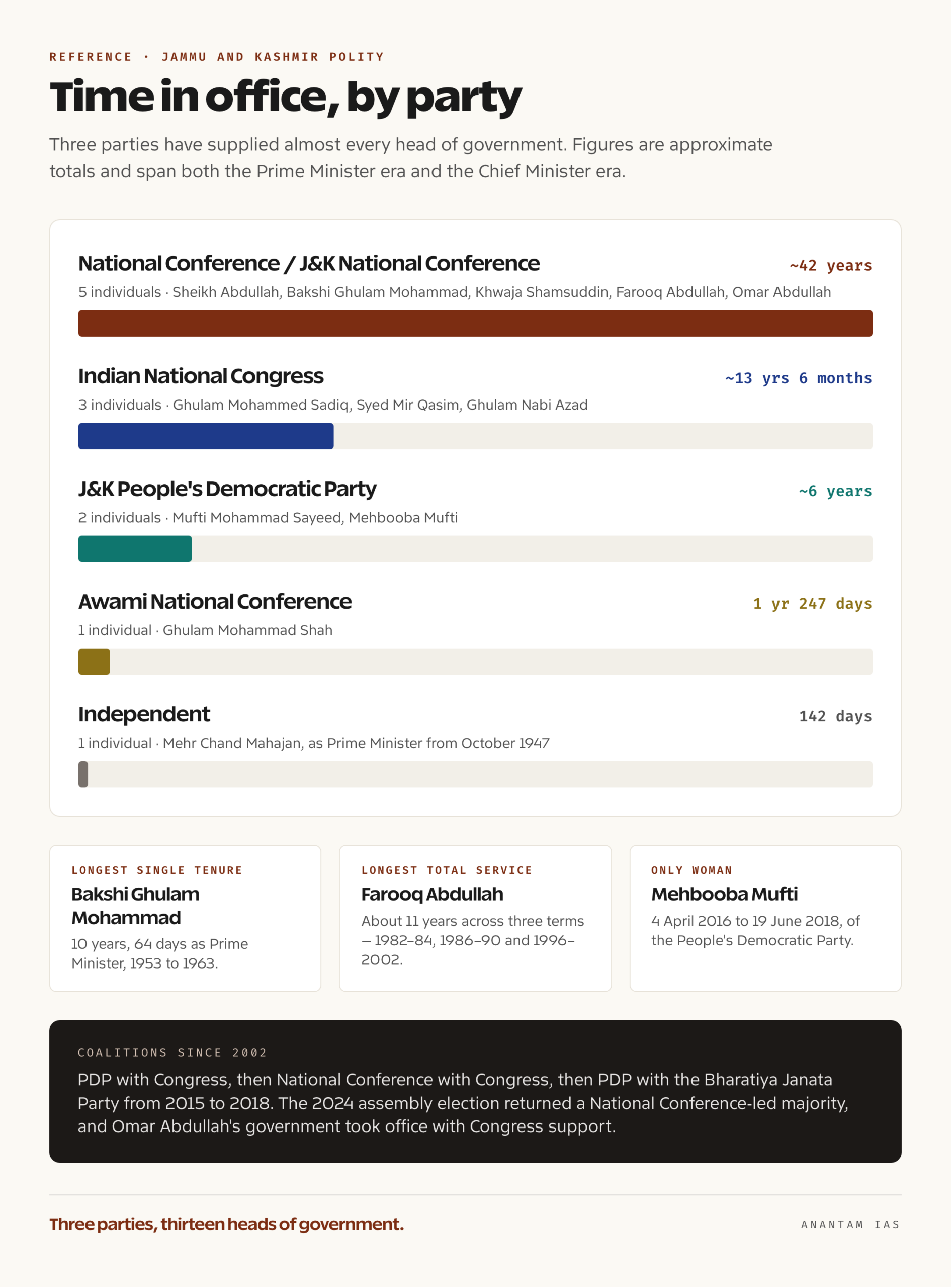
Three parties have supplied almost every head of government. The National Conference — under its earlier name and then as the Jammu & Kashmir National Conference — has held the office the longest. The Indian National Congress supplied Sadiq, Qasim and Azad. The People’s Democratic Party, founded in 1999, produced two Chief Ministers within a decade of its formation.
| Party | Individuals | Approximate time in office |
|---|---|---|
| National Conference / J&K National Conference | 5 (Sheikh Abdullah, Bakshi Ghulam Mohammad, Khwaja Shamsuddin, Farooq Abdullah, Omar Abdullah) | About 42 years across both eras |
| Indian National Congress | 3 (Sadiq, Qasim, Azad) | About 13 and a half years |
| J&K People’s Democratic Party | 2 (Mufti Mohammad Sayeed, Mehbooba Mufti) | About 6 years |
| Awami National Conference | 1 (Ghulam Mohammad Shah) | 1 year, 247 days |
| Independent | 1 (Mehr Chand Mahajan) | 142 days |
The pattern of alliances has shifted more than the party count suggests. Congress governments in the 1960s and 1970s gave way to National Conference dominance in the 1980s and 1990s. From 2002 the picture became genuinely coalitional: PDP with Congress, then National Conference with Congress, then PDP with the Bharatiya Janata Party from 2015 to 2018. The 2024 assembly election returned a National Conference-led majority, and Omar Abdullah’s government took office with Congress support.
Records and Quick Facts
- Current Chief Minister: Omar Abdullah, J&K National Conference, in office since 16 October 2024.
- First Chief Minister (post-1965 title): Ghulam Mohammed Sadiq, from 30 March 1965.
- First Prime Minister of the state after October 1947: Mehr Chand Mahajan.
- Shortest tenure: Mehr Chand Mahajan’s 142 days as Prime Minister. Among Chief Ministers, Mufti Mohammad Sayeed’s second term of 312 days is the shortest.
- Most terms: Farooq Abdullah, three.
- Only woman: Mehbooba Mufti, 4 April 2016 to 19 June 2018.
- Died in office: Ghulam Mohammed Sadiq (1971), Sheikh Abdullah (1982) and Mufti Mohammad Sayeed (2016).
- Spells of central administration: eight of Governor’s Rule and three of President’s Rule between 1977 and 2019, plus the 2019-2024 period with no elected government.
- Longest gap without an elected government: 31 October 2019 to 16 October 2024, just under five years, following the 2019 reorganisation.
- Assembly strength: 90 elected seats, with provision for five nominated members.
FAQ
Who is the current Chief Minister of Jammu and Kashmir? Omar Abdullah of the Jammu & Kashmir National Conference. He was sworn in on 16 October 2024 after the assembly election held in September and October that year, and he is the first Chief Minister of the Union Territory of Jammu and Kashmir.
Who was the first Chief Minister of Jammu and Kashmir? Ghulam Mohammed Sadiq. He was serving as Prime Minister when the Constitution of Jammu and Kashmir (Sixth Amendment) Act, 1965 replaced that title with “Chief Minister” on 30 March 1965, so he became the first officeholder under the new designation and continued until his death in December 1971.
Why was the head of government called Prime Minister until 1965? Jammu and Kashmir had its own constitution, which used the designations “Sadar-i-Riyasat” for the head of state and “Prime Minister” for the head of government. The Sixth Amendment to that constitution substituted “Governor” and “Chief Minister” respectively, bringing the nomenclature in line with other Indian states.
Who has served the longest as Chief Minister of Jammu and Kashmir? Farooq Abdullah has the longest total service under the Chief Minister title, roughly 11 years across three terms. The longest single unbroken tenure by any head of government belongs to Bakshi Ghulam Mohammad, who served 10 years and 64 days as Prime Minister from 1953 to 1963.
What is the difference between Governor’s Rule and President’s Rule in Jammu and Kashmir? Governor’s Rule was a provision of the former state constitution that let the Governor take over the administration for up to six months. President’s Rule under Article 356 of the Constitution of India is the central instrument that applies to states generally, and in Jammu and Kashmir it typically followed once the six-month Governor’s Rule limit expired. After the 2019 reorganisation, only the Article 356 route and Lieutenant Governor’s administration remain relevant.
Practice Questions
Practice MCQs
- The head of government of Jammu and Kashmir was designated “Prime Minister” until which year? (a) 1957 (b) 1962 (c) 1965 (d) 1975 — Answer: (c) The Constitution of Jammu and Kashmir (Sixth Amendment) Act, 1965 substituted “Chief Minister” for “Prime Minister” with effect from 30 March 1965.
- Who became the first Chief Minister of Jammu and Kashmir after the title change? (a) Sheikh Abdullah (b) Bakshi Ghulam Mohammad (c) Syed Mir Qasim (d) Ghulam Mohammed Sadiq — Answer: (d) Sadiq was already Prime Minister and simply continued in office under the new designation from 30 March 1965.
- Under which Act was the former state of Jammu and Kashmir reorganised into two Union Territories? (a) States Reorganisation Act, 1956 (b) Jammu and Kashmir Reorganisation Act, 2019 (c) North-Eastern Areas (Reorganisation) Act, 1971 (d) Government of Union Territories Act, 1963 — Answer: (b) The 2019 Act created the Union Territories of Jammu and Kashmir and of Ladakh with effect from 31 October 2019.
- Who is the only woman to have served as Chief Minister of Jammu and Kashmir? (a) Mehbooba Mufti (b) Sheila Dikshit (c) Rabri Devi (d) Anandiben Patel — Answer: (a) Mehbooba Mufti of the People’s Democratic Party held office from 4 April 2016 to 19 June 2018.
- Article 164 of the Constitution of India deals with which of the following? (a) Appointment of the Governor (b) Appointment of the Chief Minister and other ministers (c) Dissolution of the legislative assembly (d) Powers of the Election Commission — Answer: (b) Article 164 provides for the appointment of the Chief Minister by the Governor, of other ministers on the Chief Minister’s advice, and for collective responsibility to the assembly.