Chief Ministers of Karnataka: Complete List, Tenure and Party
Every Chief Minister of Karnataka since 1947, including the Mysore State years before the 1973 renaming, with term dates, parties and all six President's Rule spells.
The current Chief Minister of Karnataka is D. K. Shivakumar of the Indian National Congress, sworn in on 3 June 2026. He took over from Siddaramaiah under a power-sharing arrangement agreed inside the Congress after the 2023 election, and was administered the oath by Governor Thaawarchand Gehlot along with thirteen ministers.
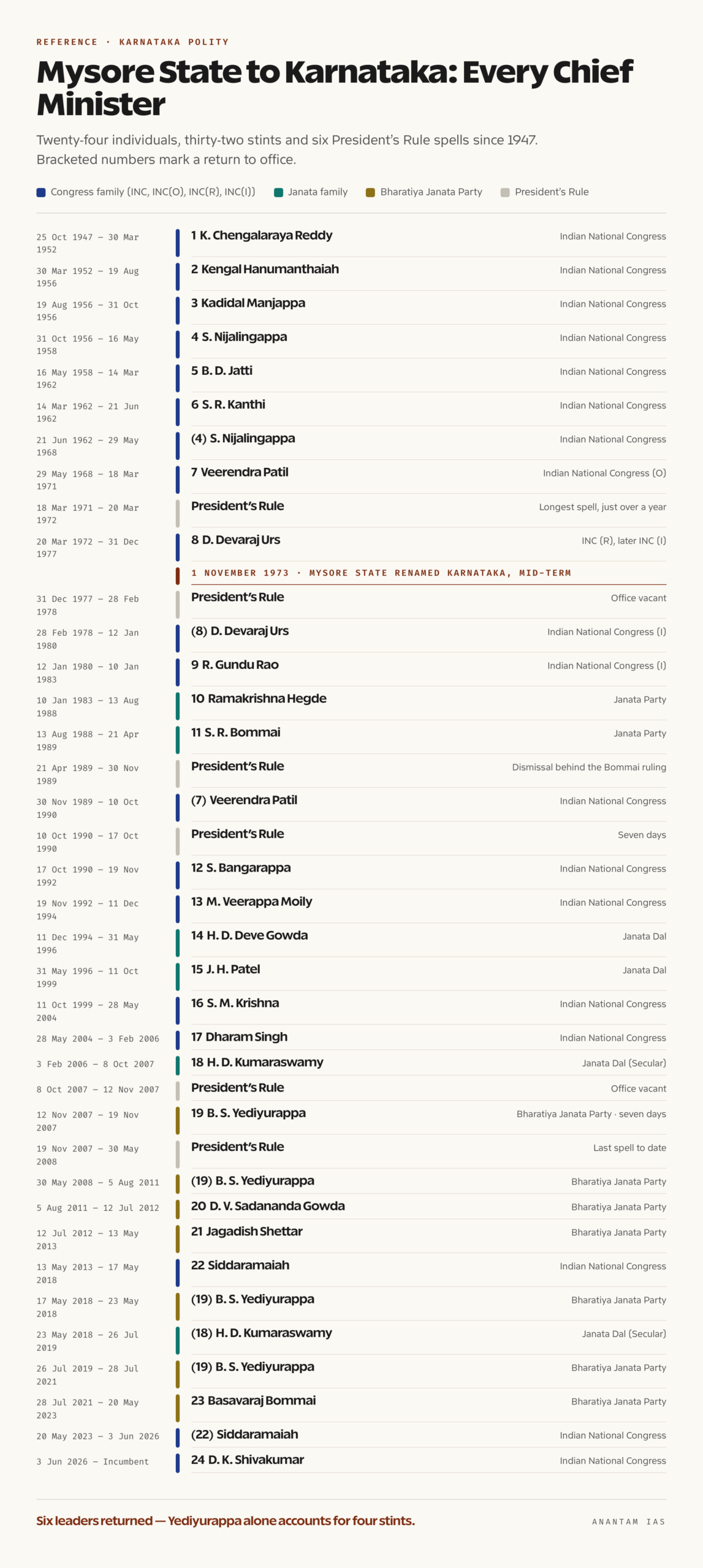
Karnataka’s list is longer and choppier than most states’. Twenty-four people have led the state government since 1947, and they have done so across thirty-two separate stints — because six leaders came back for second, third or even fourth turns, and because coalitions here have a habit of collapsing mid-term. The office has also fallen vacant six times under President’s Rule.
How the Office Works in Karnataka
Article 164 of the Constitution is the operative provision. The Governor appoints the Chief Minister; the other ministers are appointed by the Governor on the Chief Minister’s advice; and the council of ministers is collectively responsible to the Legislative Assembly. The Governor is the state’s formal head, but executive power in practice rests with the Chief Minister.
The Governor’s discretion is bounded by convention. The invitation goes to whoever can command a majority in the 224-member Karnataka Legislative Assembly, elected for five years unless dissolved earlier. If that majority disappears, the government falls. Karnataka has tested this rule more than most states — the Supreme Court’s landmark ruling on the misuse of Article 356 grew out of the 1989 dismissal of the S. R. Bommai government here.
Karnataka also has a Legislative Council, an upper house, and a Chief Minister may sit in either chamber. D. V. Sadananda Gowda held office in 2011-12 as a member of the Council rather than the Assembly.
There is no limit on how many times a person may be appointed. B. S. Yediyurappa was sworn in four separate times, which is the state record.
Complete List of Chief Ministers of Karnataka
Where this list starts needs explaining. The princely Kingdom of Mysore became Mysore State after independence, and K. Chengalaraya Reddy headed its government from 25 October 1947 — first as Premier, then as Chief Minister once the Constitution came into force. On 1 November 1956 the States Reorganisation Act enlarged Mysore State with the Kannada-speaking districts of the Bombay, Hyderabad and Madras states plus the whole of Coorg. And on 1 November 1973 the Mysore State (Alteration of Name) Act renamed the state Karnataka.
So the office is continuous but the state’s name is not. This table runs from 1947 and numbers every individual in order of first taking office, which is why the count reaches 24. Official and encyclopaedic listings often restart the numbering at the 1973 renaming, making D. Devaraj Urs the “first” Chief Minister of Karnataka and D. K. Shivakumar the eighteenth — both counts are defensible, they just measure different things.
| # | Name | Term Start | Term End | Party | Notes |
|---|---|---|---|---|---|
| 1 | K. Chengalaraya Reddy | 25 October 1947 | 30 March 1952 | Indian National Congress | Premier of Mysore State until 26 January 1950, then Chief Minister |
| 2 | Kengal Hanumanthaiah | 30 March 1952 | 19 August 1956 | Indian National Congress | Oversaw the building of the Vidhana Soudha |
| 3 | Kadidal Manjappa | 19 August 1956 | 31 October 1956 | Indian National Congress | Last Chief Minister of the pre-reorganisation state |
| 4 | S. Nijalingappa | 31 October 1956 | 16 May 1958 | Indian National Congress | First Chief Minister of the enlarged Mysore State |
| 5 | B. D. Jatti | 16 May 1958 | 14 March 1962 | Indian National Congress | Later Vice-President of India, 1974-79 |
| 6 | S. R. Kanthi | 14 March 1962 | 21 June 1962 | Indian National Congress | |
| (4) | S. Nijalingappa | 21 June 1962 | 29 May 1968 | Indian National Congress | Second stint |
| 7 | Veerendra Patil | 29 May 1968 | 18 March 1971 | Indian National Congress (O) | |
| — | President’s Rule | 18 March 1971 | 20 March 1972 | — | Office vacant; assembly dissolved |
| 8 | D. Devaraj Urs | 20 March 1972 | 31 December 1977 | Indian National Congress (R), later INC (I) | State renamed Karnataka on 1 November 1973, mid-term |
| — | President’s Rule | 31 December 1977 | 28 February 1978 | — | Office vacant; assembly dissolved |
| (8) | D. Devaraj Urs | 28 February 1978 | 12 January 1980 | Indian National Congress (I) | Second stint |
| 9 | R. Gundu Rao | 12 January 1980 | 10 January 1983 | Indian National Congress (I) | |
| 10 | Ramakrishna Hegde | 10 January 1983 | 13 August 1988 | Janata Party | First Chief Minister from outside the Congress family |
| 11 | S. R. Bommai | 13 August 1988 | 21 April 1989 | Janata Party | Dismissal led to the Supreme Court’s S. R. Bommai ruling |
| — | President’s Rule | 21 April 1989 | 30 November 1989 | — | Office vacant; assembly dissolved |
| (7) | Veerendra Patil | 30 November 1989 | 10 October 1990 | Indian National Congress | Returned after a gap of more than 18 years |
| — | President’s Rule | 10 October 1990 | 17 October 1990 | — | Office vacant; seven days |
| 12 | S. Bangarappa | 17 October 1990 | 19 November 1992 | Indian National Congress | |
| 13 | M. Veerappa Moily | 19 November 1992 | 11 December 1994 | Indian National Congress | |
| 14 | H. D. Deve Gowda | 11 December 1994 | 31 May 1996 | Janata Dal | Left to become Prime Minister of India |
| 15 | J. H. Patel | 31 May 1996 | 11 October 1999 | Janata Dal | |
| 16 | S. M. Krishna | 11 October 1999 | 28 May 2004 | Indian National Congress | |
| 17 | Dharam Singh | 28 May 2004 | 3 February 2006 | Indian National Congress | Congress-JD(S) coalition |
| 18 | H. D. Kumaraswamy | 3 February 2006 | 8 October 2007 | Janata Dal (Secular) | JD(S)-BJP coalition |
| — | President’s Rule | 8 October 2007 | 12 November 2007 | — | Office vacant |
| 19 | B. S. Yediyurappa | 12 November 2007 | 19 November 2007 | Bharatiya Janata Party | Seven days; lost the confidence vote |
| — | President’s Rule | 19 November 2007 | 30 May 2008 | — | Office vacant; assembly dissolved |
| (19) | B. S. Yediyurappa | 30 May 2008 | 5 August 2011 | Bharatiya Janata Party | First full BJP government in a southern state |
| 20 | D. V. Sadananda Gowda | 5 August 2011 | 12 July 2012 | Bharatiya Janata Party | Held office as a member of the Legislative Council |
| 21 | Jagadish Shettar | 12 July 2012 | 13 May 2013 | Bharatiya Janata Party | |
| 22 | Siddaramaiah | 13 May 2013 | 17 May 2018 | Indian National Congress | Completed a full five-year term |
| (19) | B. S. Yediyurappa | 17 May 2018 | 23 May 2018 | Bharatiya Janata Party | Resigned before the confidence vote |
| (18) | H. D. Kumaraswamy | 23 May 2018 | 26 July 2019 | Janata Dal (Secular) | Congress-JD(S) coalition; fell on a trust vote |
| (19) | B. S. Yediyurappa | 26 July 2019 | 28 July 2021 | Bharatiya Janata Party | Fourth and final stint |
| 23 | Basavaraj Bommai | 28 July 2021 | 20 May 2023 | Bharatiya Janata Party | |
| (22) | Siddaramaiah | 20 May 2023 | 3 June 2026 | Indian National Congress | Second stint |
| 24 | D. K. Shivakumar | 3 June 2026 | Incumbent | Indian National Congress | Took over under a Congress power-sharing arrangement |
Twenty-four individuals, thirty-two stints. Numbers in brackets mark returns, and six leaders have one — Nijalingappa, Devaraj Urs, Veerendra Patil, Kumaraswamy, Siddaramaiah and Yediyurappa, who alone accounts for four.
Two dates in the table carry small source disagreements worth flagging. The 2007-08 President’s Rule is given by some listings as ending 29 May 2008 and by others as 30 May 2008, the day Yediyurappa was sworn in. And Yediyurappa announced his resignation on 19 May 2018 after failing to demonstrate a majority, but formally remained in office until Kumaraswamy took oath on 23 May — which is why his 2018 stint is sometimes described as two days and sometimes as six.
Longest-Serving and Most Notable Chief Ministers
Siddaramaiah is the longest-serving Chief Minister in the state’s history, with about 8 years and 18 days in total — five years and four days in his first stint from 2013 to 2018, and just over three years in his second from 2023 to 2026. He is also the only person to have completed a full five-year term and then returned for another.
D. Devaraj Urs is second at roughly 7 years and 239 days, and S. Nijalingappa third at about 7 years and 175 days. Urs is the pivotal figure of the 1970s: he presided over the renaming of the state in 1973, pushed land reform and tenancy legislation, and built a political base among backward classes and minorities that reshaped Karnataka’s electoral map for a generation.
Ramakrishna Hegde broke the Congress monopoly. His Janata Party government of 1983 was the first in the state led by someone from outside the Congress and its splinters, and he is remembered for decentralisation — the Zilla Parishad and Mandal Panchayat legislation that gave Karnataka one of India’s earliest working systems of elected local government.
S. R. Bommai’s short tenure produced the most consequential legal legacy of any Karnataka Chief Minister. His government was dismissed in April 1989 and the case he brought led to the Supreme Court’s 1994 judgment in S. R. Bommai v. Union of India, which made President’s Rule judicially reviewable and required that a government’s majority be tested on the floor of the house rather than assessed in a Governor’s report.
Two leaders went on to higher office. H. D. Deve Gowda left the Chief Minister’s chair in 1996 to become Prime Minister of India. B. D. Jatti, Chief Minister from 1958 to 1962, became Vice-President in 1974 and served as acting President in 1977.
And B. S. Yediyurappa holds the record for returns. Sworn in four times between 2007 and 2019, he led the BJP to its first government in any southern state, and his 2007 seven-day tenure remains one of the shortest in Indian state politics.
How Power Has Shifted: Party Trends in Karnataka
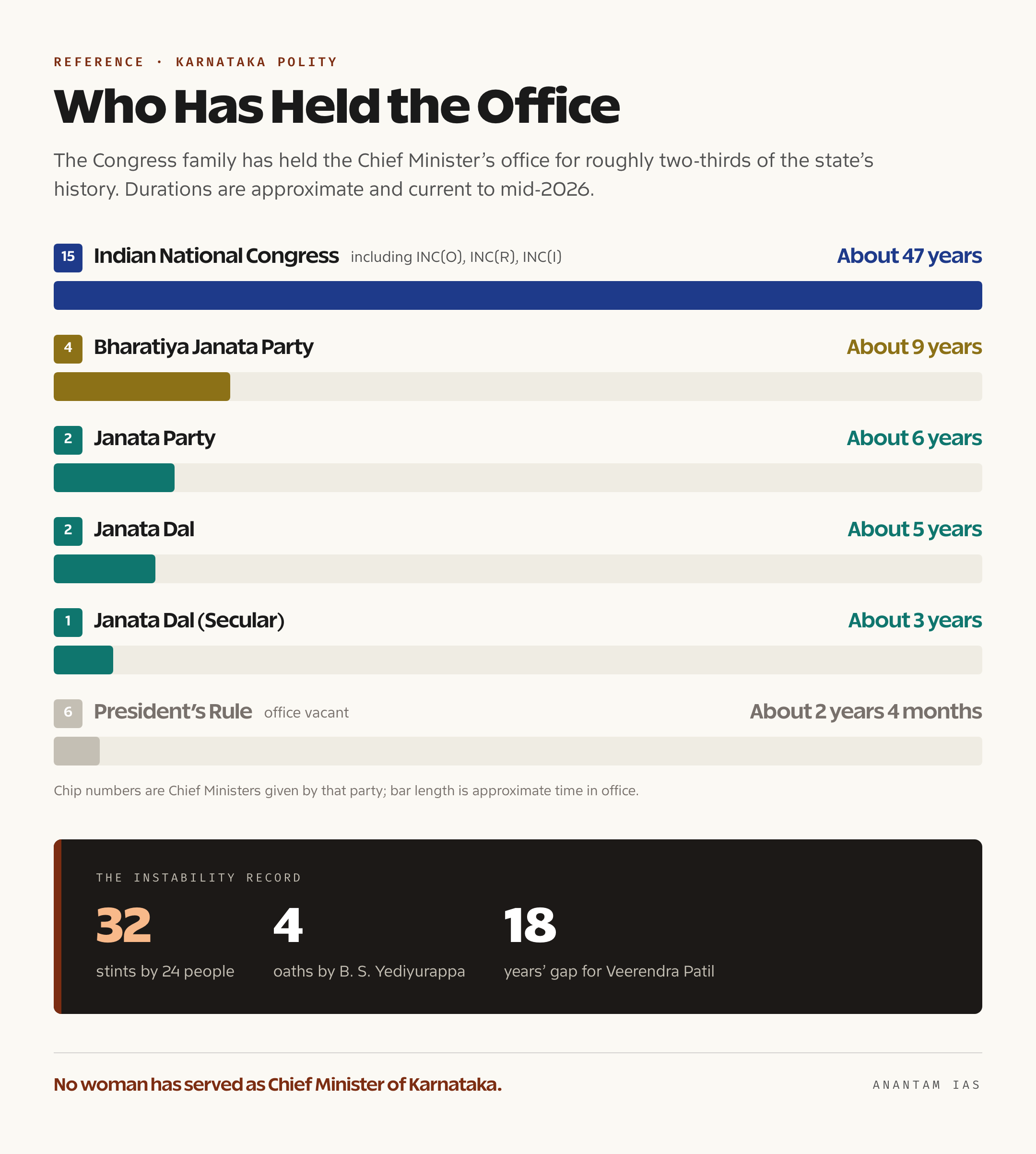
For the first three and a half decades the Congress governed almost without interruption — through its own splits, which is why the party column of the table reads INC, then INC(O), INC(R) and INC(I) in quick succession. The break came in 1983 with Ramakrishna Hegde, and since then no party has held the office for more than two consecutive assembly terms.
| Party | Chief Ministers | Approximate Time in Office |
|---|---|---|
| Indian National Congress (including INC(O), INC(R), INC(I)) | 15 | About 47 years |
| Bharatiya Janata Party | 4 | About 9 years |
| Janata Party | 2 | About 6 years |
| Janata Dal | 2 | About 5 years |
| Janata Dal (Secular) | 1 | About 3 years |
| President’s Rule | — | About 2 years 4 months |
Durations are approximate and current to mid-2026; they shift with every day the incumbent serves.
Three trends stand out. The first is the fragmentation of the anti-Congress vote into the Janata family, which split repeatedly and left the JD(S) as a regionally concentrated but rarely decisive force in the old Mysore districts. The second is the BJP’s steady rise from 2004 onwards, giving it four Chief Ministers and its first southern government. The third is Karnataka’s coalition instability: of the state’s thirty-two stints, a striking number lasted under two years, and three of the six President’s Rule spells followed a coalition collapse rather than an electoral verdict.
Records and Quick Facts
First Chief Minister: K. Chengalaraya Reddy of Mysore State, from 25 October 1947. S. Nijalingappa was the first of the enlarged post-1956 state, and D. Devaraj Urs the first to hold the title Chief Minister of Karnataka after the 1973 renaming.
Current Chief Minister: D. K. Shivakumar, sworn in on 3 June 2026.
Longest serving: Siddaramaiah, about 8 years and 18 days across two stints.
Longest single unbroken stint: Devaraj Urs, 20 March 1972 to 31 December 1977 — five years and 286 days.
Shortest stints: B. S. Yediyurappa twice — seven days in November 2007 and under a week in May 2018.
Most times sworn in: B. S. Yediyurappa, four.
Longest gap between terms: Veerendra Patil, more than eighteen years and six months between March 1971 and November 1989.
Individuals versus stints: 24 people, 32 separate stints.
President’s Rule spells: six — 1971-72, 1977-78, 1989, October 1990, October-November 2007 and 2007-08. The 1971-72 spell was the longest at just over a year; the October 1990 spell lasted seven days.
Family pairs: two father-and-son pairs have held the office — H. D. Deve Gowda and H. D. Kumaraswamy, and S. R. Bommai and Basavaraj Bommai.
No woman has served as Chief Minister of Karnataka.
FAQ
Who is the current Chief Minister of Karnataka? D. K. Shivakumar of the Indian National Congress, in office since 3 June 2026. He succeeded Siddaramaiah under a leadership rotation agreed within the Congress after the 2023 assembly election.
Who was the first Chief Minister of Karnataka? It depends on where you start. K. Chengalaraya Reddy headed Mysore State from 1947, S. Nijalingappa led the enlarged state formed in 1956, and D. Devaraj Urs was in office when Mysore State was renamed Karnataka on 1 November 1973 — so he is the first to hold the title under the present name.
Who served the longest as Chief Minister of Karnataka? Siddaramaiah, with roughly 8 years and 18 days across two stints. The longest unbroken single stint belongs to D. Devaraj Urs.
How many Chief Ministers has Karnataka had? Twenty-four individuals since 1947, across thirty-two separate stints. Counting only from the 1973 renaming, D. K. Shivakumar is the eighteenth.
How is the Chief Minister of Karnataka appointed? Under Article 164 the Governor makes the appointment, by convention inviting the leader who can command a majority in the 224-member Legislative Assembly. The Chief Minister and council of ministers remain in office only while the assembly retains confidence in them.
Practice Questions
Practice MCQs
- Who is the Chief Minister of Karnataka as of 2026? (a) Siddaramaiah (b) Basavaraj Bommai (c) D. K. Shivakumar (d) B. S. Yediyurappa — Answer: (c) D. K. Shivakumar was sworn in on 3 June 2026.
- Mysore State was renamed Karnataka in which year? (a) 1956 (b) 1969 (c) 1973 (d) 1980 — Answer: (c) The Mysore State (Alteration of Name) Act took effect on 1 November 1973.
- Which Karnataka Chief Minister later became Prime Minister of India? (a) S. Nijalingappa (b) H. D. Deve Gowda (c) Veerappa Moily (d) S. M. Krishna — Answer: (b) Deve Gowda left the state office in 1996 to head the union government.
- The dismissal of which Karnataka Chief Minister’s government led to a landmark Supreme Court ruling on Article 356? (a) Ramakrishna Hegde (b) S. R. Bommai (c) Veerendra Patil (d) R. Gundu Rao — Answer: (b) The 1989 dismissal produced S. R. Bommai v. Union of India in 1994.
- Who has been sworn in as Chief Minister of Karnataka the most number of times? (a) Siddaramaiah (b) D. Devaraj Urs (c) B. S. Yediyurappa (d) H. D. Kumaraswamy — Answer: (c) Yediyurappa took the oath four separate times between 2007 and 2019.