Kolleru Lake — Ramsar Wetland Between Krishna & Godavari & UPSC Geography Guide
Complete UPSC guide to Kolleru Lake — location in Andhra Pradesh, Ramsar site, largest freshwater lake, Kolleru Wildlife Sanctuary, threats, and conservation.
Kolleru Lake is one of India's largest freshwater lakes, located in the state of Andhra Pradesh between the deltas of the Krishna and Godavari rivers. Designated as a Ramsar Wetland of International Importance in 2002 and as a Wildlife Sanctuary in 1999, Kolleru plays a critical ecological role as a natural flood buffer, a biodiversity hotspot for migratory birds, and a vital resource for local communities. However, the lake has faced severe degradation from aquaculture encroachment, pollution, and reduced water inflow.
For UPSC, Kolleru Lake is relevant to Geography (GS Paper I) for Indian lakes and drainage, and to Environment (GS Paper III) for wetland conservation, Ramsar Convention, and biodiversity.
Location and Physical Features
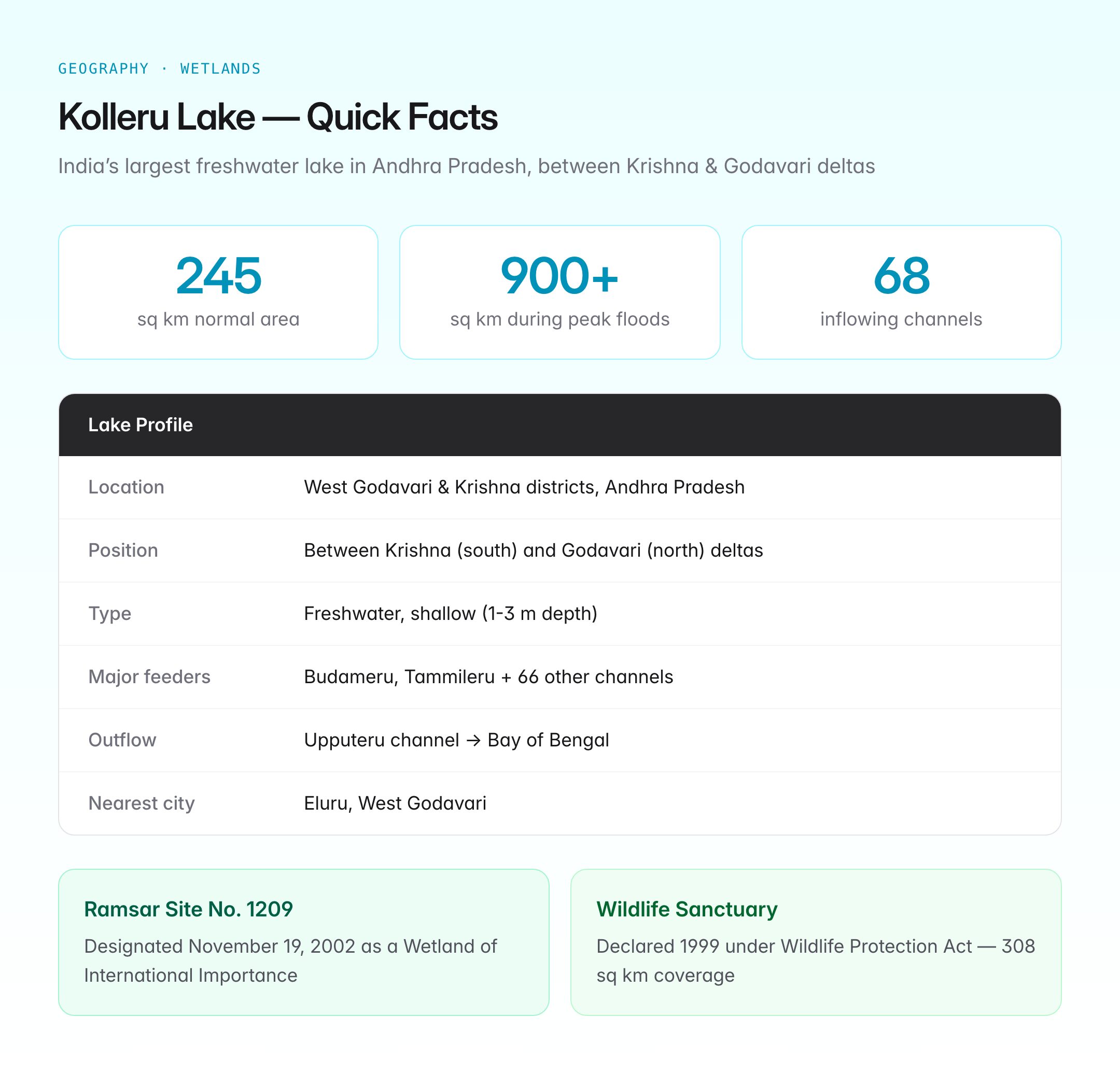
| Feature | Detail |
|---|---|
| Location | West Godavari and Krishna districts, Andhra Pradesh |
| Coordinates | Approximately 16.37 N, 81.12 E |
| Position | Between the deltas of the Krishna (south) and Godavari (north) rivers |
| Area | Approximately 245 sq km at the +5 MSL (mean sea level) contour; expands to over 900 sq km during peak floods |
| Elevation | Low-lying, near sea level |
| Type | Freshwater lake (shallow, seasonal variation in area) |
| Maximum depth | Shallow — typically 1-3 metres |
| Major feeder streams | 68 inflowing channels, including Budameru and Tammileru |
| Outflow | Upputeru channel, draining into the Bay of Bengal |
| Nearest major city | Eluru (West Godavari district) |
How Kolleru Functions
Kolleru Lake acts as a natural flood-balancing reservoir between the Krishna and Godavari river systems. During the monsoon, excess water from both river basins drains into Kolleru through 68 feeder channels. The lake absorbs this floodwater, preventing inundation of downstream areas. It then slowly releases water through the Upputeru channel into the Bay of Bengal.
This flood-buffering function makes Kolleru ecologically and economically critical for the densely populated coastal Andhra Pradesh.
Ecological Significance
Biodiversity
Kolleru Lake supports a rich ecosystem:
- Fish — historically one of India's most productive freshwater fisheries, supporting local fishing communities
- Migratory birds — the lake is a wintering ground for thousands of migratory birds from Siberia, Central Asia, and other regions
- Resident birds — large populations of pelicans, painted storks, herons, cormorants, and other waterbirds
- Aquatic vegetation — extensive beds of lotus, water hyacinth, and other macrophytes
Atapaka Bird Sanctuary
The Atapaka Bird Sanctuary (also called Kolleru Bird Sanctuary or Atapaka Sanctuary) is located within the Kolleru Lake ecosystem. It is particularly known for:
- Grey pelicans (Pelecanus philippensis) — one of the largest breeding colonies in India
- Painted storks (Mycteria leucocephala)
- Open-billed storks, darters, and night herons
- Peak bird arrivals occur between October and March
The sanctuary is a significant site for birdwatching and ornithological research.
Kolleru Wildlife Sanctuary
Kolleru Wildlife Sanctuary was declared in 1999 under the Wildlife Protection Act, 1972, covering an area of 308 sq km. The sanctuary encompasses the core lake area and surrounding wetlands. The notification aimed to provide legal protection against encroachment and pollution.
Ramsar Designation
Kolleru Lake was designated as a Wetland of International Importance under the Ramsar Convention on November 19, 2002 (Ramsar Site No. 1209). The designation recognises its value as:
- A critical habitat for migratory and resident waterbirds
- A flood-buffering wetland between two major river systems
- A freshwater ecosystem supporting significant biodiversity
- A resource for fisheries and local livelihoods
What is the Ramsar Convention?
| Feature | Detail |
|---|---|
| Full name | Convention on Wetlands of International Importance (Ramsar Convention) |
| Signed | February 2, 1971, in Ramsar, Iran |
| Objective | Conservation and wise use of wetlands |
| India's accession | 1982 |
| India's Ramsar sites | 100 sites (as of 2026, after Surha Tal became the 100th) — the third-highest in the world |
Threats to Kolleru Lake
Aquaculture Encroachment
The most serious threat to Kolleru has been the explosive growth of commercial aquaculture (fish and prawn farming) within the lake bed:
- Starting in the 1970s-80s, entrepreneurs constructed thousands of fish ponds (tank bunds) within the lake
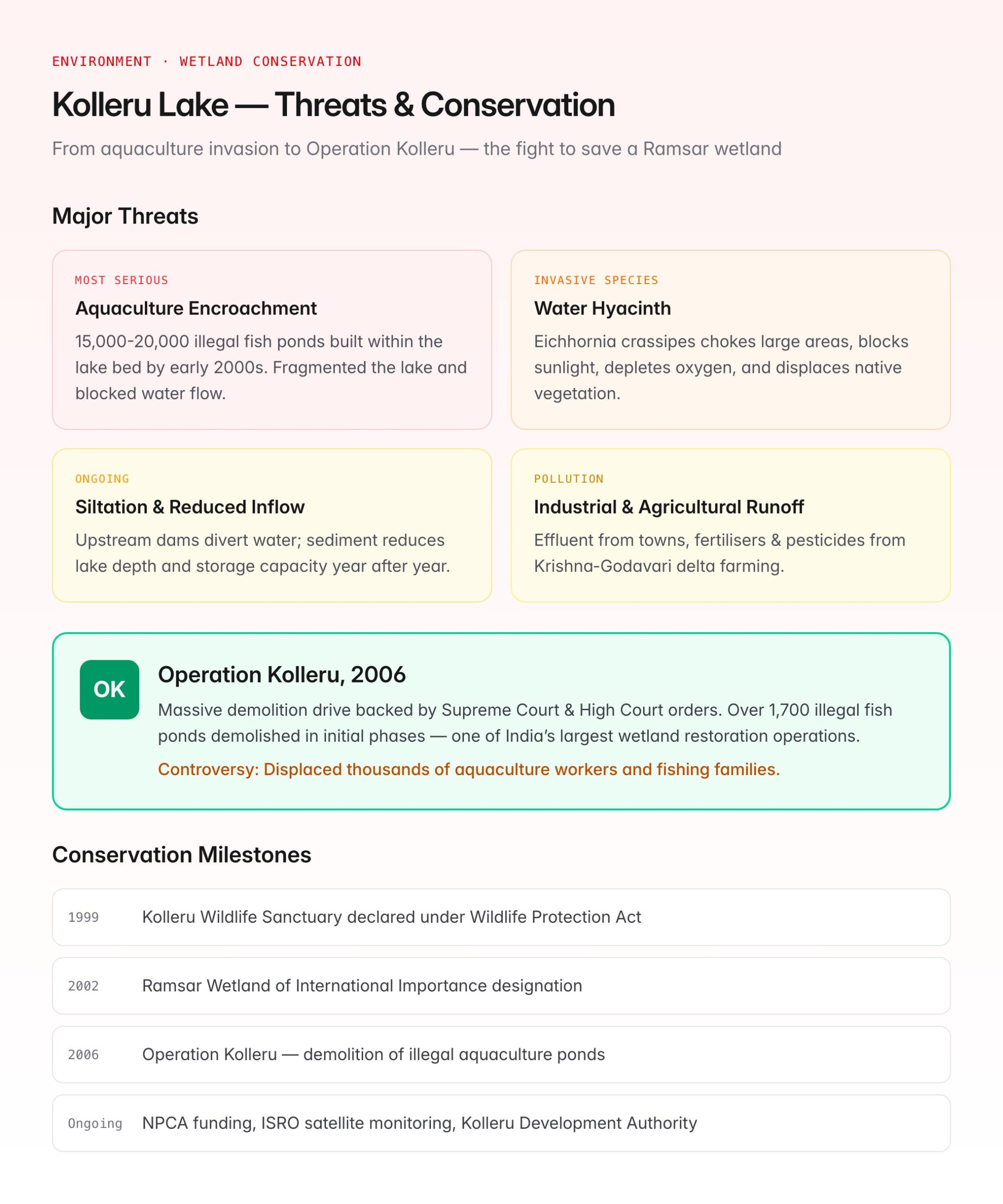
- By the early 2000s, an estimated 15,000-20,000 fish ponds had been built, occupying a significant portion of the lake bed
- These ponds fragmented the lake, reduced water holding capacity, blocked water flow, and discharged polluted wastewater
- The aquaculture boom was driven by high export demand for prawns and freshwater fish
Operation Kolleru (2006)
In response to the environmental crisis, the Andhra Pradesh government launched Operation Kolleru in January 2006:
- A massive demolition drive destroyed thousands of illegal fish ponds within the lake
- Over 1,700 fish ponds were demolished in the initial phases
- The operation was backed by Supreme Court and High Court orders directing the restoration of the lake
- It was one of India's largest wetland restoration operations
However, the operation was controversial — it displaced thousands of aquaculture workers and fishing families who depended on the fish ponds for their livelihoods.
Other Threats
| Threat | Impact |
|---|---|
| Siltation | Sediment from upstream areas reduces lake depth and capacity |
| Industrial and domestic pollution | Effluent from surrounding towns and industries contaminates water |
| Agricultural runoff | Fertilisers and pesticides from the intensively farmed Krishna-Godavari delta |
| Invasive species | Water hyacinth (Eichhornia crassipes) chokes large areas of the lake |
| Reduced inflow | Upstream dams and irrigation diversions reduce water reaching the lake |
| Encroachment | Agricultural and residential encroachment on the lake periphery |
Conservation Efforts
| Initiative | Detail |
|---|---|
| Kolleru Wildlife Sanctuary (1999) | Legal protection under Wildlife Protection Act |
| Ramsar designation (2002) | International recognition and monitoring |
| Operation Kolleru (2006) | Demolition of illegal fish ponds |
| Kolleru Development Authority | State body for coordinated lake management |
| National Plan for Conservation of Aquatic Ecosystems (NPCA) | Central government funding for restoration |
| ISRO monitoring | Satellite-based monitoring of lake area, water spread, and encroachment |
Comparison with Other Important Indian Lakes
| Lake | State | Type | Ramsar | Key Feature |
|---|---|---|---|---|
| Kolleru | Andhra Pradesh | Freshwater | Yes (2002) | Largest freshwater lake in AP; between Krishna-Godavari deltas |
| Chilika | Odisha | Brackish lagoon | Yes (1981) | Largest brackish water lagoon in Asia |
| Pulicat | AP/Tamil Nadu | Brackish lagoon | No | Second-largest brackish water lagoon in India |
| Loktak | Manipur | Freshwater | Yes (1990) | Floating phumdis; Keibul Lamjao National Park |
| Wular | Jammu & Kashmir | Freshwater | Yes (1990) | Largest freshwater lake in India |
| Sambhar | Rajasthan | Saline | Yes (1990) | Largest inland saline lake in India |
UPSC Relevance
GS Paper Mapping
| Paper | Topic | Connection |
|---|---|---|
| GS Paper I | Indian Geography — Lakes and Drainage | Location between Krishna-Godavari deltas, freshwater lake |
| GS Paper III | Environment — Wetland Conservation | Ramsar Convention, Operation Kolleru, NPCA |
| GS Paper III | Biodiversity | Migratory birds, Atapaka Bird Sanctuary, pelican colonies |
| GS Paper III | Environment — Pollution | Aquaculture encroachment, agricultural runoff |
Key Points for Prelims
- Kolleru Lake is located in Andhra Pradesh between the Krishna and Godavari river deltas
- It is one of India's largest freshwater lakes with an area of approximately 245 sq km (expanding to 900+ sq km during floods)
- Designated as a Ramsar Wetland of International Importance in 2002
- Declared a Wildlife Sanctuary in 1999 under the Wildlife Protection Act
- The Atapaka Bird Sanctuary within Kolleru is known for grey pelicans and painted storks
- The lake functions as a natural flood buffer between the Krishna and Godavari systems
- Operation Kolleru (2006) demolished thousands of illegal aquaculture ponds within the lake
- Water drains from Kolleru into the Bay of Bengal through the Upputeru channel
- 68 feeder channels bring water into the lake, including Budameru and Tammileru
- Water hyacinth is a major invasive species threatening the lake ecosystem