Land Pooling in India: The Rajasthan Model, Urbanisation and Alternatives to Acquisition (UPSC GS)
Land pooling lets owners pool their plots, the agency builds the roads and trunk infrastructure, and each owner gets back a smaller but fully serviced, higher-value plot. Here is the full picture — how it works, how it differs from acquisition under the 2013 law, the Rajasthan model and other state schemes — explained for UPSC GS3.
The cheapest way for a government to build a new city is to not buy the land for it. That sounds like a riddle, but it is exactly the bet that more and more Indian states are now placing. In late March 2026, the Jaipur Development Authority unveiled five fresh land pooling schemes across the city — on Mahal Road, Agra Road, Kalwar Road and near Tonk Road — covering well over a thousand hectares of farmland on Jaipur’s edge, all to be turned into industrial, residential and mixed-use townships without the state paying upfront compensation for a single acre. Instead of writing cheques, the authority is asking landowners to throw their plots into a common pot, take a smaller piece back once roads and drains are in, and grow rich on the difference.
That bet is at the heart of a quiet shift in how India urbanises. For a decade, the country’s land law has made acquisition slow, costly and litigious, and the result has been stalled highways, half-built industrial parks and farmers who feel cheated. Land pooling offers a different deal — keep the owner in the picture as a partner rather than a victim — and states from Andhra Pradesh to Gujarat to Maharashtra have run with it. For a UPSC aspirant, this is a topic that sits squarely in GS Paper 3’s terrain of infrastructure, resource mobilisation and inclusive growth, and it rewards anyone who can explain the mechanics cleanly and weigh the trade-offs honestly.
What Land Pooling Is and How It Works
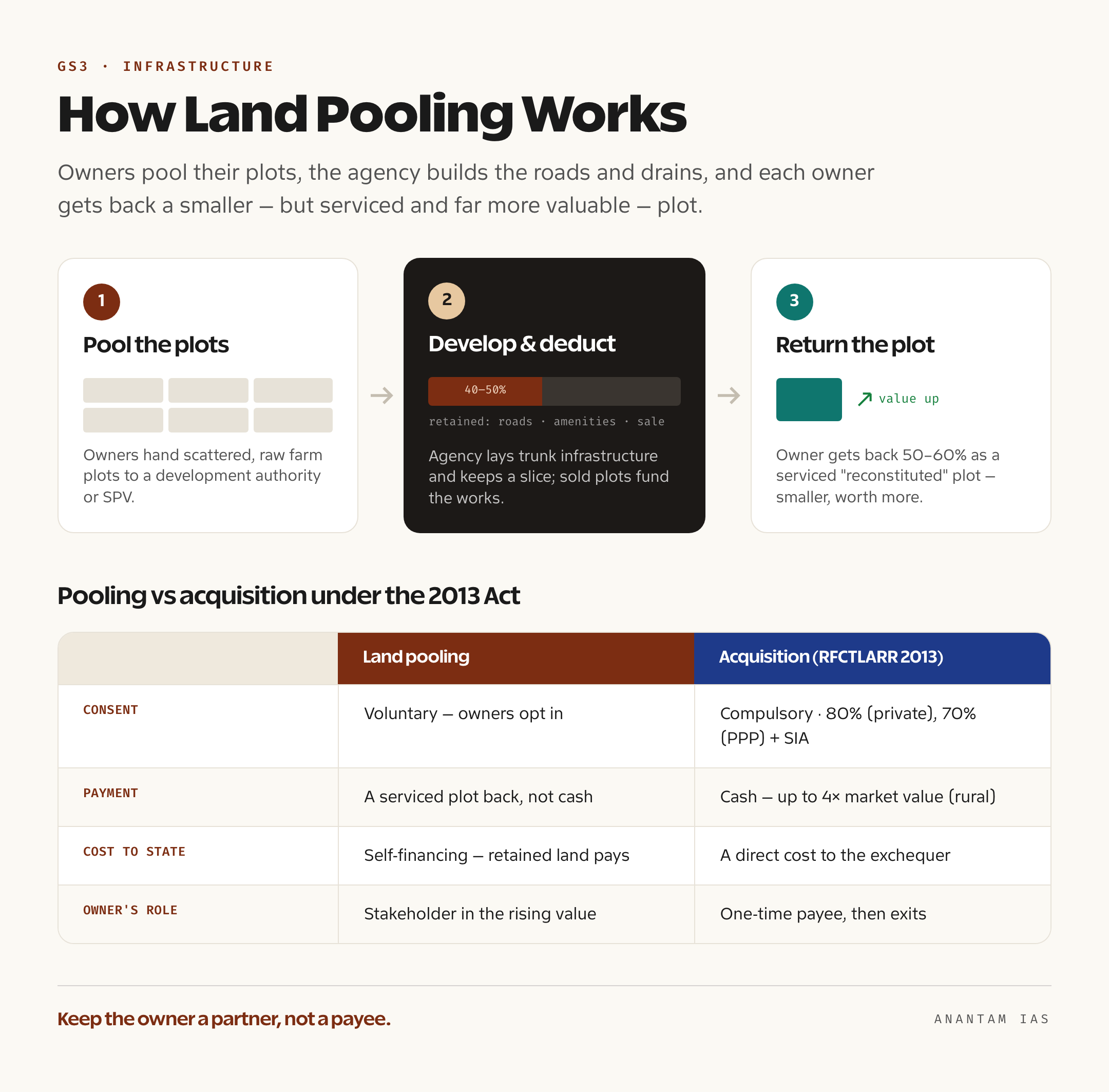
Strip away the jargon and land pooling is a simple swap. A group of landowners hands over their scattered, irregular farm plots to a development agency — a city development authority or a special purpose vehicle set up for the project. The agency throws all the plots into one big pool, redraws the whole area as a planned layout with roads, water lines, sewerage, parks and public amenities, and then returns to each owner a smaller but fully serviced plot inside that new layout. The technical name for what you get back is a “reconstituted plot” — a re-cut piece of land in the developed scheme that corresponds to the value of what you put in. Because the agency keeps a slice of the pooled land to pay for all of this, you walk away with less area but, in most cases, far more value.
Here is the rough arithmetic that makes it work. The agency typically deducts somewhere between 40 and 50 per cent of the pooled land. Part of that deduction goes to the unavoidable public stuff — roads, drains, parks, schools, the trunk infrastructure no private layout can do without. The rest is “value capture” — serviced plots the agency sells in the open market to fund the whole development, so the project pays for itself without a budget line. The owner gets back the remaining 50 to 60 per cent as a developed plot. And the bet is that a serviced urban plot, with a road in front and a sewer underneath, is worth several times more per square foot than the raw agricultural land that went in. So an owner who surrenders an acre of farmland and receives back, say, half an acre of plotted urban land usually ends up wealthier than before — without having sold and walked away. As the Observer Research Foundation has put it, the compensation in land pooling does not come from the state’s treasury at all; it comes from the owner now holding land that has risen sharply in value once the area is developed.
Two design choices decide whether a scheme is fair. The first is the deduction ratio — how much land the agency keeps. The Delhi Development Authority’s policy, for instance, returns 60 per cent of the pooled land to the owner-developer side in its more developed category and 48 per cent in the less developed one, keeping the rest for infrastructure and public housing. The second is whether owners get anything while they wait, because development takes years. The better schemes add a transitional annuity — a yearly payment to tide the family over until the new plot is ready and sellable. Get those two levers right and the model can be genuinely win-win. Get them wrong — keep too much land, or pay nothing during the gap — and pooling starts to feel like acquisition by another name.
How It Differs From Acquisition Under the 2013 Law
To see why states are reaching for pooling, you have to understand what they are reaching away from. India’s land acquisition is governed by the Right to Fair Compensation and Transparency in Land Acquisition, Rehabilitation and Resettlement Act of 2013 — usually shortened to the RFCTLARR Act, or just the 2013 Act. It was a deliberate, pro-farmer overhaul of the colonial-era Land Acquisition Act of 1894, and it loaded the process with safeguards. The state must pay heavy compensation — up to four times the market value for rural land and twice the market value for urban land, plus solatium and rehabilitation grants. It must conduct a Social Impact Assessment, or SIA, to study how the project will affect livelihoods and communities. And when the land is taken for private companies or public-private partnerships, it must obtain the consent of the affected families — 80 per cent for purely private projects and 70 per cent for PPP projects.
Those safeguards were a moral correction, but they came with a practical cost. The SIA and consent steps can stretch acquisition over years; the four-times-market-value formula makes large projects punishingly expensive; and a single disputed valuation can drag the whole thing into court. Add it up and acquisition under the 2013 Act became, for many states, too slow and too dear to build the highways, ring roads and industrial corridors a fast-urbanising country needs. So several state governments amended the law to dilute the SIA or the consent clause for their own projects — which only deepened the trust problem the 2013 Act was meant to solve.
Land pooling sidesteps the whole tangle, and the contrasts are sharp. Acquisition is compulsory; pooling is meant to be voluntary, with owners opting in. Acquisition pays cash and ends the relationship; pooling returns land and keeps the owner as a stakeholder in the upside. Acquisition is a cost to the exchequer; pooling is largely self-financing, because the retained land funds the infrastructure. Acquisition forces a one-time valuation fight; pooling lets the owner ride the rise in land value rather than argue about it. And because nobody is forced off their land and everybody shares in the gain, pooling tends to draw far less litigation and far less anger. That said, it is not a free lunch — pooling demands clean land records, patient owners and competent planning, and where any of those are missing it can stall or sour, as the next sections show.
The Rajasthan Model and the Jaipur Schemes
Rajasthan gives the model its own statutory backbone. The state’s framework rests on the Rajasthan Land Pooling Schemes Act, 2016 — formally Act No. 14 of 2018, which received the President’s assent in June 2018 — a dedicated law that lets urban development authorities assemble land for planned townships and infrastructure through pooling rather than acquisition. The Act creates the machinery the model needs: a designated Land Pooling Officer to run each scheme, a defined procedure to notify an area, pool the plots, prepare the layout and allot reconstituted plots back to owners, and a legal route to deal with objections. It puts pooling on the same firm footing in Rajasthan that the Town Planning Scheme has long enjoyed in Gujarat.
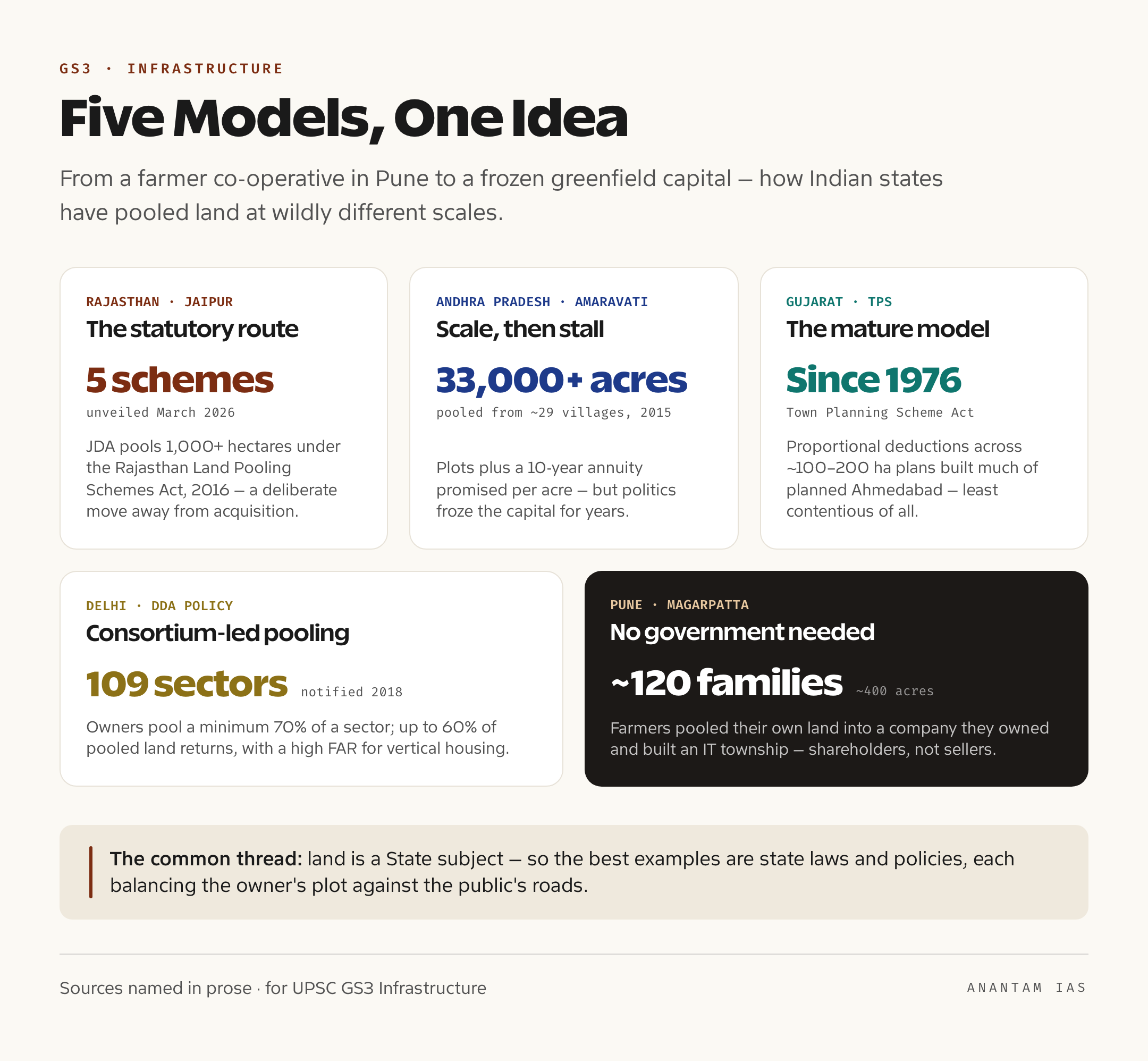
The March 2026 Jaipur schemes are this framework in action, and the numbers tell the story of how the model is meant to balance public and private interest. On Mahal Road, the Jaipur Development Authority has earmarked a 127-hectare parcel in Ramchandrapura for an industrial zone, with 58 per cent of the land set aside for industrial and recreational use and road networks running up to 200 feet wide; a much larger 266-hectare parcel nearby on the same road is slated mainly for housing. The mixed-use scheme near Tonk Road, in the Muhana Mandi area, devotes 62 per cent of its land to residential use while reserving space for public and semi-public purposes. Across the five schemes — which also include parcels on Kalwar Road of over 380 hectares and a heritage-themed plan near Agra Road — the JDA is pooling well over a thousand hectares to expand the city in a planned way, then returning serviced plots to the original owners once the layouts are built.
What makes Rajasthan’s push notable is the timing and the framing. The state has positioned land pooling as its primary tool for orderly urban expansion precisely to reduce its dependence on costly, slow compulsory acquisition — a deliberate policy choice rather than a one-off experiment. Pair that with the Urban Land Allotment Policy the state cabinet approved in 2025 to standardise how public land is allotted, and you can see a government trying to put its entire land-and-urbanisation toolkit on a cleaner, more predictable footing. For an aspirant, Rajasthan is the freshest, most quotable example of a state choosing pooling over acquisition by design — and Jaipur is the city where you can watch it happen scheme by scheme.
Other State Models: Amaravati, Gujarat, Delhi and Magarpatta
Rajasthan is the newest entrant, but it is walking a path others cut first, and the contrasts between the models are exactly what a strong answer uses. The grandest and most cautionary is Amaravati, the greenfield capital Andhra Pradesh began building in 2015. Through its Land Pooling Scheme, the state assembled more than 33,000 acres from farmers across nearly 29 villages — one of the largest voluntary land assemblies anywhere — promising each owner who surrendered an acre a package of developed plots back, in the order of around 1,000 square yards of residential and 450 square yards of commercial land per acre, plus an annual annuity for ten years and benefits even for landless families. On paper it was inclusive and bold. In practice, a change of government, a relocation of the capital and then a reversal left the project frozen for years, and many farmers who had given up their land waited a decade for the city they were promised. Amaravati shows both the promise of pooling at scale and how brutally it depends on political continuity.
Gujarat offers the opposite lesson — quiet, decades-long success. Under the Gujarat Town Planning and Urban Development Act of 1976, the state runs Town Planning Schemes, or TPS, the granddaddy of Indian land pooling. Each TPS covers a manageable patch — roughly 100 to 200 hectares and a few hundred landowners — where a Town Planning Officer reconstitutes the original plots into smaller final plots, takes a proportionate cut from every owner for roads and public amenities, and shares the cost of infrastructure between owners and the urban local body. The mechanism has quietly built much of Ahmedabad’s planned expansion, including stretches of its ring road. Because the deduction is proportional and the process is routine and rule-bound, the Gujarat TPS is widely held up as the most mature, least contentious version of pooling in the country.
Two more models round out the picture. The Delhi Development Authority’s Land Pooling Policy, notified in 2018, carves the city’s urbanisable land into 109 sectors and works through consortia of owners who must pool at least 70 per cent of a sector’s land before development begins; the DDA returns 60 per cent of the pooled land in its more developed category and grants a generous floor area ratio to make dense, vertical housing viable. And then there is Magarpatta in Pune — the model that needed no government at all. In the 1990s, around 120 farming families, led by Satish Magar, pooled roughly 400 acres of their own farmland into a company they jointly owned, the Magarpatta Township Development and Construction Company, and built a self-contained township with an IT park, homes, schools and a hospital. They never sold; they became shareholders in the city that rose on their fields, and many turned millionaires. Maharashtra has since institutionalised the idea through Town Planning Schemes run by bodies like the Pune Metropolitan Region Development Authority — its Mahalunge-Maan scheme, for example, returned the bulk of the final plots to landowners while keeping a share for the authority and public amenities. Five models, one idea, five very different outcomes.
Why Pooling Helps, Where It Hurts, and the Way Forward
The case for land pooling is strong enough to explain its spread. It is cheaper for the state, because the retained land funds the infrastructure instead of the budget. It is faster and less litigious, because owners who share in the gain are far less likely to go to court than owners who feel robbed. It keeps farmers as stakeholders rather than turning them into one-time payees who fritter away a cash settlement and end up landless. It produces planned, serviced urban land — roads, drains, parks, plots that fit a master plan — rather than the chaotic, unauthorised sprawl that compulsory acquisition and private speculation so often leave behind. And by capturing a share of the rise in land value for public use, it embodies a principle good urban economics has long preached but Indian cities rarely practise.
But the criticisms are real and an honest answer must name them. The biggest is the question of who gets left out. Pooling rewards those who hold title to land, which means it can completely exclude the landless — the tenant farmers, sharecroppers and agricultural labourers whose livelihoods vanish when the fields become a township, but who own no plot to pool and so receive no reconstituted plot in return. Amaravati’s roughly Rs 2,500 a month for tenant farmers was widely judged far too thin. There is also the time lag: development can take years, and a family with no transitional annuity can be left land-rich on paper but cash-poor in reality. Then there is the spectre of coercion — when an authority faces delays it can quietly make pooling effectively mandatory, as has happened in some notified areas, which hollows out the “voluntary” promise. And the model leans on two things India often lacks — clean, undisputed land records and competent, honest planning — without which valuation disputes and speculation creep right back in.
So the way forward writes itself, and it makes a tidy conclusion. Land pooling should stay genuinely voluntary, backed by clear law and clean digitised land records so consent is real and disputes are few. It must be made inclusive — building in livelihood support, skilling and a share of benefits for the landless and tenants, not just plot-holders — so the gains do not flow only to those who already owned land. It needs transitional annuities to bridge the development gap, transparent and fair deduction ratios, and the political continuity that Amaravati so painfully lacked. Done that way, pooling is not a loophole around the 2013 Act’s protections but a complement to it — a tool that lets India build the cities it needs while keeping the people who own the land as partners in the prosperity those cities create.
For Your Mains Answer
This is a high-value topic for GS Paper 3, which covers infrastructure, mobilisation of resources, inclusive growth and the issues around land and development. Questions on land acquisition reform, urbanisation and planned development, value capture financing, and farmer welfare can all draw on this material, and there is a clear GS Paper 2 angle too — governance, the federal design of land as a state subject, and the rights of vulnerable groups. The skill examiners reward is the one this article uses: explain the mechanism crisply, contrast it with acquisition under the 2013 Act, anchor it in named state examples, and then weigh the gains against the exclusion of the landless before landing a balanced verdict.
How to Build the Answer
Define first, then compare, then evaluate. Open by defining land pooling in one clean sentence — owners pool plots, the agency develops and returns a smaller serviced reconstituted plot, keeping a slice for roads, amenities and sale. Set out the arithmetic (40 to 50 per cent deduction, value capture funds the infrastructure). Contrast it point by point with acquisition under the RFCTLARR Act 2013 — voluntary versus compulsory, land versus cash, self-financing versus a treasury cost, stakeholder versus payee. Bring in two or three state examples for texture — Rajasthan and Jaipur as the freshest, Amaravati as scale-plus-caution, Gujarat TPS as the mature success. Then judge it: pros, the exclusion-of-the-landless problem, and a way-forward conclusion. That arc — define, contrast, illustrate, evaluate — fits almost any land-pooling or acquisition-reform question.
Common Mistakes to Avoid
Don’t treat pooling and acquisition as the same thing — the voluntary, land-for-land, self-financing design is the whole point. Don’t muddle the 2013 Act’s consent thresholds; it is 80 per cent for private projects and 70 per cent for PPP projects, alongside a mandatory Social Impact Assessment. Don’t present pooling as flawless — the exclusion of tenants and the landless is the criticism that earns marks, so always raise it. And don’t forget that land is a State subject, which is why the strongest examples are state laws and policies (Gujarat’s 1976 Act, Rajasthan’s 2016 Act, the Delhi and Andhra schemes) rather than a single central scheme.
A Compact Answer Spine
Land pooling = owners pool plots → agency develops trunk infrastructure → returns a smaller serviced reconstituted plot, keeping ~40-50% for roads, amenities and sale (value capture) → contrast with RFCTLARR Act 2013 acquisition: voluntary not compulsory, land not cash, self-financing not a treasury cost, stakeholder not payee, less litigation → examples: Rajasthan Land Pooling Schemes Act 2016 and Jaipur’s 2026 schemes, Amaravati (33,000+ acres pooled, then stalled), Gujarat TPS (mature, proportional), Delhi DDA (109 sectors, 60% returned), Magarpatta (farmer-owned, ~400 acres) → pros: cheaper, faster, planned, owners as stakeholders → cons: excludes landless/tenants, time lag, valuation and records problems, creeping coercion → way forward: keep it voluntary and inclusive, add annuities, digitise records, ensure political continuity.
Diagram or Flowchart Idea
Draw a simple three-box flow: a cluster of irregular raw plots → a development authority box labelled “pool + develop, deduct 40-50% for roads, amenities, sale” → a single owner receiving back a smaller, neatly plotted serviced plot with an upward value arrow. Beside it, a two-column mini-table contrasting pooling and acquisition on four rows — consent, payment form, cost to state, owner’s stake. That single visual carries both the mechanism and the comparison.
A Balanced-Conclusion Line
A line that lands the marks: “Land pooling works best not as a way around the protections of the 2013 Act but as a partner to them — letting India build planned cities at lower cost and with less conflict, provided the gains reach the tenant and the labourer, and not only those who held the title.”
How to Use Data Without Cramming
You need only a handful of anchors, not a table: 40 to 50 per cent (the typical deduction), 80 and 70 per cent (private and PPP consent under the 2013 Act), 33,000-plus acres (Amaravati’s scale), and one date each for the Gujarat (1976) and Rajasthan (2016) Acts. Drop those into the right sentences and attribute them plainly — “under Rajasthan’s 2016 land pooling law” — rather than scattering numbers without a source.
FAQ
What is land pooling in simple terms? It is a land-for-land swap for planned development. A group of owners pool their plots with a development agency; the agency lays out roads, drains, parks and other infrastructure across the whole area and then returns to each owner a smaller but fully serviced “reconstituted” plot. The agency keeps the rest of the pooled land — usually 40 to 50 per cent — to build the infrastructure and to sell, which funds the project. Because a serviced urban plot is worth far more than raw farmland, the owner typically ends up wealthier despite getting back less area.
How is land pooling different from land acquisition? Acquisition under the RFCTLARR Act 2013 is compulsory — the state takes the land and pays cash, up to four times market value in rural areas, after a Social Impact Assessment and consent (80 per cent for private projects, 70 per cent for PPP). Pooling is meant to be voluntary, pays the owner in developed land rather than cash, keeps the owner as a stakeholder in the rising value, and is largely self-financing because the retained land funds the works. Pooling tends to be cheaper for the state and far less litigious.
What is the Rajasthan land pooling model? Rajasthan runs pooling under the Rajasthan Land Pooling Schemes Act, 2016 (Act No. 14 of 2018), which gives urban development authorities a clear legal procedure — a Land Pooling Officer, notification, pooling, layout and allotment — to assemble land for townships without compulsory acquisition. In March 2026 the Jaipur Development Authority unveiled five such schemes across the city, covering over a thousand hectares on Mahal Road, Agra Road, Kalwar Road and near Tonk Road, with a large share of each scheme set aside for roads, amenities and public use and the rest returned to owners as serviced plots.
What is the biggest criticism of land pooling? That it can exclude the landless. Pooling rewards people who hold title to land, so tenant farmers, sharecroppers and agricultural labourers — whose livelihoods disappear when farmland becomes a township but who own no plot to pool — can be left with little or nothing. Other concerns are the years-long gap before the new plot is ready (hard on families with no transitional annuity), the risk of pooling being made effectively compulsory, and the model’s heavy reliance on clean land records and honest planning.
Practice Questions
Prelims MCQs
- With reference to land pooling, consider the following statements:
1. Landowners contribute their plots to a development agency and receive back a smaller, serviced “reconstituted” plot.
2. The agency retains a portion of the pooled land for roads, amenities and sale to finance the development.
3. Land pooling is, by design, a compulsory process under the RFCTLARR Act, 2013.
Which of the statements given above are correct?
(a) 1 and 2 only
(b) 2 and 3 only
(c) 1 and 3 only
(d) 1, 2 and 3
Answer: (a) Pooling returns a serviced plot and is self-financed through retained land; it is meant to be voluntary and is distinct from compulsory acquisition under the 2013 Act. - Under the Right to Fair Compensation and Transparency in Land Acquisition, Rehabilitation and Resettlement Act, 2013, the consent of how many affected families is required?
(a) 70 per cent for private projects and 80 per cent for PPP projects
(b) 80 per cent for private projects and 70 per cent for PPP projects
(c) 50 per cent for both private and PPP projects
(d) Consent is not required for any project
Answer: (b) The Act requires 80 per cent consent for purely private projects and 70 per cent for public-private partnership projects, alongside a Social Impact Assessment. - The Town Planning Scheme mechanism for assembling and reconstituting land is most closely associated with which state’s long-standing urban development law?
(a) Andhra Pradesh
(b) Rajasthan
(c) Gujarat
(d) Delhi
Answer: (c) Gujarat’s Town Planning Schemes, run under the Gujarat Town Planning and Urban Development Act, 1976, are the most mature form of land pooling in India. - The Amaravati capital project, a large land pooling exercise, is located in which state?
(a) Telangana
(b) Andhra Pradesh
(c) Karnataka
(d) Tamil Nadu
Answer: (b) Andhra Pradesh launched the Amaravati Land Pooling Scheme in 2015, assembling more than 33,000 acres from farmers across nearly 29 villages. - Which of the following is the most commonly cited criticism of the land pooling model?
(a) It always costs the state more than acquisition
(b) It excludes the landless, such as tenants and agricultural labourers, who own no plot to pool
(c) It is prohibited under the Constitution
(d) It applies only to forest land
Answer: (b) Because pooling rewards titleholders, tenant farmers and labourers who lose their livelihoods but own no land can be left out, which is the model’s central equity concern.
Mains Practice Questions
- Explain the mechanism of land pooling and discuss how it differs from compulsory land acquisition under the RFCTLARR Act, 2013. (15 marks, 250 words)
- “Land pooling is best seen not as a loophole around the 2013 land law but as a complement to it.” Critically examine this statement with reference to recent state experiences. (15 marks, 250 words)
- Discuss the strengths and limitations of land pooling as a tool for India’s urbanisation, using the examples of Amaravati, the Gujarat Town Planning Scheme and the Rajasthan model. (15 marks, 250 words)
- The exclusion of the landless is often described as the central equity problem of land pooling. Examine this concern and suggest measures to make the model more inclusive. (10 marks, 150 words)
- Value capture financing is increasingly seen as a sustainable way to fund urban infrastructure. Evaluate land pooling as an instrument of value capture, with examples from Indian cities. (15 marks, 250 words)