Layered Air Defence of India: S-400, Akash, Barak and the Multi-Tier Shield Explained
A complete UPSC GS-III explainer on India's layered air defence architecture. Covers the five-tier shield from S-400 Triumf at the outer ring to Igla MANPADS at point defence, the Ballistic Missile Defence programme, the Akash and Barak-8 medium-range belt, the QRSAM and Spyder short-range layer, and the doctrinal logic of overlapping engagement zones.
Air defence is the science of stopping anything that flies and is hostile. In modern warfare that means a sprawling threat list: high-altitude bombers, low-flying cruise missiles, ballistic missiles falling from space, helicopter gunships, fighter jets in strike packages, kamikaze drones, and weaponised commercial UAVs. No single missile system can defeat all of these. The geometry, speeds, and signatures are too different. So every modern air force builds a layered shield. The S-400 handles the long, fast threats at the edge of the envelope. The Akash and Barak-8 handle the medium ranges. The QRSAM and Spyder handle the short ranges and quick-reaction needs. The Igla MANPADS sits at the last metres. India’s architecture follows this template, with the addition of a Ballistic Missile Defence programme that handles the threats coming in on parabolic trajectories from space.
This guide walks through the layered air defence architecture of India for UPSC GS-III aspirants. It explains why layering exists, what each layer is sized to defeat, the principal Indian and imported systems that fill each tier, the BMD programme as a separate vertical, and the doctrinal logic that ties the whole architecture together.
Why Layered Air Defence Exists
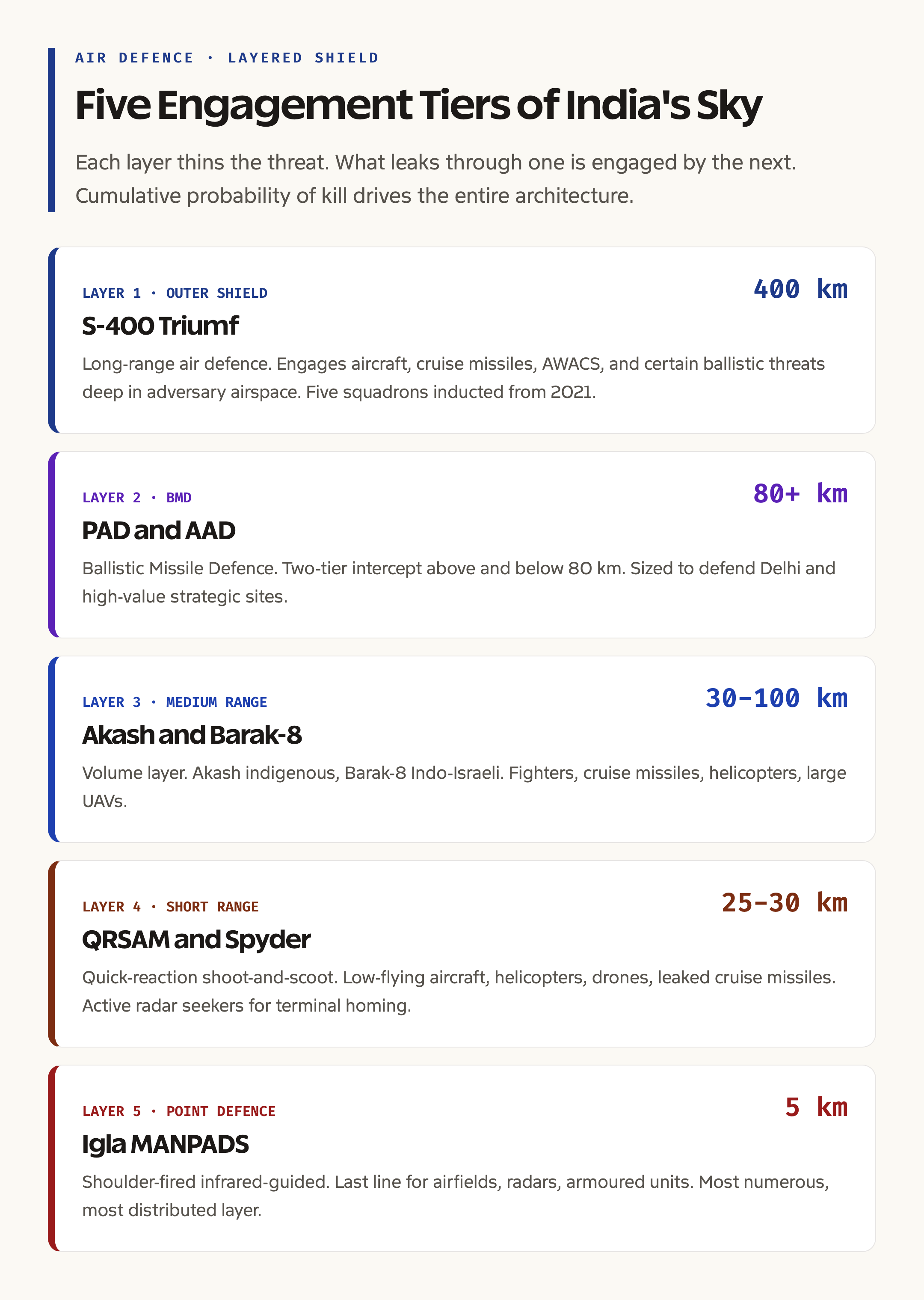
A single air defence layer fails for two reasons. The first is range. A missile that can intercept a target 400 kilometres away has very different physics from one that intercepts a target two kilometres away. The first has to fly fast and high, with a large rocket and a sophisticated seeker. The second has to react in seconds, slew quickly, and engage at low altitude where ground clutter is severe. No design optimises for both. The second reason is leakage. Even a 90 percent reliable system lets one in ten threats through. If a salvo of cruise missiles or drones is large enough, leakage from the outer layer becomes the threat the next layer has to absorb.
Layering solves both problems. The outer layer thins the threat. The middle layer engages what leaks through. The inner layer protects critical assets at the last moment. If each layer has a credible probability of kill, the cumulative probability that any single threat reaches the protected target falls toward zero. This is the doctrinal logic that the Indian Air Force, the Army Air Defence Corps, and the Navy have been building toward for two decades.
Layer 1: The Outer Shield with S-400 Triumf
The outermost ring of the Indian shield is the S-400 Triumf, a Russian long-range air defence system inducted into the Indian Air Force from 2021. The S-400 fires four interceptor types covering nested range bands, with the longest at 400 kilometres and the shortest at 40 kilometres. Its phased-array radars can track several hundred targets simultaneously and engage dozens at a time. The system is mounted on transporter-erector-launcher vehicles that can move and shoot, which is essential for survival against a modern strike package.
The S-400 is sized to engage strategic threats far from the protected area: enemy aircraft at altitude, cruise missiles, AWACS and refuelling aircraft, and certain ballistic threats in the terminal phase. India has acquired five squadrons under a 2018 contract worth around US$ 5.4 billion. Three squadrons have been delivered, with the remaining two scheduled despite supply disruptions caused by the Russia-Ukraine war. The deployment pattern places the S-400 to cover the western and northern borders, where it dominates a wedge of airspace that pushes the engagement line deep into adversary territory.
Layer 2: Ballistic Missile Defence
Ballistic missiles travel on a parabolic trajectory that takes them above the atmosphere and back down at hypersonic speeds. They cannot be engaged by conventional air defence systems sized for aircraft and cruise missiles. They need a dedicated programme. The Indian BMD programme, run by the Defence Research and Development Organisation, is built around two interceptors. The Prithvi Air Defence, or PAD, intercepts ballistic missiles in the exo-atmospheric phase at altitudes above 80 kilometres. The Advanced Air Defence, or AAD, intercepts in the endo-atmospheric phase at altitudes between 15 and 30 kilometres. The two layers together cover the full ballistic trajectory.
The BMD programme has been tested in multiple flights since 2006 and is sized to defend high-value urban and strategic assets, primarily New Delhi and a small number of other priority sites. A second phase, AD-1 and AD-2, extends the engagement envelope to longer-range ballistic threats with higher closing speeds. BMD is a separate vertical from the conventional air defence layers because the threat physics is different, but operationally the two systems are integrated through the Integrated Air Command and Control System of the Air Force.
Layer 3: Medium Range with Akash and Barak-8
The medium-range belt is where the bulk of conventional air defence work happens. The Akash missile system is the Indian indigenous workhorse. It is a surface-to-air missile with a range of about 25 to 30 kilometres for the original Akash, extended to about 70 kilometres in the Akash-NG variant under development. Akash uses a Rajendra phased-array radar for tracking and a command-guided missile that is detonated by a proximity fuze near the target. It is in service with both the Air Force and the Army, with multiple squadrons deployed across the border belt. Akash has also been exported, with Armenia as the first foreign buyer, marking the system as one of India’s flagship defence exports.
The Barak-8, also called the Medium Range Surface to Air Missile or MRSAM, is a joint development between DRDO and Israel Aerospace Industries. It has a range of about 70 to 100 kilometres and is fielded in three variants: a naval version for warship air defence, a long-range land version for the Air Force, and a medium-range Army version. The Barak-8 is fitted with an active radar seeker, which gives it terminal homing independent of the launching ship’s radar, and a dual-pulse rocket motor that extends engagement geometry.
Together the Akash and Barak-8 cover the medium-range envelope against fighter aircraft, cruise missiles, helicopters, and large UAVs. They are the volume layer of the Indian air defence shield, with hundreds of missiles fielded across services.
Layer 4: Short Range with QRSAM and Spyder
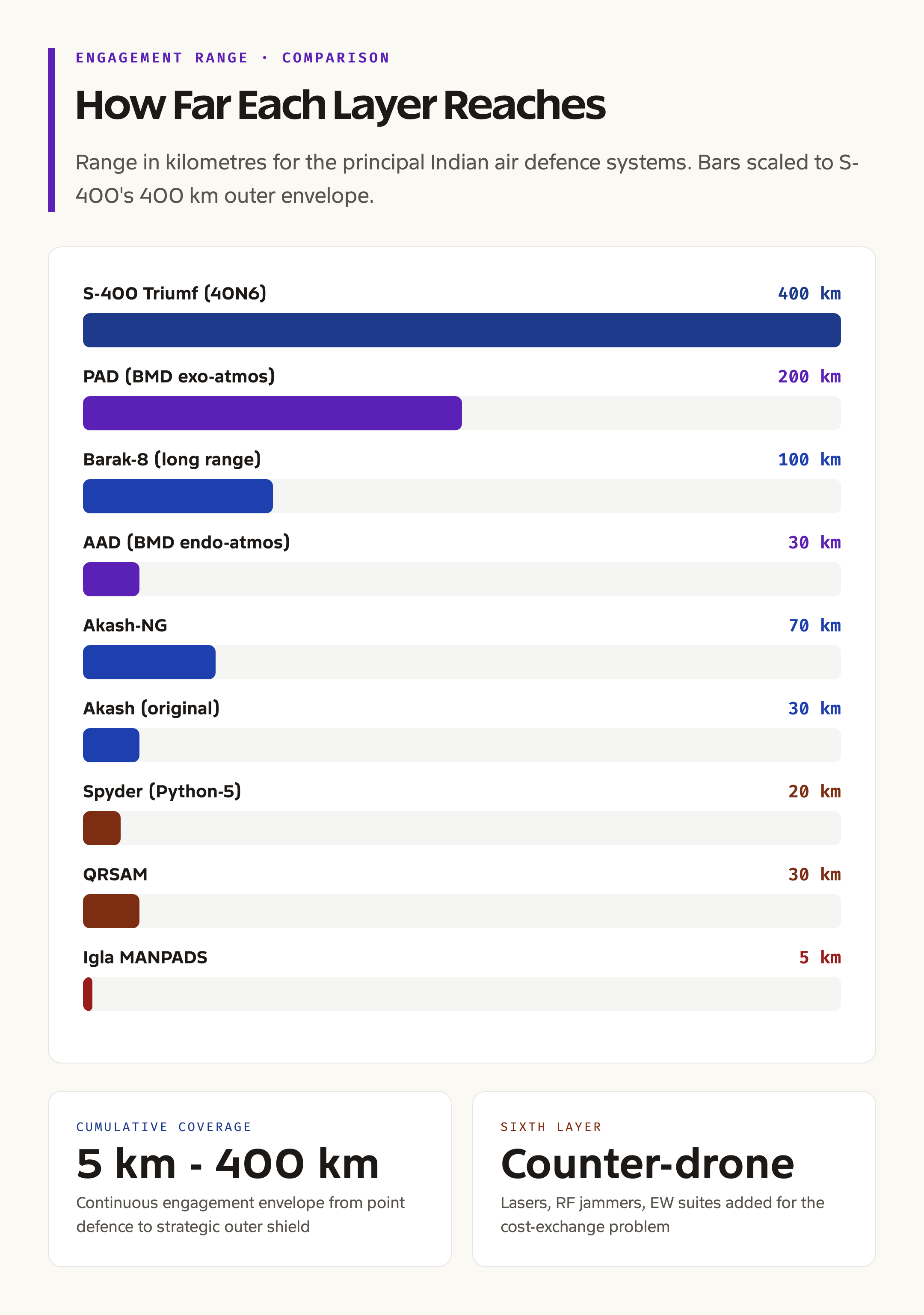
Short-range air defence is about reaction time and low-altitude engagement. A drone or a low-flying cruise missile can be on top of a target in seconds. The system that engages it has to detect, track, decide, and fire fast, often without time for human approval at every step. The Quick Reaction Surface to Air Missile, or QRSAM, is the indigenous answer. Developed by DRDO and now in series production, QRSAM has a range of about 25 to 30 kilometres, is mounted on a wheeled platform for shoot-and-scoot operations, and uses an active radar seeker for terminal homing. It is sized to escort armoured columns and protect critical assets from low-altitude threats.
The Spyder is the imported counterpart, a short-range air defence system from Israel that fires the Python-5 and Derby missiles. Spyder squadrons have been in Indian Air Force service for over a decade and form an important part of the short-range belt at strategic airbases and the borders. Together with QRSAM, the short-range layer handles low-flying aircraft, helicopters, drones, and any cruise missiles that have leaked through the outer layers.
Layer 5: Point Defence with Igla MANPADS
The innermost layer is point defence, where the system protects a single asset, like a radar site, an airfield, or an armoured unit, against threats already inside the medium and short-range bubbles. The Igla MANPADS, or Man-Portable Air Defence System, is a shoulder-fired infrared-guided missile with a range of about five kilometres. India operates the Igla and is procuring the modernised Igla-S as a stop-gap pending the indigenous Very Short Range Air Defence System, or VSHORADS, that DRDO has been developing.
MANPADS are not the most capable layer in absolute terms, but they are the most numerous and the most distributed. Every infantry battalion, every armoured regiment, and every airfield has them in significant numbers. They are the last line of defence and, against drones in particular, they are now critical given the volume of small UAV threats in modern conflicts.
Counter-Drone Layer: A Sixth Tier in the Making
The five-layer template was designed before the era of cheap, attritable drones. The Russia-Ukraine war and the conflicts in West Asia have shown that swarms of small drones can saturate any air defence system that depends on multi-million-dollar interceptors. The cost-exchange ratio is wrong: a US$ 500 quadcopter is engaged by a US$ 500,000 missile.
India is building a sixth layer specifically for the counter-drone problem. It includes laser-based directed-energy weapons, radio-frequency jammers that disrupt drone command links and GPS, electronic warfare suites that take over enemy drones, and dedicated kinetic interceptors sized for small targets. DRDO has demonstrated counter-drone systems that combine radar detection, electro-optical tracking, jamming, and laser kill, and the services have begun procurement in volume. For more on the operational dynamics of drone warfare, see the article on the Atlas drone swarm and India defense.
Integration and Command
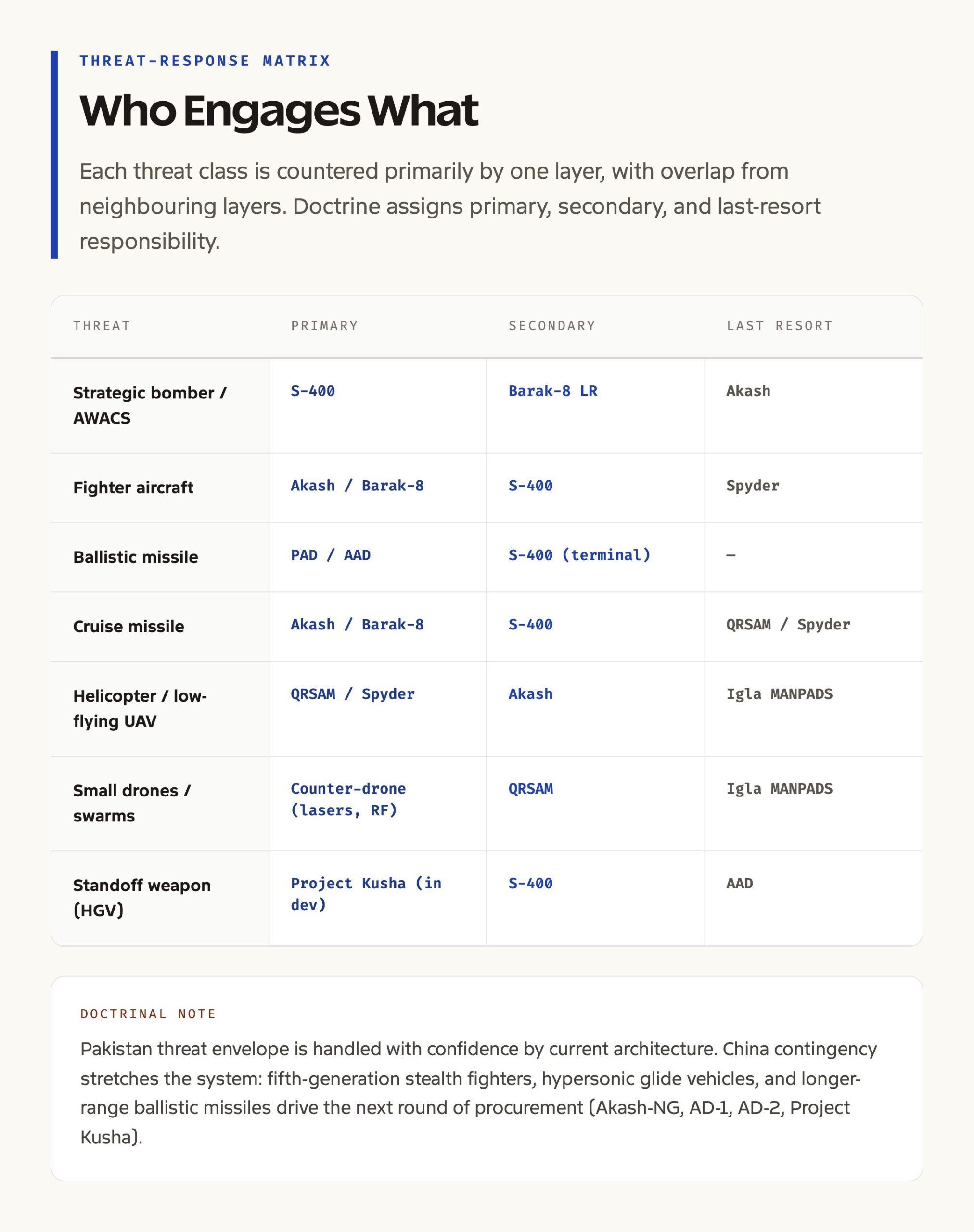
A layered shield is only as good as its integration. Five separate systems firing independently is not air defence. It is five sets of crews competing for the same airspace. The Integrated Air Command and Control System, or IACCS, is the digital backbone that ties the whole architecture together. It fuses radar tracks from ground-based, naval, and airborne sensors into a single air picture, distributes target assignments to the appropriate firing units based on engagement geometry, and prevents fratricide and double engagement. The Indian Air Force operates the system, with feeds from the Army Air Defence and the Navy.
The integration challenge is considerable. The S-400 is Russian. The Barak-8 is Indo-Israeli. The Akash and QRSAM are Indian. The Spyder is Israeli. Each system has its own command interfaces, data formats, and operating procedures. IACCS bridges them at the level of the air picture and the engagement command, but full data-link interoperability across all systems is a multi-year programme that is still in progress.
Strategic and Doctrinal Stakes
The layered shield is sized for two threat scenarios. The first is a high-intensity conflict with Pakistan, where the threat list includes Chinese-supplied JF-17 and J-10 aircraft, Babur and Ra’ad cruise missiles, Shaheen and Ghaznavi ballistic missiles, and an expanding fleet of drones. The second is a contingency with China, where the threat list extends to fifth-generation fighters, hypersonic glide vehicles, longer-range ballistic missiles, and large drone formations.
The current architecture handles the Pakistan scenario with confidence. The China scenario is harder. The S-400 is sized for fourth and fourth-plus-generation aircraft, not necessarily for fifth-generation stealth platforms or hypersonic glide vehicles. The BMD programme is sized for medium-range ballistic threats, not for the longer-range Chinese systems. Both gaps are being addressed in the next generation of Indian air defence procurement, which includes the Akash-NG, the AD-1 and AD-2 BMD interceptors, and the Project Kusha long-range air defence system. For the broader strategic frame, see the defence budget of India.
The cost picture is also relevant. The S-400 acquisition cost about US$ 5.4 billion. The Barak-8 programme has cost over US$ 2 billion across variants. Akash production runs into thousands of crores annually. The cumulative investment in the layered shield is one of the largest single line items in Indian defence procurement, and it has to be sustained at this level for decades to keep the architecture credible.
Frequently Asked Questions
What is layered air defence?
Layered air defence is a doctrine in which multiple air defence systems with different ranges are fielded together so that any threat that leaks through one layer is engaged by the next. The Indian shield has five layers, from S-400 Triumf at 400 kilometres to Igla MANPADS at five kilometres.
How many layers does India’s air defence have?
The conventional architecture has five layers: S-400 long-range, BMD for ballistic missiles, Akash and Barak-8 at medium range, QRSAM and Spyder at short range, and Igla MANPADS at point defence. A sixth counter-drone layer is in development.
What is the range of the S-400 in Indian service?
The S-400 has four interceptor types with ranges of 40, 120, 250, and 400 kilometres. The longest-range interceptor allows the system to engage targets deep inside adversary airspace.
How is BMD different from regular air defence?
Ballistic Missile Defence engages missiles on parabolic trajectories that travel above the atmosphere and re-enter at hypersonic speeds. The interceptors and radars are different from those used against aircraft and cruise missiles. India’s BMD has two layers: PAD for exo-atmospheric and AAD for endo-atmospheric intercepts.
What is the difference between Akash and Barak-8?
Akash is an indigenous Indian medium-range missile with about 30 kilometres range, command-guided and proximity-fuzed. Barak-8 is a joint Indo-Israeli development with about 70 to 100 kilometres range and an active radar seeker for terminal homing. The two systems together fill the medium-range belt.
Where does counter-drone capability fit?
Counter-drone is a sixth layer being added to the architecture. It uses lasers, radio-frequency jammers, electronic warfare suites, and small kinetic interceptors sized for the cost-exchange problem of cheap drone threats. DRDO and the services are procuring counter-drone systems in volume.
How are the layers integrated operationally?
The Integrated Air Command and Control System fuses radar tracks from ground, naval, and airborne sensors into one air picture and distributes engagement orders to the appropriate firing units. It bridges the different systems at the air-picture and command level, with full data-link interoperability still in progress.