LGBTQ+ Meaning: Full Form, Rights in India and Section 377 Verdict
LGBTQ+ meaning, full form, and evolution of queer rights in India: from Section 377 to NALSA v Union of India, Navtej Johar and the 2023 marriage-equality verdi
Introduction
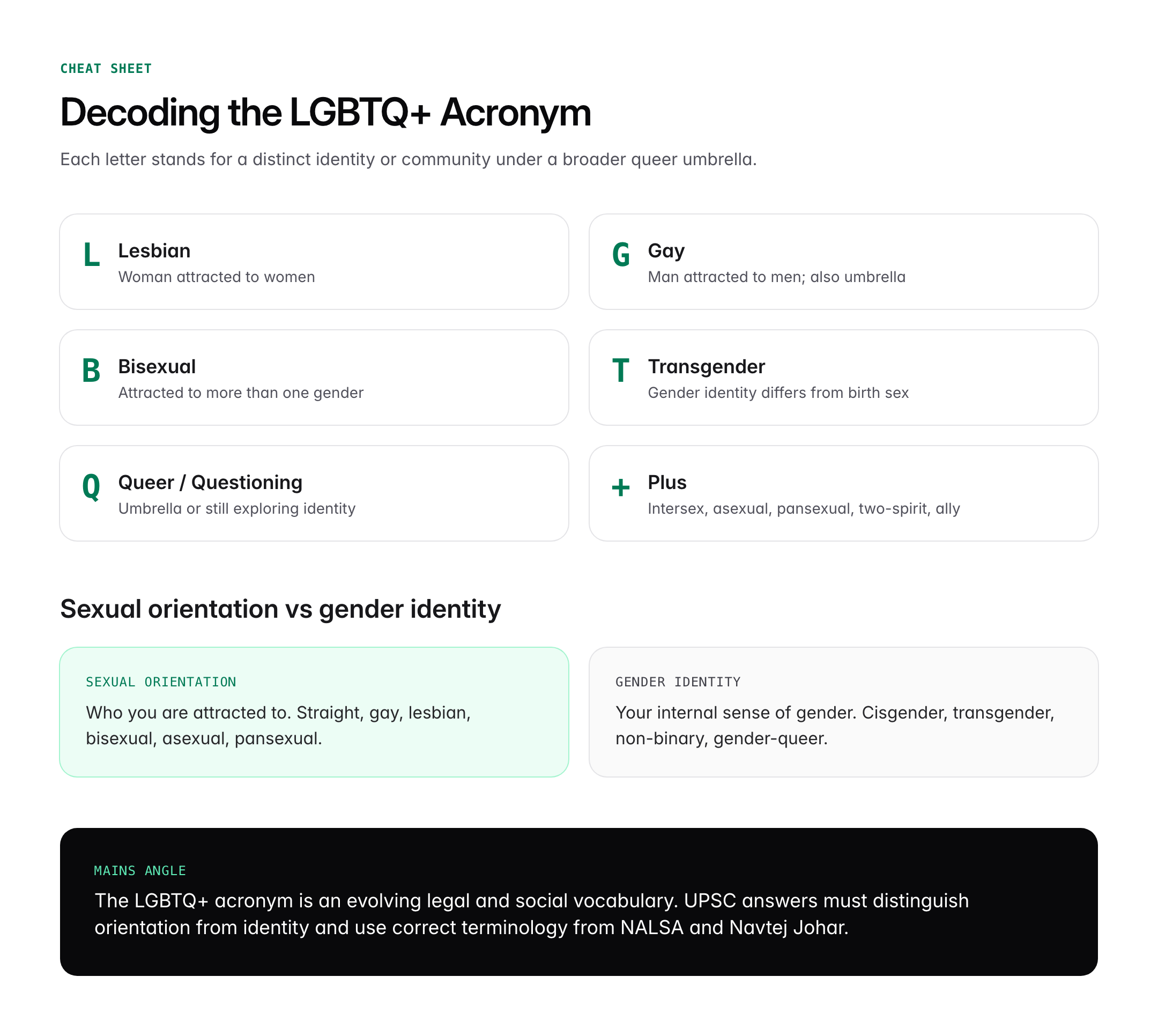
The acronym LGBTQ+ has become the shorthand for a broad and evolving family of sexual orientations and gender identities that exist beyond the heterosexual-cisgender default. It stands for Lesbian, Gay, Bisexual, Transgender and Queer (or Questioning), with the plus sign signalling an open set that can include intersex people, asexual people, pansexuals, two-spirit individuals and many other identities. For UPSC aspirants, the acronym is less important than what it represents: the legal, social and political journey of an Indian minority from criminalisation to constitutional recognition.
India’s relationship with LGBTQ+ rights has moved dramatically in a single decade. The 2014 NALSA judgment recognised transgender persons as the third gender. The 2018 Navtej Singh Johar verdict read down Section 377 of the IPC to decriminalise consensual same-sex relations. The 2023 Supriyo Chakraborty judgment declined to grant marriage equality but urged the state to address discrimination. Together these cases have made the LGBTQ+ question a live site of constitutional interpretation under Articles 14, 15, 19 and 21, which is precisely why GS1 Society, GS2 Fundamental Rights and Essay papers increasingly touch on it.
Quick Facts at a Glance
| Term | Meaning |
|---|---|
| L | Lesbian (a woman attracted to women) |
| G | Gay (a man attracted to men, also umbrella term) |
| B | Bisexual (attracted to more than one gender) |
| T | Transgender (gender identity differs from sex assigned at birth) |
| Q | Queer (umbrella) or Questioning |
| + | Intersex, asexual, pansexual, two-spirit, ally and more |
| I | Intersex (variations in sex characteristics) |
| A | Asexual (little or no sexual attraction) |
| Milestone | Year | Relevance |
|---|---|---|
| NALSA v Union of India | 2014 | Third gender recognition |
| Transgender Persons (Protection of Rights) Act | 2019 | Statutory rights framework |
| Navtej Singh Johar v Union of India | 2018 | Decriminalisation of Section 377 |
| Supriyo Chakraborty v Union of India | 2023 | Marriage equality declined |
Background and Historical Context
Queer lives are not foreign to Indian civilisation. The Kamasutra of Vatsyayana explicitly discusses “tritiya prakriti” or the third nature. Temple carvings at Khajuraho and Konark, the figure of Ardhanarishvara in Shaiva iconography, and references in Mughal court literature to homoerotic attachments show that pre-colonial India had a large vocabulary for diverse sexualities and gender expressions. The hijra community, present across South Asia for centuries, held ceremonial roles in Mughal courts.
Colonial modernity criminalised this world. Section 377 of the Indian Penal Code, drafted by Thomas Babington Macaulay and enacted in 1860, punished “carnal intercourse against the order of nature” with imprisonment up to life. The Criminal Tribes Act 1871 branded eunuchs and hijras a criminal tribe subject to registration and surveillance, a designation repealed only in 1952. These laws survived independence largely unchallenged until the 1990s.
The turning point came with the HIV-AIDS crisis. The AIDS Bhedbhav Virodhi Andolan, Naz Foundation (India) Trust and later Lawyers Collective argued that Section 377 drove gay men away from healthcare and violated fundamental rights. The Delhi High Court in Naz Foundation v Government of NCT of Delhi (2009) read down Section 377 for consensual adult same-sex acts. The Supreme Court reversed this in Suresh Kumar Koushal (2013), calling the community a “minuscule fraction” of the population.
The NALSA judgment (2014) broke the impasse by recognising transgender persons as a third gender, rooted in Articles 14, 15, 16, 19 and 21. A curative petition in the Section 377 matter was heard by a larger bench, and in September 2018 a five-judge Constitution Bench unanimously decriminalised consensual same-sex relations in Navtej Singh Johar v Union of India. In October 2023, the Supreme Court in Supriyo Chakraborty declined to read same-sex marriage into the Special Marriage Act but acknowledged discrimination and asked the government to set up a high-powered committee.
Key Terms and Concepts
Sexual orientation vs gender identity
Sexual orientation refers to the gender or genders a person is emotionally, romantically or sexually attracted to: heterosexual, homosexual (lesbian or gay), bisexual, pansexual, asexual. Gender identity refers to a person’s internal sense of being male, female, both, neither or elsewhere on the spectrum, independent of sex assigned at birth. A transgender woman may be a lesbian, a bisexual or straight depending on whom she is attracted to. Conflating the two is a common error in public discourse.
Transgender and cisgender
A transgender person’s gender identity differs from the sex assigned at birth. The Transgender Persons (Protection of Rights) Act 2019 defines a transgender person as one whose gender does not match the gender assigned at birth, including trans-men and trans-women, persons with intersex variations and gender-queer persons, and those with socio-cultural identities such as kinnar, hijra, aravani and jogta. A cisgender person’s gender identity matches sex assigned at birth; the word is simply a descriptor, not a slur.
Intersex
Intersex refers to a set of biological variations in chromosomes, hormones or sex characteristics that do not fit typical binary notions of male or female bodies. The Tamil Nadu government banned non-consensual sex-selective surgeries on intersex infants in 2019 following a Madras High Court direction. Intersex is a question of biology, not orientation.
Queer
Queer was once a slur and is now a reclaimed umbrella term widely used in academic, activist and community spaces for anyone who is not cisgender and heterosexual. Some older community members still avoid it, so sensitivity is advised in official communication.
Asexual and pansexual
Asexual people experience little or no sexual attraction; they may still have romantic relationships. Pansexual people can be attracted regardless of gender. These identities are now commonly included in LGBTQ+ discussions, particularly among younger Indians.
Significance for UPSC and General Knowledge
- LGBTQ+ rights sit at the intersection of Articles 14 (equality), 15 (non-discrimination), 19 (expression) and 21 (dignity), making them a recurrent Fundamental Rights topic.
- The Navtej Johar judgment introduced “constitutional morality” as a counterweight to social morality, a concept Essay papers often quote.
- The NALSA judgment is the Indian locus classicus on gender identity and brought international human rights norms like the Yogyakarta Principles into Indian law.
- The Transgender Persons Act 2019 tests how well statutory frameworks translate judicial mandates, relevant for GS2 on implementation gaps.
- The 2023 Supriyo Chakraborty verdict framed the horizontal (state) vs vertical (private) dimensions of discrimination, a useful analytical lens.
- Social stigma, healthcare access, workplace inclusion and school bullying are GS1 Society questions attached to the LGBTQ+ conversation.
Rights and Legal Framework in India
India’s LGBTQ+ legal framework rests on three pillars: constitutional rights, judicial recognition and statutory protection. The constitutional framework begins with Article 14’s guarantee of equality before law, Article 15’s prohibition of discrimination on grounds “including sex”, which the Supreme Court in NALSA read to include gender identity, Article 19(1)(a)’s freedom of expression covering self-identified gender presentation, and Article 21’s right to life with dignity, privacy and autonomy. The Puttaswamy privacy judgment (2017) sealed this reading by declaring sexual orientation an essential attribute of privacy.
The Transgender Persons (Protection of Rights) Act 2019 is the first statute to give codified rights to transgender Indians. It provides for self-perceived gender identity, prohibits discrimination in education, employment, healthcare, housing and movement, and establishes the National Council for Transgender Persons chaired by the Minister for Social Justice and Empowerment. The Act has been criticised for requiring a District Magistrate certificate for a gender-change identity and for diluting the self-identification principle laid down by NALSA, but it remains the governing law.
Judicially, Navtej Singh Johar (2018) read Section 377 down insofar as it criminalised consensual adult same-sex relations, retaining it only for non-consensual acts and bestiality. The judgment, authored by Justices Misra, Nariman, Chandrachud and Malhotra, declared that the right to love a person of one’s choice is a facet of Article 21. Supriyo Chakraborty (2023) was a 3-2 split on whether same-sex marriage could be read into the Special Marriage Act. The majority held that marriage is a statutory creation and a matter for Parliament, but all five judges agreed on the duty of the state to prevent discrimination and to ensure access to welfare entitlements for queer couples.
Social welfare and affirmative action
Under the Transgender Persons Rules 2020, a separate identity card is issued. The SMILE scheme (Support for Marginalised Individuals for Livelihood and Enterprise), launched by the Ministry of Social Justice in 2022, offers scholarships, skill training and shelters (Garima Greh). Karnataka, Tamil Nadu, Kerala and Odisha have gone further with state-level policies and welfare boards.
Continuing legal gaps
Same-sex couples cannot marry, jointly adopt (except single-parent adoption under CARA guidelines clarified in 2023), inherit automatically under personal laws, or avail spousal benefits under pension, income tax and armed forces entitlements. A Union government-constituted committee under the Cabinet Secretary is examining administrative and welfare measures post the 2023 verdict.
Comparative Perspective
| Country | Decriminalisation | Marriage Equality | Adoption |
|---|---|---|---|
| India | 2018 (Navtej Johar) | No (2023, deferred to Parliament) | Single-parent only |
| Nepal | 2007 | 2023 (interim registration order) | Limited |
| Taiwan | Long decriminalised | 2019 (first in Asia) | Yes (2023 equal) |
| USA | 2003 (Lawrence v Texas) | 2015 (Obergefell) | Yes |
| UK | 1967 (E&W) | 2013 (E&W, Scotland) | Yes |
| South Africa | 1998 | 2006 | Yes |
India sits in the middle of the global spectrum: decriminalised but pre-marital-equality. Unlike the US or South Africa, Indian courts have located queer rights in a constitutional-morality framework rather than explicit equal-protection readings of marriage, which leaves Parliament as the principal actor for the next step.
Challenges and Criticisms
Despite judicial gains, the lived experience of LGBTQ+ Indians remains difficult. A 2023 survey by Humsafar Trust found that 52 per cent of respondents had experienced workplace discrimination, 40 per cent had faced family violence, and access to healthcare remained poor outside metros. The Transgender Persons Act 2019 is criticised on four grounds: the District Magistrate certification process, absence of reservations, weak penalties for discrimination, and failure to address sex work realities for hijra and kothi communities.
Marriage equality’s deferral in Supriyo Chakraborty left several cascading gaps. Without marriage, queer couples cannot be covered jointly under Mediclaim, nominate spouses for PF, or make medical decisions in emergencies. The High-Powered Committee constituted under the Cabinet Secretary has issued internal recommendations on joint bank accounts and hospital visitation, but no unified legal status exists. Personal laws remain a minefield because Hindu, Muslim, Christian and Parsi codes are gendered.
A countervailing debate argues that marriage is a social institution defined by tradition and that constitutional courts ought not impose a uniform definition. This view, articulated by religious bodies and by some parliamentarians, won the day at the bench. Whichever side one takes, the 2023 verdict sharpened the focus on legislative action rather than judicial creativity as the next frontier for LGBTQ+ rights in India.
Prelims Pointers
- LGBTQ+ stands for Lesbian, Gay, Bisexual, Transgender, Queer/Questioning and more.
- Section 377 IPC was read down in Navtej Singh Johar v Union of India (2018).
- The NALSA judgment (2014) recognised transgender persons as the third gender.
- The Transgender Persons (Protection of Rights) Act was enacted in 2019.
- Puttaswamy v Union of India (2017) held privacy to include sexual orientation.
- Naz Foundation (2009) was the Delhi HC decision decriminalising Section 377, later reversed in Koushal (2013).
- The Supriyo Chakraborty judgment (2023) declined to legalise same-sex marriage.
- SMILE scheme and Garima Greh are central government welfare programmes for transgender persons.
- The National Council for Transgender Persons is chaired by the Union Minister for Social Justice and Empowerment.
- Netherlands (2001) was the first country to legalise same-sex marriage.
- Taiwan (2019) was the first Asian jurisdiction to legalise same-sex marriage.
- Articles 14, 15, 19 and 21 form the constitutional basis for LGBTQ+ rights in India.
Mains Practice Questions
Q1. Constitutional morality must trump social morality. Discuss in the context of the evolution of LGBTQ+ rights in India. (15 marks, 250 words)
- Define constitutional morality with reference to Ambedkar’s Constituent Assembly speech.
- Trace Naz Foundation, Koushal, NALSA, Puttaswamy, Navtej Johar and Supriyo Chakraborty.
- Balance with critique: judicial over-reach concerns, representative democracy objection, and the legislative gap on marriage equality.
Q2. Examine the adequacy of the Transgender Persons (Protection of Rights) Act 2019 in light of the NALSA judgment. (10 marks, 150 words)
- Outline NALSA principles: self-identification, affirmative action, gender as Article 15 category.
- Map 2019 Act: definitions, certification process, National Council, penalties.
- Identify dilution: DM certification, no reservation, weak penalties, silence on hijra livelihood.
Conclusion
LGBTQ+ is not a western import but a modern acronym for identities and communities that have always existed in India. What has changed is the constitutional framework that now recognises them. Five benchmark judgments, two statutes and a growing body of welfare schemes have moved India from criminalisation to incomplete equality within a decade. That is fast by any standard of constitutional reform.
Yet decriminalisation is not equality. Marriage, adoption, social security, workplace inclusion and freedom from violence are the pending chapters. For the UPSC aspirant, the LGBTQ+ story is a case study in how fundamental rights are interpreted, how statutory law lags judicial thinking, and how social change is driven by constitutional morality. Keep the five cases, three Articles, one statute and a handful of schemes ready, and the topic will serve across GS1, GS2, Essay and the interview board.
Frequently Asked Questions
What is the meaning of LGBTQ+?
LGBTQ+ stands for Lesbian, Gay, Bisexual, Transgender, and Queer or Questioning, with the plus sign indicating other identities such as intersex, asexual, pansexual and two-spirit. It is an umbrella acronym for people whose sexual orientations or gender identities fall outside the heterosexual-cisgender default.
What does LGBTQ full form stand for?
The full form of LGBTQ is Lesbian, Gay, Bisexual, Transgender, Queer. Lesbian refers to women attracted to women, gay to men attracted to men, bisexual to people attracted to more than one gender, transgender to those whose gender identity differs from birth-assigned sex, and queer as an umbrella or reclaimed term.
Why is LGBTQ+ important for UPSC preparation?
The topic intersects GS1 Society (social issues, diversity), GS2 (fundamental rights under Articles 14, 15, 19, 21, and judicial review through Navtej Johar, NALSA, Supriyo Chakraborty), Ethics (GS4 on dignity and constitutional morality), and Essay. It also tests current affairs on the 2019 Transgender Persons Act and post-2023 marriage equality debates.
What is Section 377 and what happened to it?
Section 377 of the Indian Penal Code, enacted in 1860, criminalised carnal intercourse against the order of nature. In Navtej Singh Johar v Union of India (2018) a five-judge Supreme Court bench unanimously read it down for consensual adult same-sex relations, retaining it only for non-consensual acts and bestiality, thereby decriminalising homosexuality.
How is LGBTQ+ related to the NALSA judgment?
NALSA v Union of India (2014) recognised transgender persons as a third gender with rights under Articles 14, 15, 16, 19 and 21. It paved the way for the 2019 Transgender Persons Act and shaped the constitutional reasoning in Navtej Johar and Puttaswamy, anchoring LGBTQ+ rights in India’s fundamental rights framework.
Is same-sex marriage legal in India?
No. In Supriyo Chakraborty v Union of India (October 2023) the Supreme Court by a 3-2 majority declined to read same-sex marriage into the Special Marriage Act, holding that marriage is a statutory creation for Parliament to legislate. All five judges urged the state to prevent discrimination and set up a high-powered committee on welfare entitlements.
What are the rights of transgender persons in India?
The Transgender Persons (Protection of Rights) Act 2019 bans discrimination, guarantees access to education, employment, healthcare and housing, allows self-perceived gender identity subject to District Magistrate certification, establishes the National Council for Transgender Persons, and mandates welfare schemes such as SMILE and Garima Greh shelters.
What is the difference between transgender and intersex?
Transgender is a gender identity term describing someone whose identity differs from the sex assigned at birth. Intersex is a biological term referring to people born with variations in chromosomes, hormones or sex characteristics that do not fit typical male or female binaries. A person can be intersex and cisgender, or intersex and transgender.