Madhav National Park: Madhya Pradesh’s Shivpuri Tiger Reserve
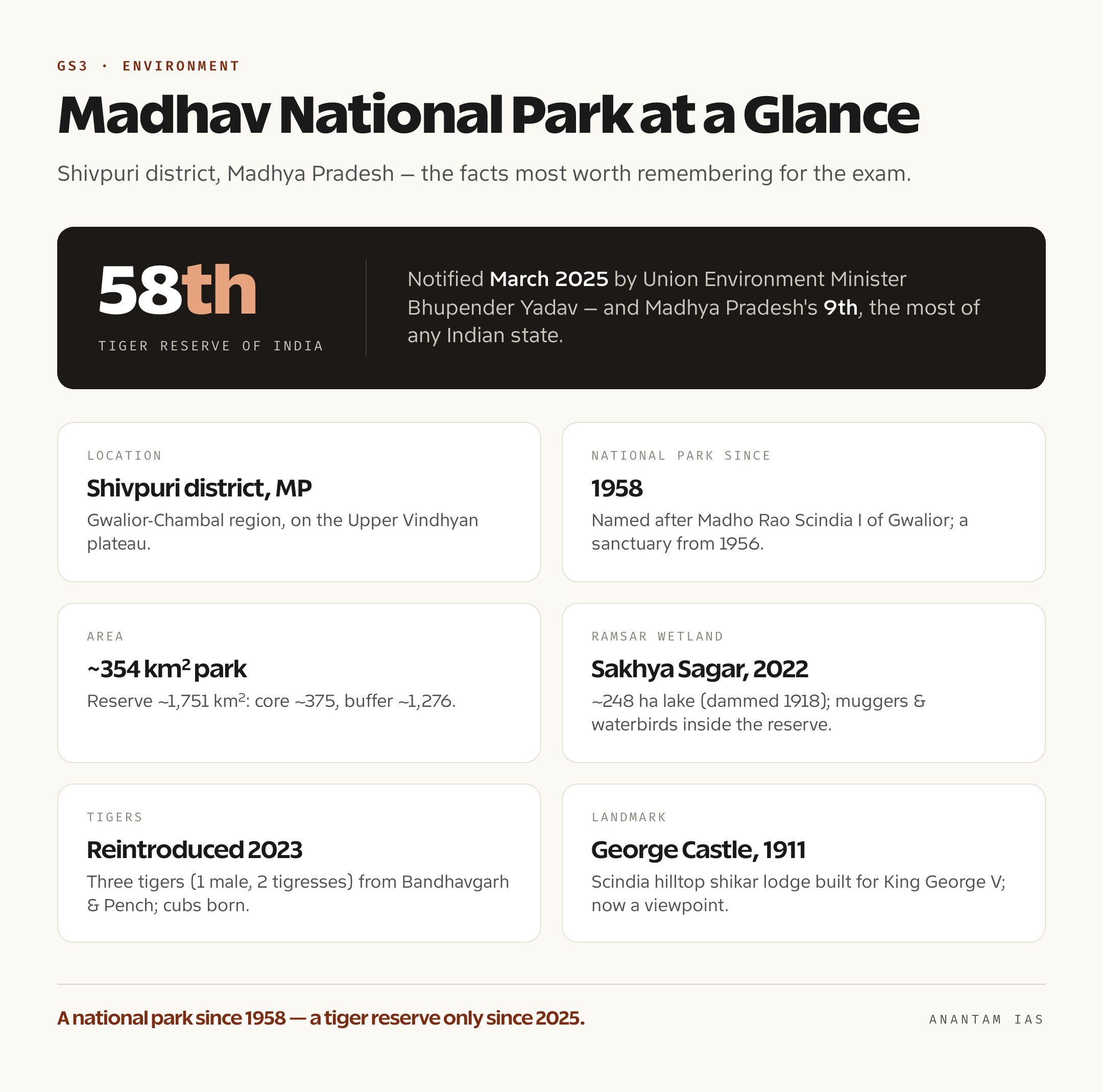
Madhav National Park in Shivpuri was notified as India's 58th tiger reserve in March 2025 — and Madhya Pradesh's ninth. From a Scindia hunting estate to a recovering big-cat landscape, here is the full story for UPSC.
Stand on the rim of Sakhya Sagar at first light and the place looks more like a painting than a tiger forest — a still sheet of water, marsh crocodiles basking on the far bank, an old British-era pavilion called George Castle catching the sun on the hill behind. For nearly half a century this was a forest with no tigers in it at all; the last resident big cats vanished in the late 1970s. So when three tigers padded out of their crates here in 2023, they were walking back into a landscape that had been waiting for them for a generation.
That return is why Madhav National Park, in the Shivpuri district of Madhya Pradesh, has moved from a quiet backwater of the conservation map to a headline. In March 2025, the Union government notified it as India’s 58th tiger reserve — and Madhya Pradesh’s ninth, the most of any state. For a UPSC aspirant, Madhav is a compact case study in almost everything Project Tiger now stands for: reintroduction, corridor planning, the friction between highways and wildlife, and a state that has turned the conservation of one species into a brand.
Where Madhav Is, and What It Looks Like
Madhav National Park sits in Shivpuri district, in the Gwalior-Chambal region of northern Madhya Pradesh, on the northern edge of the country’s Central Highlands. The terrain is the Upper Vindhyan plateau — low forested hills falling away to flat grasslands and two artificial lakes — and it lies within the Khathiar-Gir dry deciduous forest ecoregion that runs across central India. The national park covers roughly 354 square kilometres, and the tiger reserve declared around it is far larger, of which more below.
The park’s defining feature is water in a dry land. Two lakes anchor it: Sakhya Sagar and the adjoining Madhav Sagar, both created by damming the Manihar river in the early twentieth century under the Scindias. Sakhya Sagar in particular is the ecological heart of the place, ringed by marsh and crowded with marsh crocodiles, turtles and waterbirds. The forest around the lakes is classic Northern Tropical dry deciduous and dry thorn forest, with the tree locally called kardhai (Anogeissus pendula) dominating, alongside khair, salai, tendu and palas, and patches of bamboo and grassland that feed the deer.
The wildlife reads like a roll-call of the central Indian dry forest. Beyond the reintroduced tigers, the carnivores include leopard, striped hyena, jackal, jungle cat, the Indian wolf and the occasional sloth bear. The herbivores — the prey base a tiger population lives or dies by — run from chital and sambar to nilgai, the four-horned antelope (chausingha), chinkara and wild boar. Mugger crocodiles patrol Sakhya Sagar alongside Indian pythons and monitor lizards, and the birdlife is rich enough on its own to draw visitors, from crested serpent eagles overhead to the painted storks and migratory geese on the water. It is a complete dry-deciduous ecosystem; the only thing missing for half a century was the animal at the top of it.
The catch — and it matters for the exam — is the road. National highways slice through the landscape here; the busy corridor between Agra and the south, long numbered NH-3 and NH-46, passes close to the park, carrying heavy traffic across what should be unbroken wildlife habitat. So Madhav is also a live example of the “linear infrastructure versus wildlife corridor” debate that GS-III examiners love. A protected area cut by a national highway is a protected area with a problem.
A Royal Shikar Estate That Became a National Park
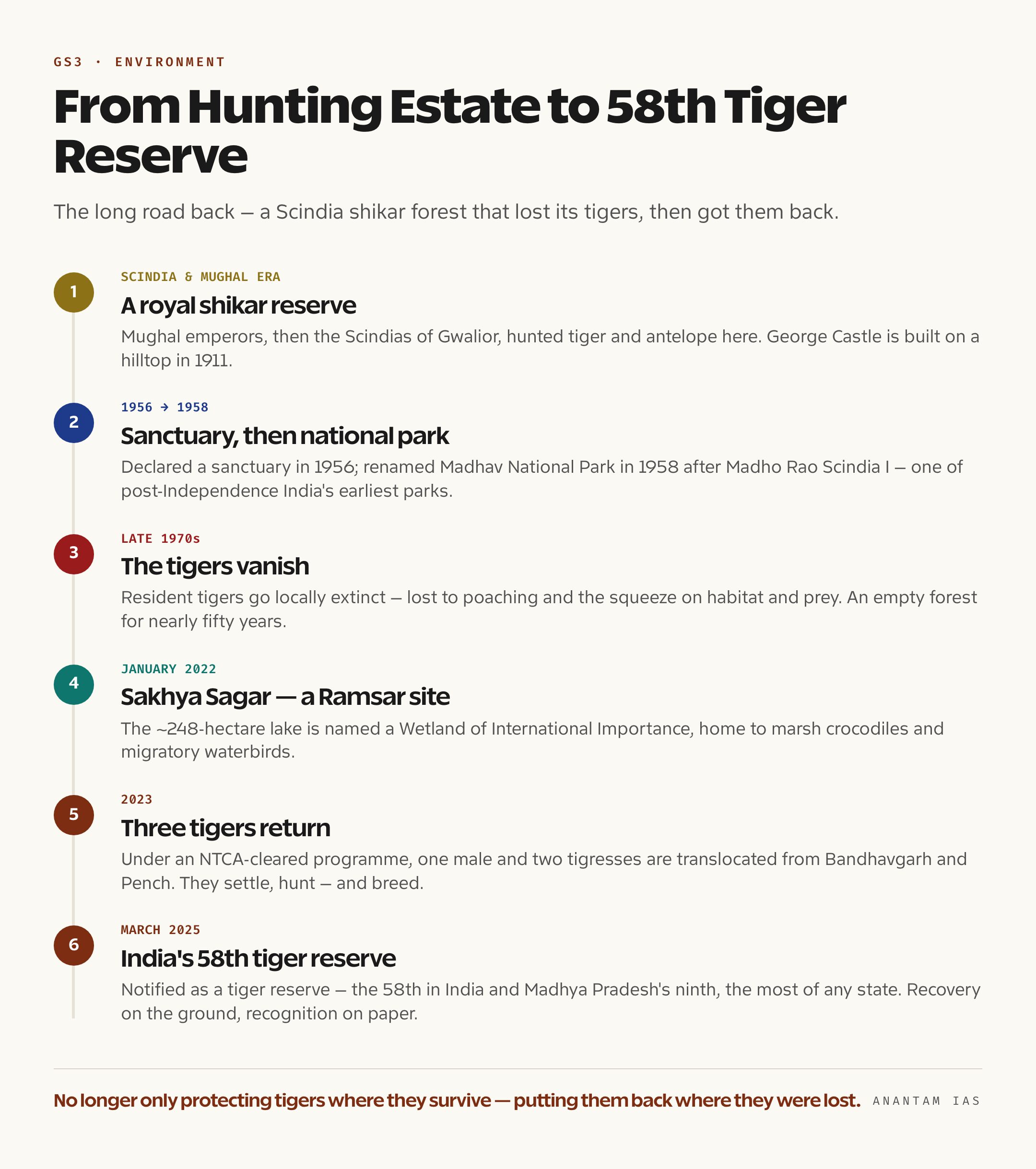
Madhav did not begin as a sanctuary. It began as a hunting ground. The forests around Shivpuri lay on the old route between Agra and the Deccan, and Mughal emperors are recorded hunting here on the march; later the Scindia rulers of Gwalior made it their private shikar reserve, where tiger, leopard and antelope were shot for sport. The British, too, came to hunt. The most charming relic of that era is George Castle, a viewing lodge the Scindia ruler built in 1911 on a hilltop inside the present park for an overnight halt by King George V, who was expected to break his journey for a tiger shoot — a visit that, by most accounts, never quite happened. The empty castle now serves as a heritage viewpoint, and the cenotaph (chhatri) of Madho Rao Scindia stands nearby.
The shift from estate to sanctuary came after Independence. The area was declared a sanctuary in 1956 — first as Shivpuri National Park over a smaller core — and in 1958 it was renamed Madhav National Park, after Madho Rao Scindia I, the Gwalior maharaja who had developed the lakes and lodges. That makes Madhav one of the earliest national parks notified in post-Independence India, a useful prelims fact in its own right. For decades it drifted along as a scenic, lightly visited park better known for its lakes and crocodiles than its cats, because the cats were gone.
That long quiet ended only recently, and the recovery has been deliberate. Two graphics below summarise the park at a glance and the arc from royal hunting estate to India’s newest tiger reserve.
Sakhya Sagar: A Ramsar Wetland Inside a Tiger Reserve
Long before the tigers came back, Madhav earned a different kind of recognition. In January 2022, Sakhya Sagar was designated a Wetland of International Importance under the Ramsar Convention — the 1971 international treaty for the conservation and wise use of wetlands. It was one of a clutch of Indian sites added that year as the country pushed its Ramsar tally sharply upward, and it gave the park a wetland identity to sit beside its forest one.
Sakhya Sagar covers about 248 hectares and was created in 1918 by damming the Manihar. Its claim to international status rests on biodiversity, not size. The lake holds a significant population of the marsh crocodile, or mugger (Crocodylus palustris), and supports turtles, fish, amphibians and a long list of resident and migratory waterbirds — bar-headed goose, painted stork, spot-billed duck, pochards and more — that make it a winter stopover on the central Indian flyway. The Ramsar listing matters because it layers an international conservation obligation on top of the national park, and because it makes Madhav a rare case where a Ramsar wetland sits inside what is now a tiger reserve.
But the wetland also carries a warning that’s worth knowing. Sakhya Sagar has struggled with invasive water hyacinth choking its surface, and the surrounding forest fights Lantana camara, an aggressive invasive shrub that crowds out the native grasses tigers’ prey depend on. So even a celebrated site is not a finished story; a Ramsar tag is a responsibility, not a trophy. That tension — recognition on paper, hard management work on the ground — runs through the whole of Madhav.
Tigers Return, and a 58th Reserve Is Born
The headline event is the tigers. Madhav’s resident tigers had gone locally extinct by the late 1970s, lost to poaching and the slow squeeze of habitat and prey. The forest stayed — but empty of its apex predator. Under a reintroduction programme aligned with Project Tiger and cleared by the National Tiger Conservation Authority (NTCA), the statutory body that oversees India’s tiger reserves, that was set right. In 2023, the Madhya Pradesh forest department translocated three tigers — a male and two tigresses, drawn from the state’s source populations at reserves such as Bandhavgarh and Pench — into Madhav. The animals settled, hunted and, crucially, bred: cubs born in the park signalled that the habitat could once again hold a self-sustaining population, lifting the count to a small but growing handful.
Recovery on the ground cleared the way for recognition on paper. In March 2025, Union Environment Minister Bhupender Yadav announced that Madhav had been notified as a tiger reserve — India’s 58th, and Madhya Pradesh’s ninth. The reserve approved around the park is far bigger than the old national park core: an NTCA proposal set it at roughly 1,751 square kilometres in all, with a core of about 375 square kilometres and a buffer of around 1,276 square kilometres, the buffer being the zone where regulated human activity is allowed around a strictly protected core. That two-layer core-and-buffer design is the standard architecture of every Indian tiger reserve, and it’s worth remembering as a concept, not just a number.
It helps to be clear on why reintroduction even arises, because it’s a question Mains can ask directly. A tiger going locally extinct doesn’t just remove a tourist draw; it removes the apex predator that keeps herbivore numbers in check and the forest in balance, and an “empty forest” — green but missing its top carnivore — slowly loses its ecological function. Putting tigers back is harder than it sounds: you need enough prey waiting, a habitat free of the threats that emptied it in the first place, and source populations healthy enough to spare animals. Madhav had the habitat and the lakes; what it needed was a secured prey base and protection, which is exactly what the reserve framework is meant to deliver. The proof of concept is the cubs — a tiger that breeds in a new home has, in effect, voted that the home will do.
The notification also cements a larger claim. With nine tiger reserves, Madhya Pradesh has more than any other state — Kanha, Bandhavgarh, Pench, Satpura, Panna, Sanjay-Dubri, Ratapani, Veerangana Durgavati and now Madhav. The “Tiger State” tag is earned in population, too: the 2022 All India Tiger Estimation put Madhya Pradesh first in the country with about 785 tigers, out of a national total of roughly 3,682. And that national figure is the bigger story Madhav plugs into — India now holds the large majority of the world’s wild tigers across 58 reserves, a recovery from barely 1,400 tigers counted in 2006. Madhav is one small node in that comeback, but it’s a telling one, because it shows India is no longer only protecting tigers where they survive; it is putting them back where they were lost.
Conservation Challenges and the Corridor Question
A reintroduced population is fragile, and Madhav’s problems are the textbook ones. The most visible is the highway. With a national highway running through the landscape, the reserve faces habitat fragmentation, roadkill risk and the disturbance of heavy traffic cutting across animal movement — the classic case against linear infrastructure in protected areas. The response is the standard toolkit: underpasses and overpasses, speed regulation, and physical barriers, including a long boundary wall built to reduce conflict between wildlife and the villages on the fringe. Whether mitigation can fully offset a busy road through a small reserve is exactly the kind of open question Mains answers should sit with rather than resolve glibly.
The other pressures are familiar across central India. The prey base — chital, sambar, nilgai and the rest — has to be built up continuously so a growing tiger population has enough to eat. Invasive species, the water hyacinth on Sakhya Sagar and Lantana in the forest, degrade habitat and have to be cleared at cost. Grazing and encroachment from fringe villages compete for the same land, which is why buffer-zone management and community livelihoods are as much a part of tiger conservation as the cats themselves. And tourism, the economic lifeline that funds much of this, has to be paced to the reserve’s ecological carrying capacity rather than its revenue targets.
Set against these problems is Madhav’s real strategic value: location. It sits within reach of the wider central Indian tiger landscape and close to the Ranthambore-Chambal belt to the north and the cheetah-reintroduction site at Kuno to the west, in Sheopur. So a new reserve here is not just one more dot on the map; it is a potential stepping stone in a network of corridors that lets big cats disperse between populations instead of being marooned in islands. That is the cutting edge of Indian conservation thinking — not isolated reserves, but connected landscapes — and it is why a relatively small, road-cut park in Shivpuri matters more than its size suggests.
For Your Mains Answer
Madhav is a ready-made example for GS Paper 3, under environment and biodiversity — specifically conservation, protected-area management and the institutional machinery of Project Tiger and the NTCA. It also serves the recurring “development versus environment” theme through the highway-versus-corridor angle, and it touches GS Paper 1 geography when a question turns on India’s physiographic regions or wetlands. Treat Madhav as a concrete case study to illustrate a broader argument about reintroduction and connected landscapes, not as a fact-sheet to recite.
How to Build the Answer
Open with what makes Madhav current, not with a definition: a forest that lost its tigers in the 1970s and got them back in 2023, then became India’s 58th tiger reserve in 2025. Move outward in order — the reintroduction and NTCA’s core-and-buffer model, the Ramsar wetland layered inside it, the highway-corridor challenge, and finally the bigger picture of connected landscapes linking Madhav toward Ranthambore and the central Indian belt. Close on the shift from preserving tigers where they survive to restoring them where they were lost.
Common Mistakes to Avoid
Don’t get the status wrong — Madhav was a national park from 1958 but became a tiger reserve only in 2025, and conflating the two dates is an easy way to lose credibility. Don’t treat reintroduction as a guaranteed success; a handful of tigers and a few cubs is recovery beginning, not recovery achieved. Don’t ignore the wetland and crocodile dimension, which makes Madhav unusually multi-layered. And don’t write a travel brochure — examiners want the conservation argument, not the safari timings.
A Compact Answer Spine
Royal Scindia shikar reserve → national park in 1958, named after Madho Rao Scindia → resident tigers extinct by late 1970s → Sakhya Sagar a Ramsar wetland (2022), home to muggers and waterbirds → three tigers reintroduced in 2023, cubs born → notified India’s 58th tiger reserve and MP’s 9th in March 2025 (core-and-buffer under NTCA) → challenges: highway fragmentation, invasives, prey base, tourism → strategic value as a corridor node toward Ranthambore and the central Indian landscape.
Diagram or Flowchart Idea
Draw a simple before-and-after arrow. Left box: “Empty forest — last tigers lost in the late 1970s, scenic lakes, no apex predator.” Right box: “Recovering tiger reserve — 2023 reintroduction, cubs born, 58th tiger reserve (2025).” Label the arrow “reintroduction under Project Tiger / NTCA.” Beneath it, sketch a tiny core-and-buffer ring with a highway cutting across to flag the corridor problem. A clean visual like this earns marks fast and shows you grasp the process, not just the facts.
A Balanced-Conclusion Line
Close with the idea that Madhav marks a maturing of Indian tiger conservation — from defending the last strongholds to actively rebuilding lost populations and stitching reserves into connected landscapes — provided the harder, slower work of managing highways, invasives and fringe communities keeps pace with the celebration of a new reserve.
How to Use Data Without Cramming
You don’t need a wall of numbers. Five anchors do the work: national park in 1958, Sakhya Sagar’s Ramsar listing in 2022, the 2023 reintroduction of three tigers, the March 2025 notification as the 58th tiger reserve, and Madhya Pradesh’s roughly 785 tigers leading a national total of about 3,682. Drop those precisely and let the argument carry the rest.
FAQ
When did Madhav National Park become a tiger reserve, and which number is it? Madhav was notified as a tiger reserve in March 2025, announced by Union Environment Minister Bhupender Yadav. It is India’s 58th tiger reserve and Madhya Pradesh’s ninth — the most of any Indian state. It had been a national park since 1958, but a tiger reserve only from 2025.
Where is Madhav National Park and what is it named after? It lies in Shivpuri district, in the Gwalior-Chambal region of northern Madhya Pradesh, on the Upper Vindhyan plateau. It was a royal hunting reserve of the Scindias of Gwalior and was named after Madho Rao Scindia I when it was declared a national park in 1958. Its best-known landmarks are the lakes Sakhya Sagar and Madhav Sagar and the colonial-era lodge George Castle.
How were tigers brought back to Madhav? Madhav’s resident tigers went locally extinct by the late 1970s. In 2023, under a reintroduction programme cleared by the National Tiger Conservation Authority, the Madhya Pradesh forest department translocated three tigers — one male and two tigresses — from the state’s source populations such as Bandhavgarh and Pench. The tigers bred, and cubs born in the park signalled that the habitat could again support tigers.
Why is Sakhya Sagar important? Sakhya Sagar, a roughly 248-hectare lake inside the park created by damming the Manihar river, was designated a Ramsar Site — a Wetland of International Importance — in January 2022. It supports a significant population of marsh crocodiles (muggers) along with turtles, fish and many resident and migratory waterbirds, making Madhav a rare case where a Ramsar wetland sits inside a tiger reserve.
Practice Questions
Prelims MCQs
- With reference to Madhav National Park, consider its recent status. The park was notified as which numbered tiger reserve of India?
(a) 53rd
(b) 55th
(c) 58th
(d) 60th.
Answer: (c) — Madhav was declared India’s 58th tiger reserve in March 2025, and Madhya Pradesh’s ninth. - In which district and state is Madhav National Park located?
(a) Sheopur, Madhya Pradesh
(b) Shivpuri, Madhya Pradesh
(c) Chandrapur, Maharashtra
(d) Sawai Madhopur, Rajasthan.
Answer: (b) — Madhav lies in Shivpuri district, in the Gwalior-Chambal region of Madhya Pradesh. - Sakhya Sagar, associated with Madhav National Park, is significant primarily because it is a
(a) UNESCO World Heritage Site
(b) Ramsar wetland of international importance
(c) biosphere reserve
(d) marine national park.
Answer: (b) — Sakhya Sagar was designated a Ramsar Site in January 2022, known for its marsh crocodiles and waterbirds. - Consider the following about Madhav National Park:
1. It was declared a national park in 1958.
2. Its resident tigers became locally extinct by the late 1970s.
3. Tigers were reintroduced into it in 2023.
Which of the statements are correct?
(a) 1 and 2 only
(b) 2 and 3 only
(c) 1 and 3 only
(d) 1, 2 and 3.
Answer: (d) — All three are correct: a 1958 national park, tigers lost by the late 1970s, and reintroduced in 2023. - Which state has the highest number of tiger reserves in India following the notification of Madhav?
(a) Maharashtra
(b) Karnataka
(c) Madhya Pradesh
(d) Uttarakhand.
Answer: (c) — With Madhav as its ninth, Madhya Pradesh has the most tiger reserves and is called the “Tiger State,” leading the 2022 estimation with about 785 tigers.
Mains Practice Questions
- “India’s tiger conservation has moved from protecting surviving populations to actively restoring lost ones.” Examine this shift with reference to the reintroduction of tigers at Madhav National Park. (15 marks, 250 words)
- Discuss how the core-and-buffer model under the National Tiger Conservation Authority balances strict protection with the livelihood needs of fringe communities, using Madhav Tiger Reserve as an example. (15 marks, 250 words)
- Linear infrastructure such as national highways poses a growing threat to wildlife corridors in central India. Evaluate the challenges and mitigation measures in the context of Madhav National Park. (15 marks, 250 words)
- The designation of Sakhya Sagar as a Ramsar Site within a tiger reserve illustrates the layering of conservation obligations on a single landscape. Comment on the opportunities and management challenges this creates. (10 marks, 150 words)
- “Connected landscapes, not isolated reserves, are the future of big-cat conservation in India.” Assess this proposition with reference to Madhav’s position relative to the Ranthambore-Chambal and Kuno landscapes. (15 marks, 250 words)