Mandatory Disclosure of Arrest Grounds: Article 22, Section 47 BNSS, and the Pankaj Bansal Doctrine
Mandatory disclosure of arrest grounds explained: Article 22(1) fundamental right, Section 47 of BNSS 2023, Pankaj Bansal v. Union of India 2023, written grounds rule, and the difference between reasons and grounds of arrest.
The moment a person is arrested in India, the Constitution gives them a small handful of rights that determine whether the arrest is lawful or amounts to illegal detention. The most fundamental of these is the right to be told why. Article 22(1) of the Constitution states, in unconditional language, that no person who is arrested shall be detained in custody without being informed, as soon as may be, of the grounds for such arrest. This provision is not a procedural courtesy. It is a fundamental right enforceable in any court, and a violation of it can render the arrest itself void.
For decades, the practical content of this right was unclear. Did the police have to put the grounds of arrest in writing? Did they have to give a copy to the arrested person or only inform them orally? Did the same standard apply to ordinary criminal offences and special economic crimes? The Supreme Court has now answered these questions in a series of rulings culminating in the Pankaj Bansal v. Union of India judgment of 2023 and a 2024 ruling that extended the principle from the Prevention of Money Laundering Act to ordinary offences under the Bharatiya Nyaya Sanhita and the Indian Penal Code.
Section 47 of the Bharatiya Nagarik Suraksha Sanhita, 2023, which replaced Section 50 of the Code of Criminal Procedure on July 1, 2024, codifies the duty of the arresting officer in plainer language than before. This guide unpacks how the constitutional right, the statutory duty, and the judicial doctrine fit together.
Quick Facts on Mandatory Disclosure of Arrest Grounds
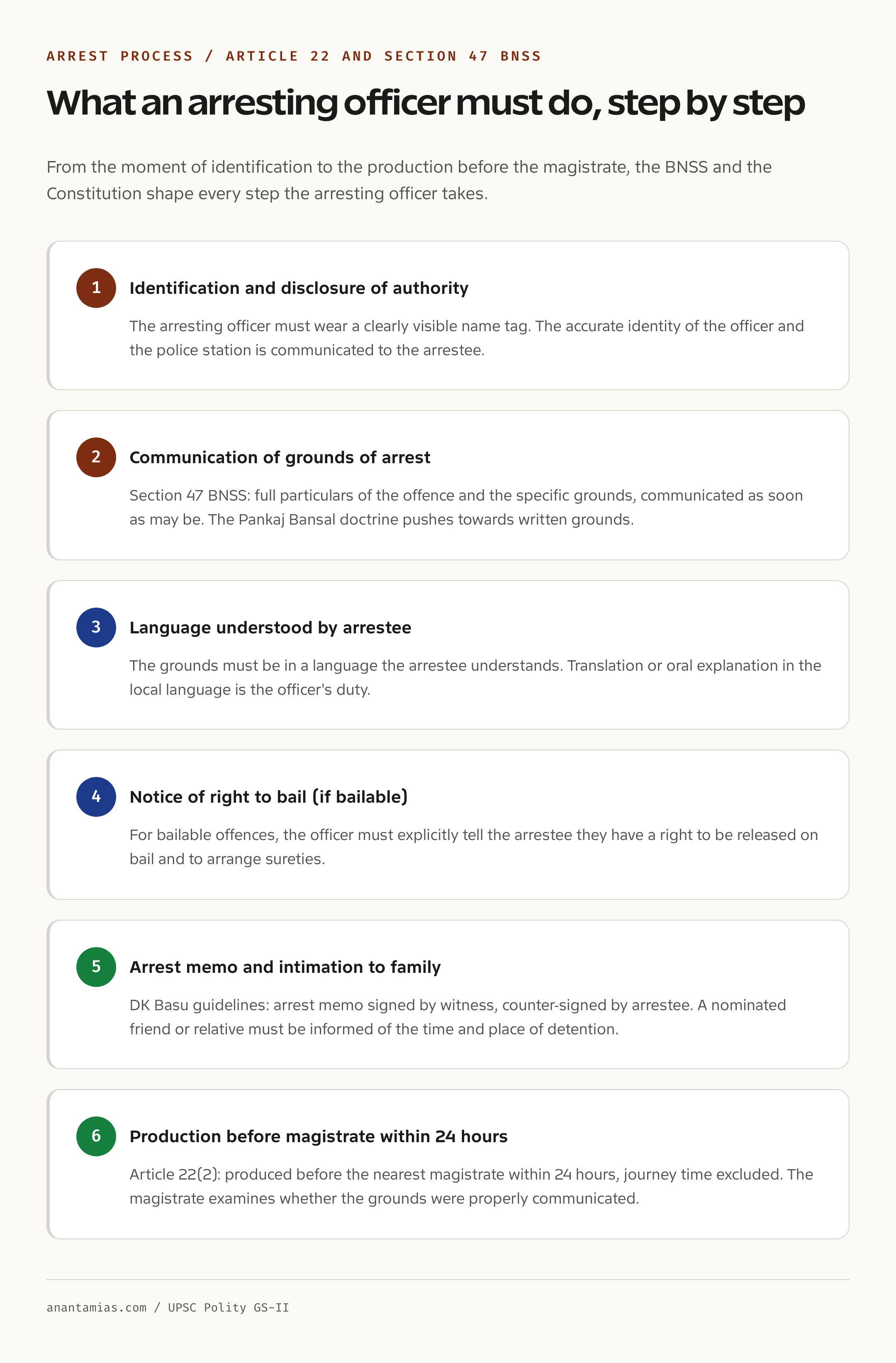
Article 22(1) of the Indian Constitution states that no arrested person shall be detained in custody without being informed, as soon as may be, of the grounds for arrest. This is a fundamental right under Part III of the Constitution. Section 47 of the Bharatiya Nagarik Suraksha Sanhita, 2023, replacing Section 50 of the CrPC, requires every police officer arresting a person without a warrant to inform the person of the full particulars of the offence and the grounds for arrest. If the offence is bailable, the police officer must explicitly inform the person of the right to be released on bail and to arrange sureties. The Supreme Court in Pankaj Bansal v. Union of India (2023) ruled that for arrests under the Prevention of Money Laundering Act, the grounds of arrest must be furnished in writing. In a 2024 ruling, the Court extended this written-grounds requirement, in principle, to arrests under the Bharatiya Nyaya Sanhita and the Indian Penal Code. The Court has held that the information must be communicated in a language the arrestee understands. The doctrine distinguishes between “reasons” of arrest (internal police justification) and “grounds” of arrest (specific facts and allegations); the police must share the grounds, not merely the reasons.
What “Communicating the Grounds of Arrest” Means
Communicating the grounds of arrest is a substantive obligation that goes well beyond informing a person they are being arrested. The grounds must contain enough specific factual content to allow the arrested person, or their lawyer, to understand exactly what offence is being alleged and on what evidence. This serves two practical purposes. First, it allows the person to engage a lawyer who can examine the basis of the arrest. Second, and more importantly, it allows the person to apply for bail, anticipatory or regular, with full knowledge of the case being made out.
A simple statement like “you are being arrested for theft under Section 379” is not enough. The grounds must contain the specific factual allegations that connect the arrested person to the offence. They must say, for example, that the person was identified by a witness leaving the scene of a burglary at 10 p.m. on a stated date, that fingerprints recovered from the safe match a sample on file, or that intercepted communications place them at the planning stage of the offence. The Court’s reasoning is that a person who does not know the specific allegations cannot meaningfully exercise the right to challenge the detention, which would empty Article 22(1) of any practical content.
The communication has to happen in a language the arrested person understands. This is not just a matter of sentiment. In a country with the linguistic diversity of India, an arrest memo in English handed to a person who speaks only Bhojpuri or Tamil is no communication at all. Where the arrested person does not understand the language of the original document, the police are required to explain the grounds in a language they do understand, and increasingly, to provide a translated copy.
Background and Historical Context
The right to be informed of the grounds of arrest is not a recent judicial invention. Article 22 was part of the original 1950 Constitution, drafted in conscious response to the experience of preventive detention and arbitrary arrest under colonial rule. Article 22 has two main parts. The first, applying to criminal arrests, gives every arrested person the right to know the grounds of arrest, the right to consult a lawyer of choice, and the right to be produced before a magistrate within 24 hours. The second, applying to preventive detention, gives narrower protections that have been the subject of a long doctrinal debate.
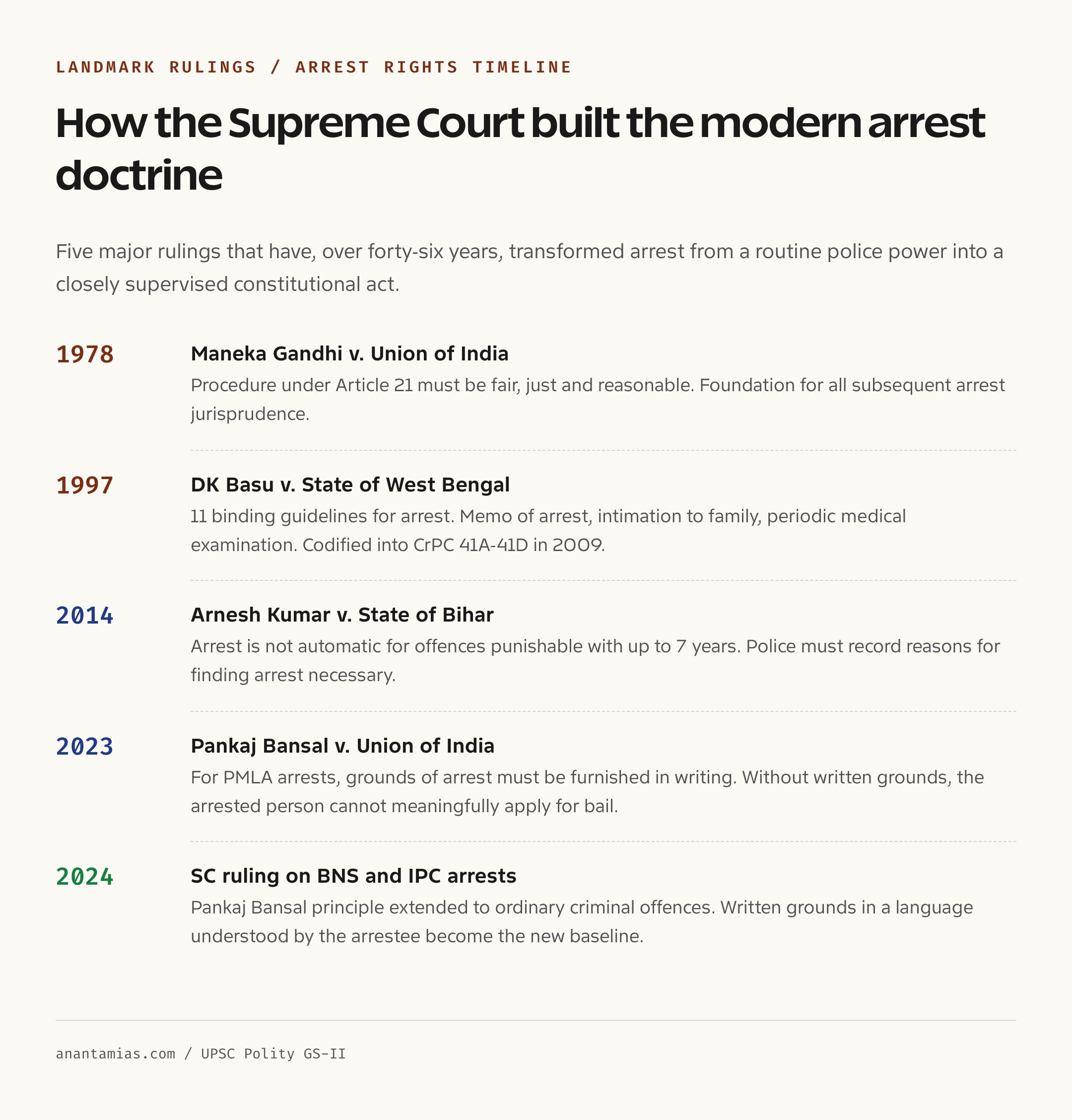
Through the early decades after Independence, the Article 22(1) right was treated by police as procedural. Many arrests went forward with only a verbal mention of the offence, or with the communication of the grounds delayed until production before the magistrate. The first major intervention by the Supreme Court came in D.K. Basu v. State of West Bengal in 1997, where the Court laid down 11 binding guidelines for arrest, including the requirement of a memo of arrest signed by a witness and counter-signed by the arrestee, and intimation to the arrestee’s family about the time and place of arrest and detention. The D.K. Basu guidelines were later codified into Sections 41A through 41D of the Criminal Procedure Code in the 2009 amendment.
In 2014, in Arnesh Kumar v. State of Bihar, the Court ruled that for offences punishable with up to seven years’ imprisonment, arrest should not be automatic, and police must record reasons for finding arrest necessary. This shifted the doctrinal focus from how arrests are conducted to whether arrests are necessary in the first place.
The next major shift came under the special economic-offence laws. Pankaj Bansal v. Union of India in 2023 dealt with arrests by the Enforcement Directorate under the Prevention of Money Laundering Act. The Court ruled that the ED was required to furnish the grounds of arrest in writing, in a copy delivered to the arrested person, so that the arrested person could effectively seek bail and challenge the arrest. The Court reasoned that PMLA bail is conditional on the dual test of Section 45, and a person who does not have written grounds cannot prepare a serious bail application. In 2024, this principle was extended to arrests under the Bharatiya Nyaya Sanhita and the Indian Penal Code, on the same constitutional logic.
Article 22 of the Constitution: The Foundation
Article 22 sits in the Right to Freedom cluster of fundamental rights. Article 22(1) gives every person who is arrested for an offence three rights: the right to be informed, as soon as may be, of the grounds of arrest; the right to consult, and to be defended by, a legal practitioner of choice; and, by reading 22(2) together, the right to be produced before the nearest magistrate within 24 hours of arrest, excluding journey time. Article 22(3) carves out exceptions for enemy aliens and persons under preventive detention laws, where the protections of clauses (1) and (2) do not apply. Articles 22(4) through 22(7) regulate preventive detention, requiring an Advisory Board of judicial members for detention longer than three months and prescribing other safeguards.
The right to be informed of the grounds of arrest is grouped with the right to legal representation for a reason. Without timely and specific knowledge of the allegations, legal representation becomes ineffective. The Court has read these rights as one continuous protection, and arrest in violation of either renders the detention unconstitutional. This is the key reason why courts, on a habeas corpus petition, frequently order release of arrested persons where the grounds were not communicated or were communicated inadequately. Read together with the broader fundamental rights framework, Article 22 fits within the constitutional commitment to liberty that runs from Article 19 through Article 21.
Why This Matters
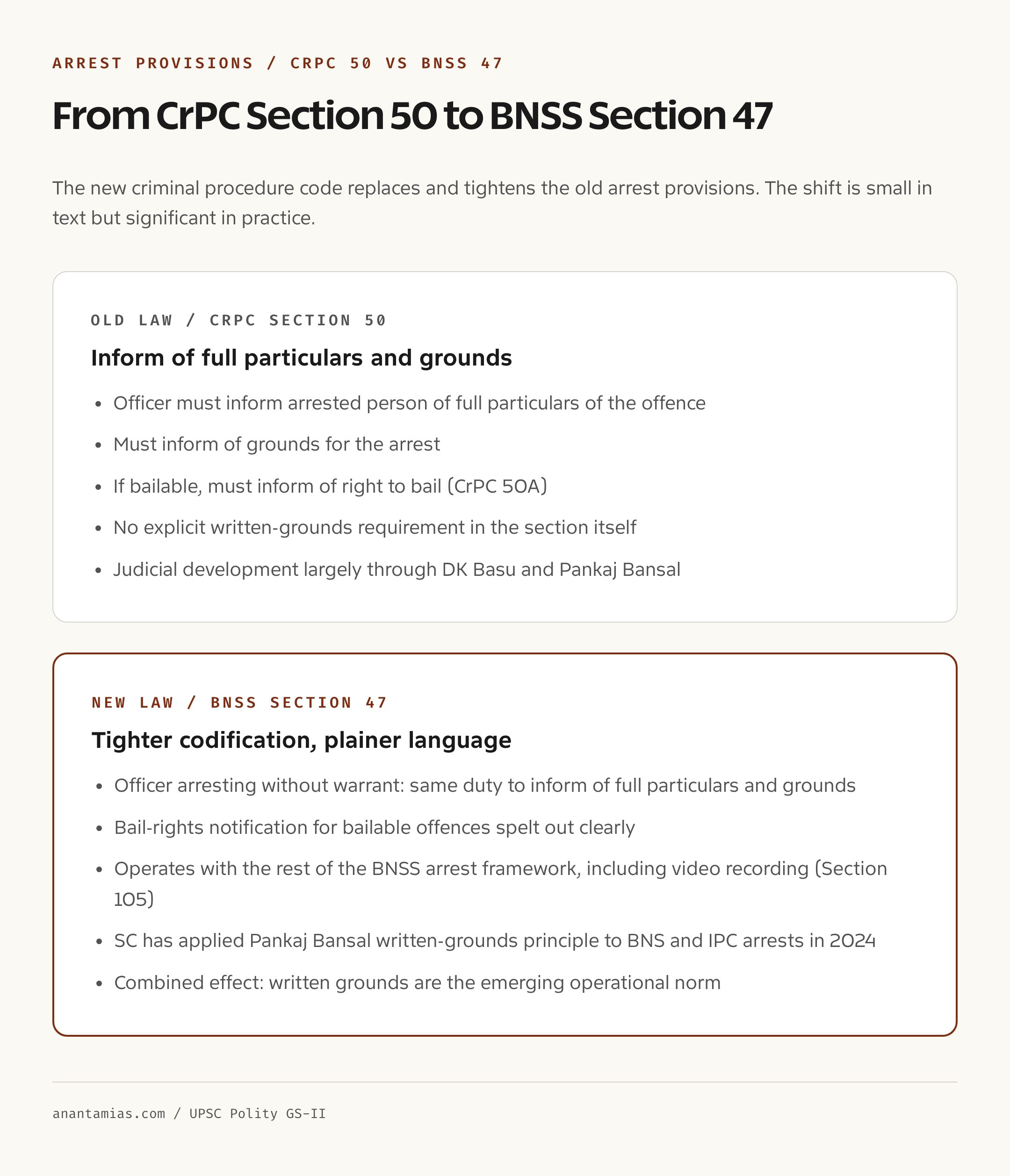
For citizens, the doctrine matters because it is the most reliable shield against arbitrary detention. Knowing the grounds of arrest is the first step in challenging the arrest before a magistrate, applying for bail, and engaging counsel. Without specific written grounds, an arrested person can spend days or weeks in custody before the substance of the allegations becomes clear, by which time the constitutional remedy of habeas corpus may be a paper protection at best.
For the police, the doctrine imposes higher discipline at the moment of arrest. Generic, formulaic arrest memos no longer survive judicial scrutiny. The investigating officer must articulate the case, in writing, at the time of arrest. This forces a more deliberate decision and reduces the likelihood of arrest by reflex.
For the wider criminal justice system, the doctrine sets a baseline procedural standard against which all custodial actions are measured. Every Magistrate’s Court hearing the first remand application now examines whether the grounds were communicated in writing, in a language the arrestee understood, with a copy provided. This is a small change with a significant practical consequence for how Indian arrests are conducted.
Detailed Analysis: “Reasons” Versus “Grounds” of Arrest
The Supreme Court has carefully distinguished between two terms that are often used interchangeably: “reasons” and “grounds” of arrest. The reasons are the internal police justification for proceeding with arrest. The reasons might include the seriousness of the offence, the likelihood of evidence tampering, the risk of the accused absconding, or the need for custodial interrogation. These are arguments addressed to the police hierarchy and the magistrate.
The grounds of arrest are different. They are the specific facts and allegations that connect the arrested person to a particular offence. The grounds say what the arrested person is alleged to have done, when, where, and on what evidence. The grounds answer the question “why am I being arrested?” not in the bureaucratic sense of police procedure but in the substantive sense of the case against the person.
The distinction matters because Article 22(1) requires communication of the grounds. Sharing the reasons, without the grounds, does not satisfy the constitutional requirement. A police officer who tells an arrested person “we are arresting you because the case is serious and there is a risk of you tampering with evidence” has stated the reasons but withheld the grounds. The arrested person, on this information, cannot prepare a defence or apply for bail. The Court’s insistence on the grounds, in writing, in a language the arrestee understands, closes this gap.
Comparative Perspective: India and Other Jurisdictions
The Indian doctrine on arrest grounds finds parallels in several other constitutional systems. In the United States, the Miranda v. Arizona doctrine of 1966 requires police to inform arrested persons of their right to remain silent, the right to counsel, and the consequences of speaking. The European Convention on Human Rights, in Article 5(2), requires that anyone arrested be informed promptly, in a language they understand, of the reasons for the arrest and the charge against them. The United Kingdom’s Police and Criminal Evidence Act, 1984 requires arrest information to be communicated as soon as practicable.
What sets the Indian doctrine apart is the specific written-grounds rule emerging from Pankaj Bansal and the 2024 extension. Few jurisdictions require, as a matter of constitutional law, that grounds of arrest be reduced to writing and delivered to the arrested person at the moment of arrest. The Indian Court has reasoned this from the structural connection between arrest, bail, and habeas corpus, and from the practical reality that oral grounds are easily contested or denied later.
Challenges and Implementation Issues
Several challenges remain. First, training. The doctrine has moved faster than police training capacity. Many officers in district and rural police stations are still using arrest memos drafted decades ago, with insufficient space and structure for written grounds. Standardising arrest memo templates across states is an unfinished task.
Second, language. India has 22 scheduled languages and hundreds of dialects. Producing grounds in a language the arrestee understands, especially in border districts and metropolitan areas with high migrant populations, requires investment in translation capacity. Some states have begun to issue multilingual arrest memo templates; others have not.
Third, the special-laws gap. Arrests under special legislation like the Unlawful Activities Prevention Act, the National Security Act, and various state preventive detention laws operate under their own procedural regimes. The constitutional principle of mandatory grounds applies, but its precise statutory implementation under each special law is uneven.
Fourth, accountability for non-compliance. Even where grounds are not communicated or communicated inadequately, the typical remedy has been release on bail rather than punitive consequences for the arresting officer. Some High Courts have recently begun ordering compensation under Article 21 for violations, but this remains exceptional rather than routine.
Prelims Pointers
Article 22(1) of the Constitution requires that every arrested person be informed, as soon as may be, of the grounds of arrest, in a language they understand, and the right to consult a legal practitioner. Article 22(2) requires production before a magistrate within 24 hours of arrest, excluding journey time. Article 22(3) excludes enemy aliens and preventive detention from these protections. Section 47 of the Bharatiya Nagarik Suraksha Sanhita, 2023 replaces Section 50 of the CrPC and codifies the duty of the arresting officer to communicate full particulars of the offence and grounds for arrest. D.K. Basu v. State of West Bengal (1997) laid down the original arrest memo guidelines. Pankaj Bansal v. Union of India (2023) ruled that grounds of arrest under the PMLA must be furnished in writing. The 2024 SC ruling extended the written-grounds rule to arrests under the BNS and IPC. The “reasons” of arrest are the internal police justification; the “grounds” of arrest are the specific facts and allegations. The BNSS came into effect on July 1, 2024.
Mains Practice Questions
Discuss the constitutional framework for the rights of an arrested person in India under Article 22. How has the Supreme Court strengthened these rights through recent rulings? (15 marks, 250 words)
Explain the distinction between “reasons” and “grounds” of arrest as developed by the Supreme Court. Why does this distinction matter for the protection of personal liberty under Article 21? (10 marks, 150 words)
Section 47 of the BNSS marks an evolution from Section 50 of the CrPC. Critically analyse this provision in the light of recent Supreme Court rulings on the disclosure of arrest grounds. (15 marks, 250 words)
Way Forward
The doctrine of mandatory disclosure of arrest grounds has matured in the constitutional jurisprudence over a quarter of a century. The next stage is implementation. Three concrete steps would consolidate the gains. First, every state should adopt a standard arrest memo template that includes a structured field for written grounds, signed contemporaneously by the arresting officer and acknowledged by the arrestee. Second, training programmes for new and serving police officers should incorporate the doctrine, with case studies from the leading judgments. Third, arrest grounds should be uploaded to the Crime and Criminal Tracking Network and Systems within a fixed time window, providing a digital audit trail for magistrates and reviewing courts.
The Supreme Court is likely to continue refining the doctrine in cases involving special laws, terror investigations, and economic offences. The direction of travel is clear. Article 22(1) is being read as a substantive constitutional protection rather than a procedural ritual, and the implementation framework is being aligned with that reading. The Bharatiya Nagarik Suraksha Sanhita has provided the statutory architecture; the courts are providing the constitutional content.
Frequently Asked Questions
What does Article 22(1) of the Indian Constitution guarantee?
Article 22(1) gives every arrested person the right to be informed, as soon as may be, of the grounds of arrest and the right to consult and be defended by a legal practitioner of choice. Article 22(2) read alongside requires production before a magistrate within 24 hours of arrest, excluding journey time. These are fundamental rights enforceable in any court.
What is Section 47 of the BNSS?
Section 47 of the Bharatiya Nagarik Suraksha Sanhita, 2023 replaces Section 50 of the Code of Criminal Procedure. It requires every police officer arresting a person without a warrant to inform the person of the full particulars of the offence and the grounds for arrest, and to inform the person of the right to bail if the offence is bailable. The BNSS came into effect on July 1, 2024.
What did the Supreme Court rule in Pankaj Bansal v. Union of India?
In Pankaj Bansal v. Union of India (2023), the Supreme Court ruled that for arrests under the Prevention of Money Laundering Act, the Enforcement Directorate must furnish the grounds of arrest to the arrested person in writing. The Court reasoned that without written grounds, the arrested person cannot meaningfully apply for bail or challenge the arrest under the strict bail conditions of Section 45 PMLA.
What is the difference between u0022reasonsu0022 and u0022groundsu0022 of arrest?
The u0022reasonsu0022 of arrest are the internal police justification, such as the seriousness of the offence or the risk of evidence tampering. The u0022groundsu0022 of arrest are the specific facts and allegations connecting the arrested person to a particular offence. Article 22(1) requires communication of the grounds, not merely the reasons.
Do the grounds of arrest have to be in writing?
For arrests under the Prevention of Money Laundering Act, the Supreme Court has held in Pankaj Bansal that grounds must be furnished in writing. In a 2024 ruling, the Court extended this principle, in substance, to arrests under the Bharatiya Nyaya Sanhita and the Indian Penal Code. Written grounds are now the emerging standard for all serious arrests.
What are the D.K. Basu guidelines?
The D.K. Basu v. State of West Bengal (1997) judgment laid down 11 binding guidelines for arrest, including a memo of arrest with the time and date, signed by a witness and counter-signed by the arrestee, intimation to the arrestee’s friend or relative, and a medical examination at periodic intervals. These guidelines were partially codified into Sections 41A through 41D of the CrPC and have been carried into the BNSS.
Can an arrest be quashed if the grounds are not communicated?
Yes. An arrest in violation of Article 22(1) is unconstitutional, and courts have repeatedly ordered release on a habeas corpus petition or directed the arrested person be released on bail when the grounds were not communicated or were communicated inadequately. In some cases, courts have also awarded compensation under Article 21.
Does the doctrine apply only to police arrests?
No. The doctrine applies to all arrests by state agencies, including arrests by the Enforcement Directorate under the PMLA, the Central Bureau of Investigation, and the Narcotics Control Bureau. Specific statutory regimes may add procedural elements, but the constitutional core under Article 22 applies universally.