Marine Pollution: Sources, Dead Zones and Why It Is So Hard to Tackle
About 80 percent of marine pollution originates on land, which is why ocean conservation begins upstream. A source-by-source breakdown, the science of dead zones and oceanic gyres, and what a source-to-sea approach would mean for India.
Ocean conservation does not begin at the coast. Nearly 80 percent of marine pollution originates from land-based activity, which means the decisive interventions are sewage treatment, solid waste management and farm practice, often hundreds of kilometres inland. Any strategy that starts at the shoreline is already too late.
That single number reorganises the whole subject. Marine pollution is not primarily a maritime problem. It is a river-basin and municipal-governance problem with a maritime consequence.
Where It Comes From
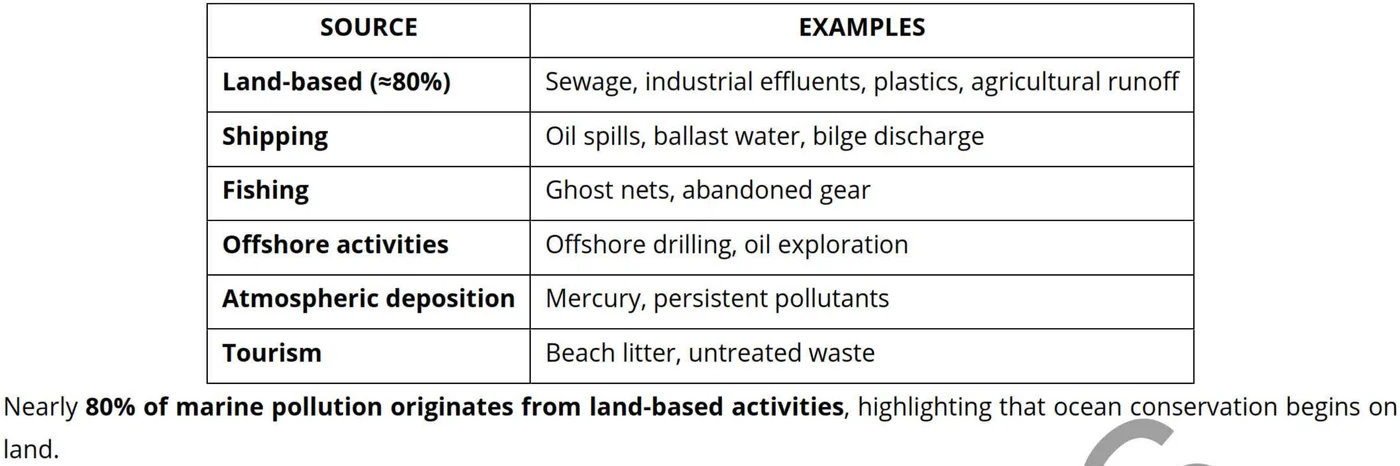
Marine pollution has both land-based and ocean-based sources, and the split is lopsided.
- Land-based, about 80 percent: sewage, industrial effluent, plastics, agricultural runoff
- Shipping: oil spills, ballast water, bilge discharge
- Fishing: ghost nets and abandoned gear
- Offshore activities: drilling and oil exploration
- Atmospheric deposition: mercury and persistent pollutants
- Tourism: beach litter and untreated waste
The Major Pollutants
Each pollutant class causes a characteristic harm, and that pairing is what makes an answer precise.
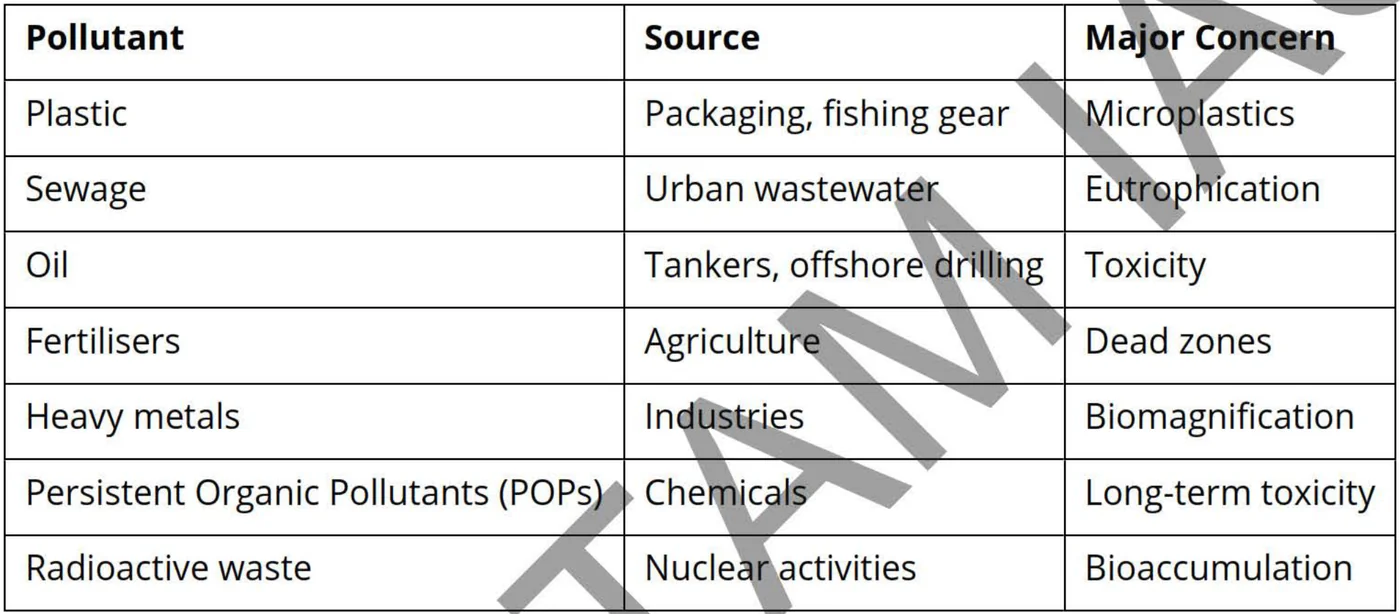
- Plastic: from packaging and fishing gear, fragmenting into microplastics
- Sewage: pathogen load and nutrient enrichment
- Oil: acute toxicity and habitat smothering
- Fertilisers: nutrient loading that creates dead zones
- Heavy metals: biomagnification up the food chain
- Persistent organic pollutants: long-term toxicity that resists breakdown
- Radioactive waste: bioaccumulation in tissue
Dead Zones: When Fertiliser Becomes Suffocation
A dead zone is an area where dissolved oxygen falls below roughly 2 mg per litre, the threshold under which most marine life cannot survive. The mechanism is indirect and worth stating carefully: nutrient runoff, mainly nitrogen and phosphorus, feeds algal blooms. When the bloom dies, its decomposition consumes the oxygen in the water column. What kills the fish is not the fertiliser. It is the decay of the life the fertiliser created.
The classic examples map neatly onto their causes.
- Gulf of Mexico: the Mississippi carrying fertiliser runoff from the US Corn Belt
- Baltic Sea: agricultural runoff plus limited water circulation
- Black Sea: nutrient pollution carried by the Danube
Two of the three are river-delivered. Again, the ocean is downstream of agriculture.
Oceanic Gyres and Why Plastic Never Leaves
Gyres are large circular current systems driven by prevailing winds and the Coriolis force. Floating plastics, abandoned fishing gear and other persistent debris are carried by these currents and converge towards the calm centres of subtropical gyres. There they accumulate over decades rather than dispersing, and under sunlight and wave energy they fragment into microplastics.
The result is that a gyre becomes a long-term reservoir of marine litter rather than a transit route. The Great Pacific Garbage Patch is the most cited case.
This is why removal is such a weak strategy on its own. A gyre concentrates decades of accumulated input; skimming the surface addresses the stock, not the flow.
Why It Is So Difficult to Tackle
Four reasons, and they compound.
Food security. Marine organisms ingest plastics and toxic chemicals that bioaccumulate and biomagnify through the food chain, threatening seafood safety.
Economic consequences. Pollution damages fisheries, aquaculture, tourism and coastal livelihoods, which directly undermines India’s Blue Economy ambitions.
Transboundary movement. Currents carry pollutants across exclusive economic zones, so unilateral national action has limited reach.
Climate feedback. Blue carbon ecosystems, mangroves, salt marshes and seagrass, store significant carbon. Pollution weakens them and reduces their mitigation capacity.
And behind all four sits public health: consumption of contaminated seafood exposes people to heavy metals, persistent organic pollutants and microplastics.
What India’s Approach Should Be
- Adopt a source-to-sea approach. UNEP’s recommendation is the correct frame: control begins upstream, integrating river-basin management with coastal governance rather than treating them as separate systems.
- Strengthen regional marine governance. Mechanisms such as the Indian Ocean Rim Association and the South Asian Seas Programme are where transboundary flows can actually be addressed.
- Fix sewage before fixing beaches. Untreated municipal sewage is the single largest controllable land-based input in most Indian coastal stretches.
- Target ghost gear. Abandoned fishing gear is a disproportionate share of harmful marine plastic and is addressable through gear marking and buy-back.
- Protect blue carbon. Mangrove and seagrass conservation is simultaneously pollution buffering, coastal protection and climate mitigation.
The reframing to hold on to is simple. Marine pollution is what happens to a country’s waste management and agricultural policy after it reaches the sea.
Frequently Asked Questions
What are the major sources of marine pollution?
Land-based sources account for roughly 80 percent, chiefly sewage, industrial effluent, plastics and agricultural runoff. The rest comes from shipping through oil spills, ballast water and bilge discharge, from fishing through ghost nets and abandoned gear, from offshore drilling and exploration, from atmospheric deposition of mercury and persistent pollutants, and from coastal tourism.
What is a dead zone?
A dead zone is an area of an ocean, sea or large lake where dissolved oxygen falls below the level needed to sustain most marine life, generally under 2 mg per litre. It is usually caused by nutrient runoff, particularly nitrogen and phosphorus from fertilisers, which triggers algal blooms whose decomposition consumes oxygen.
Which are the best-known dead zones in the world?
The Gulf of Mexico, driven by fertiliser runoff carried down the Mississippi from the US Corn Belt; the Baltic Sea, from agricultural runoff combined with limited water circulation; and the Black Sea, from nutrient pollution carried by the Danube.
What are oceanic gyres and why do they matter for pollution?
Gyres are large circular systems of ocean currents driven by prevailing winds and the Coriolis force. Floating plastics and fishing gear are carried by these currents and converge towards the calm centres of subtropical gyres, where they accumulate over decades instead of dispersing. The Great Pacific Garbage Patch is the best-known example.
Why is marine pollution described as a transboundary problem?
Currents carry pollutants across exclusive economic zones, so a country cannot secure its own waters by acting alone. Plastic entering a river in one state can end up in another country’s fishery, which is why regional mechanisms matter alongside national regulation.
What is the source-to-sea approach?
It is the principle, recommended by UNEP, that marine pollution control must begin upstream by integrating river-basin management, sewage treatment, solid waste management and agricultural practice with coastal and marine governance, instead of treating the sea as a separate jurisdiction.
How does marine pollution affect climate mitigation?
Blue carbon ecosystems, mangroves, salt marshes and seagrass meadows, store large amounts of carbon. Pollution weakens these ecosystems and reduces their capacity to sequester carbon, so marine pollution is also a climate problem, not only a biodiversity one.
What are the public health consequences?
Marine organisms ingest plastics and toxic chemicals that bioaccumulate and biomagnify up the food chain. Consumption of contaminated seafood exposes people to heavy metals, persistent organic pollutants and microplastics, with long-term health risks.
Practice Questions
Prelims MCQs
- Approximately what share of marine pollution originates from land-based sources?
(a) 20 percent
(b) 40 percent
(c) 60 percent
(d) 80 percent
Answer: (d) Land-based sources contribute roughly 80 percent, which is why marine pollution control has to begin upstream. - A dead zone is generally defined by dissolved oxygen falling below
(a) 2 mg/L
(b) 6 mg/L
(c) 10 mg/L
(d) 15 mg/L
Answer: (a) Below about 2 mg per litre, most marine life cannot be sustained. - The dead zone in the Gulf of Mexico is primarily attributed to
(a) Oil spills from offshore rigs
(b) Fertiliser runoff carried by the Mississippi
(c) Ballast water discharge
(d) Deep-sea mining plumes
Answer: (b) Nutrient runoff from the US Corn Belt is carried down the Mississippi and drives the seasonal hypoxic zone. - Oceanic gyres accumulate plastic debris primarily because
(a) Plastics are denser than seawater and sink there
(b) Converging currents transport debris to calm gyre centres
(c) Marine organisms actively collect plastics
(d) Gyres are located near major ports
Answer: (b) Wind-driven currents and the Coriolis force converge floating debris towards the relatively calm centres of subtropical gyres. - Blue carbon ecosystems include which of the following? 1. Mangroves 2. Salt marshes 3. Seagrass meadows
(a) 1 only
(b) 1 and 2 only
(c) 2 and 3 only
(d) 1, 2 and 3
Answer: (d) All three are blue carbon ecosystems, and all three lose sequestration capacity when degraded by pollution.
Mains Questions
- Nearly 80 percent of marine pollution originates on land. Examine the implications of this fact for India's institutional arrangements for ocean governance. (250 words)
- Discuss the formation of dead zones and evaluate the agricultural policy reforms needed to prevent them in Indian coastal waters. (250 words)
- Marine pollution is a transboundary problem embedded in domestic policy failures. Discuss with reference to regional cooperation mechanisms in the Indian Ocean. (150 words)
- Explain how marine pollution undermines both blue carbon sequestration and India's Blue Economy objectives. (150 words)
- Evaluate a source-to-sea approach as a governance model for India's rivers and coastal waters. (250 words)