Marital Rape in India: Legal Debate, Constitutional Questions and the Road to Criminalisation (UPSC Indian Society)
India is one of a shrinking group of countries that still shields a husband from a rape charge. Here is what the law actually says, why it is being challenged before the Supreme Court, and how to argue both sides without losing your footing.
Pick almost any serious offence in Indian criminal law and the identity of the victim does not decide whether a crime happened. Rape is the rare exception. The law that defines it carves out one relationship, and inside that relationship the same act stops being a crime. A husband who forces sex on his adult wife cannot, as a rule, be charged with rape. That single carve-out is what the phrase “marital rape” is really about, and it is now one of the most closely watched questions in Indian constitutional law.
The debate sits at the meeting point of three things UPSC keeps returning to: the fundamental rights to equality and life, the status of women inside the family, and the limits of judicial power when Parliament has chosen not to act. It is also a genuinely hard problem, with thoughtful people on both sides, which is exactly why it rewards a calm, two-sided answer rather than a slogan. The matter is currently before the Supreme Court, the government has filed its position, and the law itself was recently rewritten without removing the exception. So this is live, not historical.
What the Law Actually Says
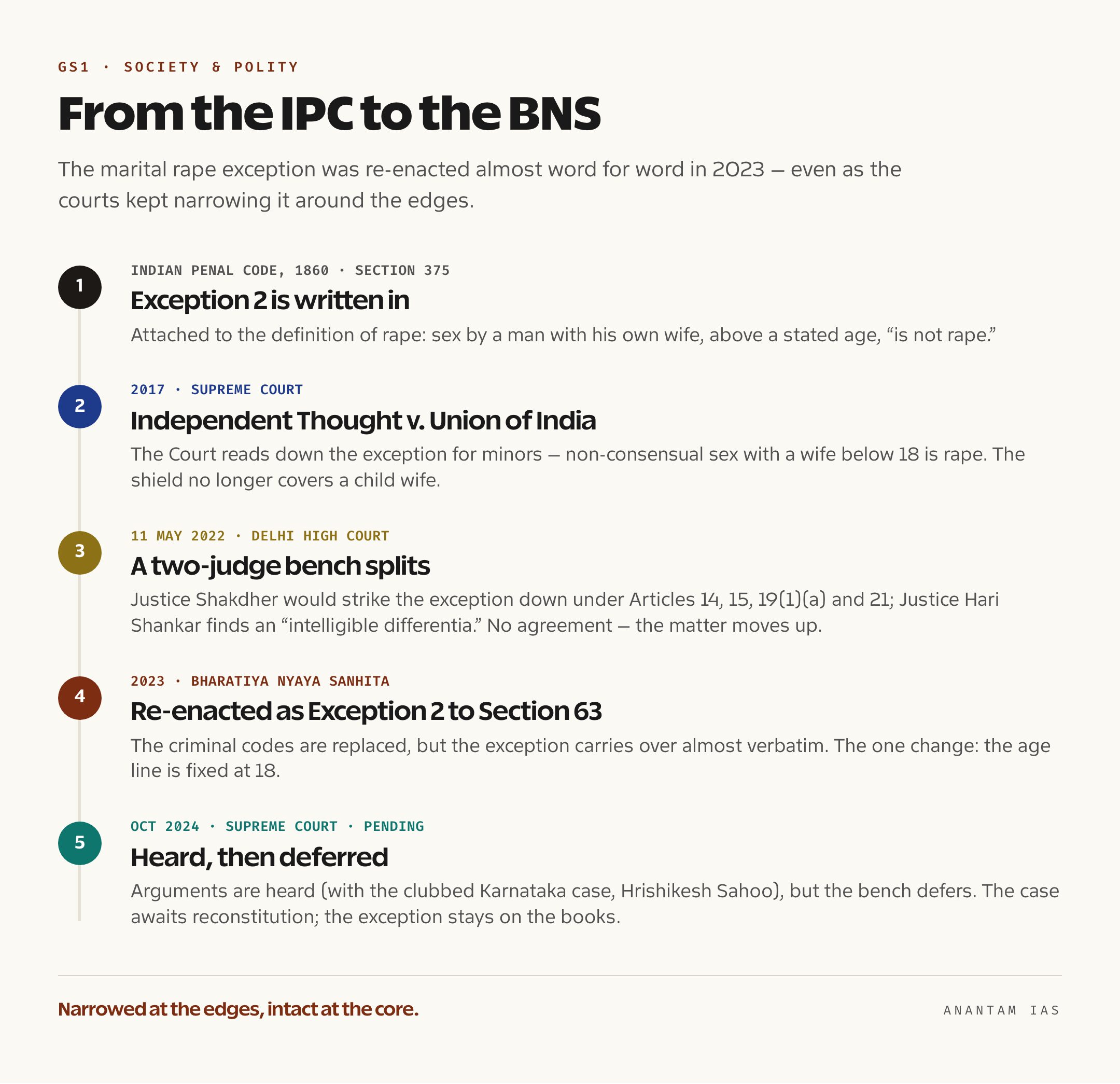
The old Indian Penal Code defined rape in Section 375, and attached to it was Exception 2: sexual intercourse by a man with his own wife, the wife not being under a stated age, “is not rape.” When the criminal codes were replaced in 2023, this did not disappear. The Bharatiya Nyaya Sanhita (BNS) re-enacted the same idea almost word for word as Exception 2 to Section 63, the section that now defines rape. The only substantive change was the age line: the BNS sets it at 18, raising the earlier threshold and aligning it with the age of consent elsewhere in law. Above that age, a wife’s lack of consent does not, by itself, make her husband’s act rape in the eyes of the statute.
It helps to be precise about what the exception does and does not do, because the topic is easy to caricature. It does not legalise violence. A husband can still be prosecuted for cruelty, for causing hurt, and under the Protection of Women from Domestic Violence Act, 2005, which expressly treats sexual abuse as a form of domestic violence and offers civil protection orders and residence rights. What the exception removes is the specific, more serious charge of rape. So a wife retains several remedies, but not the one that names the act for what petitioners say it is. That gap, between how the act is treated outside marriage and inside it, is the heart of the dispute.
The Constitutional Challenge
The legal attack runs through Articles 14 and 21 of the Constitution. The argument is that the exception creates two classes of women, married and unmarried, and protects the rapist of one but not the other, with no rational link to any legitimate object. Equality before law under Article 14 forbids exactly that kind of arbitrary classification. And the right to life and personal liberty under Article 21, which the Supreme Court has read to include dignity, bodily autonomy and the right to privacy, is said to be violated when the state declares that a married woman’s consent simply does not count. Petitioners lean on Joseph Shine v. Union of India (2018), where the Court struck down adultery and held plainly that a wife is not the property of her husband.
This came to a head in the Delhi High Court. On 11 May 2022 a two-judge bench delivered a split verdict. Justice Rajiv Shakdher held that the exception violated Articles 14, 15, 19(1)(a) and 21 and should be struck down, reasoning that marriage cannot extinguish a woman’s right to say no. Justice C. Hari Shankar disagreed, holding that there is an “intelligible differentia”, a real and recognisable difference, between a sexual relationship within marriage and one with a stranger, and that Parliament was entitled to treat the two differently. Because they could not agree, the matter moved up. A separate strand reached the Supreme Court from Karnataka, where the High Court in 2022 had refused to quash a marital-rape charge against a husband in Hrishikesh Sahoo v. State of Karnataka; the Supreme Court stayed that ruling and clubbed the cases together.
Those petitions are now pending in the Supreme Court. A bench led by the then Chief Justice D.Y. Chandrachud heard arguments in October 2024 but deferred the matter, the CJI noting he would not be able to conclude and deliver a verdict before his retirement on 10 November 2024. The case awaits a reconstituted bench, which means a definitive answer has not yet been given and the exception remains on the books.
The Arguments for Criminalisation
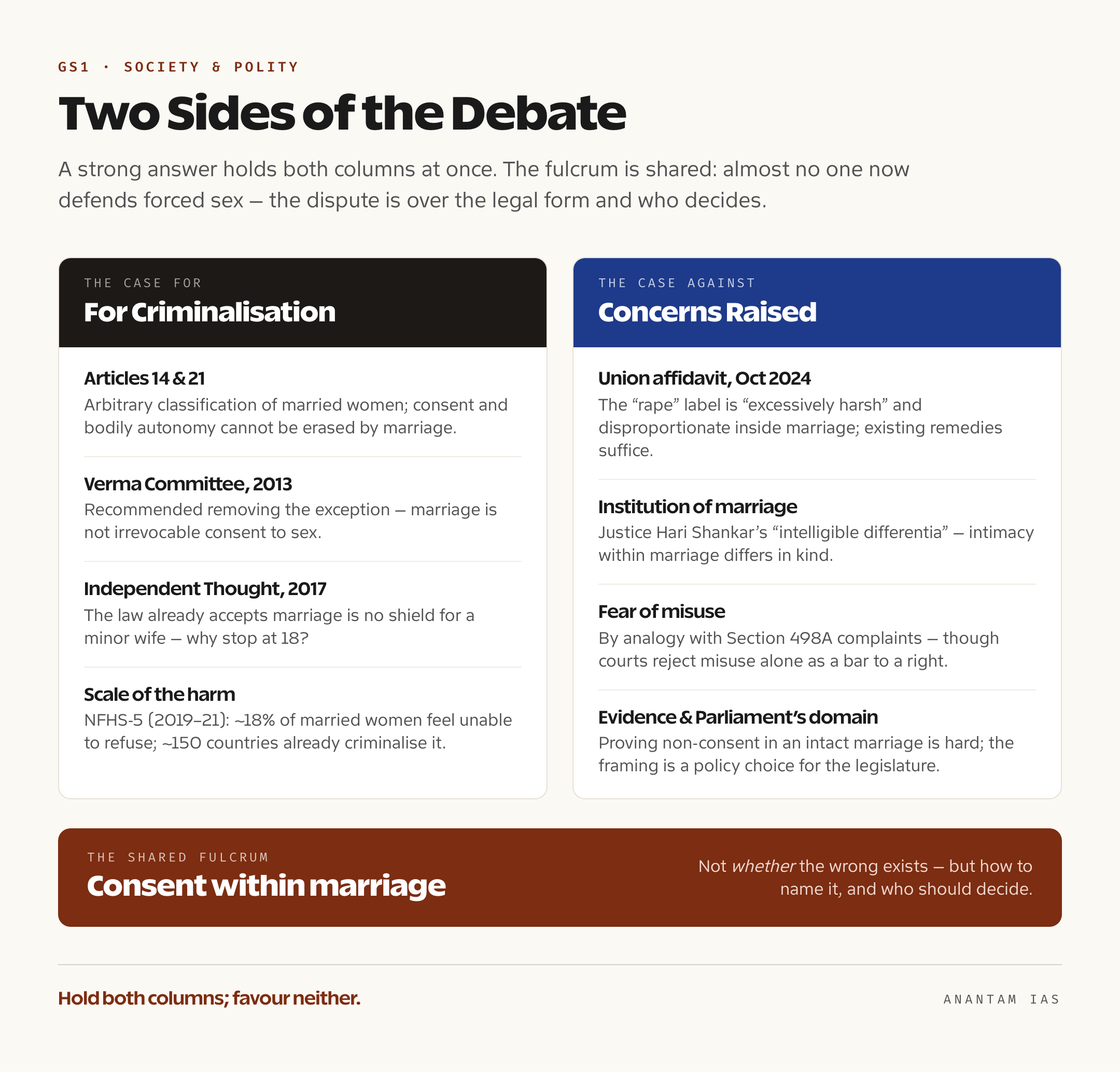
The case for removing the exception is, at its core, about consent and equality, and it is backed by an official record of reform recommendations. The Justice J.S. Verma Committee, set up after the December 2012 Delhi gang rape to overhaul sexual-offence law, recommended in 2013 that the marital rape exception be removed, holding that marriage should not be treated as irrevocable consent to sex. Supporters point out that Parliament accepted many of the committee’s other recommendations in the 2013 criminal-law amendments but left this one untouched.
A second strand is internal inconsistency within the law itself. The Supreme Court in Independent Thought v. Union of India (2017) already read down the exception so that it does not protect a husband whose wife is a minor; non-consensual sex with a wife below 18 is rape. So the law already accepts that marriage is no shield when the wife is a child. Petitioners ask why the same logic of consent should stop the day she turns 18. They also note that a separated-but-not-divorced husband could be charged for forced sex under the old code, and that the domestic violence law of 2005 names sexual abuse as wrong, all of which, they argue, makes the blanket rape exception look like a leftover from an era when a wife was treated as her husband’s property.
The third strand is the human reality the data points to. The National Family Health Survey (NFHS-5, 2019-21) found that roughly 18% of married women said they could not refuse sex with their husband even if they did not want it, and that the overwhelming majority of married women who reported any sexual violence named a current or former husband as the perpetrator. Supporters argue that an injury this common cannot be left without its proper legal name, and that comparative practice has moved decisively: marital rape is now a crime in around 150 countries, with the United Kingdom criminalising it in 1991, the United States seeing all fifty states remove their exemptions by the early 1990s, and South Africa doing so in 1993.
The Concerns Raised Against It
The other side is not simply an argument from tradition, and a fair answer takes it seriously. The Union government’s position, set out in a 49-page affidavit filed in the Supreme Court in October 2024, is the clearest statement of it. The government did not say a husband has any right to force his wife; it accepted that consent is not erased by marriage. But it argued that labelling the violation “rape”, with that offence’s severe punishment, “can arguably be considered to be excessively harsh and therefore disproportionate” inside the institution of marriage, and that other laws, cruelty provisions and the domestic violence statute, already offer remedies. It also framed the choice as one for Parliament, not the courts, given the social consequences.
Three concerns recur in this camp. The first is the institution of marriage: that a marital relationship carries an expectation of intimacy different in kind from an encounter with a stranger, and that importing the stranger-rape framework wholesale could destabilise it; this is essentially Justice Hari Shankar’s “intelligible differentia” point. Critics of the exception reply that institutions evolve, that the law already governs much else inside marriage, and that protecting an institution cannot mean protecting an act of force within it. The second is the fear of misuse, by analogy with complaints about the cruelty provision, Section 498A; the answer offered is that the mere possibility of misuse has never been accepted by the courts as a reason to deny a substantive right.
The third concern is the most practical, and it is shared even by some who want criminalisation. Proving non-consensual sex inside an ongoing marriage, where intimacy is routine and there are rarely witnesses, raises genuinely hard questions of evidence, privacy and the risk of an accused being unable to defend himself. Several jurists who support reform therefore argue not for a simple deletion but for carefully drafted provisions, graded offences, clear procedures, sensitised investigation, so that a real wrong is named without creating a law that is impossible to apply fairly. That is a debate about how to criminalise, not whether, and it belongs in any balanced answer.
The Way Forward
The honest summary is that the question is no longer whether forced sex in marriage is wrong, almost no one in the debate now defends it, but what legal form the response should take and who should decide. The courts have steadily narrowed the exception: minors are already protected, separated wives already covered, and the Supreme Court has repeatedly affirmed bodily autonomy and the equal dignity of a wife. The remaining gap is the adult wife in an intact marriage, and that is what the pending case must resolve.
A measured path forward would combine three things. Parliament could legislate directly, as the Verma Committee urged, removing the exception while drafting tailored evidentiary and procedural safeguards rather than a blunt transplant of the stranger-rape model. The state could strengthen the support architecture that already exists, the One Stop Centres, the 181 helpline, Protection Officers under the 2005 Act, so that survivors have somewhere to go regardless of how the rape question is settled. And the public conversation could shift from “marriage versus the law” to “consent within marriage”, which is where the constitutional centre of gravity already sits. Whatever the Court decides, the direction of Indian law, from Independent Thought to Joseph Shine, has been towards treating a wife as a full rights-bearing individual, not an exception to her own autonomy.
For Your Mains Answer
This topic maps cleanly onto GS Paper 1 (role of women, family and social structures), GS Paper 2 (Fundamental Rights, especially Articles 14 and 21, and judicial review of legislation) and GS Paper 4 (consent, bodily autonomy, and the ethics of privacy versus protection). It can also seed an essay on gender, law and the limits of the state. The marker is looking for a candidate who can hold both sides without collapsing into advocacy.
How to Build the Answer
Open by stating the exact legal position, Exception 2 to Section 63 of the BNS, not a vague gesture at “the law.” Then frame the constitutional challenge through Articles 14 and 21, give the case for criminalisation (Verma Committee, Independent Thought, NFHS data), give the concerns against it (the Union affidavit, the “intelligible differentia”, misuse and evidentiary difficulty), and close with a calibrated way forward. Attribute every position to a source or party; never present one side as the obvious truth.
Common Mistakes to Avoid
Don’t write it as a one-sided rights essay; the marker rewards a fair statement of the government’s and dissenting judge’s reasoning. Don’t confuse the legal threads, Independent Thought (minors), the Delhi HC split, and the pending Supreme Court case are distinct. Don’t claim the Supreme Court has decided the issue; it has not. And don’t sensationalise, the register should stay sober and analytical throughout.
A Compact Answer Spine
The law (Exception 2 to Section 63 BNS, retained from the IPC) → the constitutional challenge (Articles 14 and 21; Delhi HC split, 2022; pending in Supreme Court) → arguments for (Verma Committee 2013; Independent Thought 2017; NFHS-5; ~150 countries) → concerns against (Union affidavit, October 2024: “excessively harsh”, misuse, marriage as institution; evidentiary difficulty) → way forward (legislate with safeguards, strengthen support systems, centre consent).
Diagram or Flowchart Idea
Draw a simple two-column balance: on the left, “For Criminalisation” (Article 14 equality, Article 21 autonomy, Verma Committee, Independent Thought); on the right, “Concerns Raised” (institution of marriage, misuse fears, evidentiary difficulty, Parliament’s domain). Put “Consent within marriage” as the fulcrum. A balanced visual like this signals a balanced answer.
A Balanced-Conclusion Line
“The constitutional trajectory, from Independent Thought to Joseph Shine, points towards treating a wife as a full rights-bearing individual; the real task before Parliament and the Court is to name the wrong while drafting safeguards that keep the law both fair and usable.”
How to Use Data Without Cramming
One or two anchors are enough: the NFHS-5 finding that about 18% of married women feel unable to refuse sex, and the comparative figure of roughly 150 countries that criminalise marital rape. Pair each with a named source in the sentence rather than a footnote, and resist listing every statistic you know.
FAQ
Is marital rape a crime in India? Not as a general rule. Exception 2 to Section 63 of the Bharatiya Nyaya Sanhita, 2023, carried over from Exception 2 to Section 375 of the old Indian Penal Code, provides that sex by a man with his adult wife is not rape, even without her consent. A husband can still face other charges, such as cruelty or sexual abuse under the Protection of Women from Domestic Violence Act, 2005, but not the specific offence of rape.
What did the Delhi High Court decide in 2022? On 11 May 2022 a two-judge bench split. Justice Rajiv Shakdher held the exception unconstitutional under Articles 14, 15, 19(1)(a) and 21 and would have struck it down. Justice C. Hari Shankar held that there was a valid distinction between marital and non-marital sex and declined to do so. Because they disagreed, the matter went up to the Supreme Court, where it is still pending.
What is the government’s position? In an affidavit filed in the Supreme Court in October 2024, the Union government opposed striking down the exception. It accepted that a woman’s consent is not erased by marriage, but argued that calling the violation “rape” would be “excessively harsh” and disproportionate within marriage, pointed to existing remedies and the risk of misuse, and said the question is one for Parliament to decide.
How does this connect to the age-of-consent rule? The Supreme Court in Independent Thought v. Union of India (2017) read down the exception so that it does not protect a husband whose wife is a minor; sex with a wife below 18 is rape. The BNS then fixed the age line in the exception at 18. So the law already refuses the marital shield for minors, which is one reason petitioners argue the same consent logic should extend to adult wives.
Practice Questions
Prelims MCQs
- With reference to the marital rape exception in Indian law, consider the correct statement. The provision exempting a husband from a rape charge for non-consensual sex with his adult wife is currently found in:
(a) Section 375 of the Indian Penal Code
(b) Exception 2 to Section 63 of the Bharatiya Nyaya Sanhita, 2023
(c) the Protection of Women from Domestic Violence Act, 2005
(d) Section 498A of the Indian Penal Code.
Answer: (b) The IPC was replaced by the BNS in 2023, and the exception now sits as Exception 2 to Section 63, which defines rape. - The Independent Thought v. Union of India (2017) judgment is significant because the Supreme Court:
(a) struck down the marital rape exception entirely
(b) upheld the exception as constitutional
(c) read down the exception so it does not apply where the wife is a minor
(d) transferred the matter to Parliament.
Answer: (c) The Court held that sex with a wife below 18 is rape, narrowing the exception for minor wives while expressly leaving the broader marital rape question open. - The 2022 split verdict on the marital rape exception was delivered by which High Court?
(a) Bombay High Court
(b) Karnataka High Court
(c) Kerala High Court
(d) Delhi High Court.
Answer: (d) Justices Rajiv Shakdher and C. Hari Shankar of the Delhi High Court delivered the split verdict on 11 May 2022. - Which committee, set up after the December 2012 Delhi gang rape, recommended removing the marital rape exception?
(a) Malimath Committee
(b) Justice J.S. Verma Committee
(c) Mukul Mudgal Committee
(d) Law Commission, 172nd Report.
Answer: (b) The Justice Verma Committee (2013) recommended its removal, holding that marriage should not be treated as irrevocable consent to sex. - Consider the constitutional provisions most directly invoked in challenges to the marital rape exception:
1. Article 14 2. Article 21 3. Article 300A. Which are correctly cited?
(a) 1 and 2 only
(b) 2 and 3 only
(c) 1 and 3 only
(d) 1, 2 and 3.
Answer: (a) The challenge rests on Article 14 (equality) and Article 21 (life, dignity and autonomy); Article 300A deals with the right to property and is not relevant here.
Mains Practice Questions
- “Marriage cannot operate as irrevocable consent to sexual relations.” Critically examine the constitutional validity of the marital rape exception in light of Articles 14 and 21. (15 marks, 250 words)
- Present a balanced assessment of the arguments for and against criminalising marital rape in India, drawing on the recommendations of the Justice Verma Committee and the position taken by the Union government before the Supreme Court. (15 marks, 250 words)
- “Judicial intervention in the marital rape exception raises questions about the boundary between the courts and Parliament.” Discuss with reference to the pending case and the doctrine of separation of powers. (15 marks, 250 words)
- Examine how the marital rape debate reflects the evolving legal status of women within the Indian family, with reference to judgments such as Independent Thought (2017) and Joseph Shine (2018). (10 marks, 150 words)
- Even if the marital rape exception is removed, criminalisation raises practical concerns of evidence, privacy and possible misuse. Suggest a framework that would address these concerns while protecting a woman’s bodily autonomy. (15 marks, 250 words)