Medieval Period in Indian History — Periods, Events, Key Personalities
You can read three textbooks on the **medieval period in Indian history** and still walk into a Mains paper unable to answer one question — *"Discuss the administrative experiments of Muhammad Bin Tughlaq."* Most coaching notes hand you a chronology.
You can read three textbooks on the medieval period in Indian history and still walk into a Mains paper unable to answer one question — “Discuss the administrative experiments of Muhammad Bin Tughlaq.” Most coaching notes hand you a chronology. Dates, dynasties, capitals. Useful… but examiners don’t reward chronology. They reward people. A 1,000-page sweep of the medieval period of Indian history compressed into a question about one ruler’s decisions, his motivations, and what he got wrong. This article flips the script — twelve personalities who actually shaped the era, what they did, and why aspirants keep getting tested on them.
What does the medieval period in Indian history mean?
The medieval period in Indian history runs roughly from 712 CE to 1818 CE — from Muhammad bin Qasim’s Sindh raid to the British defeat of the Marathas in the Third Anglo-Maratha War. It splits into early medieval (712–1206), the Delhi Sultanate (1206–1526), and the Mughal-Maratha era (1526–1818). Five dynasties dominate the imagination — Slave, Khilji, Tughlaq, Mughal, Maratha — but the personalities inside those dynasties are what UPSC actually tests.
- Period span: 712–1818 CE (roughly 1,100 years)
- Dominant dynasties: 5 major (Mamluk/Slave, Khilji, Tughlaq, Mughal, Maratha) plus regional powers (Vijayanagara, Bahmani, Sayyid, Lodi)
- Capitals shifted: Delhi → Daulatabad → Agra → Fatehpur Sikri → Delhi → Pune
- Key administrative institutions born here: iqta, mansabdari, zabt, jagir, ashtapradhan
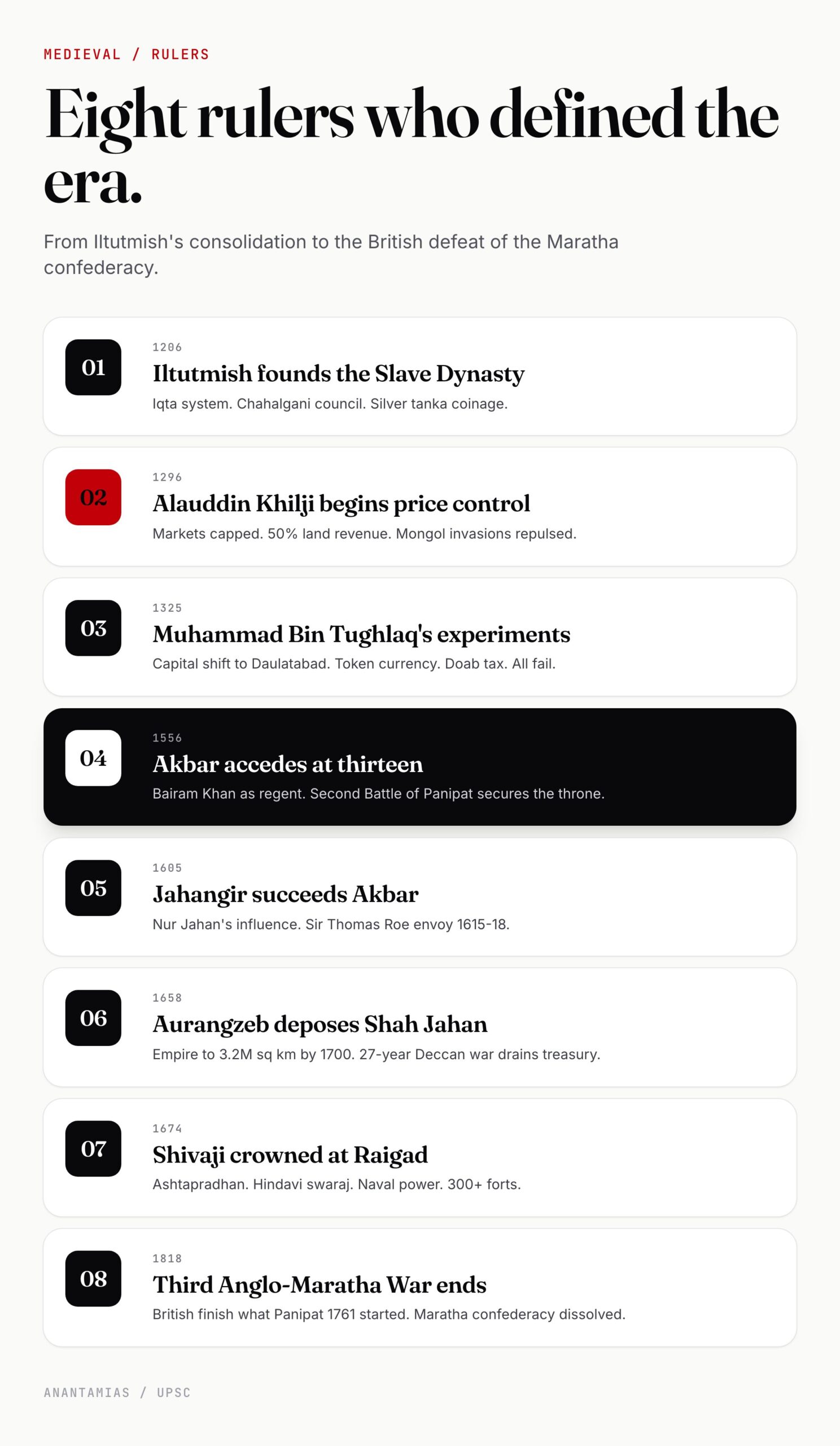
The Sultans who ran Delhi (1206–1526)
The Delhi Sultanate had thirty-five sultans across five dynasties. Five of them moved the needle. The rest, honestly, are footnote material for Prelims dates.
Iltutmish (r. 1211–1236) — the real founder
Qutbuddin Aibak founded the Slave Dynasty in 1206. But the dynasty would have collapsed in a decade without Iltutmish. He inherited a kingdom of forts and feuds and turned it into an empire. Three things you must remember:
- Iqta system institutionalised — land assignments to nobles in exchange for military service. This was the backbone of Sultanate finance for 300 years.
- The Chihalgani — his “Forty,” a council of trusted Turkish nobles. After his death they became kingmakers; after Razia’s fall, they were the real power.
- The silver tanka and copper jital — standardised coinage. India’s first proper Sultanate currency.
Iltutmish kept Genghis Khan’s Mongols out of India — politely, by refusing asylum to a Khwarazmian prince and avoiding war. That single decision saved Delhi from the sack that levelled Baghdad and Bukhara. Examiners love this story because it shows medieval statecraft as something more nuanced than swords-and-shields.
Read more on the early Delhi Sultanate.
Razia Sultana (r. 1236–1240) — the impossible succession
Razia is the only woman who sat on the Delhi throne. She lasted four years. Look, her tragedy isn’t that she failed — it’s that she succeeded for as long as she did against the Chihalgani’s revolt, the Turkish noble pushback, and the open-court appearance that scandalised conservative ulema. Iltutmish nominated her over his own sons because she was simply the most capable. Examiners ask her name as a Prelims one-liner and her story as a Mains case study on succession politics in the Sultanate.
Alauddin Khilji (r. 1296–1316) — the price-control sultan
This is the personality UPSC questions converge on. Alauddin Khilji’s reign was a laboratory. He ran it like a startup founder ran a pre-IPO company — measure everything, control everything, ship fast.
- Market reforms (sarai-i-adl, shahna-i-mandi) — fixed grain, cloth, and slave prices in Delhi. Hoarders punished. Inspectors deployed. The first systematic price control in Indian history.
- Land revenue reforms — measurement-based assessment (biswa) instead of customary estimates. The state took 50% of produce in cash.
- Military reforms — standing army with fixed pay, dagh (horse branding) and chehra (descriptive roll) to prevent fraud, war elephants registered.
- Mongol invasions repulsed — five major Mongol attacks, all defeated. Compare with Iltutmish’s diplomacy — Alauddin chose the iron-fist route and won.
His Deccan campaigns under Malik Kafur opened south India to Sultanate raids — Devagiri, Warangal, Halebid, Madurai. Wealth flowed to Delhi for a decade. Then the Khiljis collapsed within three years of his death. That is the GS-I question — why does centralised power crash so fast after a strong ruler?
Muhammad Bin Tughlaq (r. 1325–1351) — the brilliant failure
Honestly, no sultan tested Delhi’s patience harder. Muhammad Bin Tughlaq was a polymath — fluent in Arabic, Persian, mathematics, philosophy, medicine. He ran four experiments, all of them defensible on paper, all of them disasters in practice.
- Capital transfer to Daulatabad (1327) — Delhi to Devagiri, 1,500 km south. Strategic logic: control the Deccan from the centre. Practical reality: forced migration, deaths on the road, the new capital lacked water. Reversed within a decade.
- Token currency (1329) — copper and brass coins issued at silver value. State-issued IOUs. Counterfeiters destroyed the experiment in two years; the treasury accepted forgeries to honour the promise.
- Khorasan expedition — paid an army for a year, then disbanded it without marching.
- Doab tax hike — raised land revenue during a famine. Peasants revolted, fled to forests. The countryside emptied.
Ibn Battuta, the Moroccan traveller, served as Delhi’s qazi under Tughlaq for eight years. His Rihla is the single best primary source on this period. Read it once before Mains — three pages will save you from generic answers.
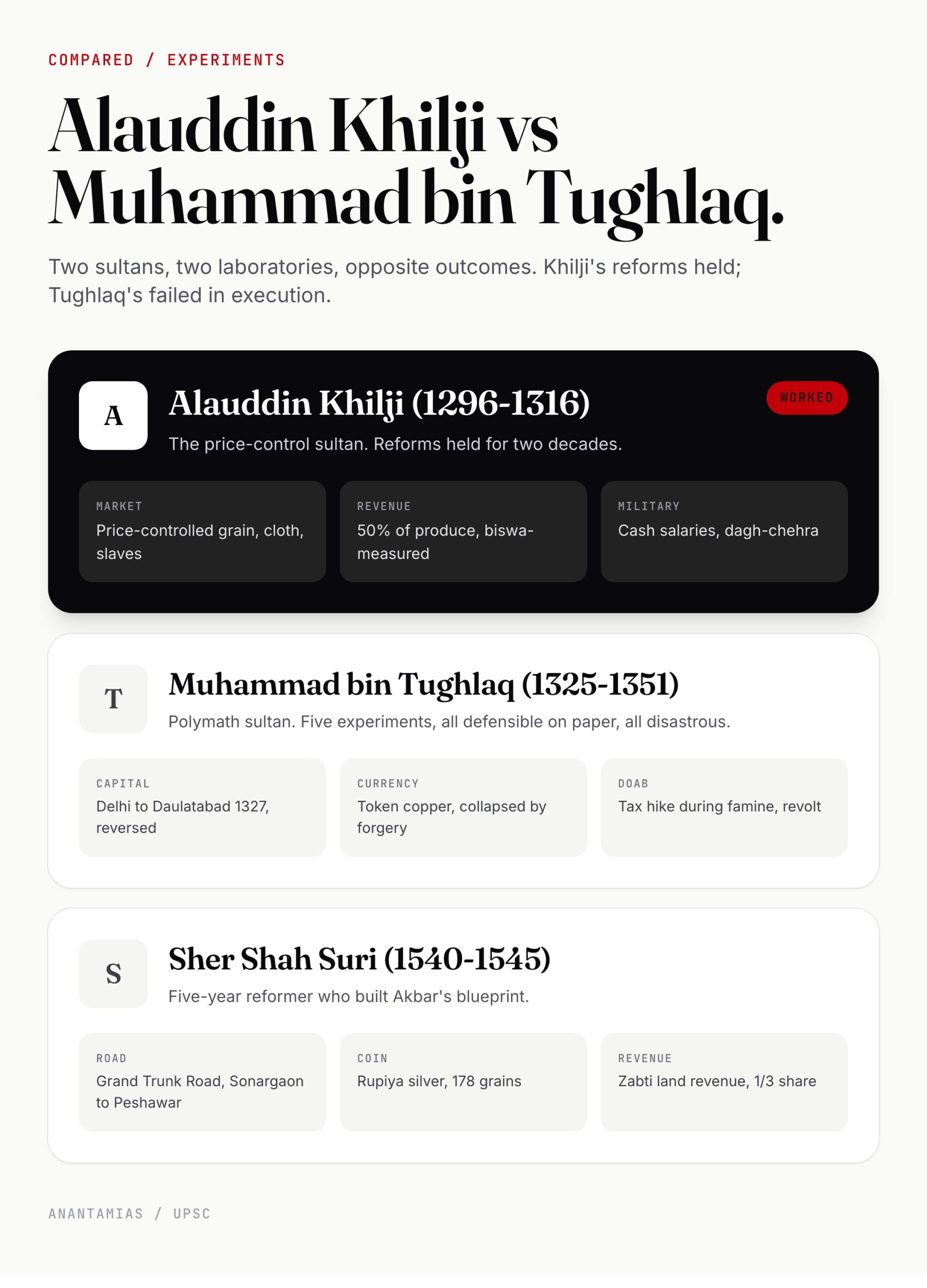
Sher Shah Suri (r. 1540–1545) — the five-year reformer
Five years on the throne. Sher Shah Suri did more administrative work than most sultans managed in fifty. He defeated Humayun at Chausa (1539) and Kannauj (1540), forcing the Mughal into Persian exile. Then he built the foundation Akbar would later inherit.
- Grand Trunk Road — re-laid from Sonargaon (Bengal) to Peshawar. Sarais every few miles. The road is still the GT Road today.
- Currency reform — the rupiya — a silver coin of 178 grains. The word rupee descends directly from this.
- Land revenue — zabti system, surveyed each plot, fixed share at one-third. Akbar’s later Todar Mal revenue system is essentially Sher Shah scaled up.
Sher Shah is the Mains essay no one writes — the proof that the medieval period of Indian history isn’t just about long reigns.
The Mughals — three giants and one collapse
Akbar (r. 1556–1605) — the synthesis
Akbar took the throne at thirteen, lost his guardian Bairam Khan within four years, and then ran one of the most consciously inclusive imperial experiments in pre-modern history. The headlines you must know:
- Mansabdari system — civil and military rank fused. Each mansabdar held a zat (personal rank) and sawar (cavalry obligation). 33 grades, from 10 to 10,000.
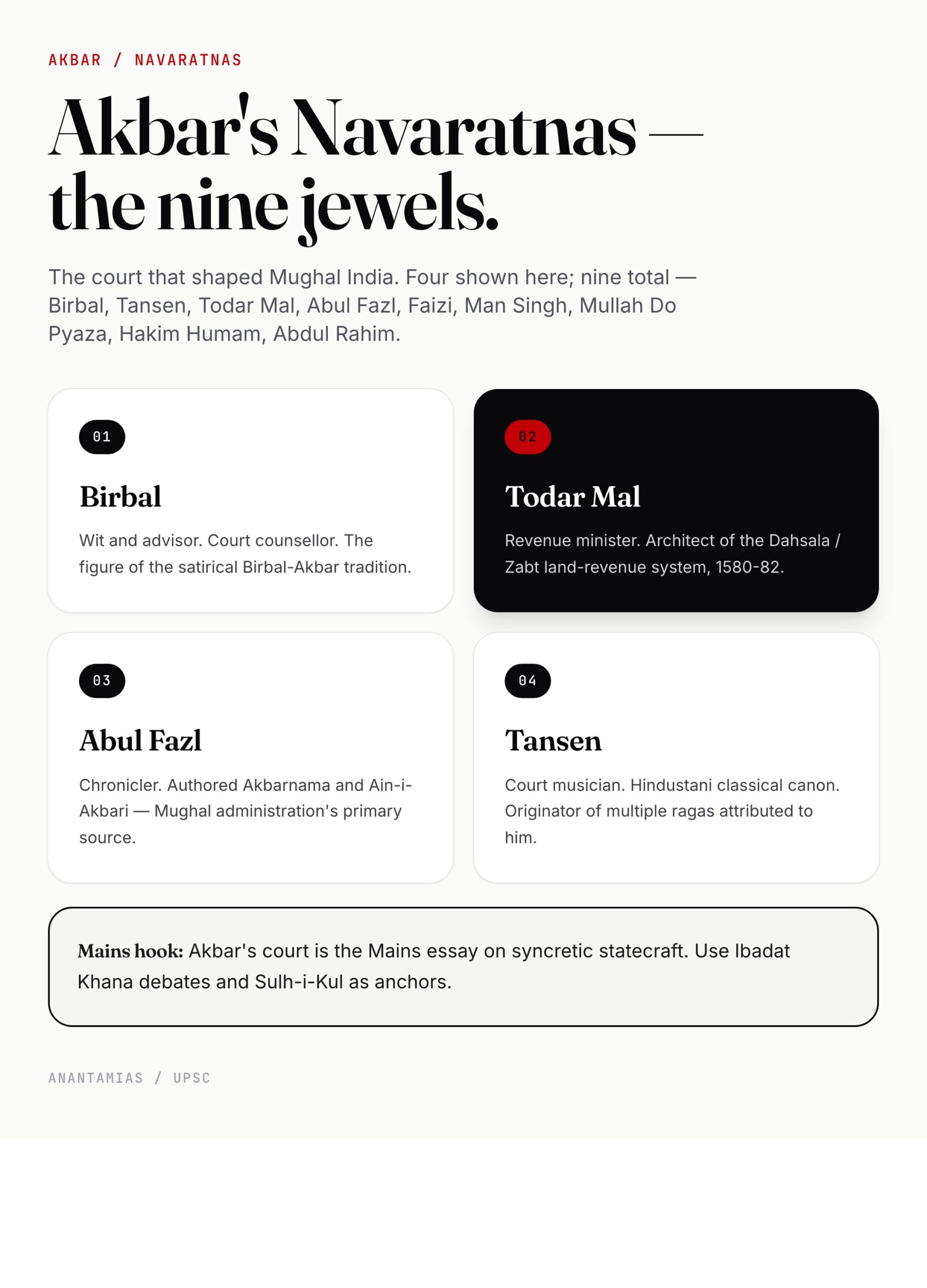
- Todar Mal’s revenue settlement (ain-i-dahsala) — average yield over ten years, fixed in cash. The most sophisticated land revenue system before the British.
- Religious policy — jizya abolished (1564), Rajput princesses married into royal household, Din-i-Ilahi proposed (1582) — a syncretic faith for the elite.
- Navaratnas — Birbal, Tansen, Todar Mal, Abul Fazl, Faizi, Raja Man Singh, Mullah Do Pyaza, Hakim Humam, Abdul Rahim Khan-i-Khana.
Akbar’s Ibadat Khana debates at Fatehpur Sikri are the seed of every modern question on Indian pluralism. UPSC doesn’t ask about Din-i-Ilahi to test memorisation — they ask because Akbar’s experiment frames a Mains essay on syncretic political theology.
Aurangzeb (r. 1658–1707) — the long, polarising reign
Aurangzeb ruled for 49 years — longer than Akbar. He doubled the empire’s territorial extent and broke its administrative back doing it. His reign is the GS-I question that aspirants either nail or fail; almost no one writes it as nuance.
- Reimposed jizya in 1679 — three centuries after Iltutmish, two centuries after Akbar abolished it.
- Deccan campaigns (1681–1707) — 26 years in the Deccan, Bijapur and Golconda annexed, but the empire’s bureaucracy collapsed under the weight.
- Maratha resistance — Shivaji’s swarajya outlasted Aurangzeb. Sambhaji captured and executed (1689). But the Marathas absorbed the lesson and rebuilt as a confederacy.
- Religious policy debate — temple destruction (Kashi Vishwanath, Mathura) sits alongside grants to other temples (Mahakaleshwar, Ujjain). Modern scholarship like Audrey Truschke’s work pushes back on the monolithic-tyrant frame. Read both sides.
The textbook narrative paints Aurangzeb as the hinge — empire-builder turned empire-breaker. Mains examiners reward the candidate who treats him as a complex administrator with contradictions, not a stock villain.
Aurangzeb’s reign and policies.
The Maratha century — Shivaji and after
Chhatrapati Shivaji (r. 1674–1680) — Hindavi Swaraj
Shivaji wasn’t just a guerrilla king. He built a state. The medieval period in Indian history doesn’t end at Mughal collapse; it ends with the Maratha confederacy that filled the vacuum.
- Crowned at Raigad (1674) — a deliberate constitutional act. He was Chhatrapati, a sovereign, not a chieftain.
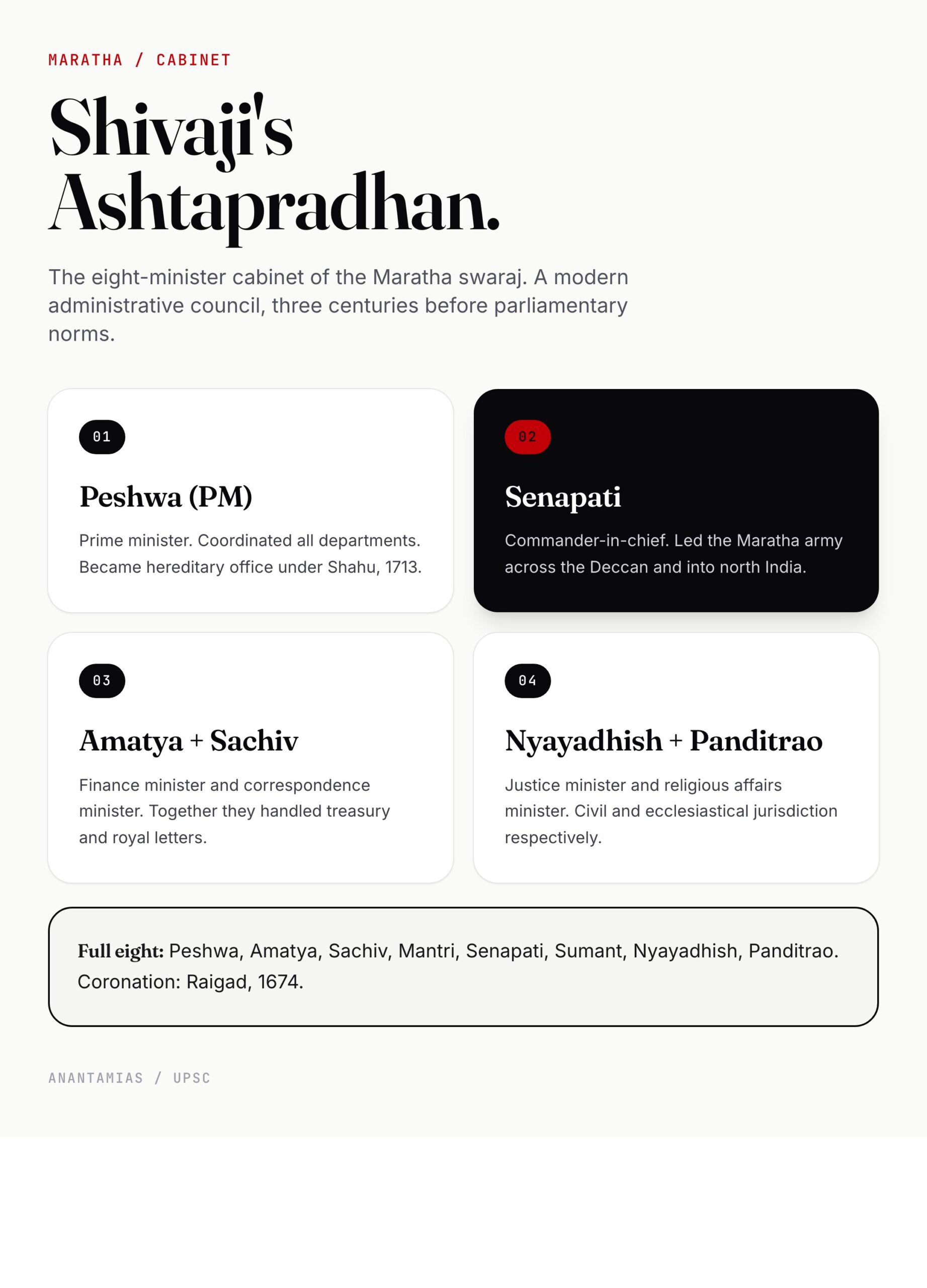
- Ashtapradhan — eight-minister cabinet (Peshwa, Amatya, Sachiv, Mantri, Senapati, Sumant, Nyayadhish, Panditrao). Modern in conception, three centuries before parliamentary cabinets.
- Naval power — coastal forts (Sindhudurg, Vijaydurg) and a fleet, unusual for an inland power in this era.
- Revenue system — chauth (one-fourth) and sardeshmukhi (one-tenth) levied on neighbouring territories.
- Fort warfare — over 300 forts in his network. Protein for any UPSC essay on Maratha military innovation.
The Treaty of Purandar (1665), the escape from Agra (1666), the coronation, and the raid on Surat are the four events you must know in detail.
Chhatrapati Shivaji Maharaj — full profile.
After Shivaji, the Marathas evolved into a confederacy under the Peshwas — Bajirao I, Balaji Bajirao, Madhavrao I. Their defeat at the Third Battle of Panipat (1761) by Ahmad Shah Abdali is the inflection point. Maratha power was bruised, not broken; it took another half-century and three Anglo-Maratha wars before the British finished what Panipat started.
The Maratha Empire and its Peshwas.
Vijayanagara — the southern story
The medieval period of Indian history isn’t only northern. Vijayanagara (1336–1646) was the last great Hindu empire of the south. Krishnadeva Raya (r. 1509–1529) is its iconic personality — patron of Telugu literature (Amuktamalyada), builder of Hampi’s grand temple complexes, defender against the Bahmani sultans.
The Battle of Talikota (1565) ended Vijayanagara as a major power. Hampi was sacked. The ruins are now a UNESCO World Heritage Site. Examiners ask Krishnadeva Raya’s name in Prelims and his administration in Mains GS-I culture questions.
Vijayanagara Empire — administration and decline.
Common medieval India misconceptions
A few corrections for the standard coaching narrative.
- Razia “failed because she was a woman.” — She failed because of Chihalgani revolt and her appointment of Yakut, an Abyssinian, as Master of the Stables. Gender was the pretext, not the cause.
- Akbar invented the mansabdari system. — He systematised it. The Persian mansab concept predates him; he scaled and codified it.
- Aurangzeb destroyed only Hindu temples. — Multiple records (Mahakaleshwar, Chitrakut Balaji, Someshwar Mahadev) show royal grants to specific temples. Selective destruction tied to political loyalty, not blanket policy. Cite the contested historiography.
- Shivaji ruled all of Maharashtra. — He ruled a fraction. The Maratha Empire as a continental power emerged under the Peshwas, post-1720.
How to revise the medieval period in Indian history in 90 minutes
A practical revision plan when you’re three days from Prelims.
- First 20 minutes — Sultanate dynasty list with founder, capital, key ruler, end. Five dynasties, fifteen lines.
- Next 20 minutes — Three sultans (Iltutmish, Alauddin Khilji, Muhammad Bin Tughlaq) — three reforms each. Nine cards.
- Next 20 minutes — Three Mughals (Akbar, Shah Jahan, Aurangzeb) — administration, religious policy, succession.
- Next 20 minutes — Shivaji’s eight ministers + four key events (Purandar, Agra escape, Raigad coronation, Surat raid).
- Final 10 minutes — Vijayanagara → Krishnadeva Raya → Talikota. One paragraph.
That’s the medieval period of Indian history in ninety minutes. Source priority: NCERT Class 7 (Our Pasts II) and Class 11 (Themes in Indian History Part II) → Satish Chandra’s Medieval India → Indo-Islamic Architecture chapter for art & monuments.
Why this matters for UPSC
GS-I in Mains has asked variations of:
- “Discuss the salient features of Iltutmish’s iqta system.” (2013)
- “Examine the significance of Krishnadeva Raya’s reign for South India.” (2016, 2020)
- “How did Akbar’s religious policy contribute to social integration?” (Asked five times in some form since 2010.)
- “Analyse the causes of the decline of the Mughal Empire under Aurangzeb’s successors.” (2014, 2019)
For Prelims, expect one ruler-period match question and one administrative-term identification question every year. For Essay, the medieval period of Indian history offers ready-made themes — pluralism, statecraft, succession, revenue innovation. Use Akbar or Sher Shah as recurring case studies.
Frequently Asked Questions
What is the time span of the medieval period in Indian history?
The medieval period in Indian history runs from approximately 712 CE (Muhammad bin Qasim’s Sindh raid) to 1818 CE (end of the Third Anglo-Maratha War). Some historians use 600–1200 as early medieval and 1200–1700 as late medieval.
Who is considered the most important ruler of the medieval period?
Akbar (1556–1605) is most frequently cited because of his administrative reforms and religious synthesis. Alauddin Khilji and Sher Shah Suri are equally tested in Mains for revenue and military reforms.
Which dynasty ruled the longest in medieval India?
The Mughals — 1526 to 1857 nominally, with effective power until ~1707 (Aurangzeb’s death). Roughly 180 years of effective rule.
Why did Muhammad Bin Tughlaq’s experiments fail?
Implementation gaps, not concept flaws. The capital shift lacked logistics, token currency lacked counterfeit-proofing, and the Doab tax hike ignored famine. Brilliant on paper, broken in execution.
What was Shivaji’s Ashtapradhan?
An eight-minister council — Peshwa (PM), Amatya (finance), Sachiv (correspondence), Mantri (intelligence), Senapati (army), Sumant (foreign affairs), Nyayadhish (justice), Panditrao (religious affairs).
What is the difference between medieval and ancient Indian history?
Ancient ends with Harsha (~647 CE) or Pala-Pratihara-Rashtrakuta tripartite struggle (~750–950). Medieval begins with Sindh’s Arab conquest (712) or the Ghurid invasions (1192), depending on the historian.
Which is the best book for the medieval period of Indian history?
Satish Chandra’s Medieval India: From Sultanate to the Mughals (two volumes) is the UPSC standard. Pair with NCERT Class 11 Themes in Indian History Part II for cultural depth.