Chief Ministers of Meghalaya: Complete List, Tenure and Party
Conrad Sangma of the National People's Party has been Chief Minister of Meghalaya since 6 March 2018. Here is the complete list of everyone who has held the office since statehood in 1972, with term dates, parties and both President's Rule spells.
Conrad Kongkal Sangma of the National People’s Party is the Chief Minister of Meghalaya. He has held the office since 6 March 2018 and was sworn in for a second term on 7 March 2023 after that year’s assembly election. He is already the longest continuously serving Chief Minister in the state’s history.
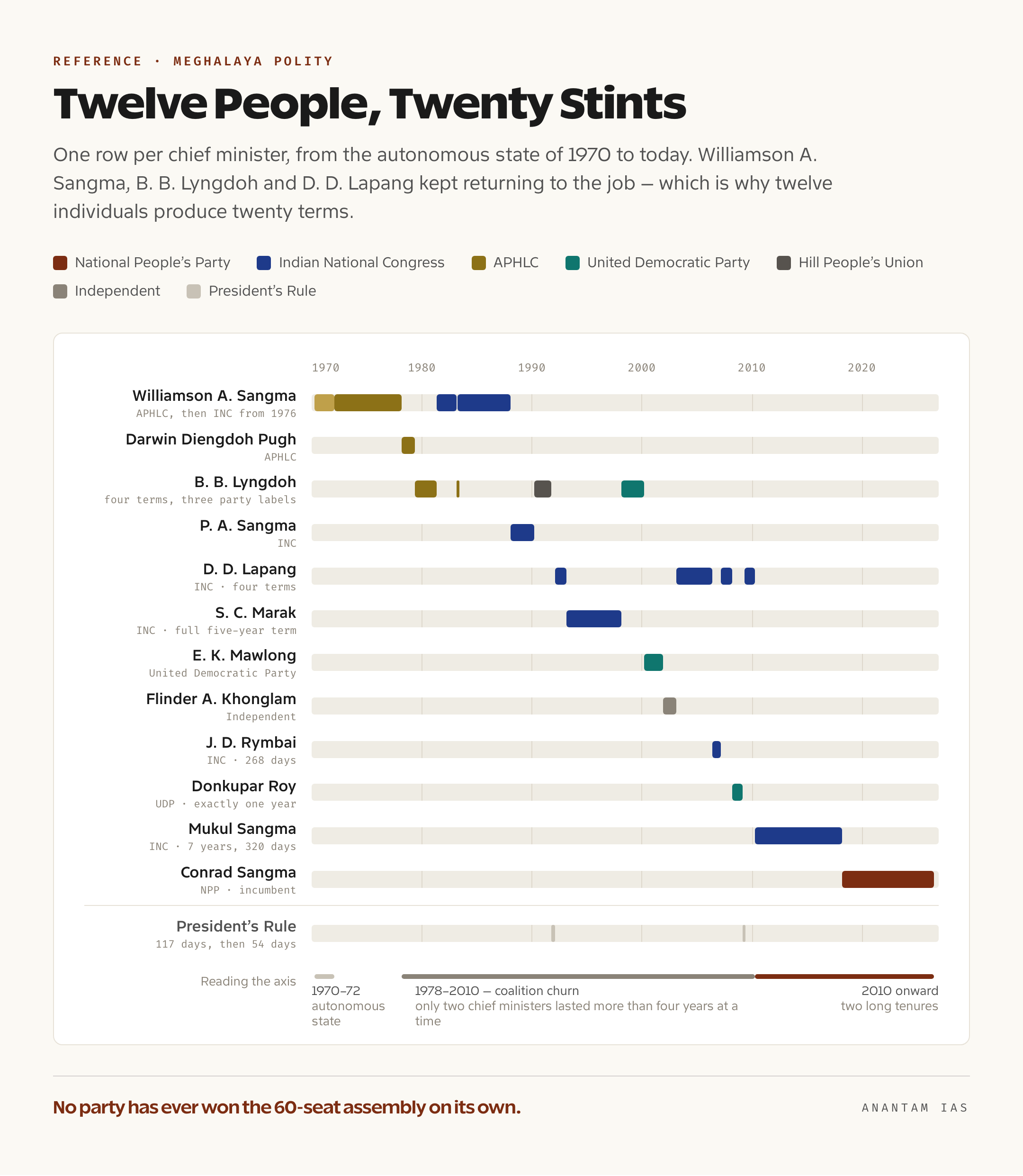
Twelve people have held the office since Meghalaya became a full state on 21 January 1972 — but they have done so across twenty separate stints, because three of them kept returning to the job after a break. Two spells of President’s Rule interrupted the chain, in 1991-92 and again in 2009. That gap between twelve individuals and twenty terms is the single most commonly muddled fact about this list.
How the Office Works in Meghalaya
Article 164 of the Constitution of India governs the appointment. The Governor appoints the Chief Minister; the other ministers are appointed by the Governor on the Chief Minister’s advice; and the council of ministers is collectively responsible to the legislative assembly. The Governor’s discretion is narrow in practice — the convention is to invite whoever can demonstrate a majority in the house.
The Meghalaya Legislative Assembly is a single chamber of 60 directly elected members, so the majority mark is 31. A Chief Minister’s term runs for five years alongside the assembly, with no limit on how many terms a person may serve, and the government falls the moment it loses the confidence of the house.
Meghalaya’s arithmetic explains its churn. No single party has ever swept the assembly outright, so almost every government has been a coalition assembled from regional parties, national parties and independents. When those coalitions have come apart mid-term — and they have, repeatedly — the result has been either a new Chief Minister from within the same assembly or, twice, President’s Rule under Article 356 of the Constitution.
Meghalaya’s story starts earlier than 1972. It first existed as an autonomous state within Assam from 2 April 1970, with Williamson A. Sangma as its Chief Minister, and became a full state under the North-Eastern Areas (Reorganisation) Act, 1971 on 21 January 1972. The list below opens with that autonomous-state period, marked separately, because Sangma’s service ran continuously across both.
Complete List of Chief Ministers of Meghalaya
| # | Name | Term Start | Term End | Party | Notes |
|---|---|---|---|---|---|
| — | Williamson A. Sangma | 2 April 1970 | 20 January 1972 | APHLC | Autonomous state of Meghalaya, before full statehood |
| 1 | Williamson A. Sangma | 21 January 1972 | 3 March 1978 | APHLC, then INC from 1976 | First Chief Minister of the full state |
| 2 | Darwin Diengdoh Pugh | 10 March 1978 | 6 May 1979 | APHLC | — |
| 3 | B. B. Lyngdoh | 7 May 1979 | 7 May 1981 | APHLC | First term |
| (1) | Williamson A. Sangma | 7 May 1981 | 2 March 1983 | Indian National Congress | Second stint |
| (3) | B. B. Lyngdoh | 2 March 1983 | 1 April 1983 | APHLC | Shortest tenure in the state’s history — 30 days |
| (1) | Williamson A. Sangma | 2 April 1983 | 5 February 1988 | Indian National Congress | Third stint |
| 4 | P. A. Sangma | 6 February 1988 | 25 March 1990 | Indian National Congress | Later Speaker of the Lok Sabha |
| (3) | B. B. Lyngdoh | 26 March 1990 | 10 October 1991 | Hill People’s Union | Third term |
| — | President’s Rule | 11 October 1991 | 5 February 1992 | — | First spell; 117 days |
| 5 | D. D. Lapang | 5 February 1992 | 19 February 1993 | Indian National Congress | First term |
| 6 | S. C. Marak | 19 February 1993 | 10 March 1998 | Indian National Congress | Completed a full five-year term |
| (3) | B. B. Lyngdoh | 10 March 1998 | 8 March 2000 | United Democratic Party | Fourth term |
| 7 | E. K. Mawlong | 8 March 2000 | 8 December 2001 | United Democratic Party | Founding president of the UDP; some listings record him as an independent |
| 8 | Flinder Anderson Khonglam | 8 December 2001 | 4 March 2003 | Independent | Headed a coalition government as an independent |
| (5) | D. D. Lapang | 4 March 2003 | 15 June 2006 | Indian National Congress | Second term; his longest continuous stretch |
| 9 | J. D. Rymbai | 15 June 2006 | 10 March 2007 | Indian National Congress | 268 days |
| (5) | D. D. Lapang | 10 March 2007 | 19 March 2008 | Indian National Congress | Third term |
| 10 | Donkupar Roy | 19 March 2008 | 19 March 2009 | United Democratic Party | Exactly one year in office |
| — | President’s Rule | 19 March 2009 | 12 May 2009 | — | Second spell; 54 days |
| (5) | D. D. Lapang | 13 May 2009 | 19 April 2010 | Indian National Congress | Fourth and final term |
| 11 | Mukul Sangma | 20 April 2010 | 6 March 2018 | Indian National Congress | Longest unbroken run by a Congress Chief Minister — 7 years, 320 days |
| 12 | Conrad Sangma | 6 March 2018 | Incumbent | National People’s Party | Sworn in for a second term on 7 March 2023 |
The list is unusually crowded for a state of Meghalaya’s size, and the reason is visible in the dates. Between 1978 and 2010, only two Chief Ministers — S. C. Marak and Williamson A. Sangma in his final stint — lasted more than four years at a time. Short gaps also appear between some terms: Sangma’s first stint ended on 3 March 1978 and Pugh took over on 10 March, and after the 2009 President’s Rule spell there was a one-day interval before Lapang returned. Since 2010 the pattern has flipped, with just two Chief Ministers covering more than sixteen years between them.
Longest-Serving and Most Notable Chief Ministers
Longest total service: Williamson A. Sangma, about 14 years and 207 days across four stints between 1970 and 1988. He also holds the longest continuous run if the autonomous-state period is counted — 7 years and 335 days from April 1970 to March 1978.
Longest continuous run since statehood: Conrad Sangma, in office without a break since 6 March 2018 — past eight years, and ahead of Mukul Sangma’s 7 years and 320 days from April 2010 to March 2018.
Most stints: B. B. Lyngdoh and D. D. Lapang, with four each. Williamson A. Sangma had three within statehood, plus the autonomous-state period before it. Lyngdoh’s four terms came under three different party labels, which tells you a great deal about how Meghalaya’s coalitions work.
Firsts: Williamson A. Sangma was the first Chief Minister, of both the autonomous state in 1970 and the full state in 1972. Conrad Sangma is the first Chief Minister from the National People’s Party, and the first from a party founded in Meghalaya that also contests outside the state. Meghalaya has never had a woman Chief Minister.
Four tenures shaped the state more than the rest. Williamson A. Sangma built the administrative machinery of a brand-new state and moved from the All Party Hill Leaders Conference into the Congress in 1976, taking the state’s dominant political current with him. P. A. Sangma’s 1988-90 term launched a national career that ended with him as Speaker of the Lok Sabha and, later, founder of the National People’s Party. Mukul Sangma’s eight-year run gave Meghalaya its first sustained stretch of stable single-leader government. And Conrad Sangma’s tenure since 2018 marks the point at which a home-grown regional party, rather than a national one, became the anchor of government in Shillong.
How Power Has Shifted: Party Trends in Meghalaya
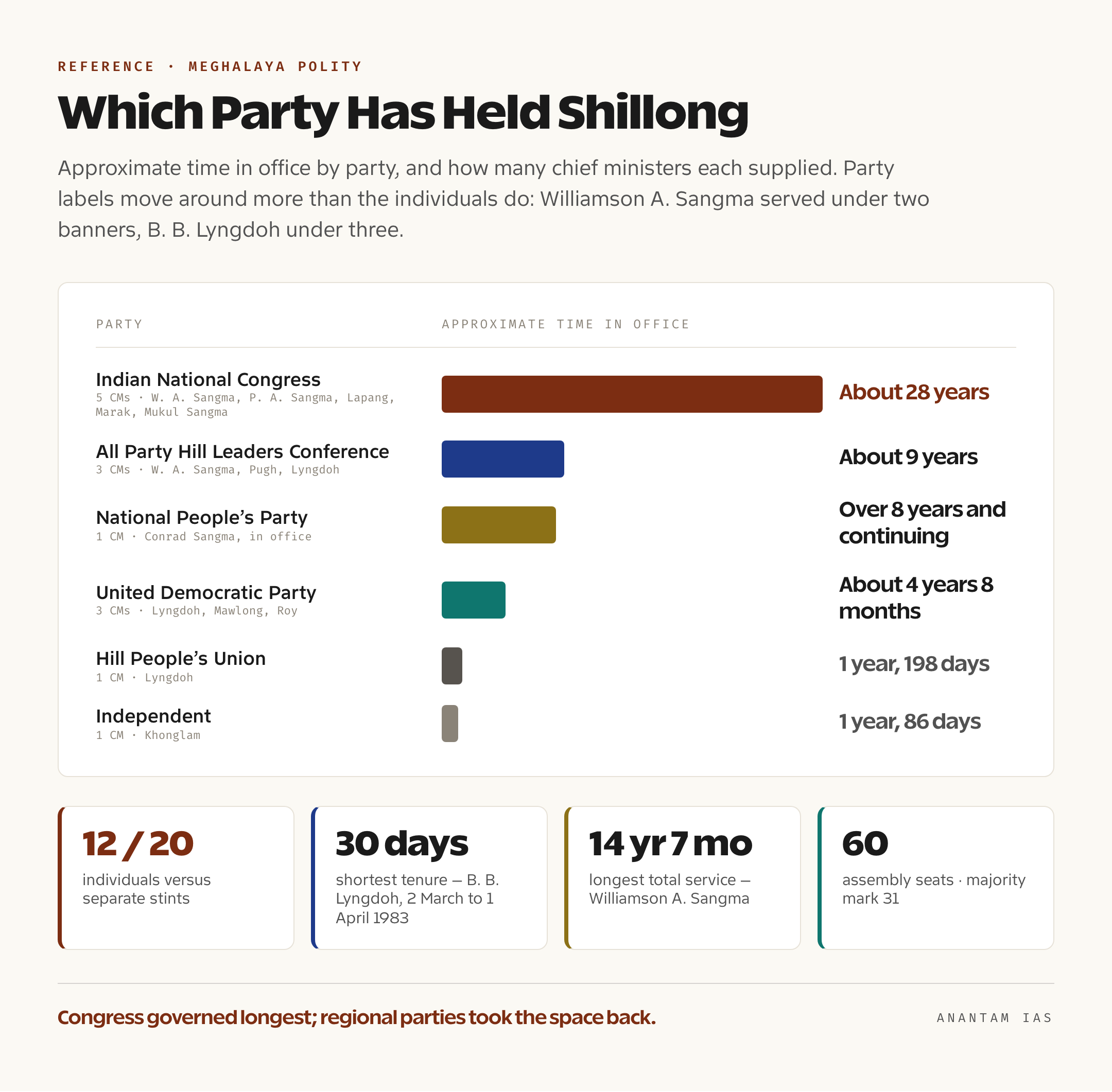
Meghalaya’s early politics belonged to the All Party Hill Leaders Conference, the movement that won statehood in the first place. The Congress absorbed much of that current from the mid-1970s and governed for most of the next three decades. Regional parties — the Hill People’s Union, the United Democratic Party and finally the National People’s Party — steadily took the space back.
| Party | Chief Ministers | Approximate time in office |
|---|---|---|
| Indian National Congress | 5 (W. A. Sangma, P. A. Sangma, Lapang, Marak, Mukul Sangma) | About 28 years |
| All Party Hill Leaders Conference | 3 (W. A. Sangma, Pugh, Lyngdoh) | About 9 years |
| National People’s Party | 1 (Conrad Sangma) | Over 8 years and continuing |
| United Democratic Party | 3 (Lyngdoh, Mawlong, Roy) | About 4 years 8 months |
| Hill People’s Union | 1 (Lyngdoh) | 1 year, 198 days |
| Independent | 1 (Khonglam) | 1 year, 86 days |
Party labels move around in Meghalaya more than the individuals do. Williamson A. Sangma served under two banners; B. B. Lyngdoh under three. Since 2018, the governing arrangement has been a coalition of the National People’s Party with the United Democratic Party and several smaller partners, with the Bharatiya Janata Party as a minor ally — the first time a party headquartered in Meghalaya has led the state without a national party at the centre of the arrangement.
Records and Quick Facts
- Current Chief Minister: Conrad Sangma, National People’s Party, since 6 March 2018.
- First Chief Minister: Williamson A. Sangma, from 21 January 1972 (and from 2 April 1970 for the autonomous state).
- Statehood: 21 January 1972, under the North-Eastern Areas (Reorganisation) Act, 1971.
- Individuals versus terms: 12 people, 20 separate stints.
- Shortest tenure: B. B. Lyngdoh, 30 days from 2 March to 1 April 1983.
- Second shortest: J. D. Rymbai, 268 days in 2006-07.
- Most stints: four each, by B. B. Lyngdoh and D. D. Lapang.
- President’s Rule spells: two — 11 October 1991 to 5 February 1992 (117 days), and 19 March to 12 May 2009 (54 days).
- Longest total service: Williamson A. Sangma, about 14 years 7 months.
- Woman Chief Minister: none so far.
- Assembly strength: 60 seats; majority mark 31.
FAQ
Who is the current Chief Minister of Meghalaya? Conrad Kongkal Sangma of the National People’s Party. He first took office on 6 March 2018 and began his second term on 7 March 2023 after the 2023 assembly election, at the head of a coalition government.
Who was the first Chief Minister of Meghalaya? Williamson A. Sangma of the All Party Hill Leaders Conference. He led the autonomous state of Meghalaya from 2 April 1970 and continued as Chief Minister of the full state from 21 January 1972.
How many Chief Ministers has Meghalaya had? Twelve individuals have held the office since statehood, but they account for twenty separate terms, because B. B. Lyngdoh and D. D. Lapang each served four times and Williamson A. Sangma held the office three times after statehood, having also led the autonomous state before it.
Who has served the longest as Chief Minister of Meghalaya? Williamson A. Sangma, with roughly 14 years and 7 months in total. Conrad Sangma holds the longest unbroken run, having been in office continuously since March 2018.
How many times has President’s Rule been imposed in Meghalaya? Twice. The first spell ran from 11 October 1991 to 5 February 1992 and the second from 19 March to 12 May 2009. Both followed the collapse of a coalition government and ended once a new majority was assembled in the existing assembly.
Practice Questions
Practice MCQs
- Meghalaya attained full statehood on which date? (a) 1 December 1963 (b) 21 January 1972 (c) 2 April 1970 (d) 20 February 1987 — Answer: (b) Meghalaya became a full state on 21 January 1972 under the North-Eastern Areas (Reorganisation) Act, 1971, having existed as an autonomous state within Assam from 2 April 1970.
- Who was the first Chief Minister of Meghalaya? (a) B. B. Lyngdoh (b) P. A. Sangma (c) Williamson A. Sangma (d) D. D. Lapang — Answer: (c) Williamson A. Sangma of the All Party Hill Leaders Conference led both the autonomous state from 1970 and the full state from 1972.
- How many times has President’s Rule been imposed in Meghalaya? (a) Once (b) Twice (c) Four times (d) Six times — Answer: (b) The two spells ran from October 1991 to February 1992 and from March to May 2009.
- Which of these leaders served four separate terms as Chief Minister of Meghalaya? (a) S. C. Marak (b) Donkupar Roy (c) D. D. Lapang (d) Mukul Sangma — Answer: (c) D. D. Lapang held the office in 1992-93, 2003-06, 2007-08 and 2009-10.
- The strength of the Meghalaya Legislative Assembly is: (a) 40 (b) 60 (c) 90 (d) 119 — Answer: (b) Meghalaya has a single chamber of 60 directly elected members, making 31 the majority mark.