Merchant Banking in India: Functions, Regulation, and Role
Merchant banking in India handles IPOs, underwriting, and advisory. Explore functions, SEBI categories, regulation, and UPSC economy relevance.
Merchant banking refers to the specialised financial services provided to corporates, governments and high-net-worth clients in areas such as capital raising, advisory, underwriting, and management of mergers and acquisitions. Unlike commercial banks that primarily accept deposits and give loans, merchant bankers do not deal with the ordinary public but act as intermediaries in the capital markets. In India, merchant banking is regulated by the Securities and Exchange Board of India (SEBI) under the SEBI (Merchant Bankers) Regulations, 1992, and has grown rapidly with the deepening of Indian equity and debt markets. For UPSC economy preparation, it sits at the intersection of financial regulation, capital formation and economic reform.
What Merchant Banking Means
The term "merchant banker" has a long European history, originally referring to merchants who also financed trade. In modern Indian usage, a merchant banker is defined under the SEBI regulations as any person engaged in the business of issue management by making arrangements regarding selling, buying or subscribing to securities or acting as manager, consultant, advisor or rendering corporate advisory services in relation to such issue management.
A merchant banker is not a bank in the ordinary sense – it does not mobilise retail deposits or offer chequing accounts. It earns primarily through fees and commissions from advisory and issue-management services.
Key Functions
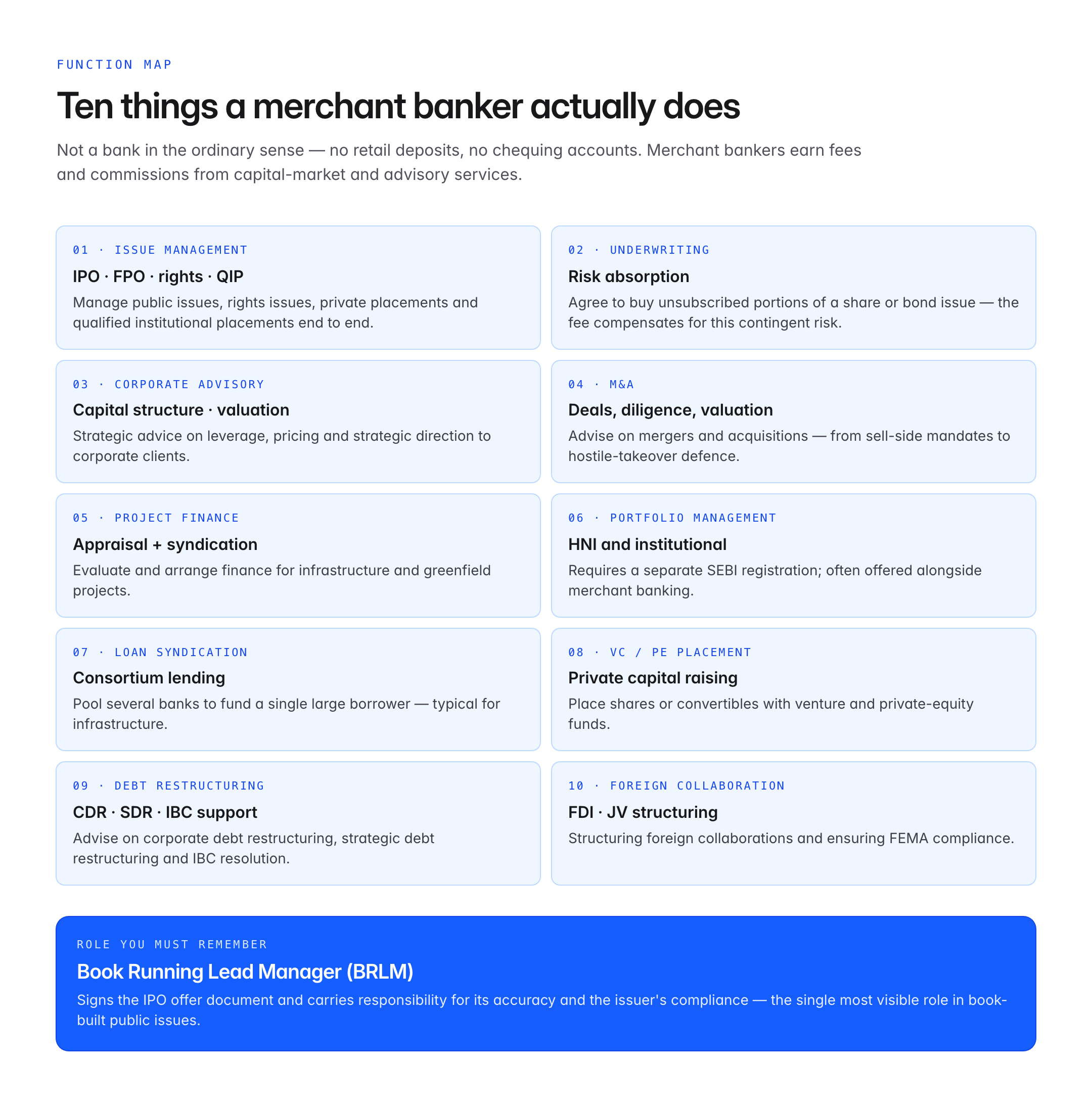
Merchant banks in India undertake a wide array of services:
- Issue management – managing public issues (IPOs, FPOs), rights issues, private placements, and QIP.
- Underwriting – agreeing to buy unsubscribed portions of a share or bond issue.
- Corporate advisory – on capital structure, valuation, strategic decisions.
- Mergers and acquisitions (M&A) – advising on deals, valuations, due diligence.
- Project appraisal and finance – evaluating and arranging finance for projects.
- Portfolio management – for HNIs and institutions (through a separate SEBI registration).
- Loan syndication – arranging consortium loans for large borrowers.
- Venture capital and private equity placement.
- Debt restructuring – advisory on CDR/SDR/IBC-linked processes.
- Credit syndication and forex services.
- Foreign collaboration – advisory on FDI, JV structuring and regulatory compliance.
Many large merchant banking houses also support ESG advisory, green bonds, and SME listing on dedicated platforms.
Regulatory Framework
Merchant banking in India is regulated primarily by SEBI under the:
- SEBI Act, 1992.
- SEBI (Merchant Bankers) Regulations, 1992.
- SEBI (Issue of Capital and Disclosure Requirements) Regulations, 2018.
- SEBI (Substantial Acquisition of Shares and Takeovers) Regulations, 2011.
- SEBI (Buy-Back of Securities) Regulations, 2018.
For banks undertaking merchant banking, the Reserve Bank of India (RBI) has its own prudential framework. Foreign exchange aspects are regulated under FEMA, 1999.
SEBI Categories (Historical and Current)
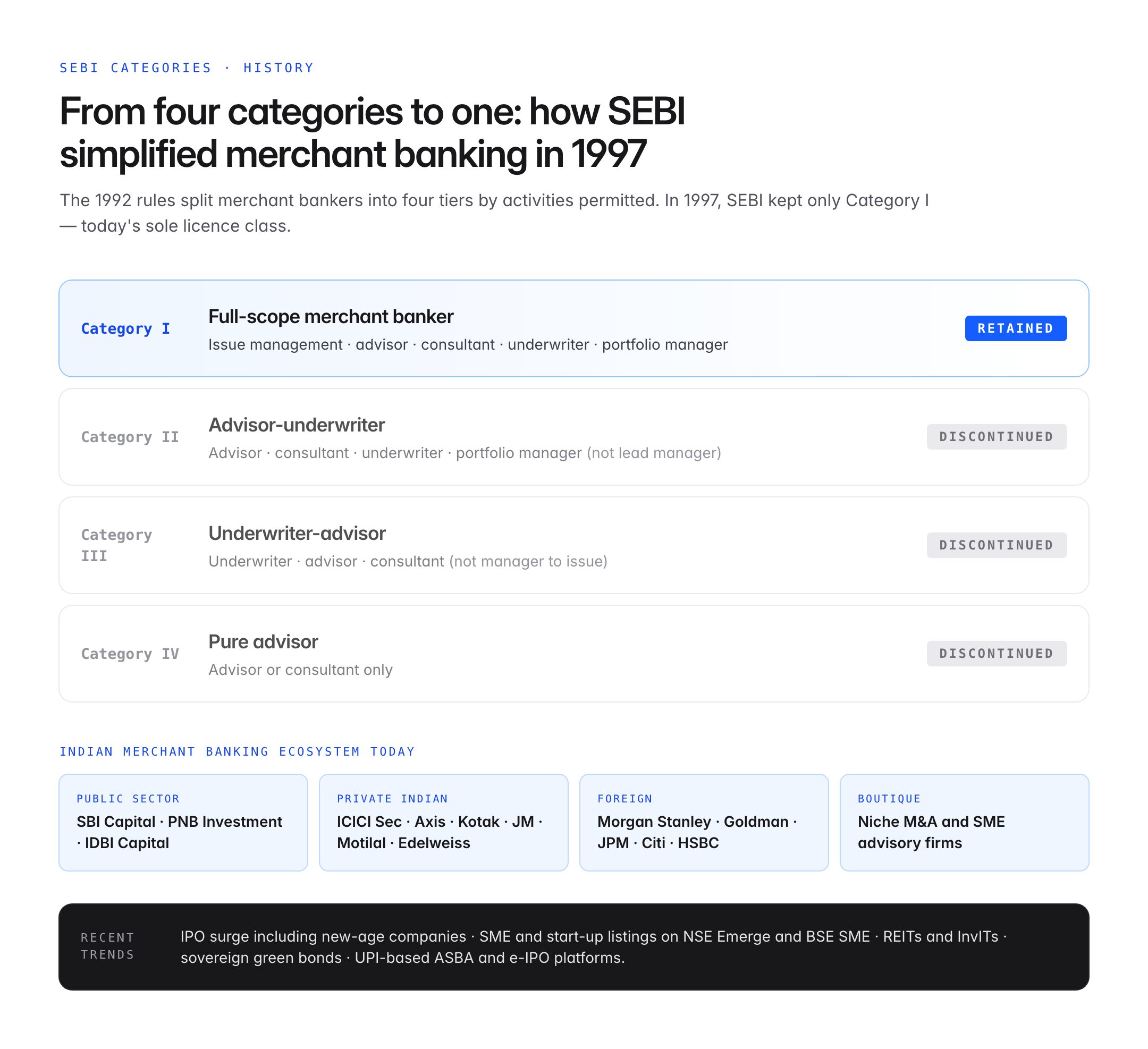
Initially, SEBI classified merchant bankers into four categories (I-IV) depending on the activities permitted:
| Category | Functions Permitted |
|---|---|
| Category I | Issue management, advisor, consultant, underwriter, portfolio manager |
| Category II | Advisor, consultant, underwriter, portfolio manager (not lead manager) |
| Category III | Underwriter, advisor, consultant (not manager to issue) |
| Category IV | Advisor or consultant only |
Since 1997, SEBI has retained only Category I; other categories have been discontinued. Today, a merchant banker registered with SEBI is a Category I merchant banker and can perform the full range of activities. Minimum net worth requirement is specified by SEBI (currently Rs 5 crore). Registration is renewable and subject to fit-and-proper norms, code of conduct, and reporting obligations.
Types of Entities in Indian Merchant Banking
The merchant banking industry in India is diverse:
- Public sector – SBI Capital Markets, PNB Investment Services, IDBI Capital, etc.
- Private Indian firms – ICICI Securities, Axis Capital, Kotak Mahindra Capital, JM Financial, Motilal Oswal, Edelweiss, etc.
- Foreign banks and investment banks – Morgan Stanley, Goldman Sachs, JPMorgan, Citi, HSBC, DSP, and others operating in India.
- Boutique investment banks – smaller firms focusing on niche M&A or SME advisory.
A merchant banker handling a public issue as the Book Running Lead Manager (BRLM) signs the offer document and carries significant responsibility for its accuracy and the issuer's compliance.
Role in Capital Formation
Merchant banks play a pivotal role in the functioning of capital markets and, by extension, in economic growth:
- Mobilising capital – help companies raise funds for expansion and innovation.
- Pricing and valuation – use book-building and benchmarking to discover fair prices.
- Risk allocation – through underwriting and distribution, they shift market risk from issuers to investors.
- Disclosure and governance – as intermediaries, they enforce disclosure standards that benefit investors.
- M&A and restructuring – enable efficient allocation of capital across firms.
- Cross-border capital flows – bring foreign investment into Indian companies through ADRs, GDRs and FPI placements.
- Support for start-ups and SMEs – through private placements, SME IPO platforms (NSE Emerge, BSE SME).
Merchant Banking vs Commercial Banking
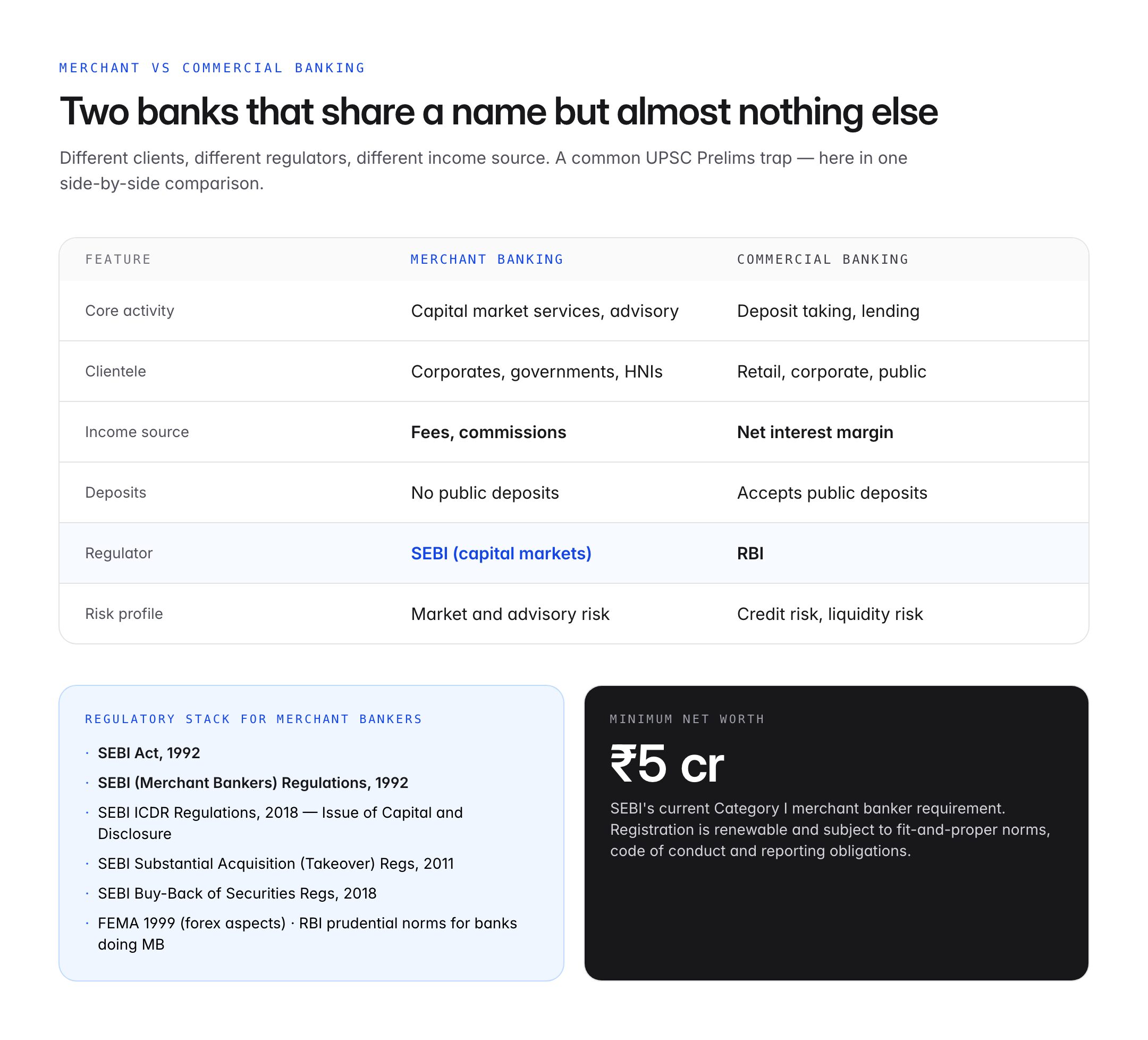
A common UPSC exam angle is the distinction between merchant and commercial banking:
| Feature | Merchant Banking | Commercial Banking |
|---|---|---|
| Core activity | Capital market services, advisory | Deposit taking, lending |
| Clientele | Corporates, governments, HNIs | Retail, corporate, public |
| Income source | Fees, commissions | Net interest margin |
| Deposits | No public deposits | Accepts public deposits |
| Regulator | SEBI (capital markets) | RBI |
| Risk profile | Market and advisory risk | Credit risk, liquidity risk |
Investment banking is a broader term often overlapping with merchant banking; in India, both are typically done under the SEBI merchant banker licence.
Recent Trends
The Indian merchant banking landscape has undergone rapid change:
- Surge in IPOs – record numbers in recent years, including digital-first and new-age companies.
- SME and start-up listings – dedicated platforms and simplified disclosures.
- REITs and InvITs – enabling securitisation of real estate and infrastructure cash flows.
- Green and sustainable finance – sovereign green bonds and corporate ESG bonds.
- Regulatory tightening – enhanced scrutiny of offer documents, price bands and disclosures.
- Digital disruption – UPI-based ASBA, e-IPO platforms, and algorithm-driven research.
Challenges
Key concerns include:
- Mis-selling risks – protecting retail investors in high-valuation IPOs.
- Conflicts of interest – balancing issuer advisory with investor interests.
- Concentration risk – dominance of a few large merchant bankers in big-ticket issues.
- Regulatory arbitrage – interplay between SEBI and RBI jurisdictions for banks with merchant banking arms.
- Quality of disclosures – ensuring transparency on related-party transactions, valuations and forward-looking statements.
UPSC Relevance
Prelims focus
- Primary regulator – SEBI, under SEBI (Merchant Bankers) Regulations, 1992.
- Originally four categories; only Category I retained today.
- Core functions – issue management, underwriting, advisory, portfolio management.
- Difference between merchant banking and commercial banking.
- Role in IPO book-building and as Book Running Lead Manager.
Mains GS-III angle
Use merchant banking in answers on:
- Development of Indian capital markets and financial deepening.
- Role of intermediaries in investor protection.
- Financing India's infrastructure and start-up ecosystem.
- Regulatory coordination between SEBI and RBI.
- ESG finance, green bonds and sustainable capital mobilisation.
Sample PYQ angle – questions on "Discuss the role of capital markets in financing India's growth" or "Bring out the difference between commercial banking and investment banking" fit this topic. Structure the answer with clear regulator-activity-impact linkages and recent trends such as REITs, SME listings and green bonds.
Merchant banking turns savings into productive capital; understanding it is central to making sense of India's evolving financial architecture.