Microplastics: Sources, Impacts, India’s Response and 2025 Treaty Update (UPSC)
UPSC guide to microplastics — primary vs secondary, health impacts, food chain bioaccumulation, India's plastic rules, UN Plastic Treaty INC-5 and 2024–26 updates.
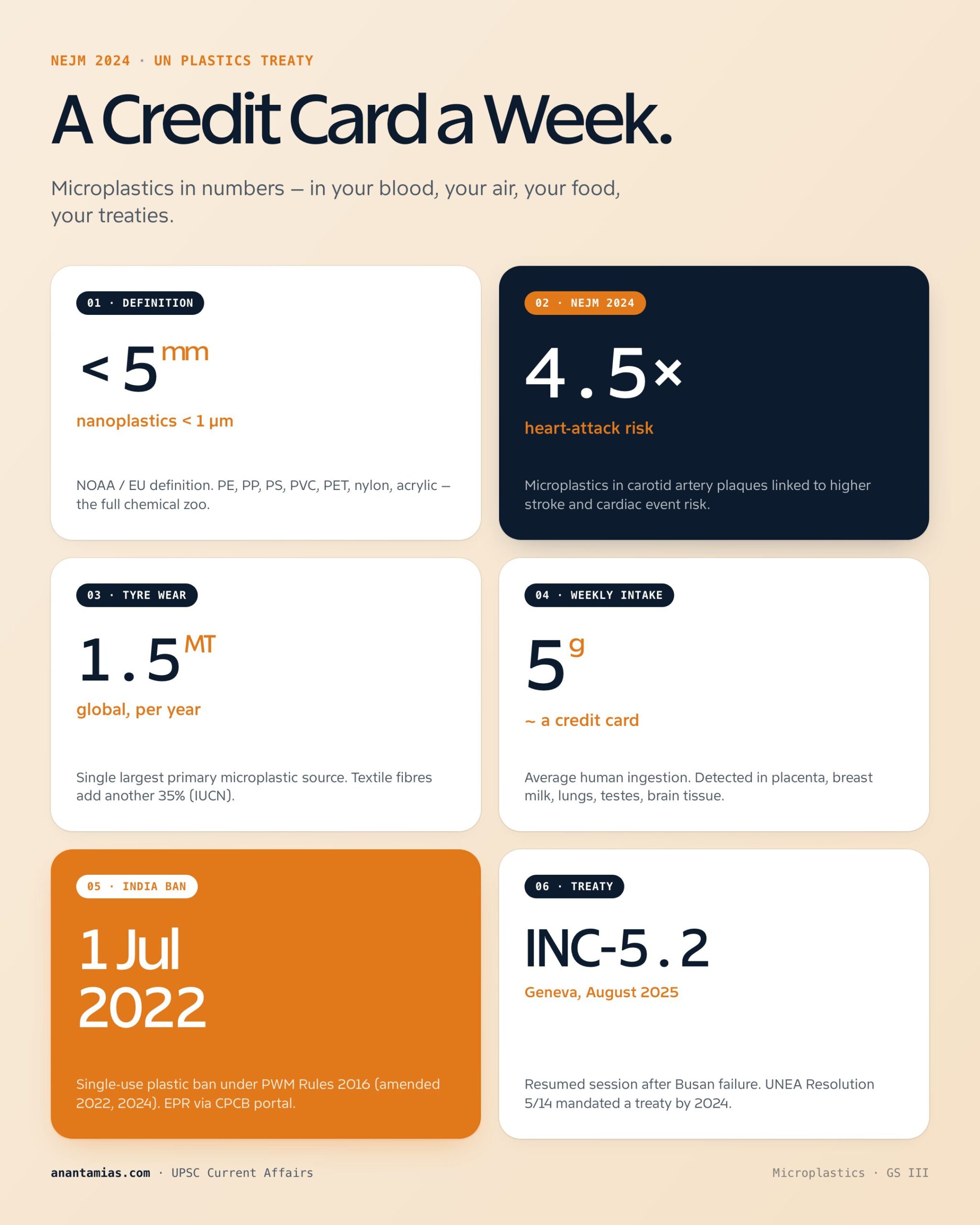
In 2022, scientists reported the first detection of microplastics in human blood. By 2024, microplastics had been found in human placentas, breast milk, lungs, testes, brain tissue and atherosclerotic plaques. In March 2024, a New England Journal of Medicine study linked microplastics in carotid arteries to a 4.5x higher risk of heart attack and stroke.
We are not just polluting the oceans. We are eating, drinking and breathing the plastics we make. The average person ingests an estimated 5 grams of microplastic a week — the weight of a credit card.
Microplastics — plastic particles smaller than 5 mm — have moved from a niche environmental concern to a mainstream public-health crisis. The world is responding through the UN Plastics Treaty (negotiations concluded INC-5.2 in August 2025) and a wave of national bans. India's Plastic Waste Management Rules, 2016 (amended 2022, 2024) are part of this response.
This guide explains what microplastics are, where they come from, what they do to ecosystems and human health, and where the regulatory action stands in 2024–26.
What Are Microplastics?
The most widely used definition is from NOAA and the EU: plastic fragments smaller than 5 mm in any dimension. Some scientists further classify:
- Macroplastics — > 25 mm
- Mesoplastics — 5–25 mm
- Microplastics — 1 µm to 5 mm
- Nanoplastics — < 1 µm (1,000 nanometres)
Microplastics are not a single material. They span a chemical zoo:
- PE (polyethylene) — bottles, bags
- PP (polypropylene) — caps, packaging
- PS (polystyrene) — foam, cups
- PVC (polyvinyl chloride) — pipes
- PET (polyethylene terephthalate) — bottles, fibres
- Nylon and acrylic — clothing fibres
Primary vs Secondary Microplastics
| Type | Origin | Examples |
|---|---|---|
| Primary microplastics | Manufactured at micro size | Microbeads (cosmetics), nurdles (pre-production pellets), synthetic textile fibres, tyre wear particles, glitter, drug capsules |
| Secondary microplastics | Created by breakdown of larger plastic | Fragmented bottles, bags, fishing nets, tarpaulins, cigarette filters, paint flakes |
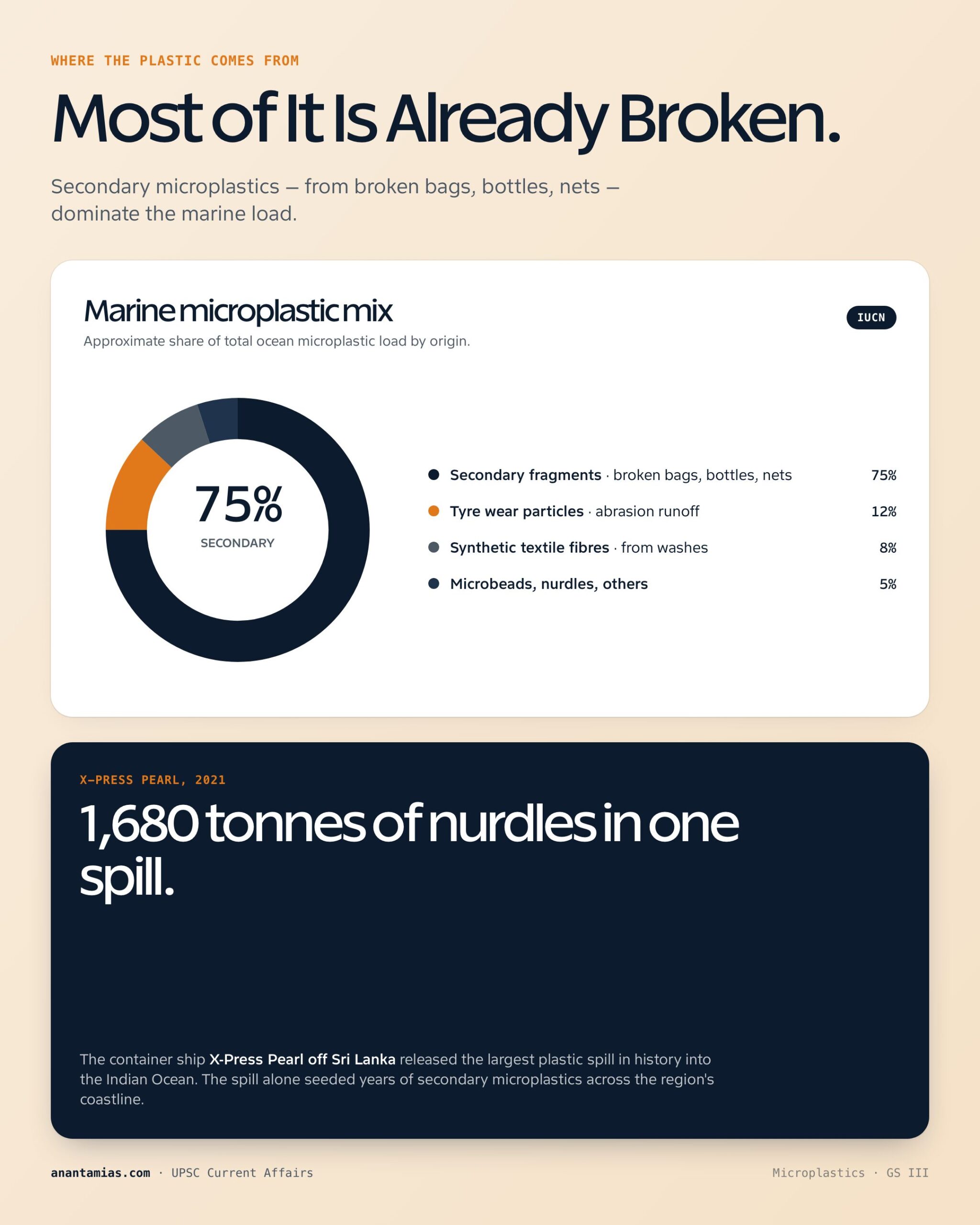
Secondary microplastics dominate — most studies estimate they account for 70–80% of marine microplastic load.
Sources of Microplastics
Synthetic Textile Fibres
A single load of synthetic clothing can release 700,000+ fibres in a wash. Polyester, nylon and acrylic fibres are now found from the deep sea to Arctic snow. The IUCN (2017) estimated 35% of primary microplastics in oceans come from textiles.
Tyre Wear Particles
Vehicle tyres shed roughly 1.5 million tonnes of microplastic globally per year. Rain washes them into stormwater, rivers and oceans. Tyre wear is the single largest primary microplastic source in many studies.
Microbeads in Cosmetics
Used in face scrubs, toothpastes, deodorants. Banned in the US (2015), UK (2018), Canada (2018) and India (2017 for personal care under BIS standards, fully phased out by 2020).
Nurdles (Pre-production Pellets)
Lentil-sized plastic pellets that are the raw material of plastics manufacturing. Spilt during transport and handling. The 2021 X-Press Pearl shipping disaster off Sri Lanka released 1,680 tonnes of nurdles into the Indian Ocean — the worst plastic spill in history.
Personal Care, Paints and Detergents
Microplastics are added as binders, abrasives and shine enhancers.
Fishing Gear
"Ghost nets" — discarded fishing gear — are major secondary microplastic sources.
Plastic Mulch in Agriculture
Used widely in horticulture, including India. Breaks down in soil over years.
Wastewater Treatment Plants
WWTPs capture 90%+ of microplastics — but the captured material ends up in sewage sludge applied to farmland, contaminating soil and food crops.
Impact on the Environment
Marine Ecosystems
- Ingestion by zooplankton, fish, seabirds, turtles and whales. Microplastics give a false sense of fullness, leading to starvation.
- Bioaccumulation and biomagnification — concentrations rise up the food chain.
- Adsorption of toxins — microplastics act like sponges for POPs (Persistent Organic Pollutants) like PCBs, DDT and dioxins, and heavy metals.
- Coral reefs — microplastics increase disease prevalence by up to 89% (Lamb et al., 2018).
- Deep-sea floor — the highest microplastic concentrations are now in deep-sea sediment, not surface waters.
Soil and Freshwater
- Reduce soil bulk density, impair water retention, alter microbial communities.
- Found in bottled water (Orb Media 2018: 93% of bottles), tap water, beer, sea salt.
Atmospheric Loading
Microplastics travel thousands of kilometres in the atmosphere. Detected in Pyrenees, Alps, French and Russian Arctic snow, and rural Indian sites.
Impact on Human Health
| System | Mechanism | Documented Risk |
|---|---|---|
| Cardiovascular | Plaques contain microplastics | 4.5x higher heart-attack/stroke risk (NEJM 2024) |
| Respiratory | Inhaled fibres lodge in lungs | Asbestos-like risk under study |
| Gastrointestinal | Ingested via food, water, salt | Inflammation, gut microbiome disruption |
| Reproductive | Detected in placenta, testes | Reduced sperm count signals |
| Endocrine | BPA, phthalates leach from plastics | Hormone disruption, obesity, infertility |
| Neurological | Detected in brain tissue (2024) | Long-term effects unclear |
A 2024 University of New Mexico study found microplastics in all 23 brain samples examined — at levels 3 to 5 times higher in dementia patients.
International Framework
UN Environment Assembly Resolution 5/14 (March 2022)
The historic "End plastic pollution" resolution mandated a legally binding international instrument by 2024. Negotiated by an Intergovernmental Negotiating Committee (INC).
Plastic Treaty Negotiations (2022–25)
| Session | Date | Location |
|---|---|---|
| INC-1 | Nov 2022 | Punta del Este, Uruguay |
| INC-2 | May 2023 | Paris |
| INC-3 | Nov 2023 | Nairobi |
| INC-4 | April 2024 | Ottawa |
| INC-5 | Nov-Dec 2024 | Busan, South Korea (failed) |
| INC-5.2 | August 2025 | Geneva (resumed session) |
The INC-5 in Busan (Dec 2024) failed to reach agreement, primarily due to disagreement between the High Ambition Coalition (EU, Norway, Rwanda — wanting production caps) and oil-producing states (Saudi Arabia, Russia, Iran — wanting waste-only treaty). India aligned with the moderate group and emphasised CBDR-RC principles.
Other Frameworks
- Basel Convention Plastic Amendments (2019, in force 2021) — regulate trans-boundary movement of plastic waste.
- Stockholm Convention on POPs — many additives are listed.
- MARPOL Annex V — bans discharge of plastic from ships.
- G20 Osaka Blue Ocean Vision (2019) — reduce additional marine plastic litter to zero by 2050.
India's Response
Plastic Waste Management Rules, 2016 (amended 2022, 2024)
- Single-use plastics ban (effective 1 July 2022) — covers earbuds, balloons, plates, cutlery, packing films, etc.
- Extended Producer Responsibility (EPR) — producers, importers and brand owners must collect and recycle plastic.
- Phase-down of PE and PP carry bags below 120 micron.
- Ban on microbeads in personal care products (BIS standard, phased to 2020).
National Action Plan on Marine Litter (2018, updated 2023)
- Coordinated by MoEFCC and Ministry of Earth Sciences.
- Coastal Cleanups annually under Swachh Bharat Mission.
Swachh Sagar, Surakshit Sagar (2022)
- World's largest coastal cleanup; covered 7,500 km coastline.
Research and Surveillance
- NCCR Chennai monitors microplastics in Indian beaches and rivers.
- CSIR-NIO Goa studies marine microplastic loads.
- Ganga River Project — IIT Roorkee, IIT Kharagpur — quantified high microplastic loads downstream of urban centres.
Standards
- BIS IS 17899:2023 — Indian Standard on plastic in personal care.
- FSSAI is examining microplastic standards in bottled water.
Recent Developments (2024–26)
- NEJM landmark study (March 2024) — microplastics in carotid arteries linked to 4.5x heart-attack/stroke risk.
- Microplastics in human brain (Feb 2024) — first confirmed via Univ of New Mexico autopsy study.
- INC-5 Busan (Dec 2024) failed; INC-5.2 resumed in Geneva August 2025 — partial agreement on monitoring and reporting; production caps deferred.
- EU Microplastic Restriction (Oct 2023, in force 2024) — bans intentionally added microplastics under REACH; phase-out by 2035 across glitter, cosmetics, fertilisers.
- India's amended Plastic Waste Management Rules, 2024 — tighter EPR thresholds and registration on CPCB EPR Portal.
- Plastic Overshoot Day 2024 — 5 September; India identified among top 12 contributors to mismanaged waste.
- WHO Bottled Water Advisory (2024) — urged tighter standards on microplastics in drinking water.
- First Global Plastics Outlook (OECD 2024) — projects global plastic production to triple by 2060 unless treaty intervenes.
- India's Recycling Targets (2024–25) — Category I plastics: 70%; Category II: 60%; Category III: 50%.
Way Forward
- Cap virgin plastic production through the Plastics Treaty.
- Phase out problematic plastics — single-use, PVC, expanded polystyrene.
- Strict standards on textiles — mandatory microfibre filters in washing machines (France 2025, EU 2030).
- Regulate tyre composition to reduce abrasion-driven microplastic release.
- Mandate microplastic standards in drinking water, bottled water, food contact materials.
- Strengthen EPR enforcement — close gaps in India's brand-owner registration.
- Invest in alternatives — bio-based, biodegradable, refill-reuse models.
- Public health surveillance — national microplastic biomonitoring in India.
- Citizen science — beach and river clean-ups linked to data collection.
- Litigation and producer accountability — apply the polluter-pays principle.
- R&D in bioremediation — plastic-eating bacteria (Ideonella sakaiensis), enzymes (PETase, MHETase).
Mains Hook
"Microplastics are no longer just an ocean problem; they are a public-health emergency. Discuss the sources, impacts and India's regulatory framework for microplastic pollution." — GS III
"Evaluate the prospects of the UN Plastics Treaty in the wake of INC-5 in Busan. What should India's negotiating position be?" — GS III
Prelims Pointers
- Microplastics: plastic fragments < 5 mm.
- Nanoplastics: < 1 µm.
- Primary microplastics: manufactured at small size — microbeads, nurdles, fibres.
- Secondary microplastics: from breakdown of larger plastic; account for ~70-80% of marine microplastic load.
- Top primary source: tyre wear particles + synthetic textile fibres.
- UNEA Resolution 5/14 (March 2022) mandated a global plastics treaty.
- INC-5 (Busan, Dec 2024) failed; INC-5.2 (Geneva, August 2025) resumed.
- Basel Convention Plastic Amendments entered into force in 2021.
- India's Single-Use Plastic Ban effective 1 July 2022 under PWM Rules 2016 (amended 2022).
- Plastic Waste Management Rules, 2016 are the principal Indian legislation; key tool: Extended Producer Responsibility (EPR).
- NEJM 2024 study — microplastics in carotid plaques linked to 4.5x cardiovascular risk.
- X-Press Pearl disaster (May 2021) — largest plastic spill in history, off Sri Lanka.
- Ideonella sakaiensis — plastic-degrading bacterium; produces enzyme PETase.
- Major Indian agencies: NCCR (Chennai), NIO (Goa), CPCB.
Conclusion
Microplastics are the long shadow of the plastic age. They started in our oceans, climbed the food web, entered our homes through our taps and our clothes, and have now reached our brains and bloodstreams. The science is clear; the policy is catching up. India's challenge is to combine its EPR rules, treaty leadership and research capacity into a coherent national strategy — before microplastics become this generation's asbestos, lead and DDT rolled into one.