Mineral Resources of Gujarat: Lignite, Bauxite, Agate, Petroleum and Salt (UPSC Geography)
Gujarat is India's only source of agate, chalk and perlite, its top producer of fluorite, silica sand and salt, the second-largest oil producer, and a leading lignite and bauxite state. Here is the full mineral map of Gujarat — what is mined where, and why it built one of India's strongest mineral-based economies — explained for UPSC Geography.
Most people picture Gujarat as a state of ports, textile mills and petrochemical giants, not as a mining state. Yet scratch the surface — quite literally — and Gujarat turns out to be one of the most mineral-rich corners of India, and an unusually unusual one. It is the only place in the country that produces agate, chalk and perlite. It sits on roughly two-thirds of India’s fluorite. It is the nation’s single largest producer of salt and one of its two biggest sources of crude oil. And it does all this without a single major deposit of the metals — iron, copper, gold — that we normally associate with a “mineral belt”. Gujarat’s wealth lies in the quieter, industrial minerals: the ones that feed cement kilns, chemical plants, glass furnaces and power stations.
That distinction is exactly what makes the state worth studying carefully. Gujarat’s geology, shaped by ancient Deccan lava flows, a long crinkled coastline, and the oil-bearing rift basin that runs up its spine, has handed it a portfolio of resources tailor-made for industry rather than ornament. Understanding what is mined where — and why those minerals matter to the economy that grew up around them — is one of the cleanest case studies in Indian economic geography. It links physical geography to industrial location, regional development to resource endowment, and it rewards anyone who can hold a mental map of the state alongside a short list of hard facts.
How Gujarat’s Geology Shapes Its Mineral Map
Before the deposits, the rock. Gujarat’s mineral story is written by three big geological facts, and once you have them, the location of almost everything else falls into place. The first is the Deccan Trap — the vast sheets of basalt lava that erupted some 66 million years ago and blanket much of Saurashtra, the Kutch peninsula and parts of the mainland. As those basalts weathered in a warm, wet climate, they shed their aluminium-rich crust and concentrated it into bauxite, the ore of aluminium. The same lava flows trapped pockets of silica-rich fluid that slowly crystallised into agate and other semi-precious stones. So the Deccan Trap is, in one stroke, the reason Gujarat has both bauxite and agate.
The second fact is the coastline and the arid Rann. Gujarat has the longest coastline of any Indian state, more than 1,600 kilometres of it, fringing two great gulfs — Kutch and Khambhat — and the salt-encrusted Rann. Sea water evaporating in shallow coastal pans and in the flat, sun-baked expanse of the Little Rann of Kutch yields salt on an industrial scale, while the marine and lagoonal sediments laid down along the shore over millions of years gave the state its limestone, gypsum, chalk and silica sand. The third fact sits underground: the Cambay rift basin, a long crack in the crust running roughly from Surat up toward the Rajasthan border, where layers of organic-rich sediment cooked over geological time into petroleum and natural gas. Trap, coast and rift — three settings, and between them they account for the great majority of what Gujarat mines and drills.
What Gujarat conspicuously lacks is the ancient crystalline rock that hosts metallic ores elsewhere in India. There is no equivalent of Jharkhand’s iron and coal or Rajasthan’s metal belt. That absence is not a weakness so much as a different specialisation: Gujarat’s minerals are overwhelmingly the industrial and fuel kind, which is precisely why the state became a manufacturing powerhouse rather than a metallurgical one. The geology pointed it toward cement, chemicals, ceramics, glass and energy — and the economy followed the rock.
The Headline Minerals: Lignite, Bauxite, Limestone, Agate and More
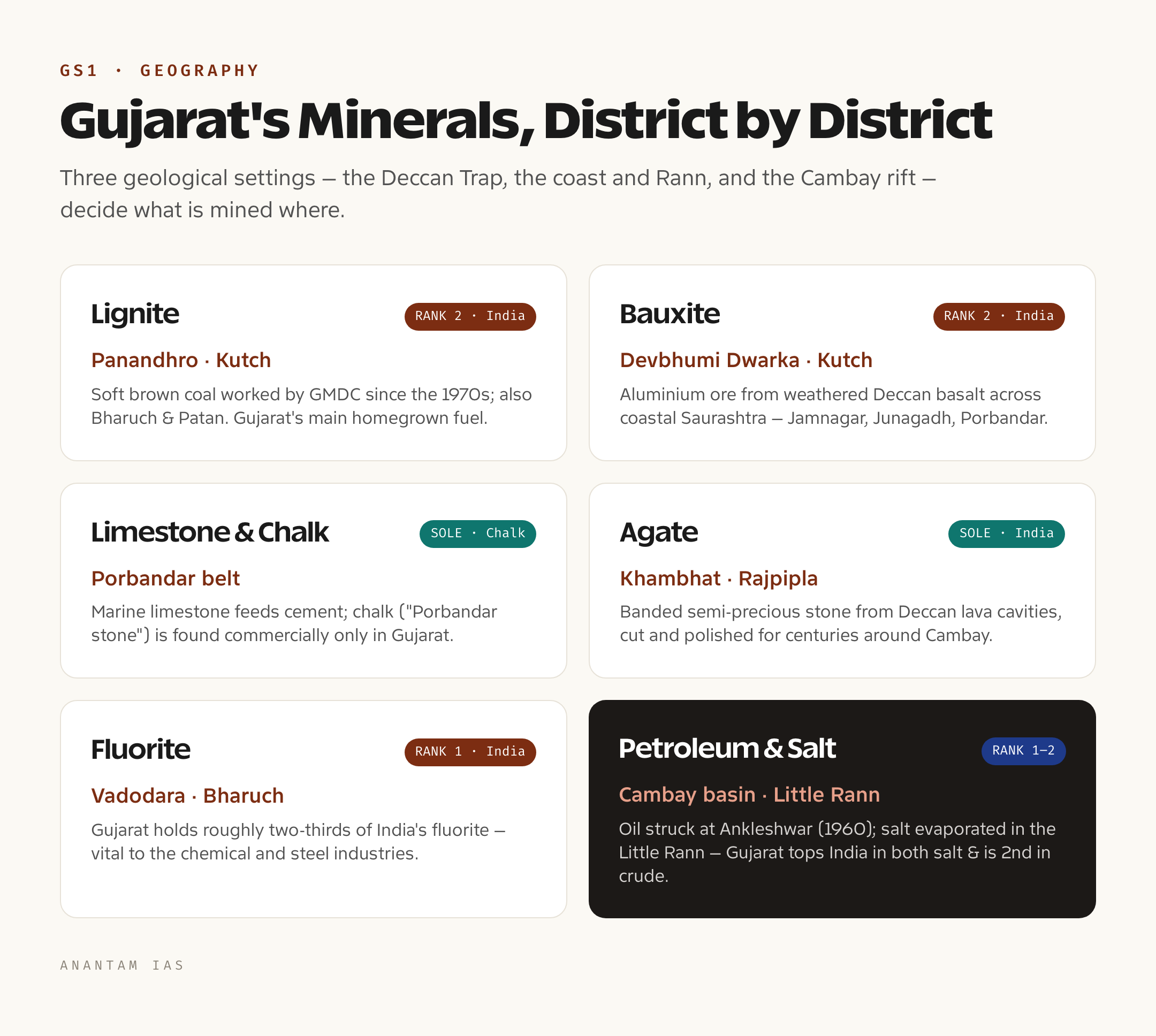
Now the deposits themselves, because this is where examiners and a working knowledge of the state both live. Start with lignite, the soft brown coal that is Gujarat’s most important solid fuel. The state has no good-quality black coal, but it holds large lignite reserves, and the flagship deposit lies at Panandhro in the Kutch region, where the Gujarat Mineral Development Corporation, the state-owned miner usually shortened to GMDC, opened its first lignite mine in the 1970s. Lignite is also worked in the Bharuch and Patan areas, and GMDC has grown on the back of it into one of India’s biggest merchant sellers of the fuel. The lignite matters because it powers thermal stations and feeds local industry with cheap heat — a homegrown energy source in a state otherwise short of coal.
Then bauxite, the aluminium ore born of weathered Deccan basalt. Gujarat is among the top bauxite-producing states in the country, with deposits scattered across the coastal districts of Saurashtra and Kutch — Devbhumi Dwarka, Jamnagar, Junagadh, Porbandar, Bhavnagar, Amreli and the Kutch peninsula. Limestone is the next workhorse: marine in origin, it is quarried widely across Saurashtra and the Kutch region, with the Porbandar belt and parts of Banaskantha and Junagadh especially productive. Limestone is the raw material of cement, and Gujarat’s abundance of it is the single biggest reason the state hosts a large cement industry clustered near the coast.
After the bulk minerals come the specialities, and these are where Gujarat is genuinely unique. Agate — the banded semi-precious stone cut and polished for centuries around Khambhat (Cambay) and the Rajpipla hills of the Bharuch area — is found in commercial quantity only in Gujarat. So is chalk, the soft white limestone known locally as Porbandar stone, quarried in the Porbandar district, and perlite, a volcanic glass used in lightweight construction. Gujarat also dominates fluorite, the fluorine-bearing mineral essential to the chemical and steel industries, with high-grade deposits in the Vadodara and Bharuch areas; it holds roughly two-thirds of India’s fluorite and ranks first in its production. Add silica sand for glassmaking, in which the state again ranks first, along with calcite, dolomite, bentonite, china clay, gypsum, manganese in the Panchmahal area and fire clay, and you have a portfolio that reads less like a mineral belt and more like a shopping list for heavy industry.
Petroleum, Natural Gas and the Cambay Basin
Gujarat’s most valuable mineral wealth, in money terms, isn’t dug from a pit at all — it’s pumped from beneath the plains. The Cambay basin, the rift running up the centre of the state, is one of India’s richest onshore petroleum provinces, and the discovery that opened it up came in 1960 at Ankleshwar, in the Bharuch district. When oil flowed there, exploration spread quickly across the basin, and a string of fields followed — Kalol, Nawagam, Sanand, Gandhar and others — turning a band of central Gujarat into the country’s first major mainland oilfield. Ankleshwar crude earned a reputation for being light and rich in petrol and kerosene, which made it especially prized.
That early start is why Gujarat is the second-largest crude-oil-producing state in India, behind only the offshore Mumbai High fields, and a significant producer of natural gas besides. The oil and the gas drove a second wave of industry: refineries and a sprawling petrochemical complex grew up around the resource, most famously at Jamnagar and at Vadodara, while gas fed fertiliser plants and power stations. Onshore output from old fields like Ankleshwar has naturally declined with age, and the state now leans more on offshore and deeper finds and on imported crude landed at its ports. But the basic geography is fixed: the rift that cracked open beneath Gujarat tens of millions of years ago is the reason the state sits at the centre of India’s oil-and-gas map, and the reason its coast bristles with refineries.
It is worth keeping petroleum mentally separate from the solid minerals, because the institutions differ. The hard minerals — lignite, bauxite, limestone, fluorite and the rest — are leased and regulated by the state and worked by bodies like GMDC and private quarriers. Petroleum and natural gas are central-list resources, explored and produced by national companies and the private firms licensed under India’s exploration policy. Both, though, spring from the same underlying truth: Gujarat’s geology is generous with the fuels and industrial minerals that power factories, even as it withholds the glamorous metals.
Salt, the Sea and Gujarat’s Mineral-Based Industries
No account of Gujarat’s minerals is complete without salt, because in sheer tonnage it dwarfs almost everything else and it is the resource the state most thoroughly dominates. Gujarat produces well over two-thirds of India’s salt — the largest share of any state by a wide margin — winning it from sea water evaporated in coastal pans along the Gulfs of Kutch and Khambhat and from brine drawn up in the flat, blinding white expanse of the Little Rann of Kutch. There, through the dry months, the salt farmers known as agariyas pump up subsoil brine and rake the crystallising salt into low ridges by hand, a livelihood as old as it is harsh. Salt is more than a kitchen staple here: it is the feedstock for the soda ash and caustic soda that anchor Gujarat’s vast chemical industry, which is why the great salt works and the chemical plants sit side by side along the coast.
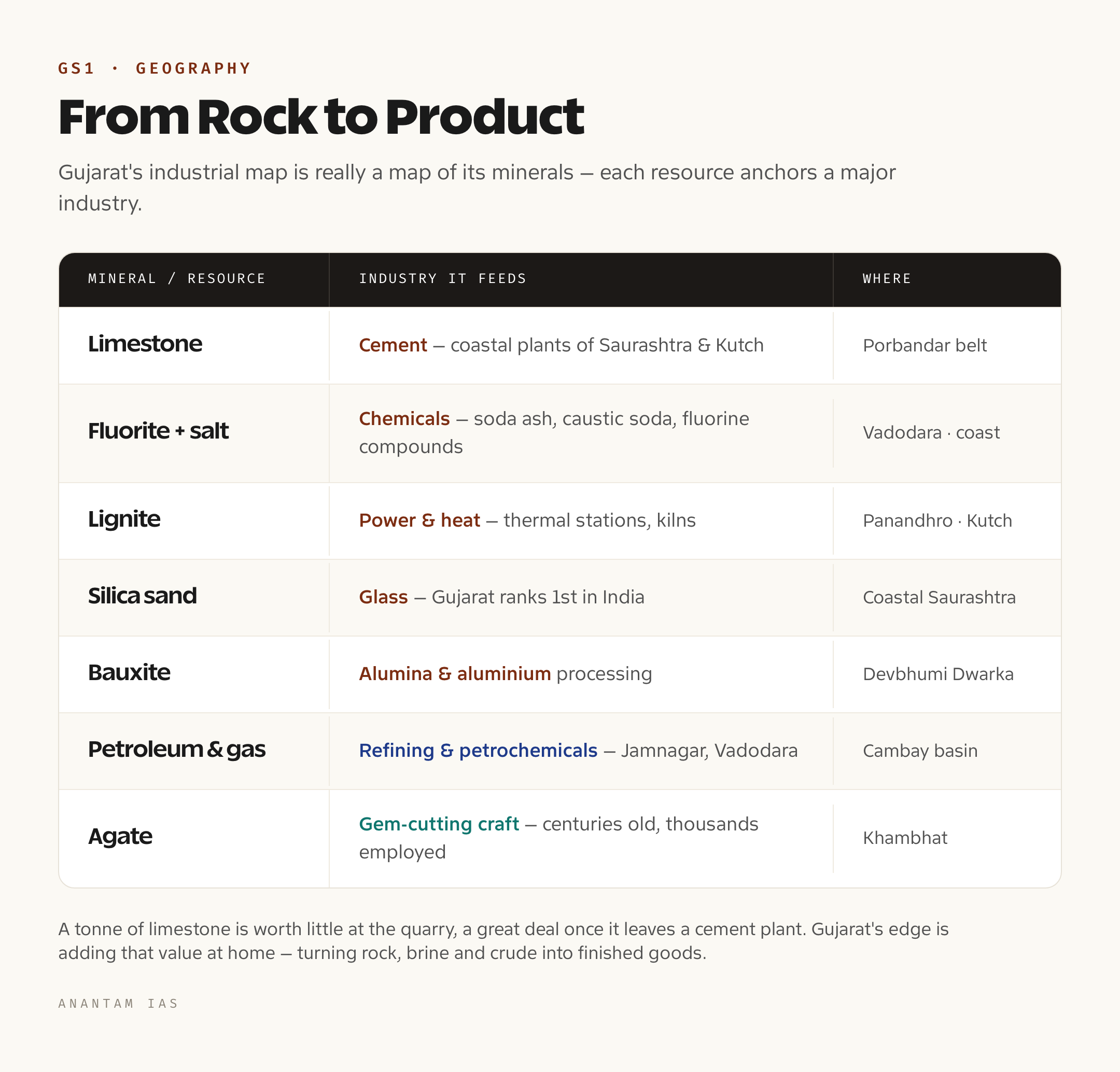
Salt is really the clearest example of the larger pattern — that Gujarat’s industrial map is, to a remarkable degree, a map of its minerals. Limestone built the cement industry; the coastal cement plants of Saurashtra and Kutch exist because the raw rock is underfoot. Fluorite and salt-derived chemicals underpin a chemicals sector that is among the largest in the country. Bauxite supports alumina and aluminium processing, silica sand feeds glassworks, china clay and fire clay supply the ceramics towns, and agate sustains a centuries-old gem-cutting craft around Khambhat that employs thousands. Even the petrochemical and refining complexes are, at root, mineral industries, built on the oil and gas of the Cambay basin.
GMDC sits at the centre of much of this as the state’s mining champion, working lignite, bauxite, fluorite, manganese and more, and increasingly diversifying into power and renewable energy on the back of its mineral base. The broader lesson for the state’s economy is that mineral wealth, smartly used, becomes industrial wealth: a tonne of limestone is worth little at the quarry but a great deal once it leaves a cement plant. Gujarat’s success has been to keep adding that value at home — to turn its rock, brine and crude into cement, chemicals, glass, aluminium and fuel rather than ship them out raw. That is what separates a mineral-rich state from a merely mineral-bearing one, and it is the thread that ties the whole of Gujarat’s resource geography together.
For Your Mains Answer
This is a useful topic for GS Paper 1, which covers the geography of India, the distribution of key natural resources, and the factors responsible for the location of industries. A question on the mineral resources of a region, on the link between resource endowment and industrial location, or on the economic geography of western India can all be answered with this material, and it doubles as a ready-made case study for state-level or competitive-exam geography. The marks come from doing what this article does — anchoring the geology to specific places, then showing how the minerals shaped the industries around them.
How to Build the Answer
Move from rock to region to industry. Open with the geological settings — Deccan Trap, the coast and Rann, the Cambay rift — because they explain everything that follows. Then map the minerals to their districts: lignite at Panandhro in Kutch, bauxite across coastal Saurashtra and Kutch, limestone and chalk near Porbandar, agate near Khambhat, fluorite in the Vadodara area, petroleum from the Cambay basin, salt from the Little Rann. Finish with the payoff — how those minerals built the cement, chemical, glass, aluminium and petrochemical industries. That arc, geology to geography to economy, fits almost any version of the question.
Common Mistakes to Avoid
Don’t call Gujarat a coal state — it has lignite, the soft brown coal, not good-quality black coal. Don’t place Panandhro anywhere but the Kutch region, or chalk anywhere but Porbandar. Don’t forget that petroleum and natural gas, not any solid mineral, are Gujarat’s most valuable underground resource. And don’t simply list minerals without linking them to industry; the examiner wants the connection between resource and factory, not a bare inventory.
A Compact Answer Spine
Geology = Deccan Trap (bauxite, agate) + coast and Rann (salt, limestone, gypsum, silica sand, chalk) + Cambay rift (petroleum, gas) → lignite at Panandhro, Kutch (GMDC); bauxite across coastal Saurashtra and Kutch; limestone and chalk around Porbandar; agate at Khambhat; fluorite in Vadodara (≈two-thirds of India’s, rank 1) → second-largest crude producer (Ankleshwar, 1960, Cambay basin) → largest salt producer (>two-thirds of India, Little Rann of Kutch) → minerals feed cement, chemicals, glass, aluminium and petrochemicals → verdict: a state that turns industrial minerals into industrial wealth.
Diagram or Flowchart Idea
Sketch a simple outline of Gujarat divided into its three mineral zones — Kutch and Saurashtra (lignite, bauxite, limestone, salt), central Gujarat (the Cambay oil-and-gas belt, agate), and the eastern hills (fluorite, manganese) — and label two or three minerals in each. A zoned schematic like this conveys the whole distribution at a glance and is far quicker to draw than a detailed map.
How to Use Data Without Cramming
You need only a handful of anchors: over two-thirds of India’s salt, roughly two-thirds of its fluorite, the second-largest crude producer, lignite first opened at Panandhro in the 1970s, and oil struck at Ankleshwar in 1960. Drop those into the right sentences and the answer reads as authoritative. Attribute them plainly — “by the state’s own mineral data” — rather than scattering precise figures you cannot defend.
FAQ
Which minerals is Gujarat the leading producer of in India? Gujarat ranks first in India for fluorite, silica sand and salt, and it is the country’s only commercial source of agate, chalk (Porbandar stone) and perlite. It is also among the top producers of lignite and bauxite, and the second-largest producer of crude oil after the offshore Mumbai High fields. In short, the state dominates the industrial and fuel minerals rather than the metallic ores.
Where is lignite mined in Gujarat, and who mines it? Gujarat’s flagship lignite deposit is at Panandhro in the Kutch region, where the state-owned Gujarat Mineral Development Corporation, or GMDC, opened its first lignite mine in the 1970s. Lignite — a soft brown coal — is also worked in the Bharuch and Patan areas. It matters because Gujarat lacks good black coal, so lignite is its main homegrown solid fuel for power and industry.
Why is Gujarat important for petroleum and natural gas? Because the Cambay rift basin, running up the centre of the state, is one of India’s richest onshore oil provinces. Oil was struck at Ankleshwar in the Bharuch district in 1960, opening up a string of fields such as Kalol and Gandhar, and Gujarat became the second-largest crude-producing state. The oil and gas in turn drove the refineries and petrochemical complexes at Jamnagar and Vadodara.
How does salt fit into Gujarat’s mineral wealth? Salt is Gujarat’s largest mineral by volume. The state produces well over two-thirds of India’s salt, evaporated from sea water in coastal pans and from brine in the Little Rann of Kutch, where agariya salt farmers work through the dry season. Beyond food, salt is the feedstock for soda ash and caustic soda, which is why it anchors Gujarat’s large coastal chemical industry.
Practice Questions
Prelims MCQs
- With reference to the mineral resources of Gujarat, consider the following: the state is the leading Indian producer of which of these?
(a) Iron ore and copper
(b) Fluorite, silica sand and salt
(c) Coal and manganese
(d) Gold and mica
Answer: (b) Gujarat ranks first in India for fluorite, silica sand and salt, and is the sole source of agate, chalk and perlite; it has no significant iron, copper or gold. - The Panandhro mine in Gujarat is associated with which mineral?
(a) Bauxite
(b) Limestone
(c) Lignite
(d) Manganese
Answer: (c) Panandhro, in the Kutch region, is Gujarat’s flagship lignite deposit, first developed by the Gujarat Mineral Development Corporation in the 1970s. - The discovery that opened up the Cambay basin as a petroleum province occurred in 1960 at which location?
(a) Kalol
(b) Ankleshwar
(c) Gandhar
(d) Jamnagar
Answer: (b) Oil was struck at Ankleshwar in the Bharuch district in 1960, triggering wider exploration across the Cambay basin. - Chalk, locally called “Porbandar stone”, is quarried mainly in which district of Gujarat?
(a) Junagadh
(b) Bharuch
(c) Porbandar
(d) Kutch
Answer: (c) Chalk, a soft white limestone, is worked in the Porbandar district, which gives the stone its local name; Gujarat is its only commercial source in India. - Gujarat’s bauxite and agate both owe their origin chiefly to which geological feature?
(a) The Cambay rift basin
(b) The weathering and lava flows of the Deccan Trap
(c) Ancient crystalline shield rocks
(d) Coastal marine sediments
Answer: (b) Weathered Deccan Trap basalt concentrated the aluminium that forms bauxite, and the same lava flows trapped the silica-rich fluids that crystallised into agate.
Mains Practice Questions
- “Gujarat is rich in industrial and fuel minerals but poor in metallic ores.” Examine this statement with reference to the geology and mineral distribution of the state. (15 marks, 250 words)
- Discuss how the mineral resources of Gujarat have shaped the location and growth of its major industries. (15 marks, 250 words)
- Account for the importance of the Cambay basin in India’s petroleum and natural gas sector, and explain its significance for Gujarat’s economy. (15 marks, 250 words)
- Bring out the role of salt as a mineral resource of Gujarat, and explain its linkage to the state’s chemical industry. (10 marks, 150 words)
- Map the distribution of the major non-metallic minerals of Gujarat, and analyse how the state’s physical geography explains that distribution. (15 marks, 250 words)