Mission Indradhanush — Immunisation Drive, Phases & UPSC Relevance
Complete guide to Mission Indradhanush covering target diseases, phases (IMI 1.0-4.0), coverage achievements, and difference from Universal Immunisation Programme.
Mission Indradhanush (MI) is a flagship immunisation initiative of the Government of India launched in December 2014 by the Ministry of Health and Family Welfare. Named after the rainbow (Indradhanush in Hindi), the mission aims to achieve full immunisation coverage for all children under two years of age and pregnant women by targeting areas with low vaccination rates. It represents a significant acceleration of India's longstanding Universal Immunisation Programme (UIP) and is a frequently asked topic in UPSC Prelims and Mains.
Background — The Universal Immunisation Programme
India's Universal Immunisation Programme (UIP) was launched in 1985 as one of the largest public health programmes in the world. It provides free vaccination against life-threatening diseases to approximately 2.67 crore newborns and 2.9 crore pregnant women annually.
Despite the UIP's scale, India's full immunisation coverage had plateaued at around 65% by 2014, with significant inter-state and inter-district variations. Pockets of low coverage — particularly in urban slums, tribal areas, and hard-to-reach regions — meant that nearly 5 lakh children died annually from vaccine-preventable diseases.
Mission Indradhanush was launched to bridge this gap and accelerate progress toward universal coverage.
Objectives of Mission Indradhanush
- Achieve full immunisation coverage of at least 90% across India.
- Target unvaccinated and partially vaccinated children and pregnant women.
- Focus on high-risk and hard-to-reach areas with historically low coverage.
- Reduce child mortality attributable to vaccine-preventable diseases.
Target Diseases
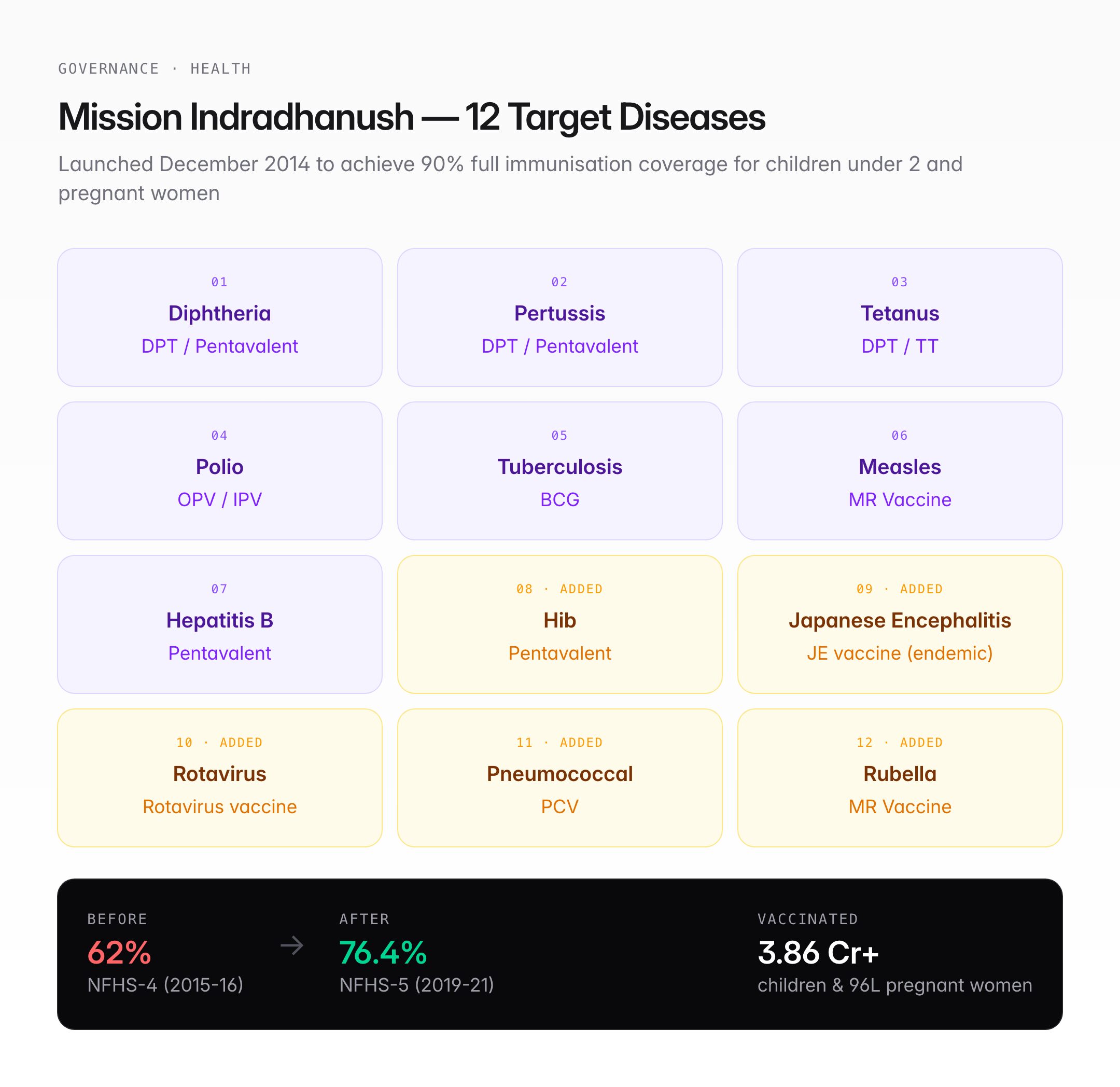
Mission Indradhanush initially targeted seven diseases, with additional antigens added over time:
| # | Disease | Vaccine |
|---|---|---|
| 1 | Diphtheria | DPT / Pentavalent |
| 2 | Pertussis (Whooping Cough) | DPT / Pentavalent |
| 3 | Tetanus | DPT / TT |
| 4 | Polio | OPV / IPV |
| 5 | Tuberculosis | BCG |
| 6 | Measles | MR (Measles-Rubella) |
| 7 | Hepatitis B | Pentavalent |
| 8 | Haemophilus influenzae type b (Hib) | Pentavalent (added) |
| 9 | Japanese Encephalitis (JE) | JE vaccine (in endemic districts) |
| 10 | Rotavirus diarrhoea | Rotavirus vaccine (phased introduction) |
| 11 | Pneumococcal disease | PCV (Pneumococcal Conjugate Vaccine) |
| 12 | Rubella | MR vaccine (added with Measles-Rubella campaign) |
The name "Indradhanush" (rainbow with seven colours) originally referred to the seven diseases; subsequent expansions increased the count beyond seven.
Phases of Mission Indradhanush
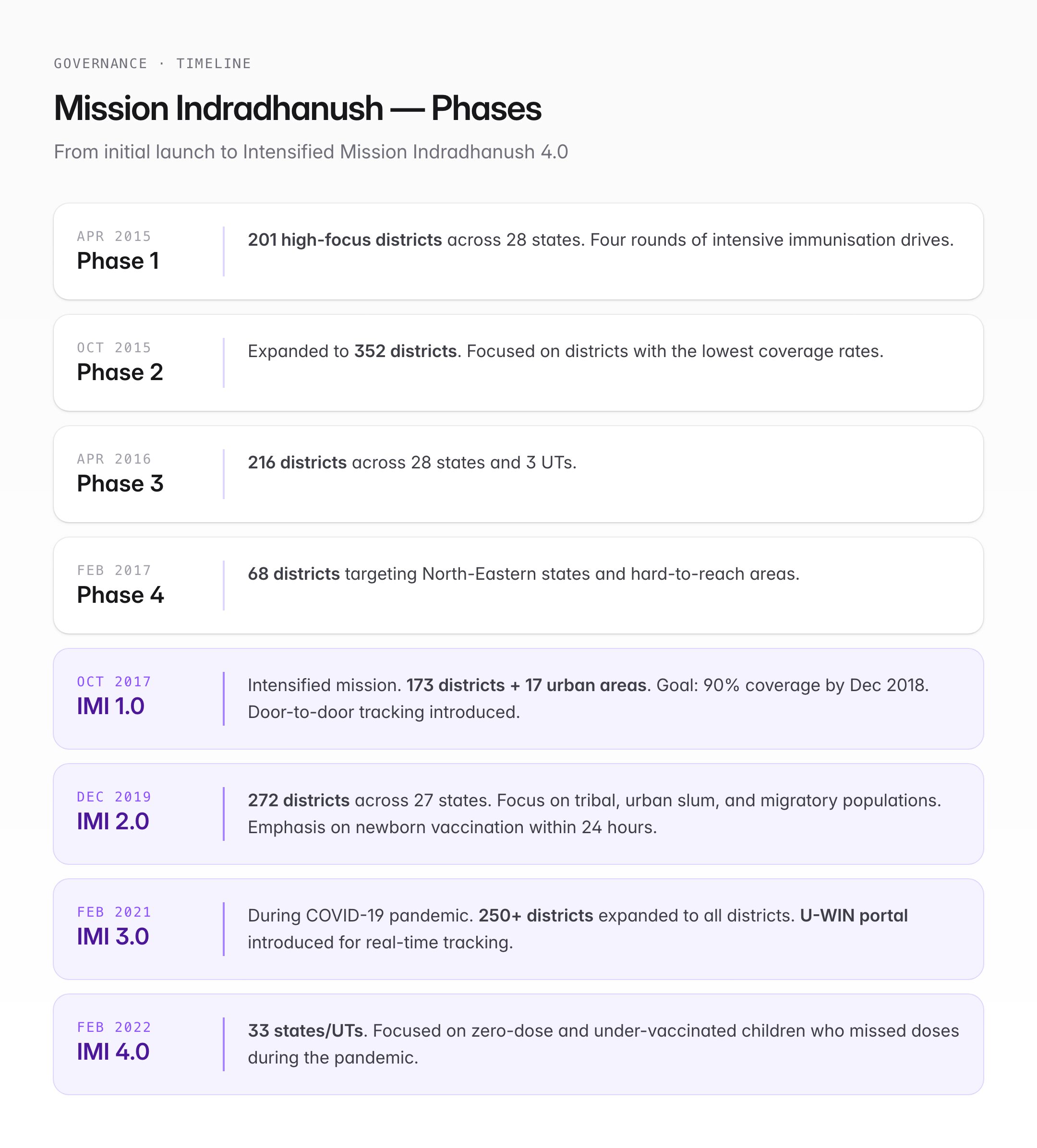
Phase 1 (April 2015)
- Covered 201 high-focus districts across 28 states.
- Conducted four rounds of intensive immunisation drives.
Phase 2 (October 2015)
- Expanded to 352 districts (including 279 from Phase 1).
- Focused on districts with the lowest coverage.
Phase 3 (April 2016)
- Covered 216 districts across 28 states and 3 UTs.
Phase 4 (February 2017)
- Targeted 68 districts in the North-Eastern states and other hard-to-reach areas.
Intensified Mission Indradhanush (IMI) 1.0 (October 2017)
- Launched by the Prime Minister with the goal of achieving 90% full immunisation coverage by December 2018.
- Focused on 173 districts and 17 urban areas identified as the most challenging.
- Introduced door-to-door tracking of unvaccinated children.
- Involved inter-ministerial coordination (Women and Child Development, Urban Development, Panchayati Raj).
IMI 2.0 (December 2019)
- Targeted 272 districts across 27 states.
- Emphasis on tribal, urban slum, and migratory populations.
- Special focus on newborn vaccination within the first 24 hours (Hepatitis B birth dose and BCG).
IMI 3.0 (February 2021)
- Launched during the COVID-19 pandemic to address immunisation disruptions.
- Covered 250 pre-identified districts and expanded to all districts.
- Used U-WIN portal for real-time tracking and beneficiary registration.
IMI 4.0 (February 2022)
- Targeted 33 states/UTs to reach children who missed doses during the pandemic.
- Focused on zero-dose and under-vaccinated children.
- Integrated with the COVID-19 vaccination infrastructure for better outreach.
Key Achievements
- Full immunisation coverage increased from 62% (NFHS-4, 2015-16) to 76.4% (NFHS-5, 2019-21).
- Over 3.86 crore children and 96 lakh pregnant women were vaccinated in the first seven phases.
- India was declared polio-free by the WHO in 2014 (pre-dating MI but reinforced by it).
- The mission significantly improved coverage in North-Eastern states and Uttar Pradesh, which had been lagging.
- The U-WIN digital platform — modelled on CoWIN — was developed for comprehensive immunisation tracking.
Mission Indradhanush vs Universal Immunisation Programme
| Feature | Universal Immunisation Programme (UIP) | Mission Indradhanush |
|---|---|---|
| Launched | 1985 | December 2014 |
| Nature | Routine, ongoing programme | Time-bound, campaign-mode acceleration |
| Coverage approach | All children/pregnant women through routine immunisation at health facilities | Specifically targets low-coverage pockets through special drives |
| Target | All eligible beneficiaries | Unvaccinated and partially vaccinated children and pregnant women |
| Frequency | Continuous (routine immunisation days) | Intensive rounds in selected districts |
| Monitoring | Routine health system monitoring | Special task forces, inter-ministerial committees, real-time tracking |
| Relationship | Base programme | Accelerator/supplement to UIP |
Important: Mission Indradhanush does not replace the UIP. It supplements it by conducting targeted, intensive drives in areas where routine immunisation has failed to reach all beneficiaries.
Implementation Strategy
The mission uses a four-pronged strategy:
- Meticulous planning — District-level micro-plans identifying session sites, mobilisers, and cold chain logistics.
- Effective communication — Community engagement through ASHA workers, Anganwadi workers, and mass media campaigns.
- Intensive monitoring — Real-time data tracking; special task forces at national, state, and district levels.
- Accountability framework — Monthly review meetings; name-based tracking of every beneficiary.
UPSC Relevance
GS Paper II — Governance: Government policies and interventions for health; issues relating to development and management of social sector.
GS Paper II — Social Justice: Welfare schemes for vulnerable sections; health infrastructure.
Prelims key facts:
- Mission Indradhanush was launched in December 2014 by the Ministry of Health and Family Welfare.
- The mission targets children under 2 years and pregnant women who are unvaccinated or partially vaccinated.
- Originally targeted 7 diseases; now covers 12 diseases including rotavirus and pneumococcal disease.
- Intensified Mission Indradhanush (IMI) was launched in October 2017 to achieve 90% coverage.
- The Universal Immunisation Programme (UIP) was launched in 1985 — MI supplements, not replaces, it.
- Full immunisation coverage rose from 62% (NFHS-4) to 76.4% (NFHS-5).
- The U-WIN portal is the digital platform for tracking routine immunisation (modelled on CoWIN).
- The mission is implemented through ASHA workers, Anganwadi workers, and inter-ministerial coordination.