Modern Monetary Theory (MMT): Can a Government Just Print Money? (UPSC Economy)
Modern Monetary Theory says a government that issues its own sovereign, floating currency can never go broke in that currency — the real constraint is inflation and real resources, not the size of the deficit. Here is the full picture: the core claims, the thinkers behind The Deficit Myth, the job guarantee, the inflation critique, and why MMT's 'print freely' logic doesn't straightforwardly fit India — explained for UPSC GS3.
Modern Monetary Theory (MMT) is a heterodox economic theory which holds that a government issuing its own sovereign, freely floating currency can never be forced to default on debt denominated in that currency, because it can always create more — so the real limit on public spending is inflation and the supply of real resources, not the size of the deficit. It reverses the usual sequence: the state spends its currency into existence first, and taxes and bonds come afterward to drain demand and manage interest rates rather than to “fund” the spending.
Few ideas in economics manage to be famous, fashionable and furiously disputed all at once, but Modern Monetary Theory pulls it off. Its central claim sounds almost too simple to be controversial: a government that issues its own currency can never run out of money. It cannot be forced to default on a debt denominated in a currency it alone creates, because it can always make more. Out of that one sentence comes a whole reordering of how we are taught to think about taxes, deficits and public spending — and a fight that has pulled in Nobel laureates, finance ministers and central bankers on every side. When Stephanie Kelton’s book The Deficit Myth hit the New York Times bestseller list in 2020, MMT stopped being a fringe seminar idea and became a political weapon.
And it matters for an aspirant far beyond the novelty. MMT forces you to confront the plumbing of how money actually enters an economy, why a sovereign state’s budget is not a household budget, and where the real limits on public spending lie. Whether you find it liberating or alarming, you cannot write a sharp answer on fiscal policy, deficit limits, monetary financing or central-bank independence without knowing what MMT asserts and where its critics say it falls apart. So treat this not as a verdict but as a map: here is the claim, here is the machinery behind it, and here is exactly why it does not transplant cleanly onto an emerging economy like India’s.
What MMT Actually Claims
Start with the heart of it, because almost every misunderstanding comes from skipping this. MMT applies to a government that issues its own sovereign, non-convertible, freely floating currency — one not pegged to gold or to a foreign currency, and not borrowing heavily in someone else’s money. For such a government, the theory says, the constraint everyone assumes is financial is actually a myth. The United States, the United Kingdom, Japan and India all create their own currency; none of them needs to find rupees or dollars before it can spend them, because it is the monopoly issuer of those very units. A currency-issuing state, in this view, can no more run out of its own money than a scorekeeper at a stadium can run out of points.
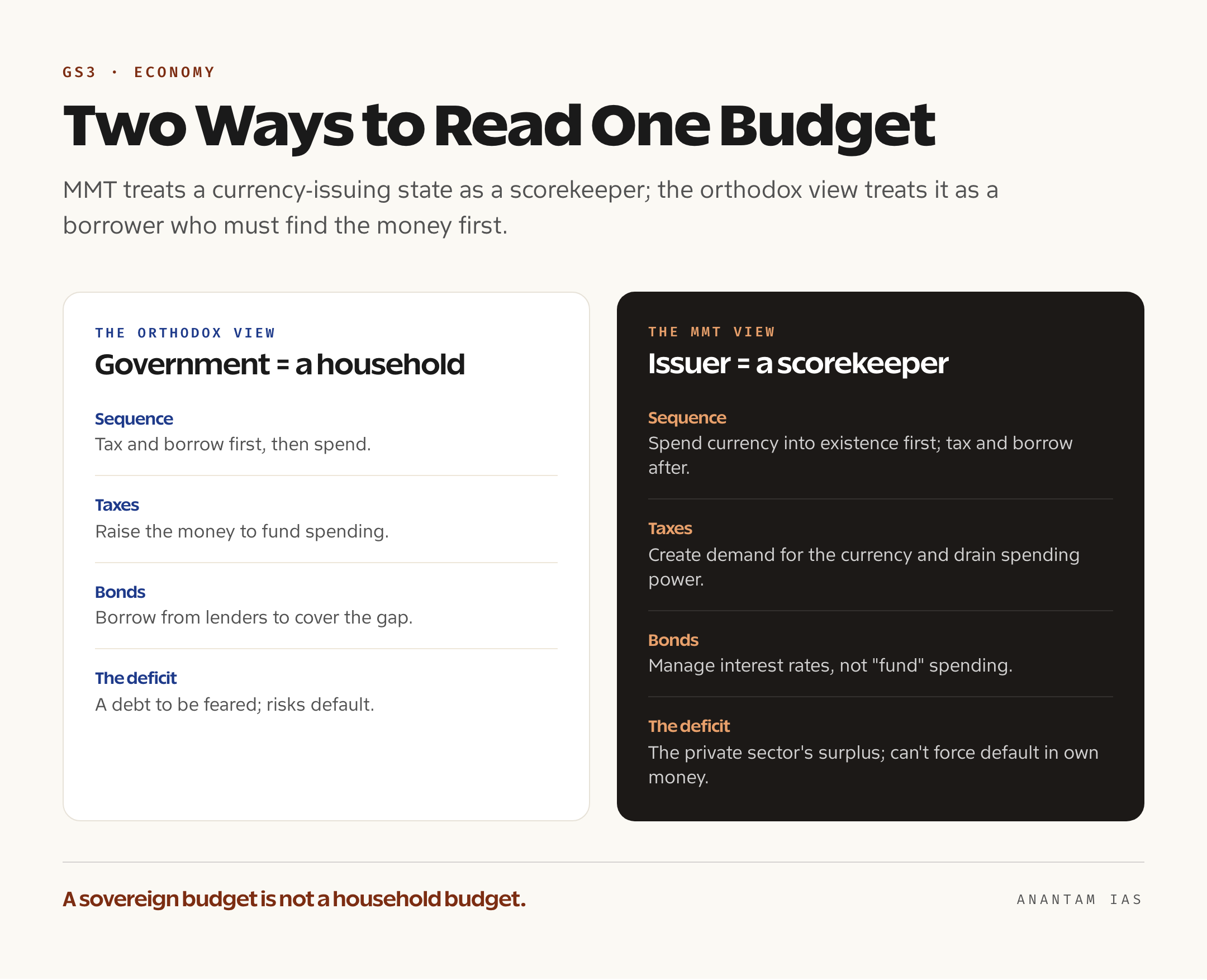
From that single premise flows a startling reversal of the usual sequence. We are taught that a government taxes and borrows in order to raise the money it then spends — first the TAB, then the spending. MMT flips the order. The government spends its currency into existence first; taxing and borrowing come afterward, and they do something quite different from “funding.” Think of it mechanically: when the Treasury pays a contractor, it simply credits a bank account at the central bank, conjuring the rupees in the act of spending them; nothing had to be “collected” first. This is the part that makes orthodox economists wince, so it is worth getting precise about what taxes and bonds are actually doing in the MMT account.
Taxes, in this telling, do not finance public spending at all. Their job is to create demand for the currency in the first place — you need rupees because the state will only accept rupees to settle your tax — and, just as importantly, to drain spending power back out of the private sector. When the government taxes, it effectively destroys money it had earlier created, cooling demand and making room for public spending without overheating the economy. Government bonds, similarly, are not a desperate search for lenders. Selling bonds drains reserves from the banking system and gives savers an interest-bearing asset; it is a tool for managing interest rates and the money supply, the theory says, not a way of “paying for” the deficit. So the deficit itself — the gap between spending and taxes — is reframed as, by accounting identity, a surplus in someone else’s pocket: the government’s red ink is the private sector’s black ink. None of this is magic; it is a chartalist, or state, theory of money, tracing back to Georg Knapp’s idea that money is “a creature of law” rather than a commodity that the state must dig up or borrow.

The Real Constraint: Inflation, Not the Deficit
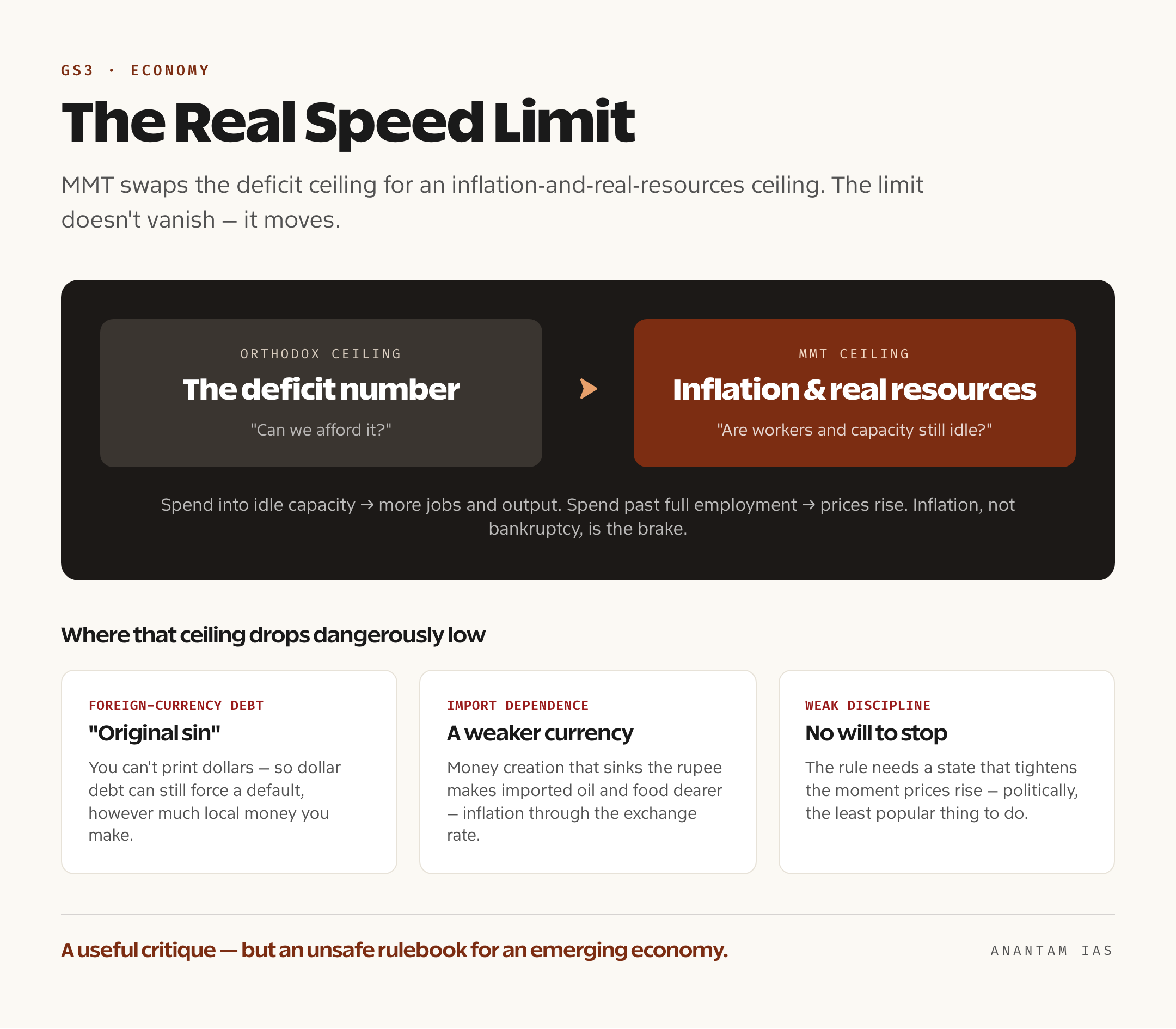
If a government can always create money, what stops it from spending without limit? Here is where MMT is more disciplined than its caricature suggests, and where students most often get it wrong. The theory does not say deficits are free or that money grows on trees. It says the binding constraint is not financial but real — it is inflation, and behind inflation, the supply of real resources: workers, factories, raw materials, energy. A government can spend as long as there are idle resources to absorb that spending. Put money into an economy with unemployed people and unused capacity, and you get more output and jobs. Keep pushing money in after the economy hits full employment — when every worker and machine is already busy — and the extra demand has nothing real to buy, so prices rise. Inflation, in MMT, is the true ceiling, and it announces itself long before any “national bankruptcy” could.
This rests on a much older idea that MMT openly borrows: Abba Lerner’s “functional finance” from the 1940s. Lerner argued that a government should judge its budget not by whether it balances but by its effect on the economy — spend and tax to keep output high and inflation low, and let the deficit fall where it may. The deficit is a residual, an outcome, never a target. So the right question, MMT insists, is never “can we afford it?” but “do we have the real resources, and will this tip us into inflation?” Frame a debate about a public programme that way and the conversation changes: a job guarantee, free childcare or a green transition becomes a question of available labour and materials, not of finding the money.
That reframing produces MMT’s signature policy: a federal job guarantee. The state offers a publicly funded job at a fixed living wage to anyone willing and able to work but unable to find private employment — an “employer of last resort.” Its champions argue this does double duty. It abolishes involuntary unemployment, and it acts as an automatic stabiliser for prices: in a slump, people flow into the guaranteed pool and public spending rises; in a boom, private firms hire them away and spending falls, all without a politician having to decide anything. The fixed wage, MMT says, anchors the whole price level. Whether that anchor would actually hold is one of the fiercest battlegrounds in the debate — and a natural bridge to the people who built the theory and the people who want to bury it.
The Thinkers and the Critics
MMT did not fall from the sky; it was assembled, deliberately, by a small and identifiable group. The investor Warren Mosler is usually credited with the founding insights in the 1990s, arriving at them from the trading desk rather than the lecture hall. The economist L. Randall Wray gave it academic rigour and wrote its first textbooks, building on the chartalist tradition and on Hyman Minsky’s work. Bill Mitchell, an Australian economist, coined the very phrase “modern monetary theory.” Pavlina Tcherneva developed the job-guarantee design in detail. And Stephanie Kelton, who advised the Bernie Sanders campaign, became its most effective public voice; The Deficit Myth turned a dense framework into an accessible argument that the deficit obsession is a self-imposed cage. Together they moved MMT from heterodox obscurity into the centre of a real policy fight.
The pushback has been ferocious, and it comes from across the spectrum. Mainstream economists like Paul Krugman, Larry Summers and Kenneth Rogoff — none of them right-wing hawks — have all attacked it. Their first charge is the obvious one: if a government simply creates money to pay its bills whenever it likes, the discipline of “inflation as the limit” is too weak to hold, and you risk runaway prices or even hyperinflation, the Weimar and Zimbabwe nightmares. The second charge is political rather than economic. MMT assumes a government will responsibly tighten — raise taxes, cut spending — the moment inflation appears. But raising taxes is the least popular thing any government does, and politicians have every incentive to keep spending and ignore the warning lights until it is too late. Critics call this the missing discipline: the theory works on a whiteboard but founders on the floor of a legislature.
The 2021-22 inflation surge handed both sides ammunition and settled nothing. When the United States and others poured enormous fiscal support into their economies during and after the pandemic, and inflation then spiked to multi-decade highs, critics said this was MMT-in-practice failing exactly as predicted — too much money chasing too few goods. MMT’s defenders replied that the inflation was driven by supply shocks, broken supply chains and energy prices, not by the mechanism they describe, and that no government had adopted a genuine MMT framework with its built-in stabilisers. One careful critique put the practical danger in numbers: had a “full MMT” spending policy been run in 2021, money growth could have exceeded 30 per cent that year — a pace no serious economist thinks is compatible with stable prices. Sceptics also press a deeper, methodological point: headline inflation indices are slow and imperfect, often missing where new money bites first — in asset prices like housing and stocks — so by the time the official “inflation signal” flashes red, the damage may already be done.
Where MMT Breaks Down — and the India Angle
Now the limit that matters most for an Indian aspirant, because it is built into MMT’s own definition and is the cleanest line you can draw in an answer. MMT applies only to a country with full “monetary sovereignty” — its own freely floating currency, debt mostly denominated in that currency, and no peg to defend. The further a country sits from that ideal, the less the theory protects it. A nation that borrows heavily in foreign currency cannot print its way out, because it cannot print dollars; it can be forced to default on dollar debt no matter how many of its own banknotes it runs off. Economists call this trap “original sin” — the historical inability of many developing countries to borrow abroad in their own currency. For such states, the supposedly all-powerful currency issuer is anything but.
India sits in an awkward middle. The rupee is sovereign and floats, and most central government debt is rupee-denominated and held domestically, which is the part of MMT’s picture that fits. But India also faces hard external constraints that rich-country MMT quietly assumes away. It runs a persistent current-account deficit and depends on imported crude oil priced in dollars, so aggressive money creation that weakened the rupee would make those imports dearer and feed straight into domestic inflation through the exchange rate. India’s inflation tolerance is lower and its institutions younger than those of the United States or Japan, and a large share of its population spends most of its income on food and fuel — the very prices that money-printing tends to push up first and hardest. So the “print freely” version of MMT does not transplant onto an emerging economy with external vulnerabilities; the resource and inflation ceiling that MMT itself names would bind far sooner and far more painfully here.
This is not an abstract worry — India lived a version of the debate during the pandemic. In 2020, with revenues collapsing and the fiscal deficit blowing past every target, several economists urged the RBI to “directly monetise” the deficit: print money to buy government bonds straight from the Treasury rather than let the government borrow from the market. That is MMT-flavoured medicine. But India had deliberately walled off exactly this practice. The FRBM Act barred the RBI from buying government securities in the primary market from 2006 onward, precisely to stop the slide into “fiscal dominance,” where the central bank’s money-printing becomes a captive of the government’s spending and its monetary policy independence dissolves. The Act left a narrow escape clause for national calamities, but policymakers ultimately chose orthodox market borrowing over direct monetisation, fearing the “slippery slope” — that once started, deficit-printing is politically impossible to stop. The episode shows the practical Indian answer to MMT: useful as a critique, dangerous as a rule.
And yet it would be lazy to dismiss MMT outright, and a good answer says so. Its sharpest contribution is the demolition of what you might call deficit-fetishism — the reflex that treats every rupee of deficit as inherently sinful and every spending proposal as something we “can’t afford.” MMT is right that a currency-issuing government’s budget is not a household’s, that austerity in a slump can be self-defeating, and that the real question is always about resources and inflation, not an arbitrary deficit number. That insight resonates even with people who reject the full theory. The honest position for India is to take the diagnosis seriously while refusing the prescription: yes, judge spending by its real effects rather than by deficit-panic, but no, do not hand a government the printing press and trust it to stop in time.
For Your Mains Answer
This is a high-value conceptual topic for GS Paper 3, which covers the Indian economy, planning, mobilisation of resources, government budgeting, and the management of fiscal and monetary policy. It maps directly onto questions about deficit financing, monetisation of the deficit, the FRBM framework, inflation control and the limits of fiscal stimulus. It is also a rich seam for the Essay paper on themes of money, the state and economic orthodoxy. What examiners reward here is exactly what this article does: state the theory fairly, then test it against constraints — and never confuse “explaining MMT” with “endorsing it.”
How to Build the Answer
Define MMT in one clean sentence (a currency-issuing sovereign cannot run out of its own money), then walk the chain: what taxes and bonds really do (drain demand and manage rates, not fund spending), the true constraint (inflation and real resources, via Lerner’s functional finance), the signature policy (the job guarantee), the critiques (inflation discipline, political will, the 2021-22 episode), and finally the sovereignty limit that frames the India angle. Close by separating the valid critique (anti-deficit-fetishism) from the unsafe prescription (free money creation). That arc — claim, mechanism, constraint, critique, India — fits almost any question on the topic.
Common Mistakes to Avoid
Don’t say MMT claims “deficits don’t matter” — it claims the financial constraint is a myth but the inflation constraint is real and binding. Don’t write that MMT says “just print money endlessly”; the resource ceiling is central to it. Don’t apply it uncritically to India — the foreign-currency, current-account and inflation constraints (the “original sin” point) are the whole reason it doesn’t transplant. And don’t treat the FRBM bar on RBI primary-market purchases as a minor detail; it is India’s institutional answer to the monetisation question and is itself examinable.
A Compact Answer Spine
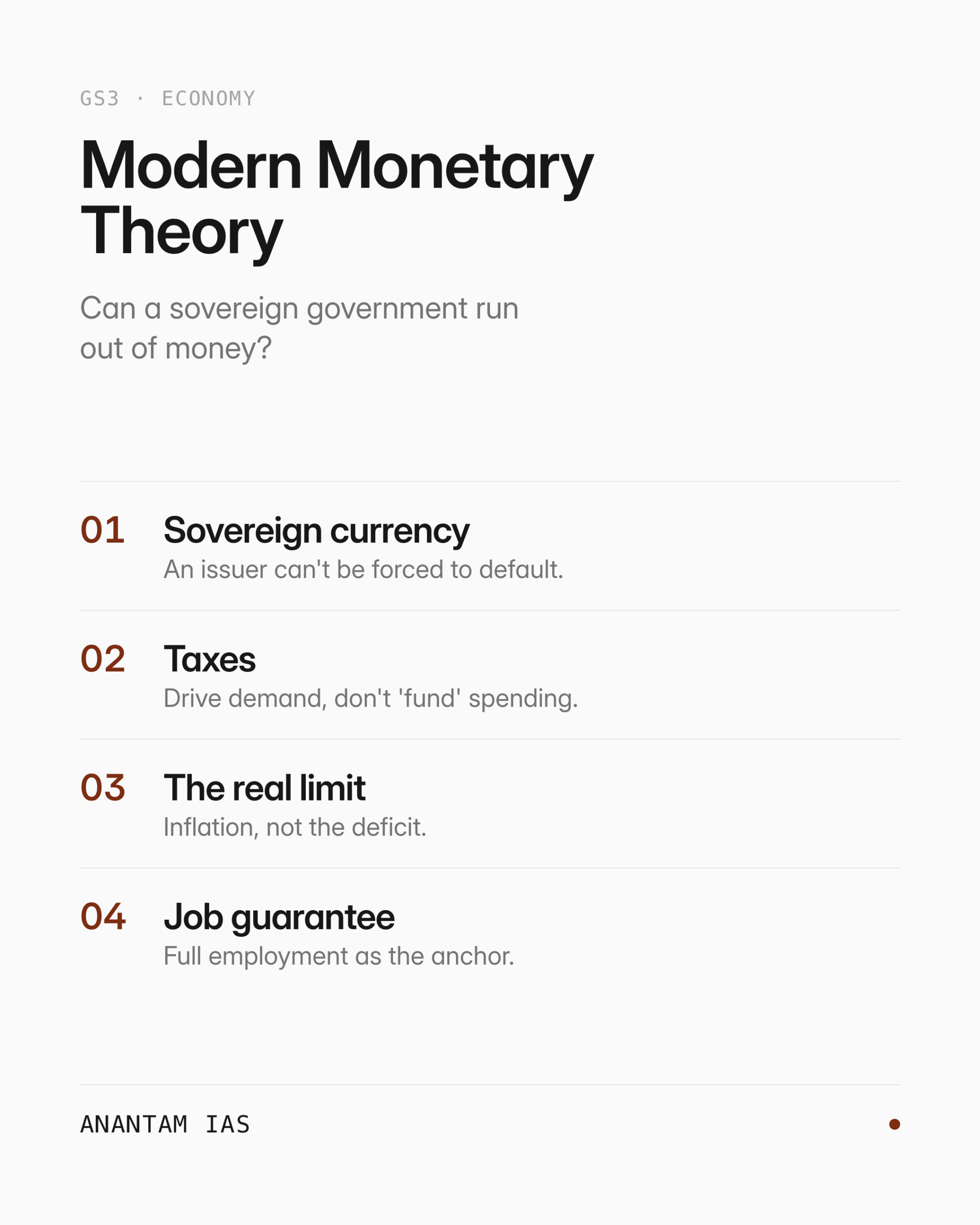
MMT = a sovereign, floating, non-convertible currency-issuer can’t be forced to default in its own money → spends first, taxes/borrows after (taxes drain demand + create currency demand; bonds manage rates, not “fund”) → real constraint is inflation + real resources, not the deficit (Lerner’s functional finance) → policy: federal job guarantee as employer of last resort → critics (Krugman, Summers, Rogoff): weak inflation discipline, no political will, 2021-22 surge → limit: needs full monetary sovereignty, fails for foreign-currency borrowers (“original sin”) → India: rupee sovereign but oil imports + current-account deficit + low inflation tolerance + FRBM bar on RBI primary purchases → verdict: keep the critique of deficit-fetishism, reject the printing-press prescription.
Diagram or Flowchart Idea
Draw a two-column “MMT vs orthodox” contrast — money, taxes, bonds, the deficit — beside a simple ceiling diagram: replace a “deficit limit” bar with an “inflation / real-resources limit,” and add a side note for the conditions (foreign-currency debt, weak institutions) under which the ceiling drops sharply. Composition plus constraint, the whole argument at a glance.
A Balanced-Conclusion Line
A line that lands the marks: “Modern Monetary Theory is more useful as a corrective than as a rulebook — it rightly shatters the myth that a sovereign budget is a household budget, but for an import-dependent emerging economy like India, the inflation and exchange-rate ceiling it names binds far too soon to make the printing press a safe tool of policy.”
How to Use Data Without Cramming
You don’t need a spreadsheet — you need anchors: The Deficit Myth (2020) as the popular landmark, the 2021-22 inflation surge as the live test case, the 2006 FRBM bar on RBI primary-market purchases as India’s institutional line, and the 2020 pandemic direct-monetisation debate as the India example. Attribute plainly — “as Stephanie Kelton argues,” “as the FRBM Act provides” — rather than scattering claims without a source.
Frequently Asked Questions
What is Modern Monetary Theory in simple terms?
Modern Monetary Theory (MMT) argues that a government which issues its own sovereign, freely floating currency — like the rupee, the US dollar or the Japanese yen — can never run out of that money and cannot be forced to default on debt denominated in it, because it can always create more. It reverses the usual order: the government spends its currency into existence first, and taxes and bonds come after, draining demand and managing interest rates rather than “funding” the spending. The real limit on spending, MMT says, is not the deficit but inflation and the supply of real resources.
Does MMT mean a government can just print money with no consequences?
No — that is the most common misreading. MMT says the financial constraint (running out of money) is a myth, but it insists the inflation constraint is real and binding. A government can spend only as long as there are idle workers and unused capacity to absorb it; push past full employment and prices rise. Critics argue this inflation check is too weak in practice, because governments lack the political will to raise taxes or cut spending in time — which is why MMT remains so controversial.
Who created MMT and what is The Deficit Myth?
MMT was developed mainly by Warren Mosler, L. Randall Wray, Bill Mitchell (who coined the term), Pavlina Tcherneva and Stephanie Kelton. The Deficit Myth (2020) is Kelton’s bestselling book that took the theory mainstream, arguing that obsessing over balanced budgets is a self-imposed trap that blocks useful public spending on jobs, healthcare and a green transition.
Can MMT be applied to India?
Only partly, and with great caution. MMT works best for a country with full monetary sovereignty — its own floating currency and debt mostly in that currency. The rupee qualifies on those counts, but India also runs a current-account deficit, imports dollar-priced oil, has lower inflation tolerance, and bars the RBI from financing the deficit directly in the primary market under the FRBM Act. Aggressive money creation would weaken the rupee and stoke inflation quickly, so the “print freely” version of MMT does not fit India — though its critique of deficit-fetishism still resonates.
Practice Questions
Prelims MCQs
- The central claim of Modern Monetary Theory (MMT) is best described by which statement?
(a) A government should always balance its budget to avoid default
(b) A government that issues its own sovereign, floating currency cannot be forced to default on debt denominated in that currency
(c) A government can never create inflation through spending
(d) Taxes are the only legitimate source of public spending
Answer: (b) MMT holds that a currency-issuing sovereign cannot run out of its own money or be forced into default in that currency; the real constraint is inflation, not solvency. - According to MMT, what is the primary function of taxation?
(a) To fund all government spending before it occurs
(b) To create demand for the currency and drain spending power from the private sector
(c) To eliminate the fiscal deficit entirely
(d) To repay foreign-currency debt
Answer: (b) In MMT, taxes create demand for the state’s currency and remove purchasing power to control inflation, rather than “funding” spending, which the issuer creates first. - MMT’s concept of the binding constraint on government spending is rooted in which earlier idea?
(a) The Phillips Curve
(b) Ricardian equivalence
(c) Abba Lerner’s “functional finance”
(d) The gold standard
Answer: (c) MMT builds on Lerner’s functional finance: judge the budget by its effect on output and inflation, not by whether it balances, with the deficit as a residual. - Why is MMT’s applicability considered limited for many emerging economies?
(a) They do not collect taxes
(b) They borrow heavily in foreign currency and face external and inflation constraints, the “original sin” problem
(c) They have no central banks
(d) They use only barter
Answer: (b) A country that borrows in foreign currency cannot print that currency, so it can still be forced to default — the “original sin” trap that breaks MMT’s protection. - Under India’s FRBM framework, which restriction is most relevant to the debate on monetising the deficit?
(a) The RBI was barred from buying government securities in the primary market from 2006
(b) The government cannot levy any new taxes
(c) The RBI must hold all reserves in gold
(d) States cannot borrow from the market
Answer: (a) The FRBM Act barred the RBI from primary-market purchases of government securities from 2006 to prevent fiscal dominance, with only a narrow escape clause for emergencies.
Mains Practice Questions
- “A government that issues its own currency can never run out of money.” Critically examine the core claims of Modern Monetary Theory and explain why the real constraint it identifies is inflation rather than the deficit. (15 marks, 250 words)
- Discuss the role of taxes and government bonds in Modern Monetary Theory and contrast it with the orthodox view that taxes and borrowing “fund” public spending. (10 marks, 150 words)
- “MMT is a useful critique but an unsafe rulebook for an emerging economy.” Analyse the limits of Modern Monetary Theory in the Indian context, with reference to monetary sovereignty, the current-account constraint and inflation. (15 marks, 250 words)
- Examine the debate over direct monetisation of the fiscal deficit in India during the pandemic, and explain how the FRBM Act addresses the risk of fiscal dominance. (15 marks, 250 words)
- Evaluate the federal job guarantee proposed by Modern Monetary Theory as an instrument for full employment and price stability. What are its strengths and its principal weaknesses? (15 marks, 250 words)