National Forest Policy of India: 1952, 1988 and the 2018 Draft (UPSC Environment)
India has had three forest policies — 1894, 1952 and 1988 — and a 2018 draft that never became policy. Here is the full arc: the colonial revenue mindset, the 1988 conservation turn that put ecology and communities first, and what the 2018 draft proposed and why it stalled, explained for UPSC GS3.
India has set itself the same forest target for more than seventy years — keep a third of the country green — and has never once hit it. The number first appeared in 1952, was carried into the landmark policy of 1988, and was written again into a draft policy in 2018 that the government circulated, debated and then quietly shelved. So when an aspirant is asked about “the National Forest Policy”, the honest answer is that there isn’t one policy but a lineage of them, each a mirror of how its age thought about trees: first as colonial timber, then as national revenue, then as ecology, and finally — in the unadopted 2018 draft — as a climate asset to be grown in partnership with private capital.
That arc is what makes this topic so rewarding. Forests sit at the meeting point of the environment, the economy, tribal rights and climate policy, and the way India’s forest policy shifted from extraction to conservation to a contested mix of both tells the whole story of Indian environmental governance in one thread. And the detail that examiners love is precisely the one most candidates blur — which idea belongs to which policy, and whether something is a stated objective or merely a management tactic buried in the fine print.
From Colonial Timber to National Revenue: 1894 and 1952
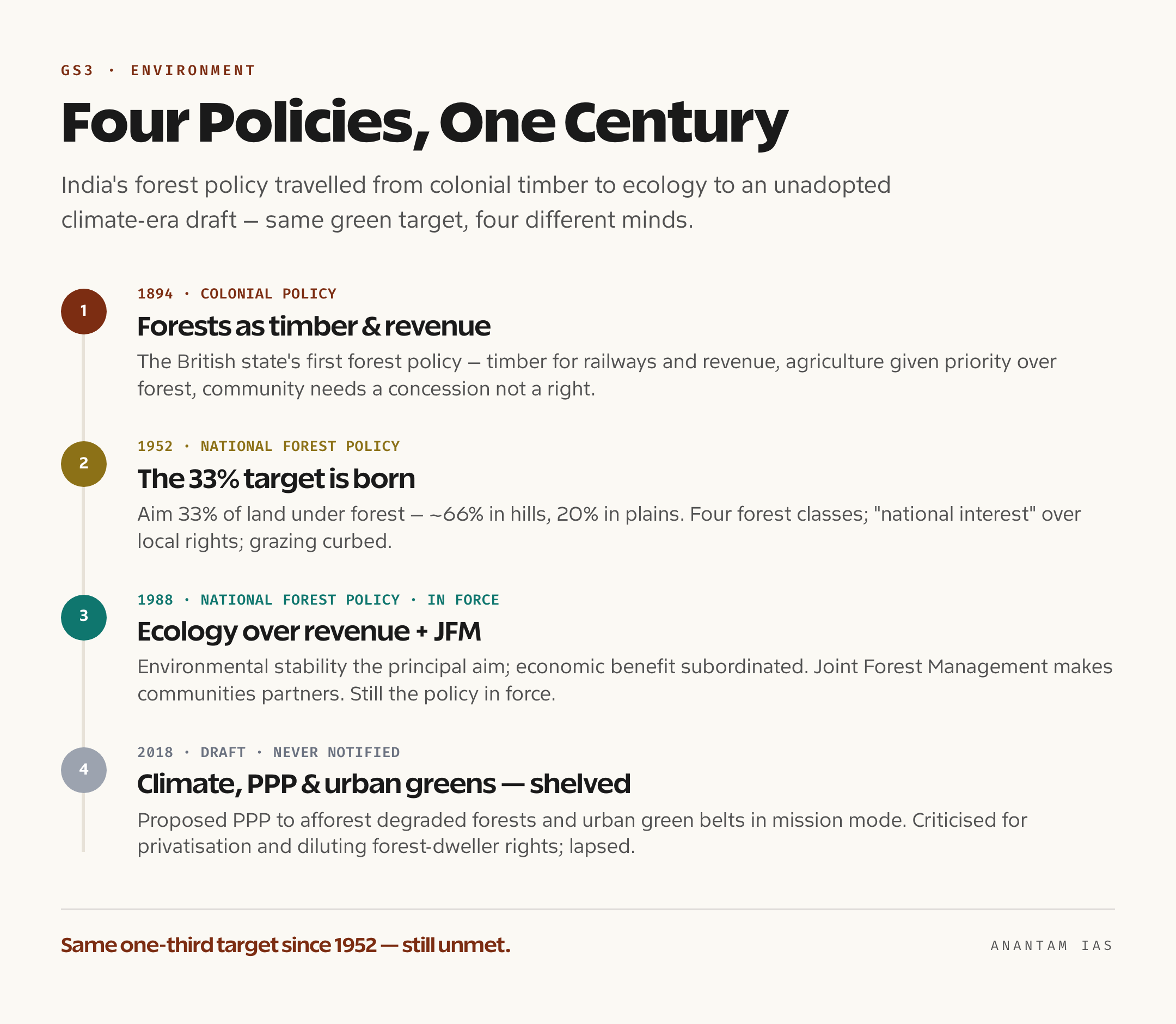
The story starts under the British, and it starts with money. The first Indian Forest Policy was issued in 1894, six years after the Indian Forest Act of 1878 had already let the colonial state declare vast tracts “reserved” and “protected”. The 1894 policy was unapologetic about its purpose: forests existed to serve the state, chiefly as a source of timber for railways, shipbuilding and revenue, and to safeguard agriculture. Where forests stood on land that could be farmed, the policy held that agriculture should usually win — trees were a resource to be managed and felled, not an ecosystem to be defended. The needs of forest-dwelling communities were treated as a concession the state might grant, not a right the people held.
Independent India’s first forest policy, in 1952, changed the flag over the forest department but kept much of the mindset beneath it. Its lasting contribution is the number every aspirant must memorise: the country should aim to bring one-third — 33 per cent — of its total land area under forest or tree cover, and within that, two-thirds (around 66 per cent) of the hills and mountains and about one-fifth (20 per cent) of the plains. The logic was sound — steep, erosion-prone slopes need far more tree cover than flat, farm-heavy plains — and that split is a favourite Prelims trap. The 1952 policy also sorted forests into four working categories: protection forests (to guard soil and climate on fragile terrain), national forests (managed for defence, communications and industry), village forests (to meet local fuel and grazing needs) and tree-lands (trees outside the formal forest estate).
But the spirit of 1952 was still revenue-first and centralising. It coined the doctrine of “national interest”, under which the wider needs of the nation overrode local claims, and it was openly wary of handing forests to village panchayats. Grazing, on which millions of pastoralists depended, was framed as “incompatible with scientific forestry” and to be curbed. The result was a policy that read forests as a national asset to be scientifically exploited, with the communities living inside them treated as a pressure to be managed. India’s tree cover kept shrinking through the following decades, and by the 1980s it was clear the revenue model had failed both the forest and the people.
The 1988 Turn: Conservation, Ecology and the Community
The National Forest Policy of 1988 is the one that still legally governs India’s forests, and it marks a genuine paradigm shift — the moment the country stopped treating forests mainly as a source of revenue and started treating them as the foundation of ecological security. Its core declaration is the line to quote: the principal aim of forest policy must be to ensure environmental stability and the maintenance of ecological balance, and the derivation of direct economic benefit must be subordinated to this principal aim. In one sentence, the priority order was inverted — ecology over income, after a century of the reverse.
The objectives flow from that aim. The 1988 policy seeks to maintain environmental stability and restore the ecological balance disturbed by deforestation; to conserve the natural heritage, the remaining natural forests and the biodiversity within them; to check soil erosion, the silting of rivers and reservoirs, and the spread of deserts; to increase substantially the forest and tree cover — repeating the 33 per cent and two-thirds-in-the-hills targets from 1952; to meet the needs of rural and tribal people for fuelwood, fodder, minor forest produce and small timber; and to encourage efficient use of forest produce so that pressure on the forest is reduced. A vital instruction sits inside this list: no forest-based industry should expect free or subsidised raw material from natural forests, and plantations to feed industry must be raised separately. The policy also discouraged the monoculture plantations that earlier afforestation had favoured, asking instead for mixed, native species.
The single biggest practical change the 1988 policy unleashed was Joint Forest Management (JFM). Acting on a 1990 circular that operationalised the policy, states began forming village-level committees that share the responsibility of protecting a patch of degraded forest — and a share of its produce — with local communities. For the first time, the people who lived around a forest became its partners rather than its trespassers. JFM spread to tens of thousands of villages and crores of hectares, and it is the policy idea most likely to be tested as the bridge between the 1988 policy and the later, rights-based Forest Rights Act of 2006. The 1988 policy, in short, recast the forest department’s job from policing and felling to conserving and sharing.
The 2018 Draft: A Climate-Era Policy That Never Became Policy
By the 2010s the 1988 policy was three decades old, and a new vocabulary had taken over the forest debate — climate change, carbon sinks, ecosystem services, public-private partnership. So in March 2018 the Ministry of Environment, Forest and Climate Change put out a Draft National Forest Policy, 2018 for public comment, meant to replace the 1988 document. Read it carefully, because it is the one most students misremember — and it never crossed the finish line. After heavy criticism the draft was not notified, so India is still governed by the 1988 policy. The 2018 text is a proposal, not a policy, and saying otherwise is an error.
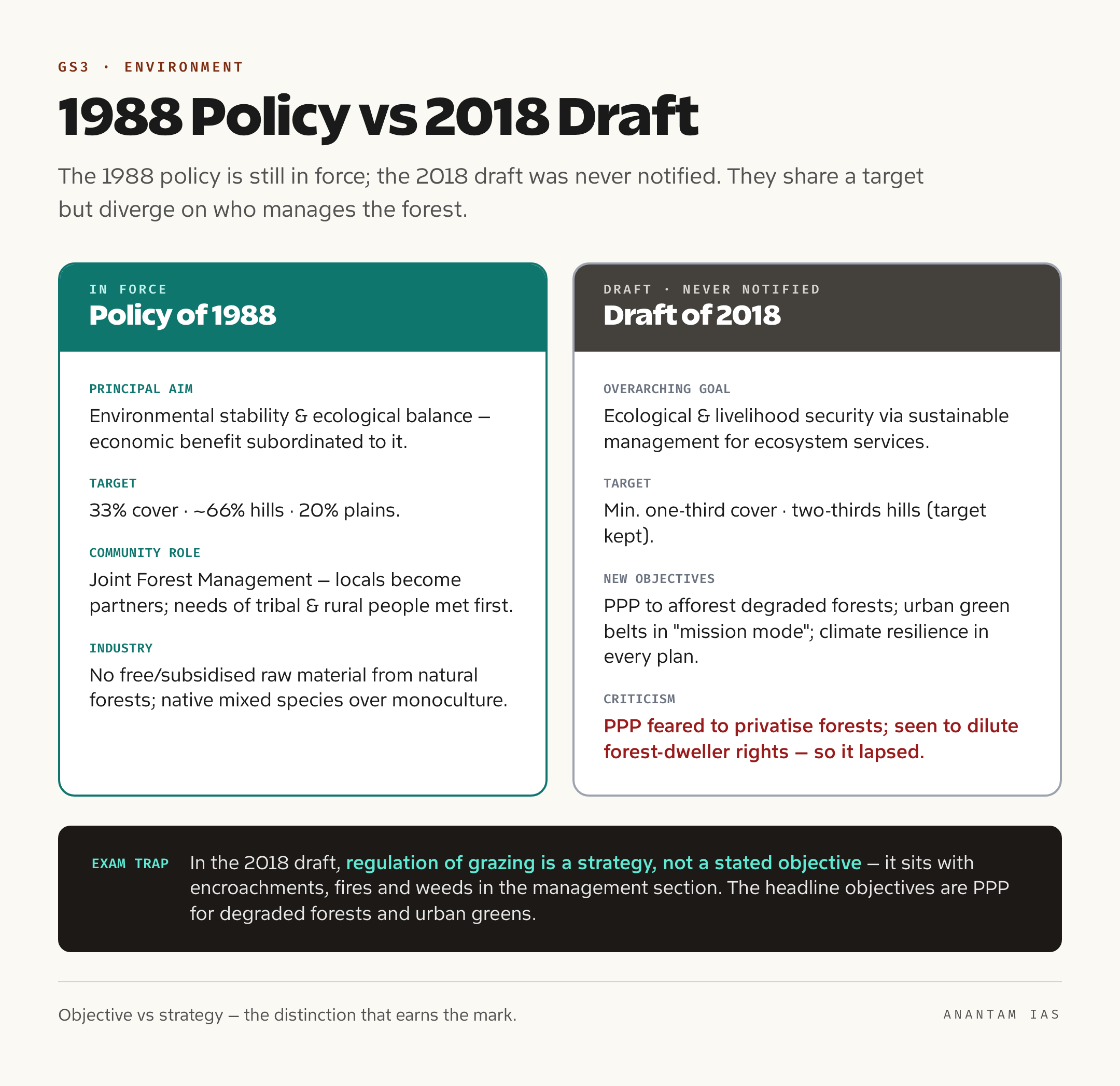
What did the draft actually set as its objectives? Its overarching goal was to safeguard the ecological and livelihood security of present and future generations through the sustainable management of forests for a steady flow of ecosystem services. It kept the familiar target of bringing a minimum of one-third of the total land area under forest and tree cover, two-thirds in the hills. Two new ideas were front-and-centre as objectives. First, it proposed developing public-private partnership (PPP) models for afforestation and reforestation of degraded forest land — land available with state forest development corporations and outside the recorded forest — so that private capital and expertise could help green areas the state had failed to. Second, it pushed trees outside forests and urban greens in “mission mode” — the urban green belts meant to cool cities, cut pollution and lift the green cover of towns. Climate resilience ran through the document: integrating climate change concerns into every working and management plan was a stated aim, not an afterthought.
Now the distinction that separates a careful answer from a careless one. Regulation of grazing is not among the draft’s stated objectives. It appears lower down, in the strategy and forest-management section, where the draft lists the threats that working plans must tackle — “encroachments, illegal tree fellings, forest fires, invasive weeds and grazing” — and proposes managing them through scientific working plans and community participation. So grazing control is a management tactic the draft would deploy, not one of the headline objectives it set out to achieve. If a question hands you a list and asks which items are objectives of the 2018 draft, the PPP-for-degraded-forests and urban-greens items qualify; grazing regulation, sitting in the strategy chapter, does not. That single fault line — objective versus strategy — is exactly the kind of fine print the topic is built to test.
Why the 2018 Draft Stalled: The Criticisms That Sank It
The draft drew sharp fire the moment it was published, and understanding why is what lets you write a balanced answer rather than a one-sided summary. The loudest objection was that the PPP-for-afforestation idea opened the forest to private and industrial interests. Critics warned that letting private firms manage “degraded” forest land to grow timber would, in practice, convert living forests and community land into commercial plantations — and that India’s habit of counting tea estates and monoculture plantations as “forest cover” already inflated the green map without delivering real, biodiverse forest. The fear was a return, in modern clothing, to the revenue-first thinking the 1988 policy had deliberately buried.
The second charge was that the draft weakened the rights of forest-dwellers. Where the 1988 policy and the 2006 Forest Rights Act had moved towards recognising community rights, tribal-rights groups argued the 2018 draft talked about partnership with private players far more confidently than partnership with the gram sabha. It proposed a National Community Forest Management Mission and spoke of merging Joint Forest Management committees with gram sabha bodies, but campaigners felt the real power and money were flowing towards corporations, not communities, and that the consent of forest-dwellers under the Forest Rights Act could be sidelined. A policy that looked, on paper, like it was greening India could in practice dilute hard-won rights.
There were quieter criticisms too — that the draft leaned on plantations and a “production forestry” mindset, that it under-integrated biodiversity registers and management committees, and that it offered no convincing fix for the steady diversion of forest for roads, mines and dams even as it promised more cover. Faced with this pushback from tribal-affairs ministries, activists and ecologists, the government let the draft lapse rather than notify it. The episode is a clean case study in how environmental policy is made and unmade in India: a genuine attempt to modernise forest governance for the climate age, undone by the unresolved tension between growing more trees and protecting the people and ecosystems already in the forest.
For Your Mains Answer
This is a core GS Paper 3 topic — environment, conservation and the governance of natural resources — and it also feeds GS Paper 2 wherever the question turns on community rights, the Forest Rights Act or Centre-state forest governance. The skill examiners reward is chronological clarity with the right idea pinned to the right policy: revenue under 1894 and 1952, ecology and JFM under 1988, climate and PPP in the unadopted 2018 draft.
How to Build the Answer
Walk the timeline, then evaluate it. Open by framing forests as ecological, economic and social capital, then move policy by policy: 1894 and 1952 (revenue-first, 33 per cent target born, communities marginal), 1988 (the paradigm shift to ecological balance, economic benefit subordinated, JFM launched, native species over monoculture), and the 2018 draft (climate framing, PPP for degraded forests, urban greens — and why it stalled). Close with a judgement on whether India needs a fresh policy and what it must get right. This define-evolve-evaluate arc fits almost any forest-policy question.
Common Mistakes to Avoid
Don’t call the 2018 draft a policy — it was never notified; the 1988 policy is still in force. Don’t list grazing regulation as an objective of the 2018 draft — it sits in the strategy and management section, not the stated objectives. Don’t credit the 33 per cent target to 1988 alone — it dates from 1952. And don’t present JFM as part of the 1988 policy text itself; it was operationalised through the 1990 circular that implemented the policy.
A Compact Answer Spine
1894 colonial timber policy → 1952 national policy: 33% cover target (≈66% hills, 20% plains), four forest classes, “national interest”, grazing curbed → 1988 policy (still in force): ecological balance the principal aim, economic benefit subordinated, biodiversity and community needs, Joint Forest Management → Draft 2018 (not adopted): livelihood + ecological security, one-third cover, PPP for afforestation of degraded forests, urban greens in mission mode, climate resilience → criticised for privatisation and diluting forest-dweller rights → shelved.
Diagram or Flowchart Idea
Draw a four-stage horizontal arrow — 1894 → 1952 → 1988 → 2018 draft — and label each stage with one word for its governing idea (Timber · Revenue · Ecology · Climate-PPP) and one anchor below it (e.g. “33% target born” under 1952, “JFM” under 1988, “shelved” under 2018). A single evolution strip like this signals command of the whole topic at a glance.
A Balanced-Conclusion Line
A line that lands the marks: “India’s forest policy has travelled from felling trees for revenue to protecting them for ecology; the failed 2018 draft showed that the next step — growing forests for the climate — will only succeed if it grows them with forest communities, not around them.”
How to Use Data Without Cramming
You need only a handful of anchors: the 33 per cent national target with its 66 per cent hills and 20 per cent plains split (1952, repeated 1988), the three notified policies (1894, 1952, 1988) plus the unadopted 2018 draft, and the fact that India’s actual forest-and-tree cover is around a quarter of its area — well short of the goal. Attribute them plainly to the policy or the State of Forest Report rather than scattering numbers loose.
FAQ
Which National Forest Policy is currently in force in India? The National Forest Policy of 1988 is still the policy in force. The Draft National Forest Policy of 2018 was circulated for comment but was never notified after it drew strong criticism, so it has no legal status. India has had three notified forest policies in total — 1894, 1952 and 1988.
What is the 33 per cent forest cover target and when was it set? It is the goal of bringing one-third of India’s total land area under forest or tree cover, with about two-thirds of the hills and one-fifth of the plains under cover. The target was first set in the National Forest Policy of 1952 and repeated in the 1988 policy and the 2018 draft. India’s actual forest-and-tree cover is around a quarter of its area, so the target remains unmet.
How did the 1988 policy differ from the 1952 one? The 1952 policy was revenue-first: it treated forests as a national asset to be scientifically exploited and was wary of community control. The 1988 policy reversed the priority, making ecological stability the principal aim and subordinating direct economic benefit to it. It also launched Joint Forest Management, making local communities partners in protecting forests rather than trespassers on them.
Why was the Draft National Forest Policy 2018 not adopted? It was criticised for proposing public-private partnerships to afforest “degraded” forest land, which critics feared would hand forests to industry and turn living forests into commercial plantations, and for weakening the rights of forest-dwelling communities recognised under the Forest Rights Act. Faced with this opposition, the government let the draft lapse rather than notify it.
Practice Questions
Prelims MCQs
- The target of bringing one-third of India’s total land area under forest or tree cover was first laid down in which forest policy?
(a) The Indian Forest Policy of 1894
(b) The National Forest Policy of 1952
(c) The National Forest Policy of 1988
(d) The Draft National Forest Policy of 2018
Answer: (b) The 33 per cent target — with about two-thirds in the hills and 20 per cent in the plains — was first set in the 1952 policy and later repeated in 1988 and the 2018 draft. - Which of the following is the principal aim of the National Forest Policy, 1988?
(a) Maximising revenue from timber for industry
(b) Ensuring environmental stability and ecological balance, with economic benefit subordinated to it
(c) Privatising the management of degraded forests
(d) Promoting monoculture plantations for paper mills
Answer: (b) The 1988 policy made environmental stability the principal aim and explicitly subordinated direct economic benefit to it. - Joint Forest Management (JFM) in India was operationalised to implement which policy?
(a) The Indian Forest Policy of 1894
(b) The National Forest Policy of 1952
(c) The National Forest Policy of 1988
(d) The Draft National Forest Policy of 2018
Answer: (c) JFM was rolled out through a 1990 circular that operationalised the 1988 policy, making village committees partners in protecting degraded forests. - Consider the stated objectives of the Draft National Forest Policy, 2018.
Which of the following was proposed as an objective rather than as a management strategy?
(a) Regulation of grazing in forests
(b) Control of forest fires and invasive weeds
(c) Public-private partnership for afforestation of degraded forest land
(d) Removal of encroachments
Answer: (c) PPP for afforestation of degraded forests and urban green belts were stated objectives; grazing, fires, weeds and encroachments appear in the strategy and management section as threats to be tackled. - Which statement about India’s forest policy is correct?
(a) The 2018 draft replaced the 1988 policy in law
(b) The 1894 policy prioritised conservation over revenue
(c) The 1988 policy is still in force and the 2018 draft was never notified
(d) The 1952 policy first introduced Joint Forest Management
Answer: (c) The 1988 policy remains in force; the 2018 draft was shelved after criticism and never notified.
Mains Practice Questions
- Trace the evolution of India’s forest policy from 1894 to the Draft National Forest Policy of 2018, and explain how the governing idea shifted from revenue to ecology to climate. (15 marks, 250 words)
- “The National Forest Policy of 1988 marked a paradigm shift in India’s approach to forests.” Examine this statement with reference to its objectives and the introduction of Joint Forest Management. (15 marks, 250 words)
- Critically analyse the public-private partnership model for afforestation of degraded forests proposed in the Draft National Forest Policy of 2018. Why did it attract criticism from tribal-rights and environmental groups? (15 marks, 250 words)
- Distinguish between the stated objectives and the management strategies of the Draft National Forest Policy of 2018, using grazing regulation and urban green belts as illustrations. (10 marks, 150 words)
- India has retained the same one-third forest cover target since 1952 but has never achieved it. Evaluate the reasons for this gap and suggest what a future forest policy must do differently. (15 marks, 250 words)