Need for Urban Wage Employment Program: A Case for Urban MGNREGA (UPSC)
Why India needs an urban wage employment program. Design, ULB role, financing, state pilots, and 2024-26 policy debate on Urban MGNREGA for UPSC GS-III.
The MGNREGA (2005) revolutionised rural employment by giving every rural household a legal right to 100 days of wage employment. Urban India has had no such guarantee. The Covid-19 lockdown of 2020 exposed the cost of this asymmetry — millions of urban informal workers, with no legal employment fallback and no reliable social protection, were forced into reverse migration on foot. Even five years later, India's urban unemployment rate continues to run higher than rural (PLFS), urban inflation hits the urban poor hardest (Crisil), and urban informal work remains low-wage and precarious (PLFS shows over 50 percent of urban workers in self-employment or casual labour). This article makes the structured case for an Urban Wage Employment Program, draws lessons from MGNREGA, and tracks 2024-26 state-level pilots and central debates — essential UPSC material under GS-III (Inclusive growth, employment) and GS-II (welfare schemes).
Why India Needs an Urban Wage Employment Program
Covid-19 as the Turning Point
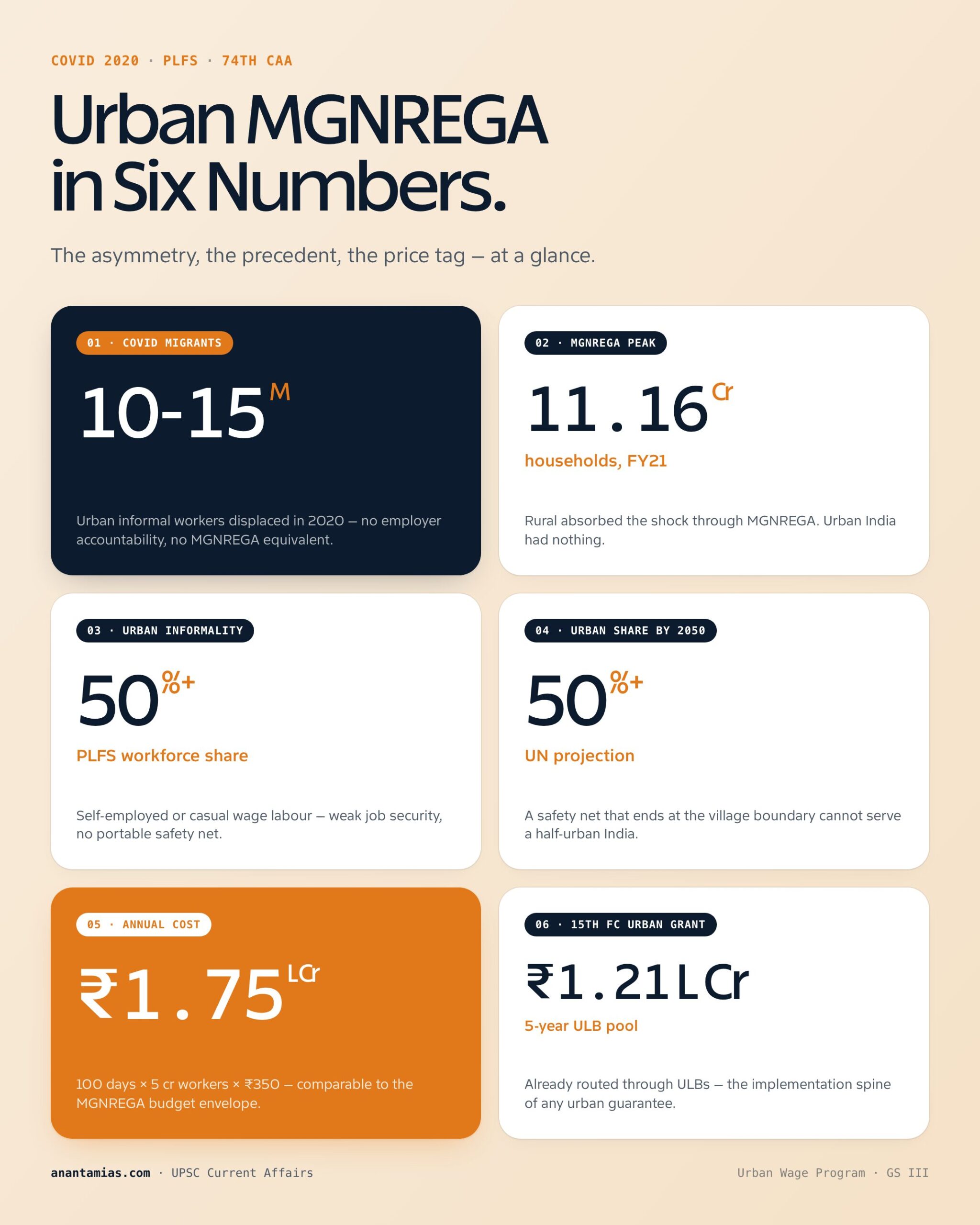
The 2020 lockdown displaced an estimated 10-15 million urban migrant workers. They had no employer accountability, no unemployment insurance, no MGNREGA equivalent, and no portable social security. Many returned to villages and accessed MGNREGA — itself absorbing 11.16 crore households in FY 2020-21, a record. The crisis surfaced an obvious policy gap: India's safety net stops at the village boundary.
The Asymmetric Safety Net
| Dimension | Rural Worker | Urban Worker |
|---|---|---|
| Employment guarantee | MGNREGA — 100 days, statutory right | None — no national programme |
| Health insurance | Ayushman Bharat-PMJAY | Ayushman Bharat-PMJAY |
| Pension | NSAP, PM-SYM | PM-SYM, APY (voluntary) |
| Maternity | Janani Suraksha, PMMVY | PMMVY |
| Food security | NFSA + PDS | NFSA + PDS (lower coverage) |
| Skilling | DDU-GKY | DDU-GKY/PMKVY |
| Migration insurance | None | None |
The rural-urban asymmetry on guaranteed employment is the most glaring gap.
Structural Drivers
- High urban inflation: Crisil and RBI bulletins consistently show urban CPI rising faster than rural over 2022-25, eroding real wages of the urban poor.
- High and persistent urban unemployment: PLFS 2023-24 (released by MoSPI 2024) shows urban unemployment around 6.6 percent for those aged 15+, nearly twice the rural rate. Youth (15-29) unemployment in urban areas exceeds 15 percent.
- Low wages and informality: PLFS shows that despite a rise in regular salaried work, just over 50 percent of urban workforce remains in self-employment or casual wage work, with weak job security.
- Few targeted urban anti-poverty programmes: The flagship MGNREGA, PM Garib Kalyan Rojgar Abhiyaan, PM Awas Yojana-Gramin are rural. NULM (2013) replaced SJSRY (1997) but emphasised self-employment and entrepreneurship rather than wage employment.
- Accelerating urbanisation: India is projected to be 42 percent urban by 2030 and over 50 percent by 2050. Without an urban employment guarantee, urbanisation risks producing slums, not prosperity.
Design of an Urban Wage Employment Program
Legal Sanctity
An urban wage employment programme should rest on a National Urban Employment Guarantee Act (NUEGA) — modelled on MGNREGA — providing a statutory right to a guaranteed number of days of wage employment at notified wage rates, enforceable through grievance redressal.
Coverage: Two-Track Design
A well-designed urban scheme must cater to two very different cohorts simultaneously:
- Urban informal workers — construction labourers, head-loaders, street vendors, domestic workers, sanitation workers — should be guaranteed 100 days of wage employment annually in public works like building/maintenance of roads, parks, drains, restoration of urban commons (water bodies, wetlands).
- Educated unemployed youth should be offered paid apprenticeships in municipal offices, government schools, primary health centres, and public hospitals, building skills and public-service experience.
Nature of Work
- Public infrastructure: Roads, footpaths, bus shelters, public toilets, drainage, parks.
- Urban commons restoration: Lakes, ponds, wetlands, urban forests, biodiversity parks.
- Municipal services: Solid waste segregation, sewage line maintenance, anti-littering drives.
- Apprenticeship roles: Teaching assistance, hospital ward assistance, e-governance front desks, ULB administrative support.
- Social-care services (newer proposals): Crèche, elderly care, public health volunteers — care economy jobs that are gender-friendly.
Implementation Architecture
- Urban Local Bodies (ULBs) — Municipalities and Municipal Corporations under the 74th Constitutional Amendment — as primary implementing units.
- Ward Sabha consultations to finalise the works list, mirroring MGNREGA's gram sabha approach.
- Mandatory social audit and public hearings by ward-level audit bodies.
- Time-bound grievance redressal — written redressal within 15 days, online portal mandatory.
- Job cards issued by ULBs, linked to Aadhaar and bank accounts for DBT wages.
- Skill-tagging so that apprentice tracks feed into NCS and PMKVY.
Financing
- Central-State sharing at 75:25 (general states) and 90:10 (NE/Himalayan), as in MGNREGA.
- Drawing on the 15th Finance Commission urban grant (Rs 1.21 lakh crore over five years), already routed through ULBs.
- Estimated cost of full national rollout (100 days for 50 million workers at Rs 350/day) — around Rs 1.75 lakh crore per year, comparable to the MGNREGA budget envelope.
State-Level Pilots and Antecedents
Kerala — Ayyankali Urban Employment Guarantee Scheme (AUEGS)
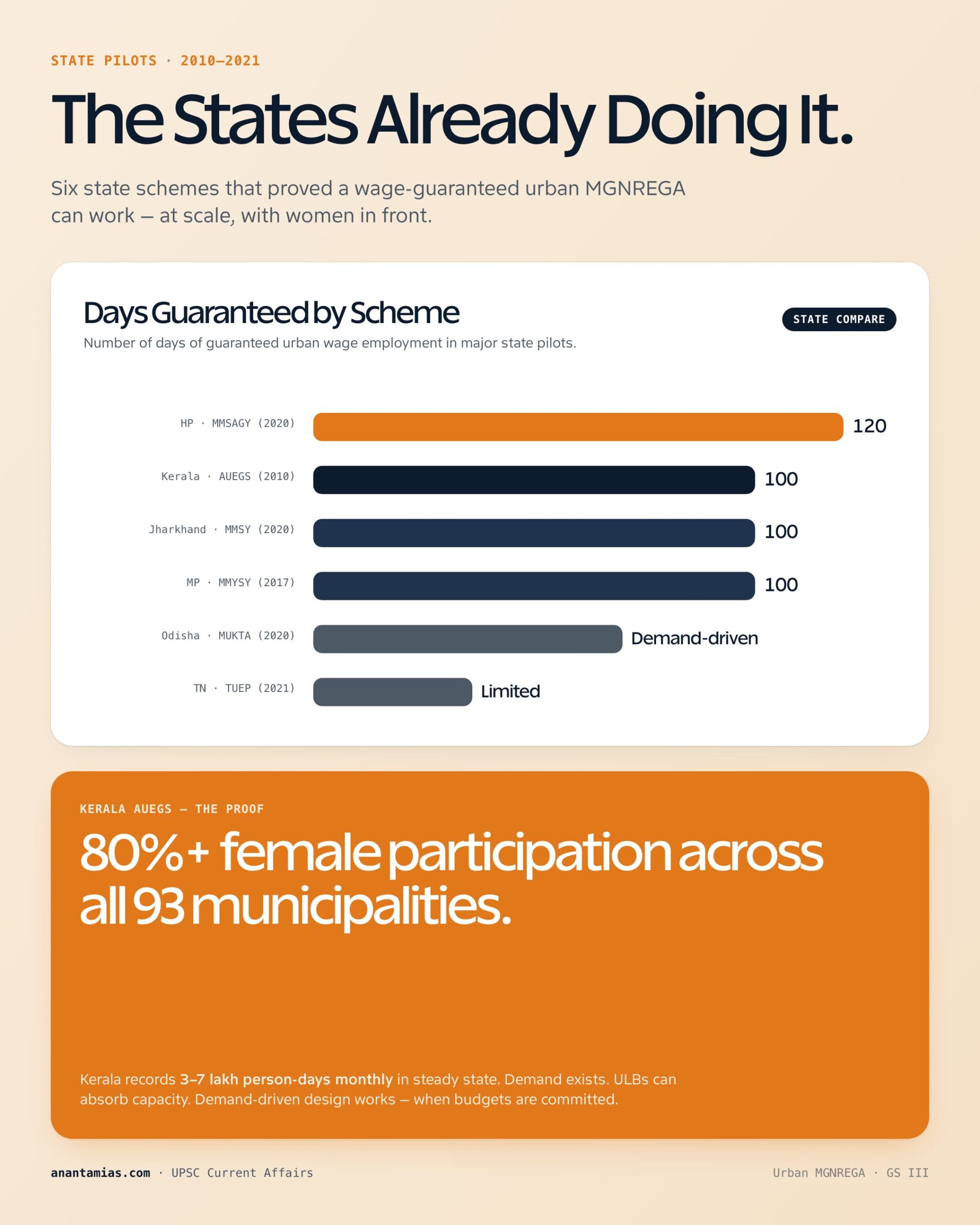
Launched 2010 by Kerala government — 100 days of wage employment in urban areas to BPL households. By 2024, AUEGS had expanded to all municipalities with women's participation >80 percent.
Himachal Pradesh — Mukhya Mantri Shahari Ajeevika Guarantee Yojana (MMSAGY)
Launched 2020 with 120 days of guaranteed work in urban areas. Active across 60+ urban local bodies.
Odisha — Mukhyamantri Karma Tatpara Abhiyan (MUKTA)
Launched April 2020 by Odisha — convergence of urban schemes for community-led works in slums. Wages paid for 72 lakh+ person-days by 2024.
Tamil Nadu, Madhya Pradesh, Jharkhand
Each launched limited urban wage schemes — Mukhyamantri Yuva Swarozgar Yojana (Jharkhand), Mukhyamantri Yuva Swabhiman Yojana (MP).
Lessons from Pilots
- Wage-employment demand exists in cities — Kerala recorded 3-7 lakh person-days monthly in steady state.
- Women's participation is high when works are within walking distance.
- ULBs can absorb capacity if given dedicated technical staff.
- Demand-driven design works only with reliable budget commitments — pilots wobble when state finances tighten.
Recent Developments (2024-26)
- Periodic Labour Force Survey (PLFS) 2023-24 (released MoSPI 2024) confirmed urban unemployment 6.6 percent (15+) and youth unemployment around 15-17 percent — keeping the urban-employment guarantee debate alive.
- Pre-Budget Economic Memoranda (2024) and NITI Aayog working notes repeatedly flagged the gap, with the Standing Committee on Labour (2023-24) recommending a national urban employment scheme.
- Budget 2024-25 announced a Rs 2 lakh crore package for employment-linked incentives but stopped short of a wage-guarantee programme; Internship Scheme for top 500 firms aims to skill 1 crore youth over five years.
- Budget 2025-26 continued the employment-linked incentive (ELI) schemes; debate on legislating an urban guarantee picked up in Parliament after PLFS data showed urban unemployment ticking up post-festive season.
- Smart Cities Mission transitioned to a maintenance phase by 2025 — urban infrastructure works under SCM provide a natural pipeline for urban wage works.
- AMRUT 2.0 (2021-26) funds water and sewerage upgrades — labour-intensive components could feed into a future urban wage scheme.
- e-Shram portal now hosts over 30 crore registered unorganised workers, providing a ready beneficiary database for any urban wage scheme.
Concerns and Counter-Arguments
- Fiscal cost: An urban MGNREGA at scale could cost Rs 1-1.75 lakh crore annually, straining the central budget already stretched by capex push.
- Productivity concerns: Critics argue urban public works may displace private contracts and create make-work jobs.
- ULB capacity weakness: Most municipalities are administratively under-resourced; running a demand-driven employment programme is non-trivial.
- Wage distortion: A guaranteed urban wage may push up wages in nearby private informal markets, raising inflation concerns.
- Targeting difficulty: Urban informality is harder to target than rural — migrants lack residential proof, and a "first-come, first-served" model may favour insiders.
Way Forward
- Pilot-to-policy approach: Synthesise lessons from Kerala, HP, and Odisha into a national framework, allow states to opt in.
- Linkage with e-Shram and Pradhan Mantri Shram Yogi Maan-Dhan for portable benefits.
- Convergence with Smart Cities, AMRUT 2.0, and Swachh Bharat Urban 2.0 to crowd in works.
- Care-economy works — crèches, elderly care — to embed gender-positive jobs.
- ULB capacity-building through urban management cadres trained at IIPA and NIUA.
- Sunset clauses to keep the programme demand-driven, not a permanent entitlement that crowds out private hiring.
International Comparisons
- Argentina's Plan Jefes y Jefas (2002) — head-of-household employment programme during economic crisis; phased out as growth resumed.
- South Africa's Expanded Public Works Programme (EPWP, 2004) — multi-sector public works, women-friendly, with a strong skills component.
- USA's New Deal Works Progress Administration (1935) — historical precedent for counter-cyclical urban public works.
- Ethiopia's Productive Safety Net Programme (PSNP) — combines transfers with public works, demonstrating effective targeting.
UPSC Relevance
GS-III Mapping
- Inclusive growth and issues arising from it — urban poverty, informality.
- Issues relating to planning, mobilization of resources — financing and ULB capacity.
- Effects of liberalisation on the economy, changes in industrial policy and their effects on industrial growth.
GS-II Mapping
- Welfare schemes for vulnerable sections of the population by the Centre and States — comparison with MGNREGA, AUEGS.
- Issues relating to development and management of social sector / services.
Prelims Pointers
- MGNREGA: 2005, 100 days, statutory, demand-driven, central+state funding.
- 74th Constitutional Amendment, 1992 — Urban Local Bodies, 12th Schedule.
- Ayyankali Urban Employment Guarantee Scheme — Kerala (2010).
- National Urban Livelihoods Mission (NULM) — 2013, replaced SJSRY (1997).
- DAY-NULM — Deendayal Antyodaya Yojana, integrating NRLM and NULM.
- e-Shram portal — Ministry of Labour & Employment, launched August 2021.
Mains Hooks
- "Discuss the rationale, design, and challenges of an Urban Wage Employment Programme on the lines of MGNREGA." (GS-III)
- "Why has India's urban poor remained outside formal employment safety nets? Suggest a roadmap." (GS-III)
- "Compare and evaluate state-level urban employment schemes (Kerala AUEGS, Odisha MUKTA, HP MMSAGY) for scaling at the national level."
An Urban Wage Employment Program is no longer a Covid-era novelty — it is a structural necessity for an India that will be half-urban by 2050. The intellectual, fiscal, and administrative blueprints already exist in MGNREGA and state pilots. What remains is political resolve and ULB capacity. For UPSC, master the gap analysis (PLFS data), design pillars (NUEGA, ULBs, social audit), and state pilots (Kerala, HP, Odisha) — and you have a complete answer for any question on urban employment guarantee.
A Comparative Snapshot of State-Level Urban Wage Schemes
| State | Scheme | Year | Days Guaranteed | Notable Features |
|---|---|---|---|---|
| Kerala | Ayyankali Urban Employment Guarantee Scheme | 2010 | 100 | Female participation >80%; covers all municipalities |
| Himachal Pradesh | Mukhya Mantri Shahari Ajeevika Guarantee Yojana | 2020 | 120 | Higher days; all ULBs |
| Odisha | Mukhyamantri Karma Tatpara Abhiyan (MUKTA) | 2020 | Demand-driven | Slum-focused; convergence model |
| Jharkhand | Mukhyamantri Shramik Yojana | 2020 | 100 | Targeted at urban informal workers |
| Tamil Nadu | TUEP / Mukhyamantri Yuvar Yojana variants | 2021 | Limited days | Skilling + wage |
| Madhya Pradesh | Mukhyamantri Yuva Swabhiman Yojana | 2017 | 100 | Apprenticeship model for educated youth |
The Care Economy Argument
A frequently-overlooked element of UEGS design is the care economy — paid work in crèches, elderly care, palliative care, mental health support, anti-domestic-violence outreach, school nutrition, and primary health follow-up. These are:
- Labour-intensive with low capital requirements.
- Women-friendly (close to home, daytime hours, less physical risk).
- Asset-creating in human form — better child outcomes, reduced elderly distress, productive future workforce.
- Aligned with NEP 2020 (early childhood), Ayushman Bharat (community health), and Anganwadi-Aanganwadi 2.0 schemes.
A robust UEGS would dedicate 30-40 percent of work-quanta to care economy rather than restricting itself to construction works — meaningfully improving female LFPR.
Synergy with India Stack
A modern UEGS would leverage India Stack for low-cost administration:
- Aadhaar-based job cards with face authentication for muster.
- DBT for wage payments through PFMS.
- Geo-tagged works on a public dashboard like NREGA-soft.
- Beneficiary list deduplication with e-Shram registry of unorganised workers.
- Grievance redressal through Mera Aadhaar Meri Pehchaan integration.
These tools were not available when MGNREGA was conceived in 2005. A UEGS can be leakage-resistant from day one and serve as a model for next-generation welfare delivery.