The New Income-Tax Act, 2025: What Changes and Why It Matters (UPSC Economy)
The Income-Tax Act, 2025 retires the six-decade-old 1961 law and comes into force from 1 April 2026. It is a structural rewrite — shorter, simpler, one tax year — not a change in tax rates. Here is what it does and why it matters for UPSC GS3.
For sixty-four years, every income-tax dispute, every refund, every salary slip’s TDS calculation in India ran on a single statute: the Income-tax Act, 1961. That law has now been retired. The Income-Tax Act, 2025 received Presidential assent on 21 August 2025 and comes into force from 1 April 2026, making the tax year 2026-27 the first full year India is taxed under a brand-new direct-tax code. The 1961 Act stands repealed on the same day.
This is one of the biggest pieces of economic legislation of the decade, and it’s easy to misunderstand. So fix what it is not in your head first. It is not a Budget. It does not cut or raise a single tax rate, and it does not invent a new tax. What it does is rewrite the entire legal architecture of how income is taxed — shorter, cleaner, built around one simplifying idea — so the law itself becomes readable. That distinction between a policy change and a structural rewrite is exactly where most candidates slip, and where you can stand out.
Why the 1961 Act Had to Go
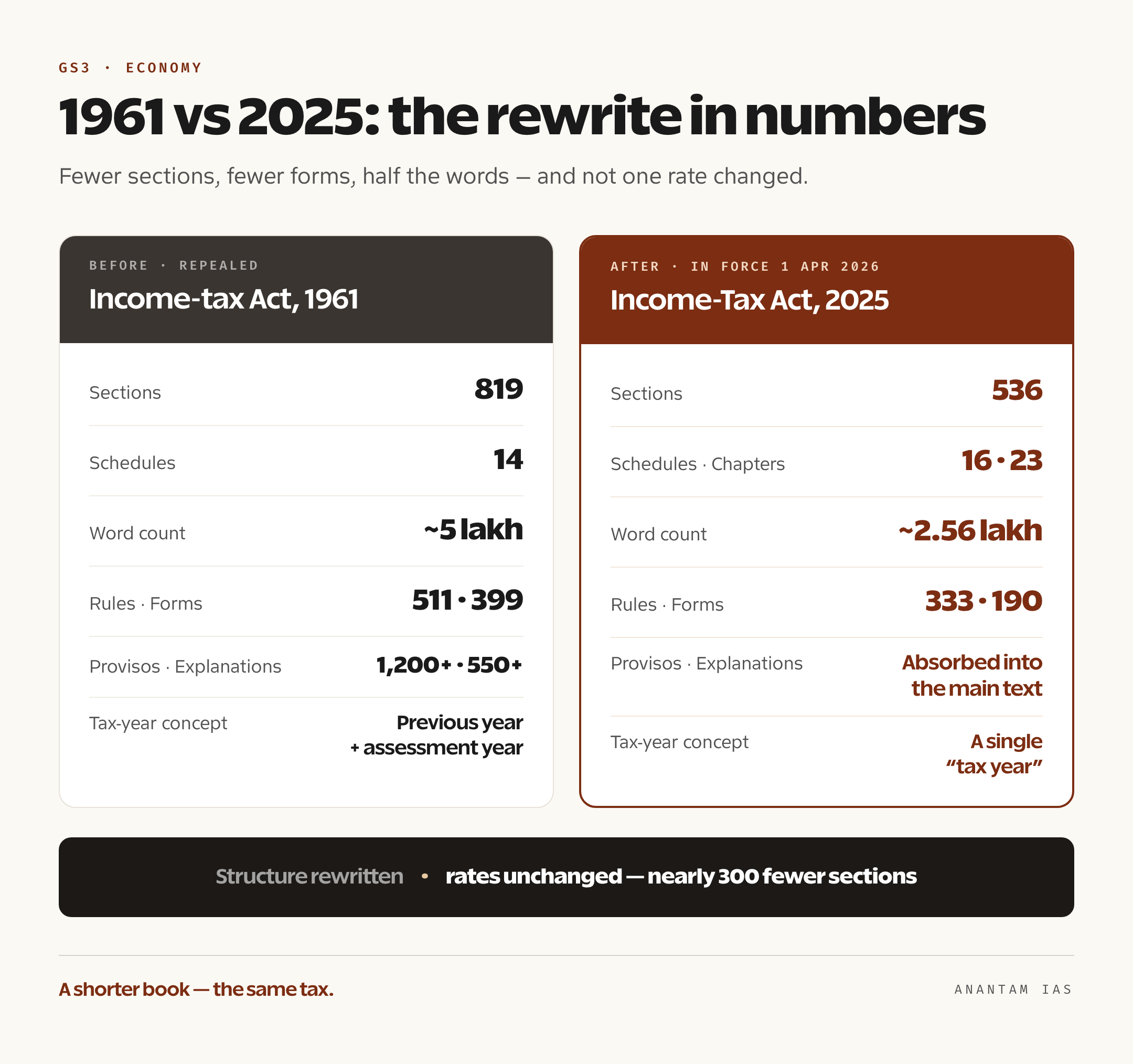
The 1961 Act didn’t fail because it was wrong. It failed because it became unreadable. When it was enacted it was a tidy statute; six decades of annual Finance Acts, court rulings and patch-up amendments turned it into one of the most amended laws on the Indian statute book. By the end it carried 819 sections and roughly half a million words, layered with more than 1,200 provisos and over 550 explanations — the small print bolted onto sections to qualify, expand or contradict what the main line had just said. Read one provision and you often had to chase three explanations and a proviso across different pages to know what it actually meant.
That complexity had a cost, and it wasn’t abstract. India’s direct-tax system became one of the most litigated in the world, with lakhs of crores of rupees locked in disputes winding through Commissioners (Appeals), the Income Tax Appellate Tribunal, High Courts and the Supreme Court. Much of that litigation wasn’t about tax evasion at all — it was about what the law even meant, two readers in good faith arriving at two different answers. So the rewrite had a clear diagnosis behind it: a law nobody can read with confidence breeds disputes, raises compliance costs, and quietly erodes the ease of doing business.
The Finance Minister, Nirmala Sitharaman, flagged a comprehensive review of the income-tax law in her July 2024 Budget speech, and the Central Board of Direct Taxes (CBDT) set up internal committees to do the heavy lifting. The brief was deliberately narrow, and that narrowness matters: simplify the language and structure, cut the dead wood, keep the tax policy untouched. The goal was a statute an ordinary taxpayer or a junior officer could actually follow, not a fresh round of give-and-take on who pays what.
What the New Act Actually Changes
Start with the single change that does the most work: the death of the “previous year” and “assessment year” distinction. Under the 1961 Act you earned income in the “previous year” but were taxed on it in the next “assessment year” — so income of 2024-25 was assessed in AY 2025-26. It tripped up beginners every single year and served no real purpose. The 2025 Act collapses both into one “tax year” that simply runs with the financial year, 1 April to 31 March. One income, one year, one label. As the Income Tax Department’s own guidance puts it, the tax year corresponds to the old previous-year concept, with a shorter first period only for newly set-up businesses.
The structural diet is just as striking. The new Act runs to 536 sections, organised into 23 chapters and 16 schedules, against the 1961 Act’s 819 sections and 14 schedules — nearly 300 fewer sections. The word count is down to about 2.56 lakh words, roughly half the old law’s bulk, and the rules and forms have been trimmed from 511 rules and 399 forms to 333 rules and 190 forms. Crucially, the drafters didn’t just delete things. They folded those 1,200-plus provisos and 550-plus explanations back into the main text, swapped dense narrative provisions for tables and formulae you can read at a glance, removed obsolete clauses, and made cross-references direct instead of sending you on a chase across the statute.
And here’s the line to underline three times: none of this touches the tax you pay. The Act imposes no new tax, changes no slab, and leaves the familiar machinery — PAN, TAN, faceless assessment, presumptive taxation for small businesses and professionals, TDS and TCS — fully intact. The rates you’ll actually be taxed at for the tax year 2026-27 are the ones set by the Finance Act under the Budget, not by this statute. The Act is the rulebook’s grammar; the Budget still writes the scores.
How It Travelled From Bill to Law
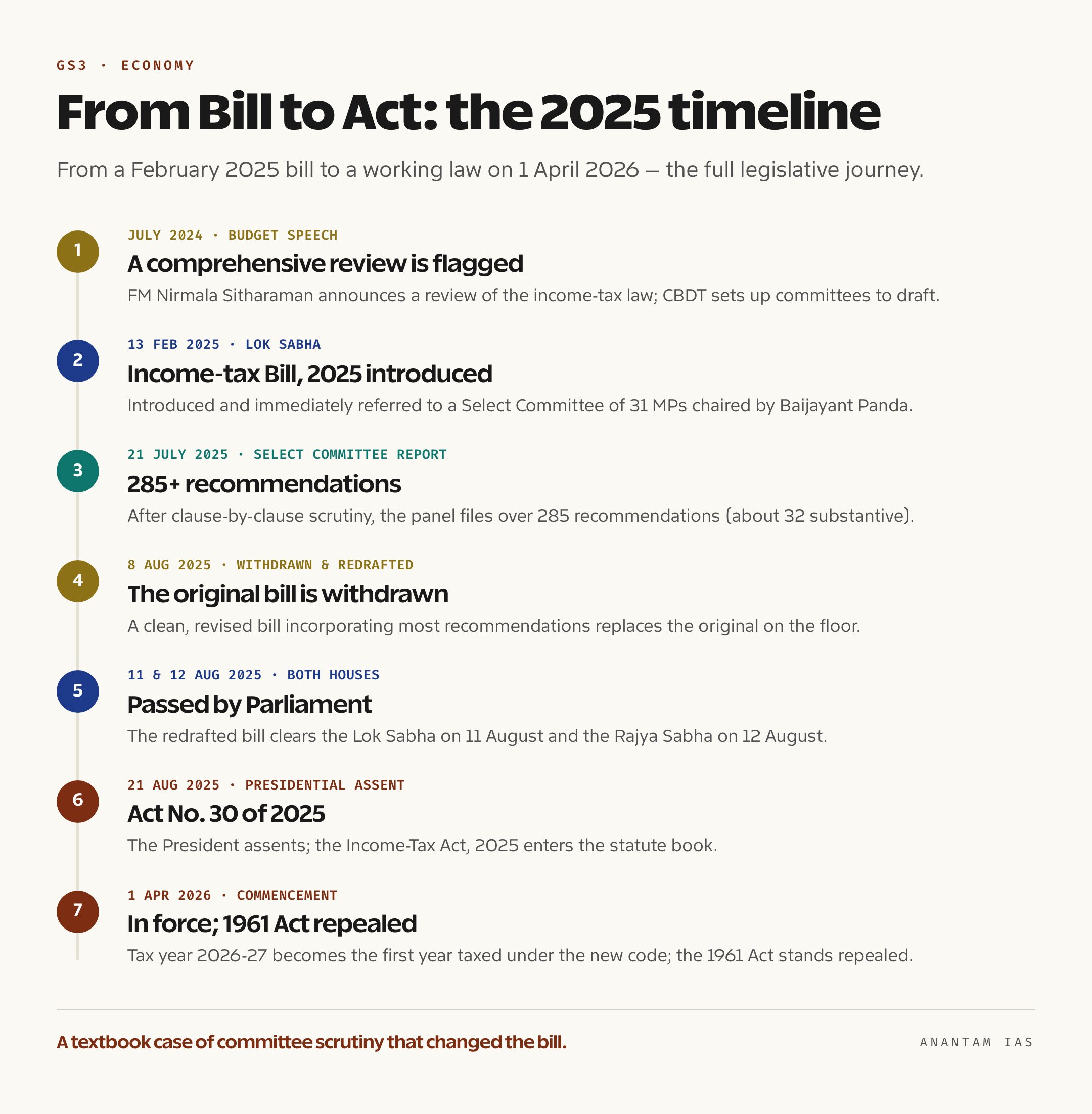
The journey matters, because it shows Parliament’s committee system doing real work rather than rubber-stamping. The original Income-tax Bill, 2025 was introduced in the Lok Sabha on 13 February 2025 and immediately referred to a Select Committee of thirty-one MPs chaired by the BJP’s Baijayant Panda. That committee didn’t treat it as a formality. After months of clause-by-clause scrutiny and consultations with industry bodies, tax professionals and officials, it submitted a report on 21 July 2025 carrying more than 285 recommendations, of which around 32 were flagged as substantive.
Most of those suggestions were about clarity — aligning phrasing, fixing cross-references, tightening definitions so a sentence couldn’t be read two ways. But some had real bite. The panel pushed back on a provision that would have denied refunds to taxpayers who filed returns after the due date, arguing it was unfair to penalise an honest taxpayer’s own money. The government took the feedback seriously enough to do something unusual: rather than amend the bill on the floor, it withdrew the original bill on 8 August 2025 and introduced a clean, revised version incorporating most of the recommendations. That redrafted bill was passed by the Lok Sabha on 11 August and the Rajya Sabha on 12 August 2025, received the President’s assent on 21 August as Act No. 30 of 2025, and was notified to come into force from 1 April 2026.
So the sequence to remember is tight and examinable: Budget 2024 announcement, CBDT drafting, February 2025 introduction, Select Committee under Panda, July report, August withdrawal-and-redraft, August assent, April 2026 commencement. It’s a textbook case of how a money-related bill moves through committee scrutiny — and a useful counter to the lazy claim that select committees never change anything.
Where the Tax Rates Actually Come From
This is where students get tangled, so let’s separate the two threads cleanly. The rebate-rich slabs everyone talks about — the ones that make income up to ₹12 lakh effectively tax-free under the new regime — did not come from the Income-Tax Act, 2025 at all. They came from the Union Budget 2025-26, delivered in February 2025, through a Finance Act amendment to the rebate provision under what was Section 87A.
Under that Budget, the new regime’s rebate threshold was raised from ₹7 lakh to ₹12 lakh, with the maximum rebate lifted to ₹60,000, so a resident individual with taxable income up to ₹12 lakh pays zero tax. For a salaried person, the standard deduction of ₹75,000 stretches that break-even point to about ₹12.75 lakh. The slabs run from a nil band through 5%, 10%, 15% and 20% up to 30% on the top bracket, with marginal relief built in so crossing ₹12 lakh by a rupee doesn’t trigger a cliff of tax. The 2025 Act simply carries this policy forward into its own renumbered sections.
The clean way to hold both ideas at once: the Budget decides how much you pay; the Act decides how the law saying so is written. A taxpayer in 2026 enjoys the ₹12-lakh rebate because of the Budget, and reads about it in a far shorter statute because of the Act. Both are reforms — but not the same reform, and conflating them is the single most common error on this topic.
The Real Concerns and What to Watch
A rewrite this big invites fair scrutiny, and the criticisms fall into three honest buckets. The first is the transition and compliance cost. Decades of settled case law, departmental circulars and software were all built around the 1961 section numbers; mapping every old reference to a new one is a genuine burden for tax professionals, businesses and the department itself in the first few years, and tax experts widely expect a fresh wave of litigation simply over how the new wording is interpreted. The Act tries to soften this with a transition framework, but the friction is real.
The second concern is whether the simplification is as deep as advertised. Critics point out that cutting word count and merging provisos is welcome housekeeping, but much of the underlying complexity of income taxation — capital gains rules, international taxation, transfer pricing, the maze of exemptions — survives because the policy survives. A shorter book is easier to carry; it isn’t automatically a simpler subject. There is also a federalism-and-treaty edge that legal commentators have flagged: provisions giving the executive wide power to define terms, including with retrospective effect, raise worries about overriding India’s tax treaties and concentrating discretion in the government.
The third, and most charged, is the taxpayer-rights question. The Act continues and arguably sharpens the authorities’ search-and-seizure reach into the “virtual digital space” — emails, social media accounts, cloud storage, virtual desktops — with the power to override access codes during a search. Commentators in the legal press warn that without a clear requirement of prior judicial authorisation, this risks “fishing expeditions” and sits uneasily with the Supreme Court’s Puttaswamy privacy jurisprudence. At the same time, the Act keeps faceless assessment — the technology-driven, anonymised system meant to cut face-to-face corruption — but reframes it as a general power for the government to design such schemes rather than a fixed statutory blueprint, which gives flexibility but less certainty. So the thing to watch from 2026 onward is simple: does litigation actually fall, do the search powers get tested in court, and does the faceless system get fairer or just faster?
For Your Mains Answer
This topic sits squarely in GS Paper 3 under “mobilization of resources,” government budgeting, and economic reforms, and it’s a clean fit for any question on tax administration, ease of doing business, or India’s fiscal capacity. It can also surface in GS Paper 2 on the role of parliamentary committees and the legislative process. Treat it as a reform of process and structure, not of rates — that framing alone signals that you understand the topic.
How to Build the Answer
Open by stating precisely what the Act is: a structural rewrite of the direct-tax law replacing the 1961 Act from 1 April 2026, not a change in tax policy. Then move in a logical arc — the problem (an unreadable, over-litigated law), the fix (one tax year, fewer sections, tables over prose, no rate change), the process (Select Committee under Panda, withdrawal and redraft), and the critique (transition cost, search-and-seizure powers, depth of simplification). Close on significance: lower compliance friction, fewer disputes, stronger direct-tax buoyancy and a more credible ease-of-doing-business story.
Common Mistakes to Avoid
Don’t claim the Act cut tax rates or created the ₹12-lakh rebate — that was the Budget, through Section 87A. Don’t write that it “simplifies the tax system” without distinguishing simpler law from a still-complex subject. Don’t ignore the rights-and-privacy concern; a one-sided cheerleading answer reads as shallow. And don’t drown the page in numbers — two or three anchors are enough.
A Compact Answer Spine
Unreadable, over-litigated 1961 Act → 2025 rewrite (536 sections, 23 chapters, ~half the words, one “tax year”) → policy unchanged, rates set by Budget → Select Committee scrutiny under Panda, August 2025 assent, April 2026 commencement → concerns (transition cost, digital search powers, privacy, depth of simplification) → significance for litigation, compliance and direct-tax buoyancy.
Diagram or Flowchart Idea
Draw a two-column “before and after” box: on the left, the 1961 Act (819 sections, ~5 lakh words, previous year + assessment year, 1,200+ provisos); on the right, the 2025 Act (536 sections, ~2.56 lakh words, single tax year, provisos absorbed). A single arrow between them labelled “structure rewritten, rates unchanged” carries your whole thesis at a glance.
A Balanced-Conclusion Line
A simpler statute is a necessary reform, but real simplification will be judged not by a lower word count in 2026 but by whether disputes actually fall and taxpayer trust actually rises in the years that follow.
How to Use Data Without Cramming
Pick anchors that prove a point, not a memory test: 819 to 536 sections (the diet), ~5 lakh to ~2.56 lakh words (roughly halved), one tax year replacing two, ₹12 lakh / ₹12.75 lakh as the Budget’s rebate threshold (clearly labelled as Budget, not Act), and 1 April 2026 as the start date. Five figures, each doing a job — that’s plenty.
FAQ
Does the Income-Tax Act, 2025 change my tax rates? No. The Act is a structural and language rewrite of the direct-tax law; it imposes no new tax and changes no slab. The rates and the rebate that makes income up to ₹12 lakh tax-free under the new regime come from the Union Budget 2025-26 through the Finance Act, not from this statute. The Act simply carries that policy forward in clearer, renumbered sections.
When does the new Act come into force, and what happens to the 1961 Act? The Income-Tax Act, 2025 received Presidential assent on 21 August 2025 and comes into force from 1 April 2026, so the tax year 2026-27 is the first year taxed under it. The Income-tax Act, 1961 stands repealed from the same date, though transition provisions preserve continuity for pending matters.
What is the new “tax year” concept? It replaces the old, confusing pair of “previous year” and “assessment year” with a single “tax year” that runs with the financial year, 1 April to 31 March. You now earn and are taxed within the same labelled year, instead of earning in the previous year and being assessed in the next assessment year.
Why was the 1961 Act replaced if the policy stays the same? Because the law itself had become unreadable. Six decades of amendments swelled it to 819 sections and roughly half a million words, with over 1,200 provisos and 550-plus explanations, fuelling one of the world’s most litigated tax systems. The 2025 Act keeps the policy but cuts the bulk — 536 sections, about half the words, tables instead of dense prose — to reduce disputes and compliance cost.
Practice Questions
Prelims MCQs
- With reference to the Income-Tax Act, 2025, consider the following: it (i) replaces the Income-tax Act, 1961; (ii) comes into force from 1 April 2026; (iii) introduces a single “tax year” replacing the previous-year and assessment-year distinction. Which are correct?
(a) (i) and (ii) only
(b) (ii) and (iii) only
(c) (i) and (iii) only
(d) (i), (ii) and (iii)
Answer: (d) All three are correct — it repeals the 1961 Act, commences on 1 April 2026, and unifies the two-year system into one tax year. - The Income-Tax Act, 2025 received the President’s assent in:
(a) February 2025
(b) July 2025
(c) August 2025
(d) April 2026
Answer: (c) It received Presidential assent on 21 August 2025 as Act No. 30 of 2025, and was notified to come into force from 1 April 2026. - Which of the following best describes the nature of the Income-Tax Act, 2025?
(a) It raises income-tax rates for high earners
(b) It is a structural and language rewrite that does not change tax rates
(c) It abolishes the new tax regime
(d) It introduces a wealth tax
Answer: (b) The Act consolidates and simplifies the law without imposing any new tax or altering slabs; rates are set by the Budget. - The Income Tax Bill, 2025 was examined by a Select Committee of the Lok Sabha chaired by:
(a) Nirmala Sitharaman
(b) Baijayant Panda
(c) Sanjay Malhotra
(d) the Chief Economic Adviser
Answer: (b) The thirty-one-member Select Committee was chaired by BJP MP Baijayant Panda and submitted over 285 recommendations. - Compared with the Income-tax Act, 1961, the Income-Tax Act, 2025 has:
(a) more sections and more words
(b) the same number of sections but fewer schedules
(c) fewer sections (536 vs 819) and roughly half the word count
(d) no schedules at all
Answer: (c) The new Act has 536 sections, 23 chapters and 16 schedules against 819 sections in the 1961 Act, with the word count cut to about 2.56 lakh.
Mains Practice Questions
- “The Income-Tax Act, 2025 reforms the form of India’s direct-tax law without reforming its substance.” Critically examine this statement. (15 marks, 250 words)
- Discuss how excessive complexity and litigation in tax law undermine the ease of doing business, and assess whether the Income-Tax Act, 2025 adequately addresses these problems. (15 marks, 250 words)
- The journey of the Income Tax Bill, 2025 illustrates the role of parliamentary select committees in lawmaking. Examine, with reference to the legislative process followed. (10 marks, 150 words)
- The expanded search-and-seizure powers over “virtual digital space” under the new income-tax law have raised privacy concerns. Discuss the tension between effective tax administration and the right to privacy. (15 marks, 250 words)
- “A simpler tax statute is a means, not an end.” In the light of the Income-Tax Act, 2025, discuss the relationship between tax simplification, compliance, and direct-tax buoyancy. (15 marks, 250 words)