NPS Vatsalya: Features, Benefits and Significance (UPSC Social Security)
NPS Vatsalya lets a parent open a pension account for a child before that child can even spell the word. Here is what it actually offers, how the account converts when the minor turns 18, and the honest case for and against it.
Most pension schemes ask you to start saving for retirement somewhere in your thirties, once the salary is steady and the realisation has landed that the working years are finite. NPS Vatsalya turns that on its head. It lets a parent open a retirement account for a child who cannot yet spell the word retirement, and start feeding it from the cradle. Announced in the Union Budget of 2024-25 and launched on 18 September 2024 by Finance Minister Nirmala Sitharaman, it’s a contributory pension account opened in the name of a minor, operated by a parent or guardian, and run under the same National Pension System architecture that already manages the retirement savings of crores of working Indians. The pitch is simple and a little audacious: give compounding fifty or sixty years instead of thirty, and a tiny annual contribution can grow into a serious old-age cushion.
That bet on time is exactly why this scheme matters beyond a single budget line. India is ageing faster than it is getting rich, its pension coverage is thin, and the joint family that once absorbed old-age care is fraying. So the question of who funds the retirement of today’s children is a real one, and NPS Vatsalya is the government’s attempt to nudge an answer into place early. It sits at the meeting point of social security, financial inclusion and pension-sector reform, which is precisely why it’s worth understanding properly rather than as a one-line current-affairs fact.
What NPS Vatsalya Is and Why It Was Launched
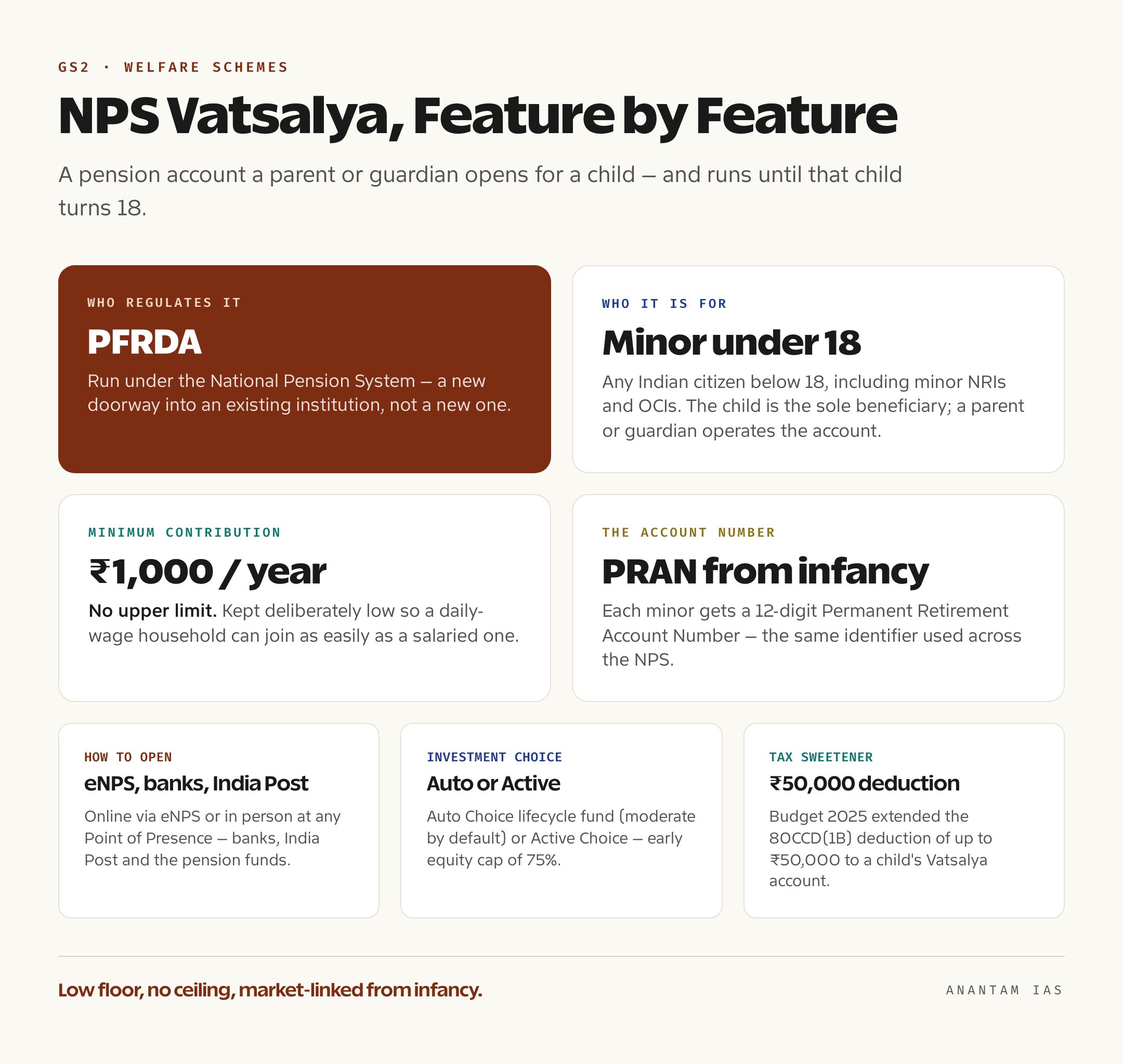
Let’s be precise about the object first, because the name carries a lot. Vatsalya is the Sanskrit word for the tender, protective love a parent feels for a child, and the scheme is built around that relationship. NPS Vatsalya is a contributory, voluntary, market-linked pension account opened for any Indian citizen below the age of 18, including minor NRIs and OCIs. The account is in the minor’s name, and the minor is the sole beneficiary, but a parent or legal guardian opens it and operates it until the child becomes an adult. It is regulated by the Pension Fund Regulatory and Development Authority, the PFRDA, which already oversees the wider National Pension System, so Vatsalya is not a new institution so much as a new doorway into an existing one.
The “why now” has two layers, and UPSC rewards candidates who can separate them. The surface reason is a savings-culture argument: Indian households save heavily, but in gold, property and bank deposits rather than in long-horizon market instruments, and almost never with retirement as the explicit goal. By opening a pension account at birth, the scheme tries to plant the habit of long-term, equity-linked saving a full generation earlier. The deeper reason is demographic. India’s share of citizens above sixty is rising steadily and is projected to roughly double over the coming decades, while formal pension coverage remains low, concentrated among government and organised-sector employees. A large part of the workforce, especially in the informal economy, will reach old age with no occupational pension at all. NPS Vatsalya does not solve that gap by itself, but it signals the direction of pension policy: shift from promising defined benefits to building defined contributions early, and let compounding do the heavy lifting.
There’s a design point worth slowing down on, because it explains the scheme’s whole logic. The selling point is not the contribution; it’s the runway. A regular saver who starts NPS at thirty gives the money about thirty years to grow before sixty. A child enrolled at, say, age three gives it nearly six decades. Over that span, even modest yearly contributions, compounding through equity and debt, can swell into a corpus several times larger than the same money saved over half the time. The Finance Ministry has consistently framed Vatsalya around exactly this idea of the “power of compounding over a long horizon.” That single sentence is the scheme’s thesis, and also, as we’ll see, the root of its sharpest criticism.
Features, Contributions and How the Account Works
Here is the architecture, feature by feature. To open an account, the guardian needs a minimum contribution, which at launch the Finance Ministry set at ₹1,000 a year, with no upper limit, deliberately keeping the floor low so that families across income levels can join. The PFRDA’s later guidelines relaxed this entry barrier further still, but the design intent is unchanged: the scheme should be open to a daily-wage household as easily as to a salaried one. Each minor account gets a Permanent Retirement Account Number, or PRAN, the same unique twelve-digit identifier used across the National Pension System, and on launch day the Finance Minister personally handed PRAN cards to new minor subscribers at events spread across roughly seventy-five locations in the country.
Opening an account is meant to be frictionless. A guardian can enrol online through the eNPS platform, or in person through a Point of Presence, the PFRDA’s term for the registered intermediaries that distribute NPS, which include most major banks, India Post and the pension funds themselves. The documents are the ordinary KYC set for the guardian, plus proof of the child’s age and identity. Once opened, the guardian chooses how the money is invested, using the same toolkit available to adult NPS subscribers and the same PFRDA-registered pension fund managers. There are two broad routes. Under Auto Choice, the money sits in a lifecycle fund that automatically tilts from equity towards safer debt as the years pass, available in aggressive, moderate and conservative variants with different equity ceilings; the default for a Vatsalya account is the moderate lifecycle fund. Under Active Choice, the guardian decides the split across equity, corporate bonds, government securities and a small alternative-assets sleeve. The early rules capped equity at 75%, though the PFRDA has since moved to let pension funds design more aggressive patterns for these very long-horizon accounts.
Two further levers complete the picture. First, liquidity is deliberately limited but not absent. After the account has run for at least three years, the guardian may make a partial withdrawal of up to 25% of the contributions made, excluding the returns earned on them, and may do so a maximum of three times before the child turns 18. The permitted reasons are tightly drawn: the minor’s education, the treatment of specified illnesses, and a disability of more than 75%. Second, on the tax side, the Union Budget of 2025 extended the National Pension System’s additional deduction of up to ₹50,000 under Section 80CCD(1B) to contributions made into a child’s Vatsalya account, over and above the older ₹1.5 lakh ceiling, giving a contributing parent a genuine tax incentive rather than only a sentimental one.
The Big Moment: What Happens When the Child Turns 18
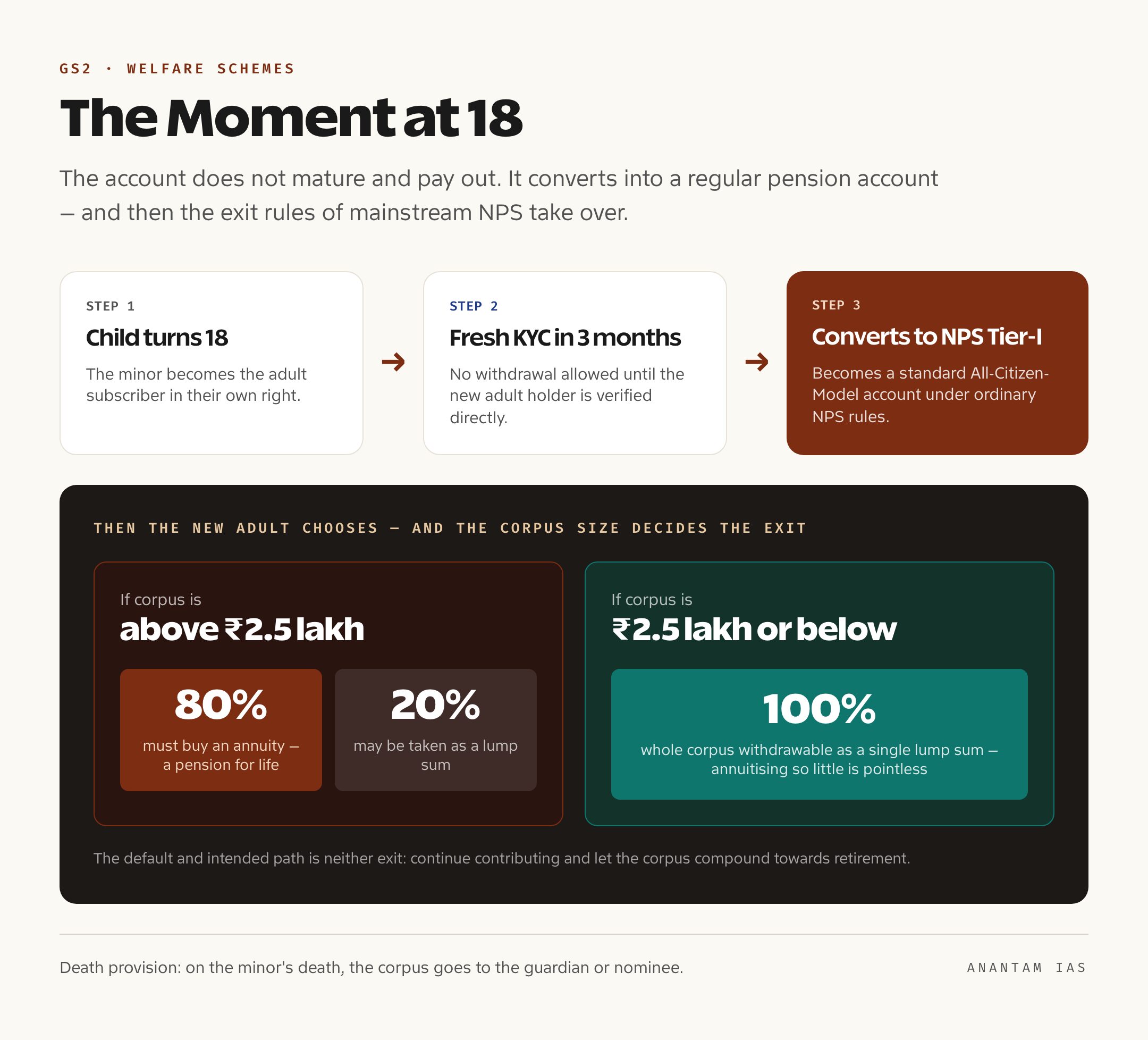
The most distinctive part of NPS Vatsalya, and the part most worth getting right, is the conversion that happens when the minor becomes an adult. The account does not simply mature and pay out like a fixed deposit. Instead, on the child turning 18, it transitions into a regular National Pension System account on the All Citizen Model, the standard NPS Tier-I account that any adult can hold. The child, now the adult subscriber in their own right, must complete a fresh KYC within three months of reaching majority, because the account was previously operated under the guardian’s identity and the system now needs to verify the new adult holder directly. Until that re-KYC is done, no withdrawal is allowed. After it, the account simply carries on under the rules and exit norms of the ordinary NPS.
At that eighteen-year mark, the new adult has real choices, and this is where the design reveals its philosophy. The default and intended path is to continue: keep the converted NPS Tier-I account running, keep contributing, and let the corpus keep compounding towards a retirement decades away. The scheme is built so that the Vatsalya years become the foundation of a lifelong pension, not a payout at adulthood. A subscriber who wants out, though, can exit, and the exit logic borrows directly from mainstream NPS. If the accumulated corpus is more than ₹2.5 lakh, the subscriber must use at least 80% of it to buy an annuity, a financial product that pays a regular pension for life, and can take only the remaining 20% as a lump sum. If the corpus is ₹2.5 lakh or below, the whole amount can be withdrawn as a single lump sum, on the sensible logic that annuitising a tiny corpus would yield a pension too small to bother with.
That 80/20 rule is the hinge of the entire scheme, so it pays to understand its intent rather than just memorise it. The heavy annuitisation requirement is what makes Vatsalya a genuine pension product and not just a long-dated savings plan. The government is not handing an eighteen-year-old a windfall to spend; it’s converting the corpus into a stream of old-age income that the subscriber cannot easily blow through at once. This is also where the long retirement-style lock-in really bites, since the bulk of the money stays committed to a pension rather than becoming freely available cash. For UPSC, the clean way to hold all of this is as a sequence: contribute through childhood, convert at 18 into NPS Tier-I after fresh KYC, then either continue building the pension or exit under the standard NPS rules, with annuitisation protecting the corpus from being cashed out prematurely. There’s also a death provision worth a line: if the minor subscriber dies, the entire accumulated wealth is paid to the guardian or nominee, and if the operating guardian dies, a new guardian must be registered with fresh KYC so the account keeps running.
Benefits, Significance and the Bigger Picture
Now to the part that earns marks: why this small scheme is treated as a meaningful policy move rather than a gimmick. Start with the household-level benefits, then widen out. For a family, NPS Vatsalya offers a disciplined, professionally managed, low-cost way to build a very long-horizon corpus for a child, with the tax sweetener of the ₹50,000 deduction and the structural advantage of starting the compounding clock as early as legally possible. The NPS administrative-cost structure is among the cheapest in Indian finance, which matters enormously over a multi-decade holding, because fees compound against you just as returns compound for you. And by making the minor the sole beneficiary, the scheme ties the saving directly to the child’s own retirement rather than to a near-term goal like marriage or college, which is a deliberate cultural nudge towards thinking about old age decades in advance.
Step back, and the significance is mostly about the gaps in India’s social-security system. The first is the pension coverage gap. A large share of Indians, especially in the informal sector, will retire with neither a government pension nor an organised-sector provident fund, relying instead on personal savings and family support. Anything that builds an early, individually owned, portable pension pot widens that thin coverage. The second is financial inclusion, extended in an unusual direction: instead of bringing adults into the formal system, Vatsalya brings children into it, with a PRAN and a market-linked account from infancy, which the government hopes seeds a savings culture that outlasts the scheme. The third is the demographic and old-age-security angle, the heart of the case. As the share of elderly Indians climbs and the traditional joint-family safety net thins, the burden of old-age support is shifting onto individual provision and the state. A scheme that quietly pre-funds the retirement of today’s children is, in effect, the state trying to get ahead of an old-age-income problem that will only sharpen in the 2050s and beyond.
It also fits a clear arc of pension-sector reform that UPSC GS3 cares about. India has been steadily moving from the older defined-benefit model, where the state promised a fixed pension and carried the funding risk, towards defined-contribution systems like the NPS, where individuals build their own corpus in market-linked funds and carry the investment risk themselves. Vatsalya pushes that logic to its earliest possible starting point. Set against the wider menu of small-savings options, its distinct edge is the combination of equity exposure and an ultra-long horizon. The Public Provident Fund offers tax-free but fixed, debt-like returns over fifteen years; the Sukanya Samriddhi Yojana offers an attractive guaranteed rate but only for a girl child and only until she is around twenty-one. Vatsalya, by contrast, can ride decades of equity growth, which over fifty years can meaningfully outpace fixed-return instruments, the everyday illustration of why compounding plus time plus equity is such a powerful combination.
Criticisms, Limits and the Honest Verdict
A strong case is only strengthened by stating its limits plainly, so here they are without flinching. The first and loudest criticism is liquidity lock-in. Because the corpus is meant to fund retirement, the money is effectively committed for the very long term: partial withdrawals before 18 are small and tightly conditional, and at 18 the 80% annuitisation rule keeps most of the corpus locked into a pension stream rather than freeing it up. For a parent who is actually saving to pay for the child’s college or first home, this is the wrong tool, and several independent analysts have made exactly that point, arguing that mutual funds or even the PPF give better liquidity and, for goals before age sixty, often more usable money. There’s a related tax wrinkle worth knowing: even where the rules allow up to 80% to be withdrawn, the Income Tax Act has tended to exempt only 60% of an NPS lump sum, so the extra slice can be taxable in the subscriber’s hands.
The second is market risk. Vatsalya is market-linked, so returns are not guaranteed; they depend on the chosen fund, the asset mix and how markets behave over the holding period. Over fifty years the long-run case for equity is strong, but the corpus can and will dip in bad years, which makes some parents uneasy about putting a child’s nest egg into something that can fall in value, unlike the PPF or Sukanya Samriddhi, where the principal is effectively protected. The third is a behavioural and awareness problem. The scheme asks parents to make a sophisticated, decades-long financial decision on a child’s behalf, choosing fund managers and asset allocations, and to keep contributing year after year against more immediate spending demands. Critics doubt that most families will prioritise a pension that pays off in fifty years over today’s pressing needs, and early awareness of the scheme has been low, so uptake risks staying concentrated among already financially literate, urban households, the very people who least need a nudge.
So what’s the honest verdict? NPS Vatsalya is a thoughtful, well-aimed instrument for a real and worsening problem, and its core logic, start early, let compounding work, lock the corpus into a genuine pension, is sound. But it’s a retirement product wearing the clothes of a child-savings product, and the gap between those two ideas is where most of the criticism lives. It will not, on its own, close India’s pension coverage gap, which is far too large for a voluntary, contributory scheme to fix; that needs a much wider net for the informal workforce. What it can do is shift the default expectation of when retirement saving begins, from the thirties to the cradle, and seed a generation that treats a pension account as something you’ve simply always had. Judged as a culture-changing nudge rather than a coverage fix, it’s a sensible piece of a much larger puzzle, and stating that distinction is exactly the kind of balance an examiner rewards.
For Your Mains Answer
This scheme is a clean double-counter for GS Paper 2, under welfare schemes and the mechanisms for protecting vulnerable sections and social security, and for GS Paper 3, under mobilisation of resources, financial markets and the pension sector. The smart move in an answer is to refuse to treat it as just another scheme to be described, and instead use it to make a larger argument about India’s old-age-income challenge and the shift from defined-benefit to defined-contribution pensions. Examiners reward the candidate who connects a small scheme to a big structural story.
How to Build the Answer
Open with the problem, not the scheme: India’s rising elderly share, thin pension coverage and a fraying family safety net. Then introduce NPS Vatsalya as one calibrated response, define it precisely as a PFRDA-regulated pension account for minors, and lay out its architecture, contribution, investment choice, conversion at 18, in two or three tight sentences. Spend the bulk of the answer on significance and critique in balance: the early-compounding and financial-inclusion case on one side, the liquidity lock-in, market risk and awareness problems on the other. Close by placing it within pension reform and being honest about what it can and cannot do.
Common Mistakes to Avoid
Don’t describe it as a child-savings or education-savings scheme; it’s a pension product, and missing that is the single most common error. Don’t forget the conversion at 18 into NPS Tier-I, which is the feature that distinguishes it from a PPF or Sukanya account. Don’t drown the answer in every number; the launch year, the minor eligibility and the 80/20 exit rule are plenty. And don’t present it as a fix for India’s pension gap; it’s a nudge, not a net, and saying so signals maturity.
A Compact Answer Spine
India’s old-age-income problem (ageing population, low pension coverage, fraying joint family) → NPS Vatsalya as a PFRDA-regulated pension account for minors, opened and run by a guardian → key features (low minimum contribution, no upper limit, Auto or Active investment choice, PRAN from infancy) → conversion at 18 into NPS Tier-I after fresh KYC, with the 80% annuity / 20% lump-sum exit logic → significance (early compounding, financial inclusion of children, pension-coverage and demographic angle, defined-contribution reform) → criticisms (liquidity lock-in, market risk, low awareness, will parents prioritise it) → balanced verdict: a culture-changing nudge, not a coverage fix.
Diagram or Flowchart Idea
Draw a simple left-to-right flow: a box labelled “Guardian opens account for minor (under 18)” → “Contributions + compounding through childhood” → a clear node at “Child turns 18: fresh KYC, converts to NPS Tier-I” → then a fork: “Continue contributing” on one branch and “Exit: 80% annuity / 20% lump sum (full lump sum if corpus is small)” on the other. A clean lifecycle flow like this earns marks fast and shows you understand the conversion, which is the heart of the scheme.
A Balanced-Conclusion Line
Something like: “NPS Vatsalya is best read not as a solution to India’s pension gap, which is far too wide for any voluntary scheme to close, but as an attempt to reset the default age at which Indians start saving for old age, from the thirties to the cradle, and on that narrower test it is a sensible, if partial, reform.” That sentence concedes the limit and claims the merit in the same breath.
How to Use Data Without Cramming
Anchor with two or three figures and attribute them in prose. Use the launch detail, that the Finance Minister launched NPS Vatsalya on 18 September 2024; use the structural fact that it’s run under the PFRDA within the National Pension System; and use the 80/20 exit rule above a ₹2.5 lakh corpus as your one precise mechanism. Pair these with the keywords examiners look for, defined-contribution pension, pension coverage gap, financial inclusion, power of compounding, demographic transition, and you sound informed without reciting a brochure.
FAQ
What exactly is NPS Vatsalya, and who can open it? NPS Vatsalya is a contributory, market-linked pension scheme for minors, regulated by the PFRDA under the National Pension System and launched on 18 September 2024. It can be opened for any Indian citizen below 18, including minor NRIs and OCIs. The account is in the child’s name, with the child as the sole beneficiary, while a parent or legal guardian opens it and operates it until the child becomes an adult.
How much do you have to contribute, and is there an upper limit? At launch, the minimum contribution was set at ₹1,000 a year, deliberately low so families across income levels can join, and there’s no upper limit on how much you can put in. A parent contributing to a child’s Vatsalya account can also claim the National Pension System’s additional deduction of up to ₹50,000 under Section 80CCD(1B), which the Union Budget of 2025 extended to the scheme.
What happens to the account when the child turns 18? On turning 18, the account converts into a regular NPS Tier-I account on the All Citizen Model, and the new adult must complete a fresh KYC within three months before any withdrawal is allowed. The subscriber can then continue contributing, or exit: if the corpus is above ₹2.5 lakh, at least 80% must buy an annuity and 20% can be taken as a lump sum, while a corpus of ₹2.5 lakh or below can be withdrawn entirely.
Can you take money out before the child turns 18? Only in a limited way. After the account has run for at least three years, a guardian can make a partial withdrawal of up to 25% of the contributions made, excluding the returns, and may do so a maximum of three times before the child turns 18. It’s allowed only for the child’s education, the treatment of specified illnesses, or a disability of more than 75%. This tight liquidity is by design, because Vatsalya is meant to fund retirement, not near-term spending.
Practice Questions
Prelims MCQs
- With reference to the NPS Vatsalya scheme, consider the following statements. Which is/are correct? It is regulated by the PFRDA under the National Pension System; it can be opened only for a girl child; the account is opened in the name of the minor.
(a) 1 only
(b) 1 and 3 only
(c) 2 and 3 only
(d) 1, 2 and 3.
Answer: (b) NPS Vatsalya is open to any Indian citizen below 18 regardless of gender, so statement 2 is wrong; the scheme is PFRDA-regulated and the account is in the minor’s name. - NPS Vatsalya was launched in which year, and by which authority is it regulated?
(a) 2022, regulated by the RBI
(b) 2023, regulated by SEBI
(c) 2024, regulated by the PFRDA
(d) 2025, regulated by IRDAI.
Answer: (c) It was announced in the 2024-25 Budget and launched on 18 September 2024, and is regulated by the Pension Fund Regulatory and Development Authority. - When the minor subscriber under NPS Vatsalya turns 18, the account:
(a) matures and is paid out entirely in cash
(b) converts into a regular NPS Tier-I account on the All Citizen Model after fresh KYC
(c) is automatically closed
(d) is transferred to a fixed deposit.
Answer: (b) The account transitions into a standard NPS Tier-I account, and the new adult must complete a fresh KYC within three months before any withdrawal. - On exit at age 18 under NPS Vatsalya, if the accumulated corpus is more than ₹2.5 lakh, what is the prescribed split?
(a) The entire corpus can be withdrawn as a lump sum
(b) 60% lump sum and 40% annuity
(c) At least 80% must be annuitised and up to 20% taken as a lump sum
(d) The entire corpus must be annuitised.
Answer: (c) Above ₹2.5 lakh, at least 80% buys an annuity and 20% can be a lump sum; a corpus of ₹2.5 lakh or below can be withdrawn fully. - Which of the following is a correct statement about partial withdrawal under NPS Vatsalya before the child turns 18?
(a) It is allowed any time after opening, without limit
(b) It is allowed after three years, up to 25% of contributions, a maximum of three times, for reasons like education or specified illness
(c) It is allowed only once, for marriage
(d) Partial withdrawal is never permitted before 18.
Answer: (b) Partial withdrawal is permitted after three years, capped at 25% of contributions, up to three times before 18, for the minor’s education, specified illnesses, or disability above 75%.
Mains Practice Questions
- “NPS Vatsalya is best understood not as a child-savings scheme but as an early-start pension product.” Examine this statement, and assess how far the scheme can address India’s pension coverage gap. (15 marks, 250 words)
- Discuss the significance of NPS Vatsalya in the context of India’s demographic transition and the shift from defined-benefit to defined-contribution pension systems. (15 marks, 250 words)
- Critically evaluate the design of NPS Vatsalya, with particular reference to its liquidity lock-in, market-linked returns, and the conversion of the account at age 18. (15 marks, 250 words)
- “Financial inclusion in India has largely targeted adults; NPS Vatsalya extends it to children.” Analyse this claim and the assumptions about household behaviour on which the scheme’s success depends. (10 marks, 150 words)
- Compare NPS Vatsalya with other long-horizon savings instruments such as the Public Provident Fund and the Sukanya Samriddhi Yojana, and bring out what makes it distinctive as a vehicle for old-age security. (10 marks, 150 words)