One Nation One Fertiliser Scheme (PMBJP): UPSC Notes 2026
One Nation One Fertiliser scheme rebrands urea, DAP, MOP and NPK as Bharat-branded fertilisers under PMBJP. Rationale, criticism, fertiliser subsidy 2025-26.
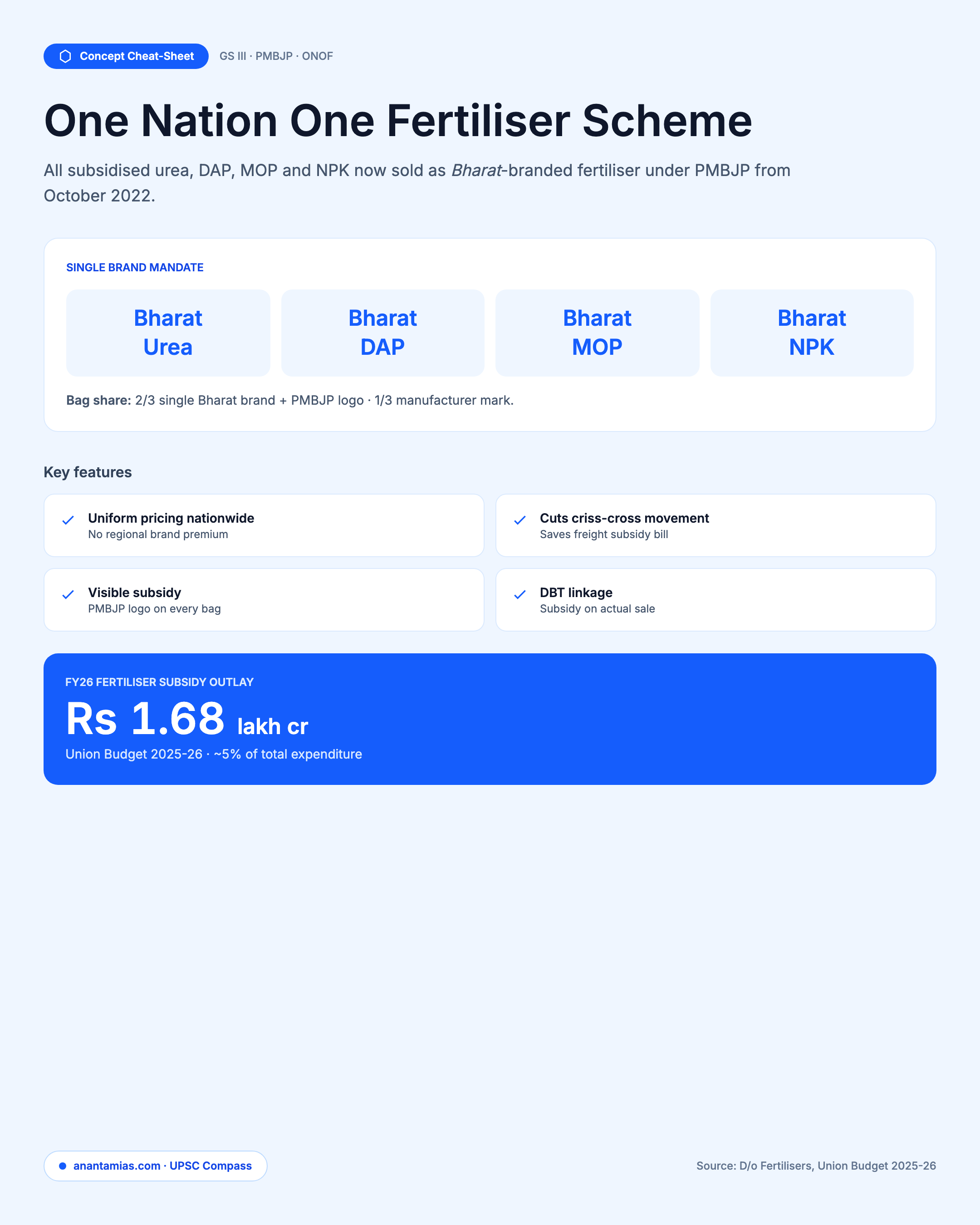
The One Nation One Fertiliser (ONOF) scheme — formally titled Pradhanmantri Bharatiya Janurvarak Pariyojana (PMBJP) — was launched by the Department of Fertilisers in October 2022 to standardise the branding of subsidised fertilisers across India under a single "Bharat" umbrella. Under PMBJP, all subsidised urea, DAP (di-ammonium phosphate), MOP (muriate of potash) and NPK (complex) fertilisers — irrespective of which company manufactures or imports them — must be sold in bags carrying the unified Bharat brand on two-thirds of the front face, with the Pradhanmantri Bharatiya Janurvarak Pariyojana logo.
The scheme is part of the Modi government's broader fertiliser-sector overhaul that includes Direct Benefit Transfer (DBT) of fertiliser subsidy, neem-coated urea, nutrient based subsidy (NBS) for non-urea fertilisers, and the recent push for nano urea and nano DAP. UPSC tests this under GS-III — agricultural subsidies, food security, public distribution systems, and government policies/interventions in the agriculture sector. Prelims has repeatedly probed brand names (Bharat Urea, Bharat DAP), launch year, and the implementing ministry.
What is the One Nation One Fertiliser Scheme?
Under ONOF/PMBJP, every bag of subsidised fertiliser sold to Indian farmers carries the same name regardless of the producer. A 45-kg urea bag from IFFCO, NFL, Coromandel, RCF, Chambal Fertilisers or any imported supplier looks identical from the front — all branded BHARAT UREA. Similarly, every DAP bag is BHARAT DAP, every potash bag is BHARAT MOP, and every complex fertiliser bag is BHARAT NPK.
The manufacturer's own name, logo and product information are restricted to the lower one-third of the bag. The remaining two-thirds carry the Bharat brand and the PMBJP logo.
Key Design Features
| Feature | Detail |
|---|---|
| Launch date | 2 October 2022 (rollout from 15 October 2022) |
| Implementing ministry | Department of Fertilisers, Ministry of Chemicals & Fertilizers |
| Mandatory bag share | Two-thirds for Bharat brand + PMBJP logo |
| Manufacturer share | One-third for own brand, name, address |
| Covered fertilisers | Urea, DAP, MOP, NPK complexes (subsidised) |
| Covered firms | All manufacturers, importers, marketers receiving subsidy under FCO/NBS |
| Excluded | Non-subsidised speciality fertilisers, water-soluble fertilisers, micronutrients |
How It Connects to the Subsidy Architecture
India runs two parallel fertiliser subsidy regimes. Urea is sold at a statutory MRP fixed by the Centre (Rs 242 per 45-kg bag for neem-coated urea), with the gap between cost and MRP reimbursed to manufacturers. Phosphatic and potassic (P&K) fertilisers including DAP, MOP and NPK complexes are covered under the Nutrient Based Subsidy (NBS) regime, where a fixed per-nutrient subsidy is paid and companies set their own MRP.
The DBT of fertiliser subsidy — implemented since 2018 — pays manufacturers only after the bag is actually scanned by a Point of Sale (PoS) device at the retail counter against a buyer's Aadhaar. Bharat-branding sits on top of this DBT plumbing: when the farmer sees a uniform Bharat bag, the political messaging of "government is paying" lands more clearly.
Background: Why the Government Rolled Out PMBJP
Massive Subsidy, Invisible Government
India's fertiliser subsidy bill has ballooned in recent years. From Rs 81,124 crore in FY21, it spiked to Rs 2.54 lakh crore in FY23 because of the global gas-price shock following the Russia-Ukraine war. The Union Budget 2024-25 allocated Rs 1.64 lakh crore to fertiliser subsidy and the Budget 2025-26 budgeted Rs 1.67 lakh crore. Despite carrying this burden, the Centre got little visibility — companies were happily selling IFFCO Urea, Kribhco Urea, NFL Urea etc. without any acknowledgement of the subsidy underwriting their MRP.
Inter-State Movement of Fertilisers
Earlier, fertilisers moved across states because freight subsidy is reimbursed by the Centre under the urea policy. A bag manufactured in Gujarat could end up in Bihar with the Centre paying both the production subsidy and the freight subsidy. Multiple brand names confused farmers about availability and price.
Build a National Brand
By branding all subsidised fertilisers as Bharat, the Centre wanted to:
- Make the subsidy visible to the end-beneficiary.
- Standardise pricing communication across states.
- Reduce brand-driven price premiums charged by some companies.
- Create a single national identity for what is essentially a public-good input.
Components of the ONOF Architecture
Bag Design Mandate
The Department of Fertilisers issued a gazette notification specifying the exact bag layout — Bharat brand colour, font size for PMBJP logo, and placement of nutrient information. Companies received a transition window of six months to clear old packaging stock.
Subsidy Pass-through under DBT
Manufacturers continue to receive their full subsidy entitlement once the PoS device validates the sale to an Aadhaar-authenticated buyer. The Bharat brand only changes the front-of-bag visual — backend subsidy mechanics are unchanged.
Pricing Regime
- Urea: statutory MRP of Rs 242/45-kg bag continues; the Bharat brand does not change consumer price.
- DAP: under NBS, the company-set MRP varies (typically Rs 1,350-1,500 per 50-kg bag in 2025-26 after special package).
- MOP and NPKs: NBS-driven; MRP fluctuates with international raw material prices.
Compliance and Penalty
Non-compliant bags can attract action under the Essential Commodities Act, 1955 and the Fertiliser Control Order (FCO), 1985 — including blacklisting from the subsidy roster.
Benefits of the One Nation One Fertiliser Scheme
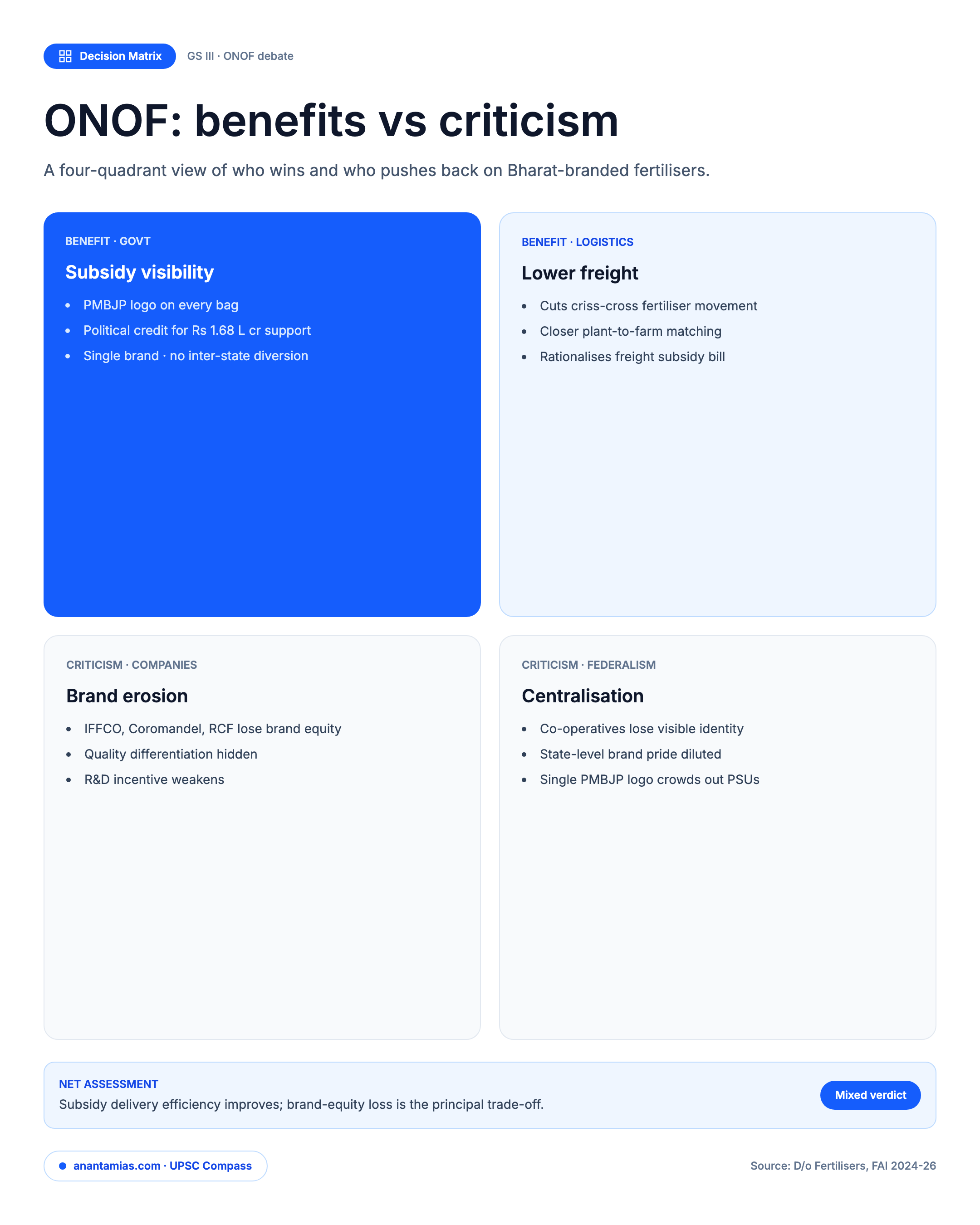
- Subsidy visibility to farmers — clearer political signalling that the Centre underwrites fertiliser cost.
- Reduced brand-driven price disparities — historically certain companies commanded a premium even for chemically identical urea.
- Simpler logistics — uniform bags ease inter-state movement; freight subsidy coordination becomes cleaner.
- Curbs grey-market arbitrage — black-marketing of higher-priced "premium" brands across state borders becomes harder.
- Push for accountability — the Bharat brand is a single point of escalation for quality complaints.
- Aligns with DBT philosophy — visible branding reinforces the message that fertiliser is a publicly funded input.
Criticism: Why ONOF Faced Backlash
Brand Equity Loss
Companies like IFFCO, Kribhco, Coromandel and Chambal Fertilisers have spent decades building brand recall, farmer-extension networks, and quality differentiation. Forcing them to become invisible behind a Bharat logo erodes brand equity built over decades.
Discourages Quality Investment
If every bag looks identical, the manufacturer loses incentive to:
- Invest in better coating technology (neem coating, slow-release).
- R&D for customised nutrient mixes suited to local soils.
- Run farmer extension and demonstration camps, since the immediate marketing return is absent.
Discourages Private Investment
Indian fertiliser sector already suffers from low private investment — most plants are 25-40 years old. ONOF further dampens private appetite because differentiation is the basis of pricing power and capital recovery.
Limits Farmer Choice
A farmer in Punjab who has trusted IFFCO since the 1980s now has a packaging-driven uniformity that dilutes that trust signal. Critics argue this violates the consumer's right to brand-led product choice.
Logistical Challenges
Some companies argue that pre-packed bags from one plant could carry the brand of a different state-allocated company because of cross-movement under the Movement Control Order. Bharat branding makes this internal inventory accounting messier.
Recent Developments (2024-2026)
| Year | Update |
|---|---|
| 2024 | Bharat-branded bags rolled out fully; subsidy bill stabilises at Rs 1.88 lakh crore |
| Budget 2024-25 | Rs 1,64,000 crore for fertiliser subsidy; urea continues to be largest head |
| 2024 | Special package for DAP of Rs 3,500 per tonne announced over and above NBS to keep MRP at Rs 1,350/bag |
| Budget 2025-26 | Rs 1,67,000 crore for fertiliser subsidy; DAP special package extended |
| 2025 | Nano DAP and Nano Urea rollout under PLI; Bharat-branded nano variants introduced |
| 2025-26 | PM PRANAM scheme rewards states that reduce conventional fertiliser use; complements ONOF push |
| 2026 | PM-Kisan AgriStack integration allows real-time tracking of Bharat-branded bag movement to PoS |
Reforms and Way Forward
- Allow secondary branding — manufacturers should be allowed to list their performance certifications, proprietary additives or quality marks alongside the Bharat logo.
- Linked traceability — every Bharat bag should carry a QR code for source plant, batch number, and shelf life.
- Performance-based subsidy — link subsidy to nutrient-use efficiency rather than just tonnage sold; this rewards quality.
- Push nano fertilisers — fast-track approvals for Nano Urea, Nano DAP, Nano MOP which reduce subsidy outgo per hectare by 30-40%.
- Strengthen FCO compliance testing — quality assurance must remain rigorous despite uniform branding.
- Promote bio-fertilisers and organic alternatives — Bharat brand can be extended to PM PRANAM-incentivised bio-products.
- Decontrol urea — economists argue that price decontrol with direct cash subsidy to farmers (PM-KISAN-style) would be more efficient than ONOF's branding overlay.
Government Schemes and Budget Allocations (2025-26)
- Fertiliser subsidy: Rs 1.67 lakh crore in Union Budget 2025-26.
- Urea subsidy: ~Rs 1.19 lakh crore.
- NBS subsidy (P&K fertilisers): ~Rs 48,000 crore.
- Special DAP package: continued through 2025-26.
- PM PRANAM (Programme for Restoration, Awareness, Generation, Nourishment and Amelioration of Mother Earth) — incentivises states cutting urea use; saved subsidy is shared 50:50 with the state.
- Market Development Assistance (MDA) for organic and bio-fertilisers — Rs 1,500 per tonne.
- Sulphur-coated urea and neem-coated urea mandates continue.
Mains Answer Hook
A model GS-III answer on ONOF should address: (a) how it makes fertiliser subsidy politically visible while leaving the massive Rs 1.67 lakh crore subsidy structure unchanged; (b) the trade-off between branding uniformity and competitive innovation; (c) why structural reforms — decontrol of urea, expansion of nano fertilisers, PM PRANAM, balanced fertilisation — matter more than packaging; (d) the linkage with DBT of fertiliser subsidy and AgriStack for real accountability.
Use the line: "Bharat branding is necessary signalling, but not sufficient reform — without nutrient-use efficiency and decontrol, ONOF is cosmetic."
Prelims Pointers
- Launch: 2 October 2022 (rolled out 15 October 2022).
- Brand names: Bharat Urea, Bharat DAP, Bharat MOP, Bharat NPK.
- Bag share: two-thirds Bharat brand + PMBJP logo, one-third manufacturer.
- Implementing ministry: Department of Fertilisers (Ministry of Chemicals and Fertilizers).
- Covered: all subsidised fertilisers — urea, DAP, MOP, NPK complexes.
- Connected schemes: DBT of fertiliser subsidy, NBS, neem-coated urea, PM PRANAM, Nano Urea/DAP, special DAP package.
- Key Act: Fertiliser Control Order, 1985 (FCO) under Essential Commodities Act, 1955.
- Budget 2025-26 fertiliser subsidy: Rs 1.67 lakh crore.
FAQ on One Nation One Fertiliser Scheme
What does ONOF mean?
One Nation One Fertiliser — a single Bharat-branded packaging mandate for all subsidised urea, DAP, MOP and NPK in India.
What is the full form of PMBJP?
Pradhanmantri Bharatiya Janurvarak Pariyojana.
Does ONOF change the price of fertilisers?
No — it changes only the bag branding. Urea MRP remains Rs 242/45-kg bag; DAP and complexes continue under NBS.
Are all fertilisers covered?
Only subsidised urea, DAP, MOP and NPK complexes. Speciality fertilisers, water-soluble fertilisers and micronutrients fall outside ONOF.
How is ONOF different from DBT of fertiliser subsidy?
DBT routes the subsidy payment to manufacturers after PoS-validated sale. ONOF mandates the brand identity on the bag. Both work together but address different ends — finance vs branding.
Who notifies ONOF compliance?
The Department of Fertilisers under the Ministry of Chemicals and Fertilizers, using powers under the Fertiliser Control Order, 1985.
The One Nation One Fertiliser scheme is a textbook example of a branding-led signalling reform. For UPSC, remember the bag layout (two-thirds Bharat), the four covered products (Bharat Urea/DAP/MOP/NPK), the implementing ministry, and the Rs 1.67 lakh crore subsidy backdrop. Pair these facts with the criticism on brand equity loss and innovation disincentives, and you have a balanced answer ready for both Prelims and Mains.