One Nation One Subscription (ONOS): Features, Coverage and Significance (UPSC Education)
One Nation One Subscription hands every student and researcher in a government institution free access to 13,000+ international journals through one national deal. Here is what it actually covers, how it works through INFLIBNET, and why critics still want open access instead.
For decades, a quiet inequality has shaped Indian research: whether you could read the latest science depended almost entirely on where you sat. A researcher at IIT Bombay could pull up a paywalled paper in seconds; a bright postgraduate in a state university in Bihar would hit a screen demanding thirty or forty dollars for the same article, and simply give up. The journals that hold the world’s cutting-edge findings have long sat behind expensive paywalls, and Indian institutions bought access piecemeal, each striking its own deal, each leaving its weaker peers behind. One Nation One Subscription, or ONOS, is the government’s attempt to demolish that wall in one move: pay for the whole country at once, and hand every student, teacher and researcher in a government institution the same front-row seat.
That is why this scheme matters far beyond a library line-item. India produces a huge volume of research but punches below its weight in citations and breakthroughs, and one stubborn reason is that too many of its researchers can’t even read the field they’re trying to contribute to. So ONOS sits right at the intersection of education policy, the science-and-technology ecosystem, and the larger Viksit Bharat ambition of becoming a knowledge economy. Approved by the Union Cabinet on 25 November 2024 and live since 1 January 2025, it’s one of the cleaner ideas in recent governance: stop bargaining as 6,000 weak buyers and start bargaining as one strong one. But whether buying access in bulk is the same as building research capacity is exactly the debate UPSC wants you to weigh.
What ONOS Is and Why It Was Launched
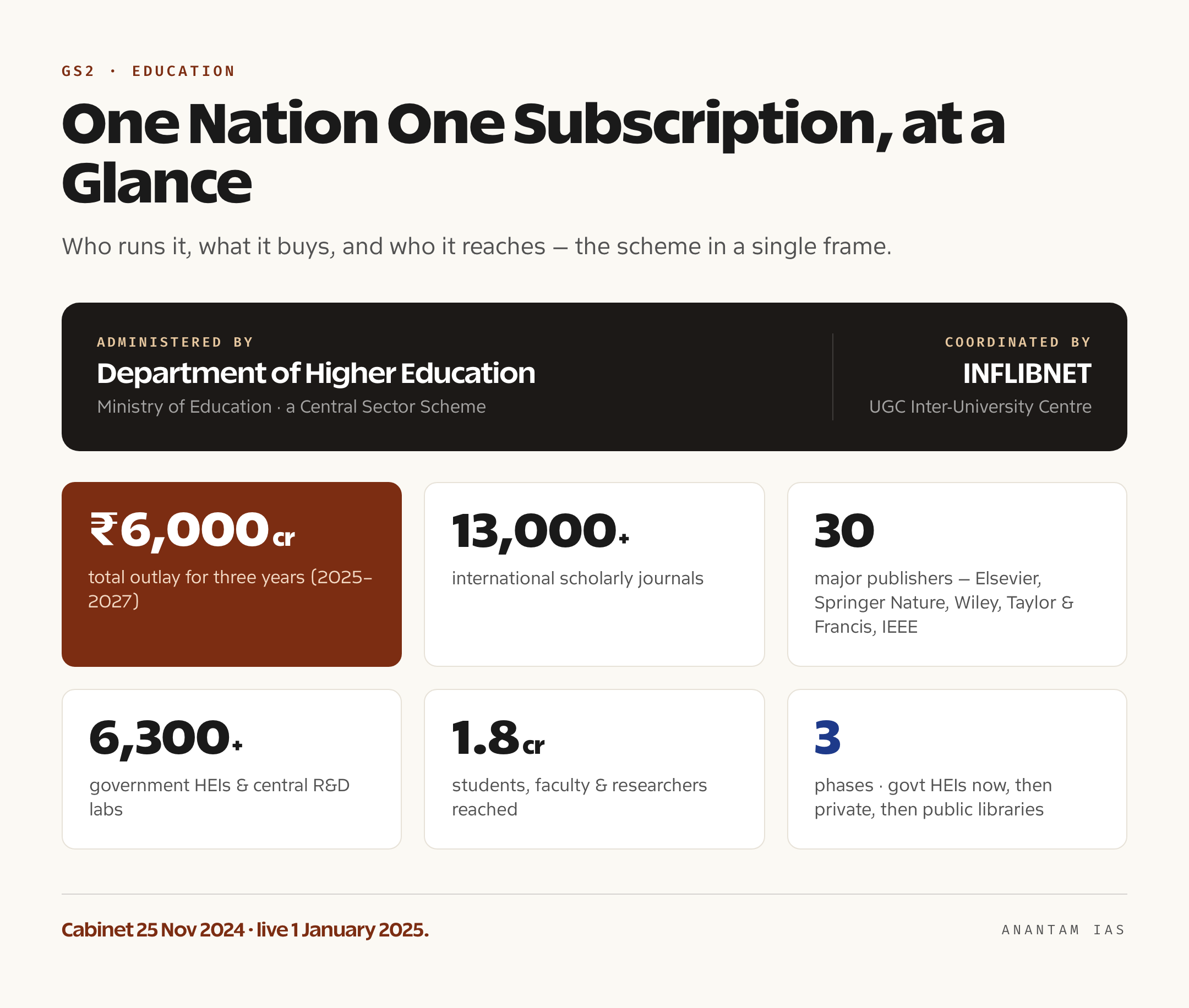
Let’s be precise about what One Nation One Subscription actually is, because the name is doing a lot of work. ONOS is a Central Sector Scheme, meaning it’s fully funded and run by the Union government rather than shared with the states, administered by the Department of Higher Education under the Ministry of Education. It’s a single, nationally coordinated subscription: instead of each university and laboratory negotiating and paying for journal access on its own, the government negotiates one national licence with the major academic publishers and pays for it centrally, so that everyone in a government higher-education institution or central research lab can read those journals for free at the point of use.
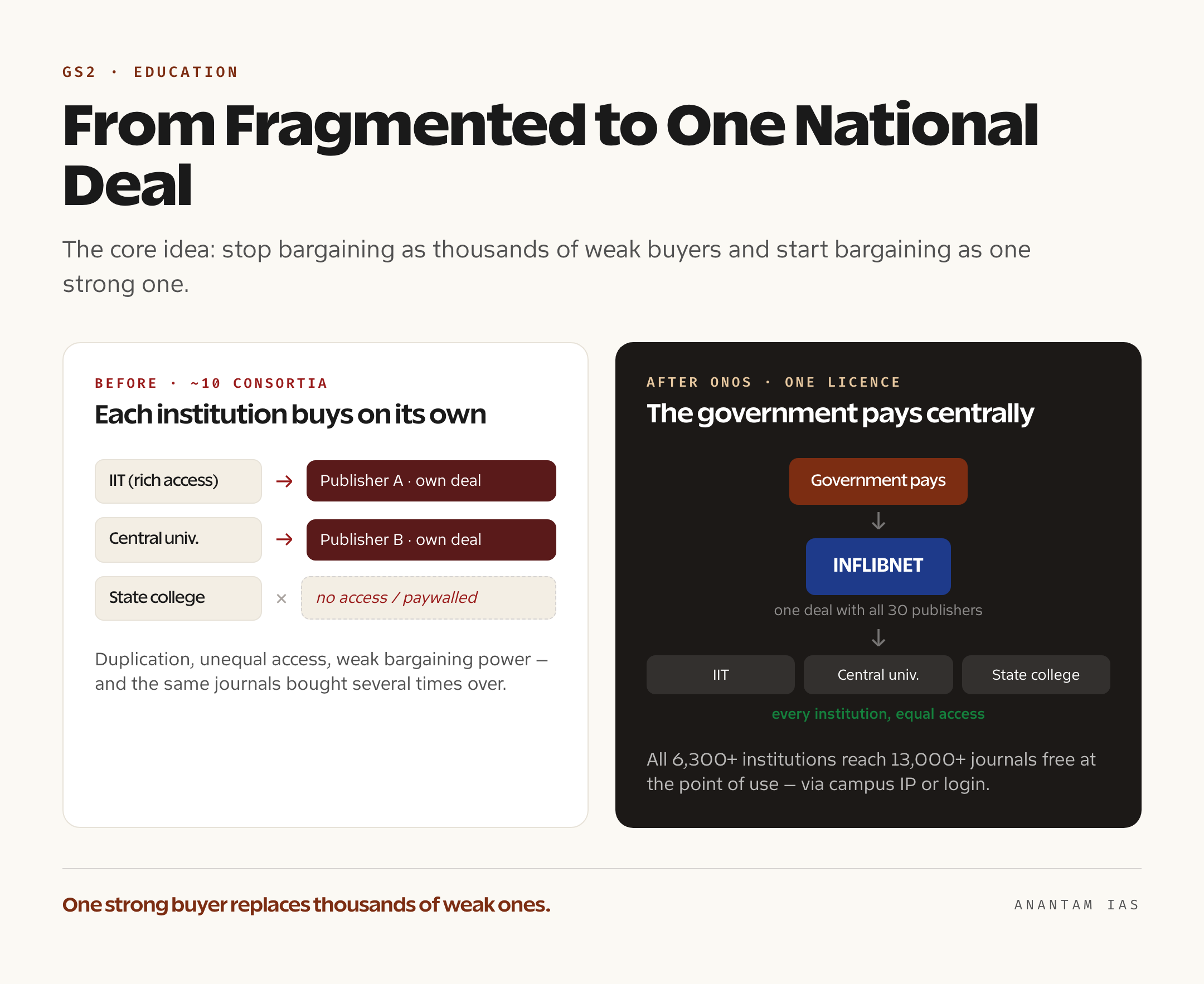
The “why now” rests on a problem India had been patching badly for years. Academic publishing is a peculiar market. Researchers, often publicly funded, hand their papers to a handful of large commercial publishers for free; the publishers then sell that research back to universities through eye-watering subscriptions. To cope, India had built up roughly ten separate library consortia over the years, scattered across different ministries and disciplines. The biggest, e-ShodhSindhu, was itself a merger of three earlier consortia, including the old UGC-INFONET. The result was a fragmented, overlapping mess: some institutions had rich access, many had almost none, the same journals were bought several times over by different bodies, and the government had no single view of what it was paying. ONOS subsumes that tangle into one deal.
So the launch logic has two strands. The first is equity. The government’s own framing is blunt: access to research should not depend on the wealth or prestige of your institution. By centralising the buy, ONOS extends the same 13,000-plus journals to a college in a small town that an IIT already enjoys. The second is leverage. When 6,000-plus institutions bargain separately, each is a small buyer the publisher can squeeze; when the nation bargains as one, it walks in as the single largest customer in the room. The Office of the Principal Scientific Adviser, which chairs the Core Committee of Secretaries overseeing the scheme, pushed exactly this argument: consolidate the demand, and you change who holds the cards at the negotiating table.
Features, Coverage and How It Works
Here is the architecture in plain terms, because the numbers are precisely what gets tested. ONOS carries a total outlay of about ₹6,000 crore for three years, covering 2025, 2026 and 2027, which works out to roughly ₹2,000 crore a year. For that money, it provides access to more than 13,000 international scholarly journals from 30 major publishers, including the big four that dominate global academic publishing, Elsevier, Springer Nature, Wiley and Taylor & Francis, alongside houses like IEEE. Those journals reach nearly 6,300 government institutions, central and state universities, colleges including every government medical college, and central R&D laboratories, and through them an estimated 1.8 crore, or about 18 million, students, faculty and researchers.
The mechanism is what makes it work, so understand it as a single national pipe rather than thousands of taps. The coordinating body is the Information and Library Network, or INFLIBNET, an Inter-University Centre of the University Grants Commission based in Gandhinagar. INFLIBNET negotiates the licence, makes the payments to all 30 publishers centrally, and runs a unified digital platform, the portal at onos.gov.in, through which institutions reach the journals. A user gets in either through their campus IP address, so any device on the institution’s network is automatically recognised, or through individual login credentials that also allow off-campus access, so a researcher can read from home. There is no per-article charge to the user and no separate subscription for the institution to manage; the government has already paid upstream.
A few design features are worth holding onto. ONOS is being rolled out in three phases. Phase 1, the one now live, covers government higher-education institutions and central R&D bodies. Phase 2 plans to extend access to private institutions, possibly for a nominal fee, recognising that a large share of Indian students study in private colleges. Phase 3 envisages universal access through public libraries, so that, in principle, any citizen could walk into a library and read frontier research. Alongside the subscription itself, the scheme sets aside a dedicated fund of about ₹150 crore a year to cover Article Processing Charges, the fees that authors pay to publish their own work in open-access journals, so the deal isn’t only about reading others’ research but also about helping Indians publish their own. And the scheme is deliberately framed as a pillar of the larger ecosystem, dovetailing with the National Education Policy 2020’s push on research and with the new Anusandhan National Research Foundation, or ANRF, which is meant to seed a research culture in tier-2 and tier-3 institutions that ONOS now equips with the reading material.
Significance and Early Results
Strip away the launch fanfare and the real promise of ONOS is straightforward: it tries to make knowledge a public good rather than a luxury that tracks an institution’s budget. For a postgraduate in a district college, the difference is concrete. Yesterday, a key paper sat behind a paywall they couldn’t cross; today it opens with a click. That single change, multiplied across 1.8 crore people, is meant to do something India’s research system has badly needed, which is to widen the base of who can do serious work, not just deepen the privilege of those already at the top.
The significance runs along several lines an examiner will reward you for separating. First, equity and the urban-elite divide. India’s research output has long been concentrated in a handful of metropolitan institutions, partly because they were the only ones who could afford to read. ONOS attacks that geographic and class skew at its root. Second, research capacity and the knowledge economy. You can’t contribute to a conversation you can’t hear; giving every researcher the literature is a precondition for raising India’s quality and quantity of original work, which matters for everything from drug discovery to climate modelling. Third, fiscal and administrative rationalisation. One national deal removes the duplication of ten overlapping consortia, gives the government a single transparent bill, and uses the country’s full bargaining weight against publishers who had grown used to charging India repeatedly for the same content.
And the early evidence is genuinely encouraging, which matters because so many Indian schemes look good only on paper. In its first year, 2025, the platform recorded over 11.3 crore research-article downloads, with users pulling roughly one crore articles every month. The reach widened sharply too: the number of participating higher-education institutions grew from about 2,300 to nearly 5,800, and the user base climbed from around 55 lakh to roughly one crore active users. Usage was led by the research heavyweights, with IIT Madras topping the charts at over 40 lakh downloads, followed by the Indian Institute of Science, Banaras Hindu University and Delhi University. So in pure access terms, the scheme is doing exactly what it promised: more people are reading more research than ever before. The harder question, which the next section takes up, is whether reading more is the same as researching better.
Criticisms and the Open-Access Debate
Now the honest part, because UPSC answers live or die on balance, and ONOS attracts a serious, well-argued critique that you should be able to put on the table. The central charge is that the scheme, for all its democratising language, mostly enriches the very commercial publishers whose pricing created the problem in the first place. India will spend on the order of ₹2,000 crore a year on these subscriptions, and analysts at the London School of Economics and elsewhere have pointed out that this is more than double the figure that earlier estimates suggested a national deal would cost, not less. A member of the negotiating process was quoted to the effect that the policy “has not resulted in savings” for India. Buying in bulk gave the country reach, but it did not obviously give it a better price.
There’s a deeper argument underneath that, and it goes to the future of how research is shared. The world is steadily moving toward open access, where research is free for anyone to read the moment it’s published, paid for at the publishing end rather than the reading end. By some estimates around half of the articles published in 2023-24 are already freely available somewhere, which raises an awkward question: why pay a premium subscription for a large body of work that is, or is becoming, free anyway? Critics argue India should have leaned harder into the alternatives, namely green open access, where authors deposit their papers in free public repositories, and so-called diamond open access, where journals charge neither readers nor authors, backed by stronger support for Article Processing Charges so Indian scholars can publish openly. On this view, ₹6,000 crore poured into legacy publishers is money spent renting access to a model that the rest of the world is trying to leave behind.
A third strand of criticism is about who actually benefits. Studies of journal usage have repeatedly found that even at well-funded institutions, researchers use only a small fraction of the journals they subscribe to, sometimes under a fifth. And the bulk of India’s research output still comes from a few hundred institutions; of more than 1,300 Indian research bodies, only a few hundred publish at any real scale. So extending 13,000 journals to 6,300 institutions, the worry runs, hands esoteric specialist content to many places that lack the faculty and research culture to use it, while the genuine bottleneck, research capacity, goes unaddressed. Reading material, in other words, is necessary but not sufficient; a college without active researchers won’t suddenly produce them because the journals turned on.
So what’s the balanced way to hold all this? The fair conclusion is that ONOS is a real and worthwhile reform that solved the access problem cleanly while leaving two harder problems open: cost discipline against powerful publishers, and the deeper task of building research capacity rather than just research access. The sensible way forward is not to abandon the scheme but to evolve it, using India’s enormous bargaining weight to push publishers toward transformative, open-access-leaning agreements over time, expanding the Article Processing Charge support so that Indian work is read globally, completing the move to private institutions and public libraries in Phases 2 and 3, and pairing the reading subscription with the capacity-building that ANRF is meant to deliver. Access was the easy half. Turning access into output is the half still to be earned.
For Your Mains Answer
This topic maps cleanly to GS Paper 2 (government policies and interventions, education, and issues of access and equity) and to GS Paper 3 (science and technology developments, and the research and innovation ecosystem). It’s also useful in essay and interview discussions on the knowledge economy, public goods, and the politics of academic publishing.
How to Build the Answer
Lead with the problem, not the press release. Frame ONOS as a fix for a specific failure, the paywall-and-fragmentation trap that left most Indian researchers unable to read their own field, then lay out its design (what it is, who runs it, the coverage and outlay), its significance (equity, research capacity, fiscal rationalisation), and its early results. Then turn the answer with the open-access critique and close on a calibrated way forward. That problem, design, significance, critique, reform arc fits almost any “evaluate this scheme” question.
Common Mistakes to Avoid
Don’t call ONOS an open-access scheme; it is a centrally bought subscription deal with commercial publishers, and confusing the two signals shallow reading. Don’t misplace the agency; it’s coordinated by INFLIBNET, a UGC inter-university centre under the Ministry of Education, not by a science ministry. Don’t present the reach figures as proof of success without acknowledging the cost and capacity critiques. And don’t forget the phased design, examiners like candidates who know Phase 1 is only government institutions.
A Compact Answer Spine
Problem (paywalls plus ten fragmented consortia, access tied to institutional wealth) → Design (Central Sector scheme, Department of Higher Education, ~₹6,000 crore for 2025-27, 13,000+ journals from 30 publishers, ~6,300 institutions, ~1.8 crore users, run via INFLIBNET, three phases, ₹150 crore/year APC fund) → Significance (equity, research capacity, knowledge economy, fiscal rationalisation, NEP 2020 and ANRF link) → Early results (11.3 crore downloads in 2025) → Critique (enriches publishers, no real savings, open-access alternatives, low actual usage) → Way forward (transformative agreements, APC expansion, Phases 2-3, capacity-building).
Diagram or Flowchart Idea
Draw two panels side by side. On the left, “Before”: a row of institutions, each with its own arrow paying its own publisher, some boxes full and some empty. On the right, “After ONOS”: all institutions feeding into one box marked INFLIBNET, which strikes one national deal with the publishers and pipes journals back to every institution equally. The visual contrast between fragmented and unified buying earns marks in seconds.
A Balanced-Conclusion Line
“One Nation One Subscription has solved the easy half of India’s research problem, access, with a clean and democratising stroke; the harder half, paying publishers less and building genuine research capacity in the institutions now switched on, is the test by which the scheme will ultimately be judged.”
How to Use Data Without Cramming
Memorise one tight set and deploy it surgically: ~₹6,000 crore over 2025-27 / 13,000+ journals / 30 publishers / ~6,300 institutions / ~1.8 crore users for the scale; “11.3 crore downloads in its first year” for the result; and “around ₹2,000 crore a year, more than double earlier estimates, with no real savings” for the critique. Three clusters, three points. Don’t recite all of them unless the question is descriptive.
FAQ
What is One Nation One Subscription (ONOS) and who runs it? ONOS is a Central Sector Scheme of the Department of Higher Education under the Ministry of Education, approved by the Union Cabinet on 25 November 2024 and operational since 1 January 2025. It provides students, faculty and researchers in government institutions with free access to international scholarly journals through one nationally negotiated, centrally paid subscription, coordinated by the Information and Library Network (INFLIBNET), a UGC inter-university centre.
What does ONOS cover, and at what cost? The scheme carries an outlay of about ₹6,000 crore for three years (2025-2027), roughly ₹2,000 crore a year. It provides access to more than 13,000 international journals from 30 major publishers, including Elsevier, Springer Nature, Wiley and Taylor & Francis, reaching nearly 6,300 government higher-education and R&D institutions and an estimated 1.8 crore students, faculty and researchers.
How is ONOS different from the earlier system? Before ONOS, India ran around ten separate library consortia, such as e-ShodhSindhu, with institutions buying journal access piecemeal, leading to duplication, unequal access and weak bargaining power. ONOS subsumes that fragmented system into a single national licence, negotiated and paid centrally by the government through INFLIBNET, so the country bargains as one large buyer and access no longer depends on an institution’s wealth.
Why do critics still argue for open access instead? Critics point out that ONOS spends around ₹2,000 crore a year with commercial publishers, more than double some earlier estimates and without clear savings, while much research is already freely available. They argue India should lean harder into green and diamond open access and stronger support for Article Processing Charges, so that research is free at the point of publication rather than rented through subscriptions, and should pair access with real research-capacity building.
Practice Questions
Prelims MCQs
- With reference to the One Nation One Subscription (ONOS) scheme, consider the following statements. Which is/are correct?
(a) It is a Centrally Sponsored Scheme shared between the Union and the states
(b) It is administered by the Department of Higher Education under the Ministry of Education
(c) It is coordinated by INFLIBNET, an Inter-University Centre of the UGC
(d) Both
(b) and (c).
Answer: (d) ONOS is a Central Sector Scheme (fully Union-funded), not Centrally Sponsored, so
(a) is wrong; it is run by the Department of Higher Education and coordinated by INFLIBNET, so
(b) and
(c) are correct. - Regarding the coverage and outlay of ONOS, which statement is correct?
(a) It has an outlay of about ₹6,000 crore for three years (2025-2027)
(b) It covers fewer than 5,000 journals
(c) It involves only the four largest publishers
(d) It is funded entirely through corporate CSR.
Answer: (a) ONOS has an outlay of roughly ₹6,000 crore for 2025-2027; it covers more than 13,000 journals from 30 publishers and is government-funded, so the other options are wrong. - ONOS is being implemented in phases. Which sequence is correct?
(a) Public libraries first, then private institutions, then government institutions
(b) Government higher-education and R&D institutions in Phase 1, private institutions in Phase 2, universal access via public libraries in Phase 3
(c) Private institutions first, then government institutions
(d) All categories simultaneously from January 2025.
Answer: (b) Phase 1 covers government institutions and central R&D bodies; Phase 2 plans to add private institutions; Phase 3 envisages universal access through public libraries. - Which of the following best describes how ONOS changed the earlier arrangement?
(a) It created India’s first-ever journal subscription
(b) It replaced fragmented consortia like e-ShodhSindhu with a single, centrally negotiated national subscription
(c) It made all journals open access at the point of publication
(d) It transferred journal procurement to individual state governments.
Answer: (b) ONOS subsumes about ten earlier consortia, including e-ShodhSindhu, into one national licence paid centrally; it is a subscription deal, not open access, and procurement is centralised, not devolved. - Consider the following about ONOS:
1. It includes a dedicated fund for Article Processing Charges.
2. It aligns with NEP 2020 and complements the Anusandhan National Research Foundation.
3. It guarantees free journal access to every Indian citizen from Phase 1. Which are correct?
(a) 1 and 2 only
(b) 1 and 3 only
(c) 2 and 3 only
(d) 1, 2 and 3.
Answer: (a) ONOS includes an APC support fund (about ₹150 crore a year) and is tied to NEP 2020 and ANRF; universal citizen access via public libraries is only the proposed Phase 3, not Phase 1, so statement 3 is wrong.
Mains Practice Questions
- “One Nation One Subscription solves the access problem but not the capacity problem.” Critically examine the design and early outcomes of ONOS in light of this statement. (15 marks, 250 words)
- Discuss how ONOS attempts to address the inequality in research access between elite and ordinary institutions in India, and the risks that this access may not translate into research output. (15 marks, 250 words)
- Examine the argument that a national subscription deal with commercial publishers, however large, is a step away from the global shift toward open access. What alternatives could India have pursued? (15 marks, 250 words)
- Evaluate the role of consolidating demand and centralised negotiation in public procurement, using ONOS and the earlier fragmented library consortia as a case study. (10 marks, 150 words)
- “Access to knowledge is a precondition for, but not a guarantee of, a knowledge economy.” In this light, assess the place of ONOS within India’s wider research and innovation ecosystem, including NEP 2020 and ANRF. (15 marks, 250 words)