Organized Crime & Terrorism Linkages in India for UPSC
UPSC guide on the crime-terror nexus covering drug trafficking, arms smuggling, FICN, hawala networks, cyber crime-terror linkages, and India's legal framework including PMLA and MCOCA.
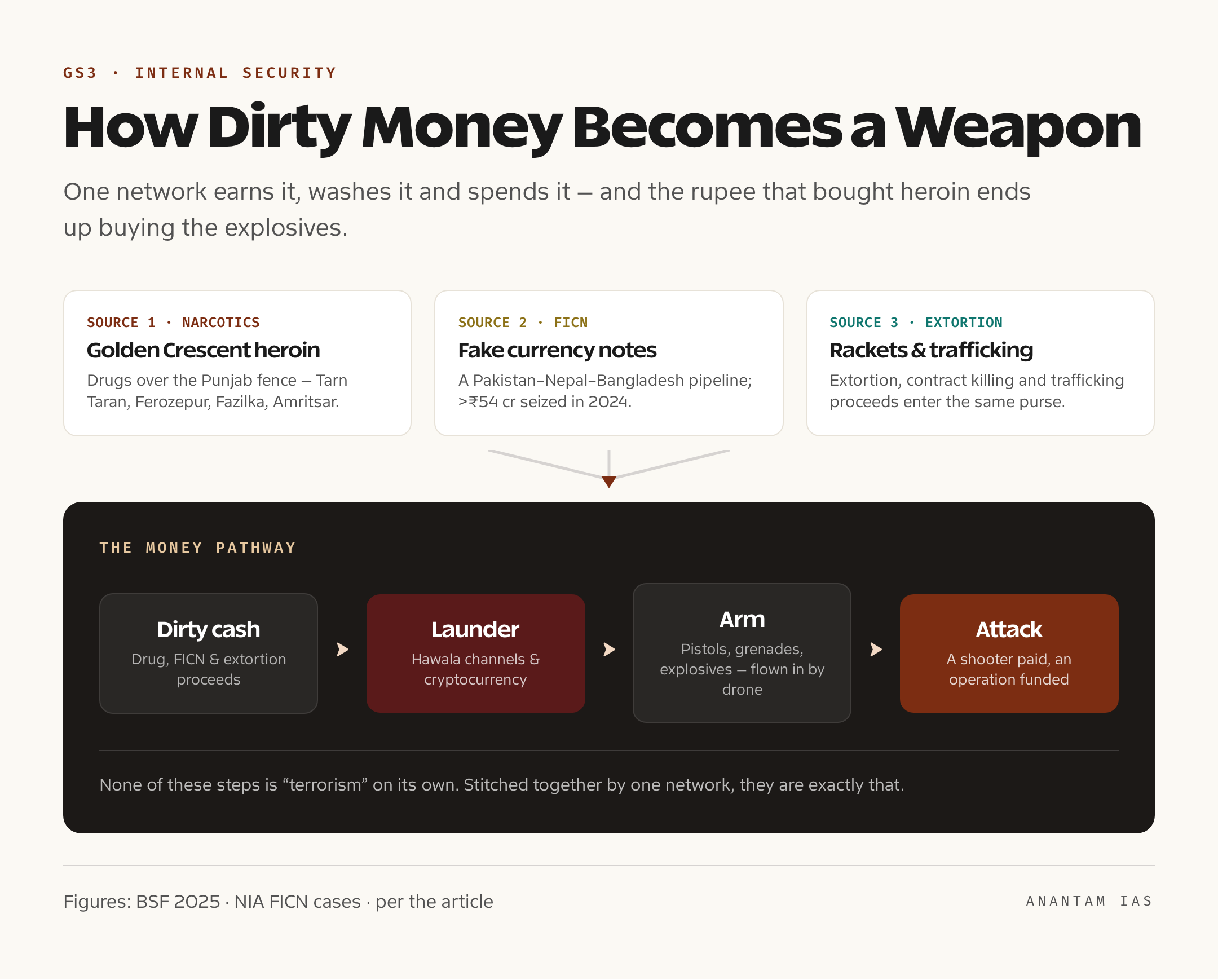
A heroin packet drops out of the night sky over a Punjab village, released by a small Chinese-made quadcopter that crossed the fence from Pakistan minutes earlier. A few districts away, the same network ferries a consignment of pistols and a couple of grenades. The drugs will be sold, the money will move through hawala channels, and some of it will end up paying a shooter or buying the explosives for an attack. None of those steps is “terrorism” on its own. Stitched together, they are exactly that.
This is the crime-terror nexus, and it is one of the hardest internal-security problems India faces, precisely because it refuses to sit in a single box. We tend to treat crime and terrorism as separate worlds — one driven by greed, the other by ideology, one a state subject for the police, the other a national-security matter for central agencies. But the people moving drugs, fake notes, weapons and trafficked humans across India’s borders increasingly serve both masters at once. Understanding how that fusion works, and how shaky our response to it has been, is now central to the GS3 internal-security syllabus.
The Challenge, Framed
Start with the two terms, because the exam rewards precision. Organised crime is continuing illegal activity carried out by a structured group — a syndicate — through violence, intimidation or corruption, for financial or material gain. Think extortion, kidnapping for ransom, drug and arms trafficking, human trafficking, counterfeiting, contract killing and large-scale fraud. The defining feature isn’t the individual crime; it’s the enterprise — a durable network with a hierarchy, a business model and the muscle to protect it. Terrorism, by contrast, is violence or its threat aimed at a political or ideological end: striking fear into a population, or coercing a government. Greed versus grievance, profit versus politics.
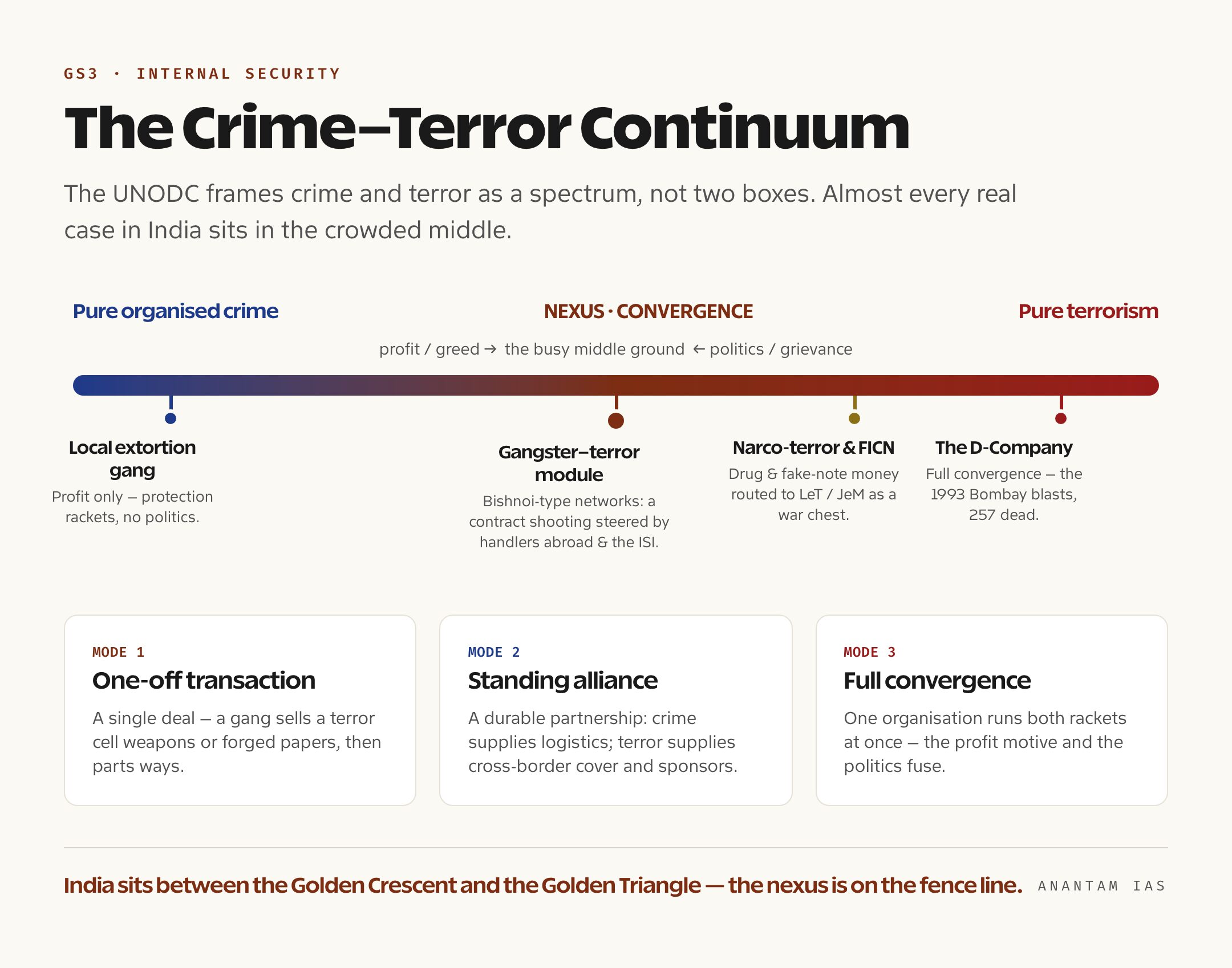
So why bracket them together? Because the wall between them has worn thin. Scholars writing for the UN Office on Drugs and Crime describe a “crime-terror continuum” — a spectrum on which a pure criminal gang sits at one end and a pure terror outfit at the other, with a wide, busy middle ground where the two borrow from each other. A terror group needs money, weapons and forged documents, and crime supplies all three. A criminal syndicate needs to move contraband across hostile borders, and a terror group’s cross-border infrastructure and state sponsors make excellent logistics. The relationship can be a one-off transaction, a standing alliance, or full convergence, where a single organisation runs both rackets. India sits in a uniquely bad neighbourhood for this. It is wedged between the world’s two great opium zones — the Golden Crescent of Afghanistan, Pakistan and Iran to the west, and the Golden Triangle of Myanmar, Laos and Thailand to the east — and shares long, porous, often hostile land and sea borders. The geography alone guarantees that the nexus is not a foreign abstraction here. It is on the fence line.
Where Crime Meets Terror
Look at how the convergence actually works on the ground, and the abstraction becomes concrete fast. The clearest case is narco-terrorism — terror groups using the drug trade’s routes, money and corrupt networks to fund and arm themselves. Research by the Observer Research Foundation has long flagged that India’s location between the Golden Crescent and Golden Triangle makes it both a transit corridor and a target. The western border is the live wire. Punjab’s proximity to Pakistan has turned districts like Tarn Taran, Ferozepur, Fazilka and Amritsar into entry points for Golden Crescent heroin, and security analysts estimate that a meaningful share of drug smuggling in Jammu and Kashmir — figures cited in the 20 to 30 per cent range — is tied to groups such as Lashkar-e-Taiba and Jaish-e-Mohammed. The drugs raise cash; the cash buys weapons and pays operatives. The crime is the war chest.
And the delivery method has gone airborne. The most striking shift of the last few years is the drone. According to figures released by the Border Security Force, in 2025 the BSF seized 272 drones along the Punjab border alone, together with over 367 kilograms of heroin smuggled in from Pakistan between January and November — drones dropping not just narcotics but pistols, grenades and explosives across the fence. From a literal handful of drone incidents in 2021, this has become a routine cross-border supply line. It collapses the old assumption that you stop smuggling by guarding the ground.
Money is the other connective tissue, and here fake Indian currency notes — FICN — are the textbook weapon. Counterfeit notes do double duty: they bleed the economy and they finance operations. Indian agencies have traced a Pakistan-Nepal-Bangladesh pipeline pushing high-quality FICN into the country, and a 2024 case investigated by the National Investigation Agency in Champaran, Bihar, showed the modern twist — counterfeit notes sourced from Pakistan-based entities through Nepali handlers, paid for in cryptocurrency. India seized more than 54 crore rupees in fake notes in 2024 by official accounts, part of hundreds of crores recovered since 2017. The NIA is now the nodal agency for high-value FICN cases and runs a dedicated Terror Funding and Fake Currency cell precisely because the counterfeiting and the terror financing are the same investigation.
Then there is the archetype that taught India this lesson the hard way: the D-Company. Dawood Ibrahim’s Mumbai syndicate began in the 1970s as a classic crime enterprise — extortion, smuggling, gold, contract killings, film piracy. It crossed the line in March 1993, when it coordinated the serial Bombay bombings that killed 257 people, allegedly moving the arms and explosives through a Dubai-Karachi route with help from Pakistan’s intelligence service. A criminal network became a terror delivery system, and Dawood was later designated a global terrorist by both the United Nations and the United States. That is convergence in its purest, most devastating form.
What’s newer is the gangster-terror module. Indian agencies now routinely describe networks that look like ordinary organised crime — extortion calls, targeted shootings, vehicle theft — but are quietly steered by handlers abroad and tied to terror outfits. The Lawrence Bishnoi gang is the example everyone cites: its jailed boss is said to direct a network of hundreds of operatives across states, and investigators have linked associated modules to Pakistan’s ISI and to pro-Khalistan groups such as Babbar Khalsa International. In November 2025, Anmol Bishnoi, the boss’s brother, was extradited from the United States and arrested by the NIA, facing dozens of cases spanning both organised-crime and terrorism law. The pattern matters: a young man recruited online for a shooting may not know or care whether his paymaster’s motive is profit or politics. To him it is a contract. To national security it is the nexus operating through a gun for hire.
India’s Institutional Response
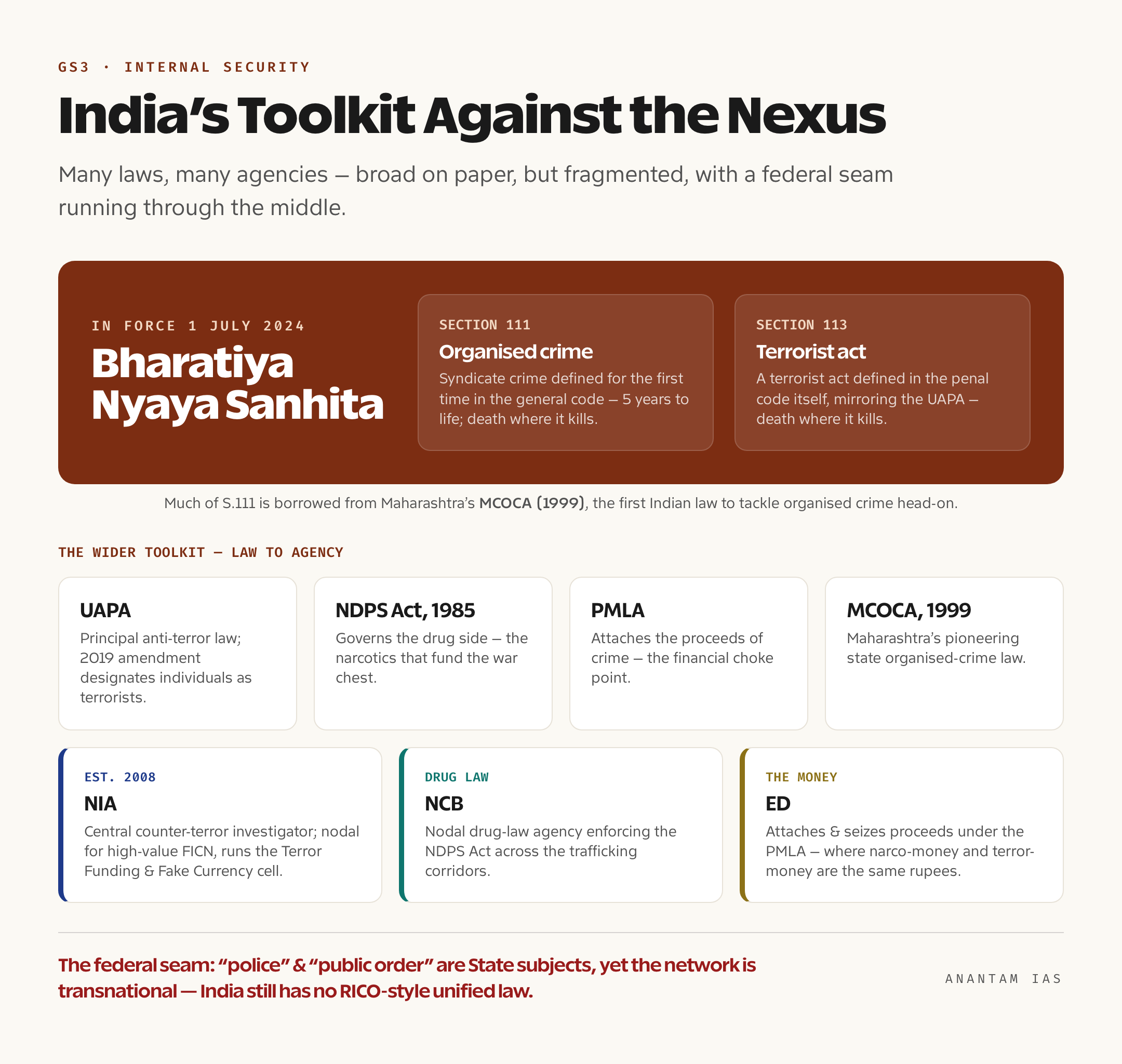
For a long time India’s biggest weakness was conceptual: there was no dedicated central law against organised crime, and the very word “terrorism” had no home in the ordinary criminal code. That changed with the Bharatiya Nyaya Sanhita, which replaced the colonial-era Indian Penal Code when the new criminal laws came into force on 1 July 2024. For the first time, the general penal code itself defines both offences. Section 111 of the BNS criminalises organised crime — continuing unlawful activity by a syndicate, covering kidnapping, extortion, contract killing, land grabbing, economic offences, cyber-crime and trafficking in people, drugs and weapons — with punishment running from five years to life, and the death penalty or life imprisonment where the crime causes death. Section 112 adds “petty organised crime” for gang-run theft and snatching. Section 113 defines a terrorist act in language that closely mirrors the older anti-terror statute, carrying the death penalty where it kills. Much of Section 111 is borrowed from state legislation that pioneered this ground, above all the Maharashtra Control of Organised Crime Act of 1999, MCOCA, the first Indian law to take organised crime head-on.
Even so, the BNS sits inside a wider toolkit rather than replacing it. The Unlawful Activities (Prevention) Act, the UAPA, remains the principal anti-terror law; amended in 2019, it lets the central government designate not just organisations but individuals as terrorists. The Narcotic Drugs and Psychotropic Substances Act of 1985, the NDPS Act, governs the drug side, enforced by the Narcotics Control Bureau, the NCB, the nodal drug-law agency. The Prevention of Money Laundering Act, the PMLA, lets the Enforcement Directorate, the ED, attach and seize the proceeds of crime — the financial choke point where narco-money and terror-money are often the same rupees. And the National Investigation Agency, created by law in 2008 in the aftermath of the 26/11 Mumbai attacks and expanded in 2019, is the central counter-terror investigator, with a mandate that now explicitly reaches human trafficking, counterfeit currency, illegal arms manufacture and cyber-terrorism — the connective offences of the nexus.
On the international side, India is a party to the UN Convention against Transnational Organized Crime, the Palermo Convention, and it scored a notable win at the Financial Action Task Force, the global money-laundering and terror-financing watchdog. In its 2024 mutual evaluation, published that September, the FATF placed India in “regular follow-up” — its best category, shared with G20 peers like the United Kingdom and France — crediting strong technical compliance and a real ability to run complex financial investigations. The architecture, in short, is no longer empty. The question is whether it works as a system.
Where the System Falls Short
It often doesn’t, and the reasons are structural rather than a matter of effort. The deepest fault line is federal. Under the Constitution, “police” and “public order” are State subjects — crime is, by design, a state’s business — yet the networks we are talking about are transnational by nature. A syndicate can run extortion from a Dubai phone, source weapons through Pakistan, route money through Nepal and crypto wallets, and pull a trigger in Maharashtra, all in a single operation. No state police force can follow that chain to its end, and the central agencies that can are forever negotiating jurisdiction. The result is a fragmented response chasing a seamless threat. India still has no genuinely unified federal organised-crime law of the American RICO kind; the BNS provisions are a real advance, but they are tried in ordinary courts by state police who may lack the reach to prove a cross-border enterprise.
Coordination is the next gap. The NIA, NCB, ED, state police, customs and the BSF each hold a piece of the picture, and the pieces don’t always meet. A drug seizure, a fake-note racket and a terror-funding trail can be three separate case files in three agencies when they are, in truth, one network. There have been steps to fix this — NATGRID to share databases, the NIA’s fake-currency cell — but information silos persist. Then comes the courtroom problem. Stringent special laws are easy to invoke and hard to conclude: under both the UAPA and the new BNS provisions, undertrials can spend years in jail before a verdict, while conviction rates stay low. The FATF made exactly this point in 2024, praising India’s disruption work but pressing it to actually convict and sanction terror financiers rather than merely arrest them. Weak witness protection compounds it — witnesses against syndicates that kill for a living do not testify lightly, and India’s protection scheme remains thin.
And every tool here carries a rights cost that an honest analysis has to name. Laws built for the nexus — preventive detention, individual terror designation, relaxed bail, admissibility of certain confessions under state acts like MCOCA — are powerful precisely because they lower the safeguards that protect ordinary defendants. That power can be misused against dissent, journalists or minorities, and low conviction rates suggest some of it is being used as process-as-punishment. The security need is genuine; so is the civil-liberties concern. A response that ignores either one fails — either it cannot catch the network, or it corrodes the rule of law the network is attacking. Holding both is the actual job.
The Way Forward
- Treat the money as the main target. The nexus dies fastest when its cash dies. Strengthen the ED-NIA-NCB financial trail, build real capacity to trace cryptocurrency and hawala, and prioritise asset forfeiture under the PMLA so that crime stops paying.
- Build genuine coordination, not just more agencies. A standing, empowered fusion centre that pools intelligence from the BSF, state police, NCB, ED and NIA in real time would do more than another statute. Make NATGRID and the NIA’s fake-currency cell the norm, not the exception.
- Counter the technology with technology. The drone supply line needs counter-drone systems along the western border as standard kit, and investigators need lawful, capable tools for the dark web and crypto tracing — matched by trained cyber-forensic manpower in state forces, not only the centre.
- Fix the federal seam carefully. Use the BNS organised-crime provisions to give states a common vocabulary, while strengthening centre-state mechanisms for transnational cases — without simply centralising policing, which the Constitution resists for good reason.
- Invest in the unglamorous end — prosecution and protection. Faster special courts, better-trained prosecutors, and a credible witness-protection scheme are what turn arrests into convictions. The FATF’s 2024 message was blunt: disruption is not the same as justice.
- Keep rights in the design, not as an afterthought. Sunset clauses, judicial review of terror designations, time-bound trials and data-protection limits are not soft add-ons; they are what keep these powers legitimate and, over time, effective.
For Your Mains Answer
This topic maps directly to GS Paper 3, under “linkages between development and spread of extremism,” “role of external state and non-state actors in creating challenges to internal security,” “challenges to internal security through communication networks, role of media and social-networking sites,” “basics of cyber security; money-laundering and its prevention,” and “security challenges and their management in border areas.” It also feeds the “various Security forces and agencies and their mandate” sub-theme. Few topics let you touch so many syllabus points at once, so it is worth mastering as a flexible answer.
How to Build the Answer
Open by defining the convergence, not by listing crimes. State what organised crime is, what terrorism is, and the key insight that the two now overlap on a continuum. Then move from mechanism to response to critique: how the nexus works (narco-terror, FICN, drones, gangster modules), how India responds (BNS, UAPA, NDPS, PMLA, NIA, NCB, ED, FATF), where it falls short (federal fragmentation, coordination, conviction, rights), and a balanced way forward. That definition-mechanism-response-gap-solution arc fits almost any phrasing of the question.
Common Mistakes to Avoid
Don’t write it as a pure law-and-order rant; the examiner wants analysis, not alarm. Don’t ignore the federal dimension — “police is a State subject” is the single most rewarding point here. Don’t forget the rights angle; an answer that only demands tougher laws looks naive. Avoid naming live political cases or framing the issue in communal terms. And don’t overclaim figures — write “an estimated” or give a range when the data is contested.
A Compact Answer Spine
Crime and terror once separate → now a continuum (UNODC framing) → India’s geography between Golden Crescent and Golden Triangle → mechanisms: narco-terror and Punjab drones, FICN, D-Company archetype, gangster-terror modules → response: BNS 2023 defines organised crime (S.111) and terrorism (S.113) for the first time in the general code, plus UAPA, NDPS, PMLA, MCOCA and the NIA/NCB/ED → gaps: federal seam, coordination silos, low convictions, rights costs → way forward: follow the money, fuse intelligence, counter-drone and cyber capacity, faster trials, rights safeguards.
Diagram or Flowchart Idea
Draw a horizontal continuum arrow: “Pure organised crime” on the left, “Pure terrorism” on the right, and a shaded middle band labelled “nexus / convergence.” Plot India’s examples along it — a local extortion gang near the left, the gangster-terror module in the middle, D-Company near full convergence. A second small flow box — drugs/FICN to hawala/crypto to arms/drones to attack — shows the money pathway. Clean, fast to draw, and it signals you understand the spectrum rather than a binary.
The Rights-and-Security Balance Angle
The mature line for your conclusion: extraordinary powers are justified by an extraordinary threat, but their legitimacy depends on restraint — judicial oversight, time-bound trials, sunset clauses and witness protection. Note that low conviction rates under stringent laws are themselves a security failure, not just a rights failure, because they signal that disruption is not translating into deterrence.
How to Use Data Without Overclaiming
Anchor with a few verifiable figures and attribute them: the BSF’s seizure of 272 drones and over 367 kg of heroin along the Punjab border in 2025; the FATF’s 2024 “regular follow-up” rating; the BNS coming into force on 1 July 2024 with organised crime under Section 111. Hedge the contested ones — the “20 to 30 per cent” share of J&K drug money linked to terror groups is an estimate, so say so. Specific, sourced and honestly bounded beats a wall of round numbers.
FAQ
What is the crime-terror nexus, in simple terms? It’s the overlap between organised crime and terrorism. Organised crime is structured illegal enterprise for profit — drugs, extortion, trafficking, counterfeiting. Terrorism is violence for a political or ideological end. The nexus is the growing middle ground where terror groups use crime to raise money and weapons, and criminal networks lend terror groups their smuggling routes and logistics. Analysts picture it as a continuum running from pure crime at one end to pure terror at the other.
Does India have a dedicated central law against organised crime? Not a standalone one, but the gap has narrowed. The Bharatiya Nyaya Sanhita, in force since 1 July 2024, defines organised crime under Section 111 and a terrorist act under Section 113 — the first time both sit in India’s general penal code rather than only in special or state laws. India still relies on a toolkit: the UAPA for terrorism, the NDPS Act for drugs, the PMLA for money-laundering, and state laws like Maharashtra’s MCOCA, enforced by agencies including the NIA, NCB and ED.
What is narco-terrorism and why is Punjab so exposed? Narco-terrorism is the use of the drug trade — its routes, profits and networks — to fund and arm terrorism. Punjab is exposed because it borders Pakistan and lies on the trafficking path from the Golden Crescent, one of the world’s largest opium-producing regions. Smugglers now use drones to drop heroin and weapons across the border fence; the BSF reported seizing 272 such drones and over 367 kg of heroin along the Punjab border in 2025.
How does fake currency connect crime to terror? Fake Indian currency notes, or FICN, attack the economy and bankroll operations at the same time. Indian agencies have traced organised FICN pipelines through Pakistan, Nepal and Bangladesh, sometimes paid for in cryptocurrency, with the counterfeit cash feeding terror financing. That is why the NIA acts as the nodal agency for high-value FICN cases and runs a dedicated Terror Funding and Fake Currency cell — treating the counterfeiting and the terror funding as one investigation.