Panipat War: Three Battles of Panipat, Dates, Outcomes and UPSC Notes
Complete guide to the three Battles of Panipat in 1526, 1556 and 1761. Babur, Akbar, Marathas, Ahmad Shah Abdali, outcomes and significance for UPSC.
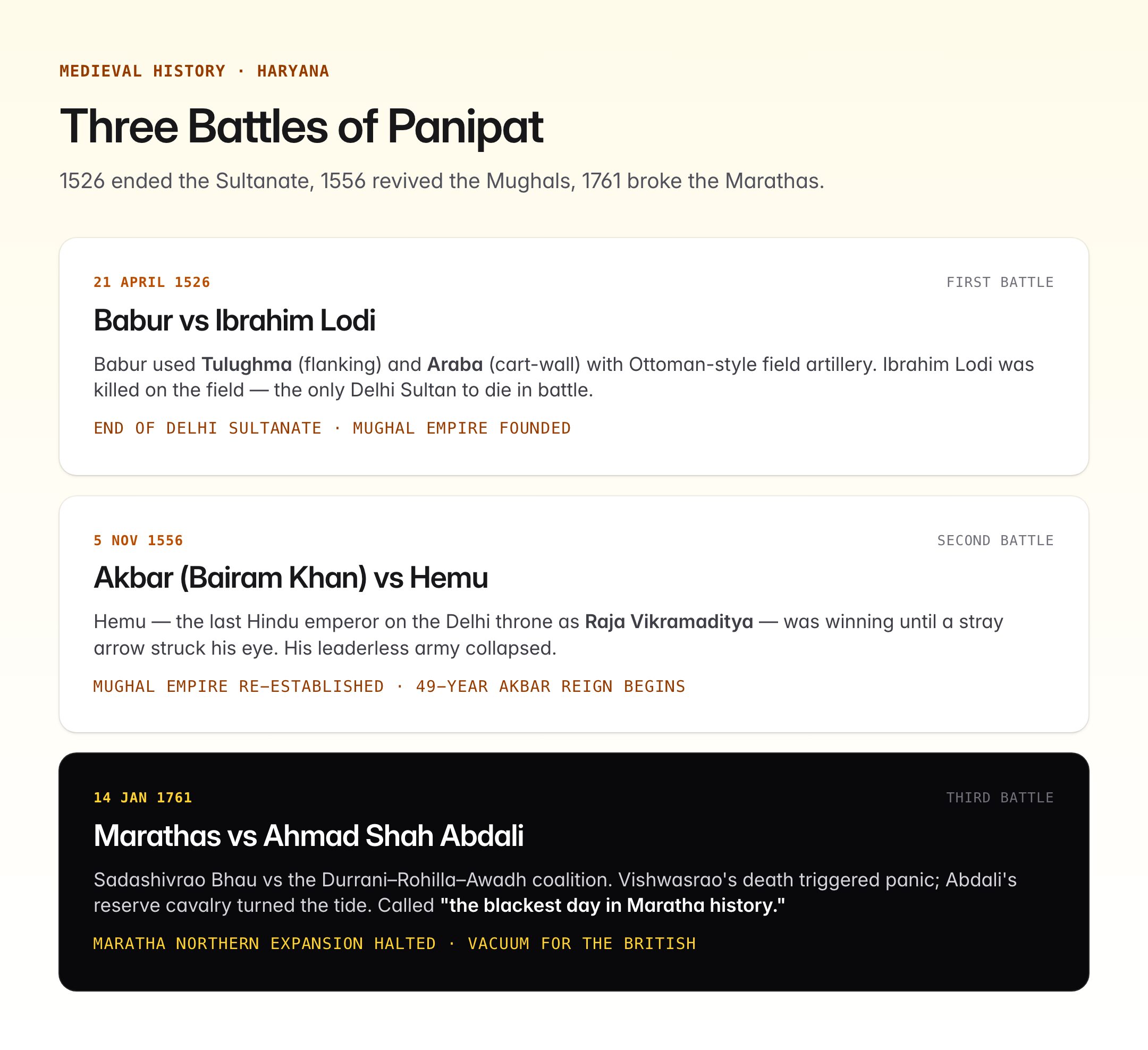
The Panipat War is a popular label for the three decisive battles fought at Panipat in present-day Haryana, each of which altered the political map of India. Panipat, located roughly 90 km north of Delhi on the banks of the Yamuna along the old Grand Trunk Road, was a natural battlefield for any army marching from Afghanistan or Central Asia towards the imperial city of Delhi. The three battles of 1526, 1556 and 1761 sealed, in turn, the fate of the Delhi Sultanate, the restoration of the Mughal Empire, and the Maratha expansion into North India.
Why Panipat?
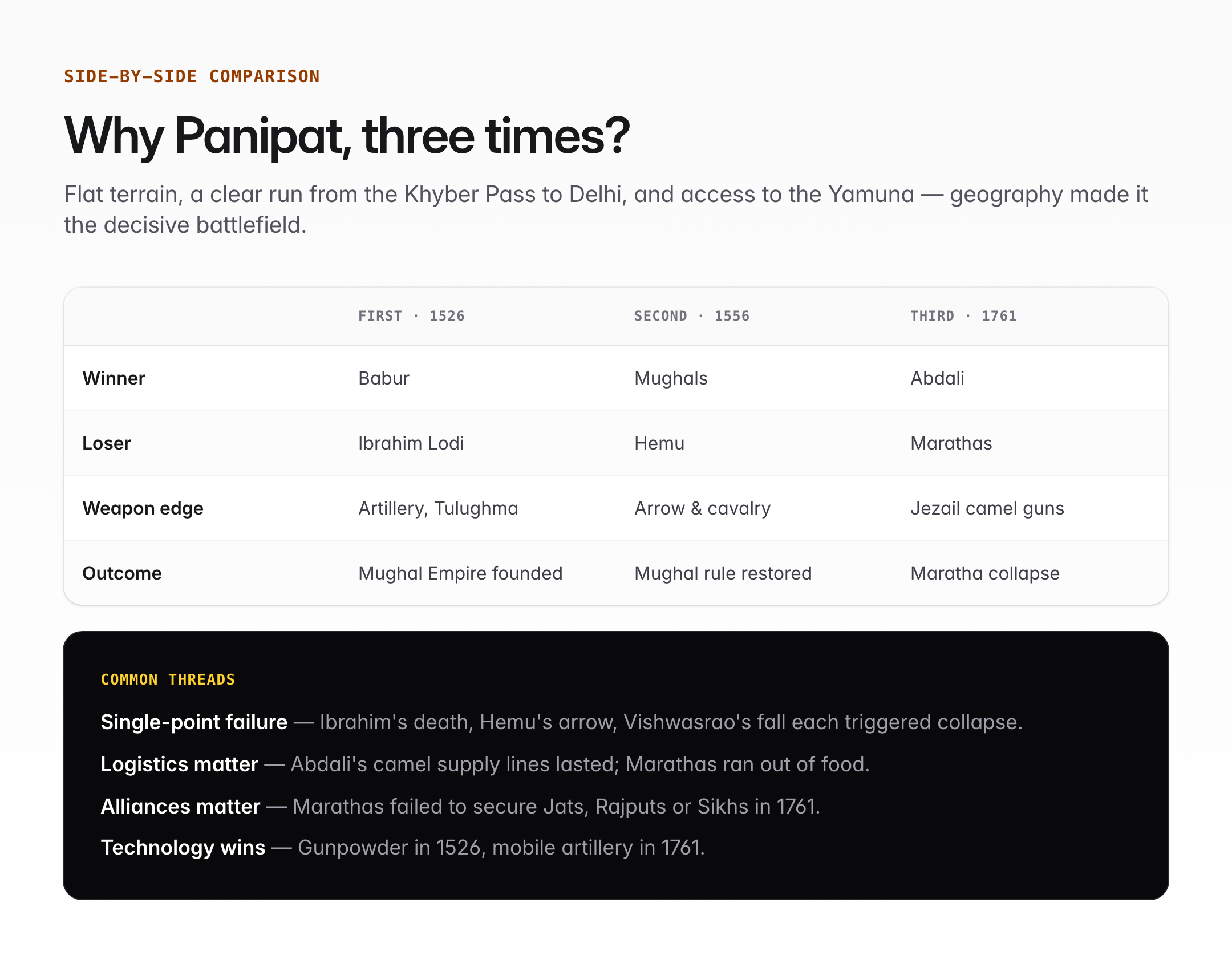
Panipat's flat, open plain lay on the main invasion corridor from the Khyber Pass to Delhi. Rivers, forests and hills are absent here, giving a decisive edge to armies with cavalry, artillery and maneuver. For defenders or invaders, control of Panipat effectively meant control of Delhi.
Overview Table: The Three Battles of Panipat
| Feature | First Battle (1526) | Second Battle (1556) | Third Battle (1761) |
|---|---|---|---|
| Date | 21 April 1526 | 5 November 1556 | 14 January 1761 |
| Contenders | Babur vs Ibrahim Lodi | Akbar (Bairam Khan) vs Hemu | Marathas (Sadashivrao Bhau) vs Ahmad Shah Abdali |
| Winner | Babur | Mughals (Akbar) | Ahmad Shah Abdali |
| Loser | Ibrahim Lodi (killed) | Hemu (captured and executed) | Marathas (Sadashivrao killed, Vishwasrao killed) |
| Weapons highlight | Gunpowder, field artillery, Tulughma | Elephants, cavalry, flying arrow that struck Hemu | Heavy artillery, mobile Afghan cavalry |
| Outcome | Foundation of Mughal Empire | Re-establishment of Mughal Empire | Collapse of Maratha northern ambitions |
First Battle of Panipat – 21 April 1526
The First Battle pitted Zahir-ud-din Muhammad Babur, the Timurid ruler of Kabul, against Ibrahim Lodi, the last sultan of the Delhi Sultanate.
Background
- Daulat Khan Lodi (governor of Punjab), Alam Khan (Ibrahim's uncle) and Rana Sanga of Mewar (according to some accounts) had invited Babur to attack Ibrahim.
- Babur had already made four earlier expeditions into India between 1519 and 1524.
- Ibrahim Lodi commanded a numerically superior force of around 1,00,000 troops and 1,000 elephants, while Babur had roughly 12,000-15,000 men.
Tactics
Babur used two innovations unprecedented in North Indian warfare.
| Tactic | Description |
|---|---|
| Tulughma | Division of the army into left, right, centre and flanking units for encirclement |
| Araba | Protective cart-wall (carts tied together) behind which musketeers and cannons operated |
| Ottoman-style artillery | Field artillery under Turkish gunners Ustad Ali Quli and Mustafa |
Result
Ibrahim Lodi was killed on the battlefield – the only Delhi Sultan to die in action. Babur occupied Delhi and then Agra.
Significance
- End of the Lodi dynasty and the Delhi Sultanate (1206-1526).
- Foundation of the Mughal Empire in India.
- Introduction of gunpowder warfare, field artillery and mobile tactics that transformed Indian warfare for the next two centuries.
- Brought the famous Koh-i-Noor diamond into Mughal possession.
Second Battle of Panipat – 5 November 1556
The Second Battle was fought between the forces of the young Akbar (aged 13), advised by his regent Bairam Khan, and Hemu Chandra Vikramaditya, the Hindu general and prime minister of Adil Shah Suri.
Background
- Babur's son Humayun had lost the empire to Sher Shah Suri in 1540 and regained it only in 1555.
- Humayun died in January 1556 after falling down the stairs of his library at Purana Qila. Akbar was crowned in Kalanaur, Punjab.
- Sensing weakness, Hemu, previously a market supervisor who had risen to be chief minister and general, seized Agra and Delhi (winning 22 successive battles) and crowned himself Raja Vikramaditya – becoming the last Hindu emperor to sit on the Delhi throne.
The Battle
Hemu had a large force, including a powerful elephant corps, and an early advantage over the Mughals. But a chance arrow struck him in the eye; he fell unconscious. His army, leaderless, panicked and disintegrated. Hemu was captured and beheaded by Bairam Khan (or, in some accounts, by Akbar himself for the symbolic title of Ghazi).
Significance
- Secured the restoration of Mughal rule in North India.
- Paved the way for Akbar's 49-year reign (1556-1605) and the consolidation of one of the world's greatest empires.
- Ended the last credible Afghan-Suri challenge to the Mughals.
- Demonstrated the fragility of medieval battles: a single arrow decided the fate of a continent.
Third Battle of Panipat – 14 January 1761
The Third Battle was fought between the Maratha Confederacy, led by Sadashivrao Bhau (cousin of Peshwa Balaji Baji Rao), and the Afghan ruler Ahmad Shah Abdali (Durrani), allied with Najib-ud-Daula of the Rohillas and the Nawab of Awadh, Shuja-ud-Daula.
Background
- After Aurangzeb's death in 1707, the Mughal Empire had fragmented, and the Marathas had extended their dominion across most of India.
- In 1757, the Maratha armies reached the Attock on the Indus.
- Ahmad Shah Abdali, who had repeatedly raided North India since 1748, invaded once again in 1759, turning back the Maratha advance.
- The Peshwa dispatched an army of about 45,000 soldiers under Sadashivrao Bhau and his young nephew Vishwasrao, accompanied by non-combatants (pilgrims, women, bazaar people).
The Battle
The armies camped opposite each other for nearly three months near Panipat. Both sides suffered supply shortages. On 14 January 1761, the Marathas launched an assault. The early morning went in their favour – the Durrani right flank wavered. But when Vishwasrao was killed by a stray bullet, Sadashivrao dismounted from his elephant to steady the troops. The missing elephant created rumours of his death, the Maratha army panicked, and Abdali's reserve Rohilla cavalry and fresh camel-mounted artillery (jezail) turned the tide.
| Casualty | Estimate |
|---|---|
| Marathas killed | 40,000-70,000 soldiers and non-combatants |
| Afghans killed | Around 20,000 |
Significance
- Though Abdali won militarily, his losses were so heavy that he left India soon after and never returned.
- The Marathas' northern advance was checked for a decade. However, they regained most of North India by 1770.
- More importantly, the battle created a power vacuum in North India that neither Marathas nor Afghans could fully fill – a vacuum into which the British East India Company, victorious at Plassey (1757) and Buxar (1764), eventually stepped.
- It was described by contemporaries as "the blackest day in Maratha history" – almost an entire generation of Maratha leadership perished.
Comparative Significance
| Dimension | First (1526) | Second (1556) | Third (1761) |
|---|---|---|---|
| Political consequence | Delhi Sultanate ends, Mughal Empire begins | Mughal Empire re-established | Maratha northern expansion halted |
| Military innovation | Gunpowder and Tulughma introduced to India | Traditional Mughal tactics consolidate | Heavy artillery and logistics prove decisive |
| Long-term impact | Birth of Mughal India | 200 years of imperial stability | Cleared the path for British paramountcy |
Why Panipat was Fought Three Times
Geography, not coincidence. Panipat's flat terrain suited cavalry-rich armies approaching Delhi from the northwest. Whoever sought to be master of Hindustan had to pass through or defend this corridor. Delhi itself was too cramped for large armies; Panipat offered room for deployment, with access to the Yamuna for water.
Lessons and Legacy
- Each battle was decided less by numbers and more by leadership, tactics, artillery use and logistics.
- Alliance-making matters – Hemu had no external allies; the Marathas failed to secure Jat, Rajput or Sikh cooperation in 1761.
- Supply and terrain – Abdali's long camel-line kept food flowing; the Marathas ran short.
- Single-point failure – Ibrahim Lodi's death, Hemu's arrow wound, Vishwasrao's fall – each triggered catastrophic collapse, showing how medieval armies were tied to visible leadership.
Panipat remains a word in Marathi that means disaster, while in Persian and Urdu it evokes the idea of a conclusive encounter.
UPSC Relevance
Prelims: Expect straight factual questions on dates (1526, 1556, 1761), contenders, outcomes, tactics (Tulughma, Araba), and supporting allies (Najib-ud-Daula, Shuja-ud-Daula). Match-the-column patterns with battles and rulers are common.
Mains GS-1 (Medieval History): Use the Panipat battles to anchor answers on the rise and fall of the Delhi Sultanate, foundation and consolidation of the Mughal Empire, military revolution in India (gunpowder and artillery), and the decline of Maratha power. The Third Battle is essential for any question on eighteenth-century politics and the rise of British power.
GS-3 (Security, Internal Conflict): Candidates can draw analogies on coalition-building, logistics and supply lines, and leadership in conflict.
Essay and Ethics: The battles provide rich material on leadership under pressure, hubris of power, importance of alliances, and the contingency of historical outcomes.
Remember the crisp triad – 1526 ended the Sultanate, 1556 revived the Mughals, 1761 broke the Marathas – to handle any Panipat-themed question with confidence.