Paper Leaks and the Crisis of Exam Integrity
A UPSC Mains GS2 editorial on India's exam-leak crisis, the Public Examinations Act 2024, and why deterrence alone can't fix a fragile testing system.
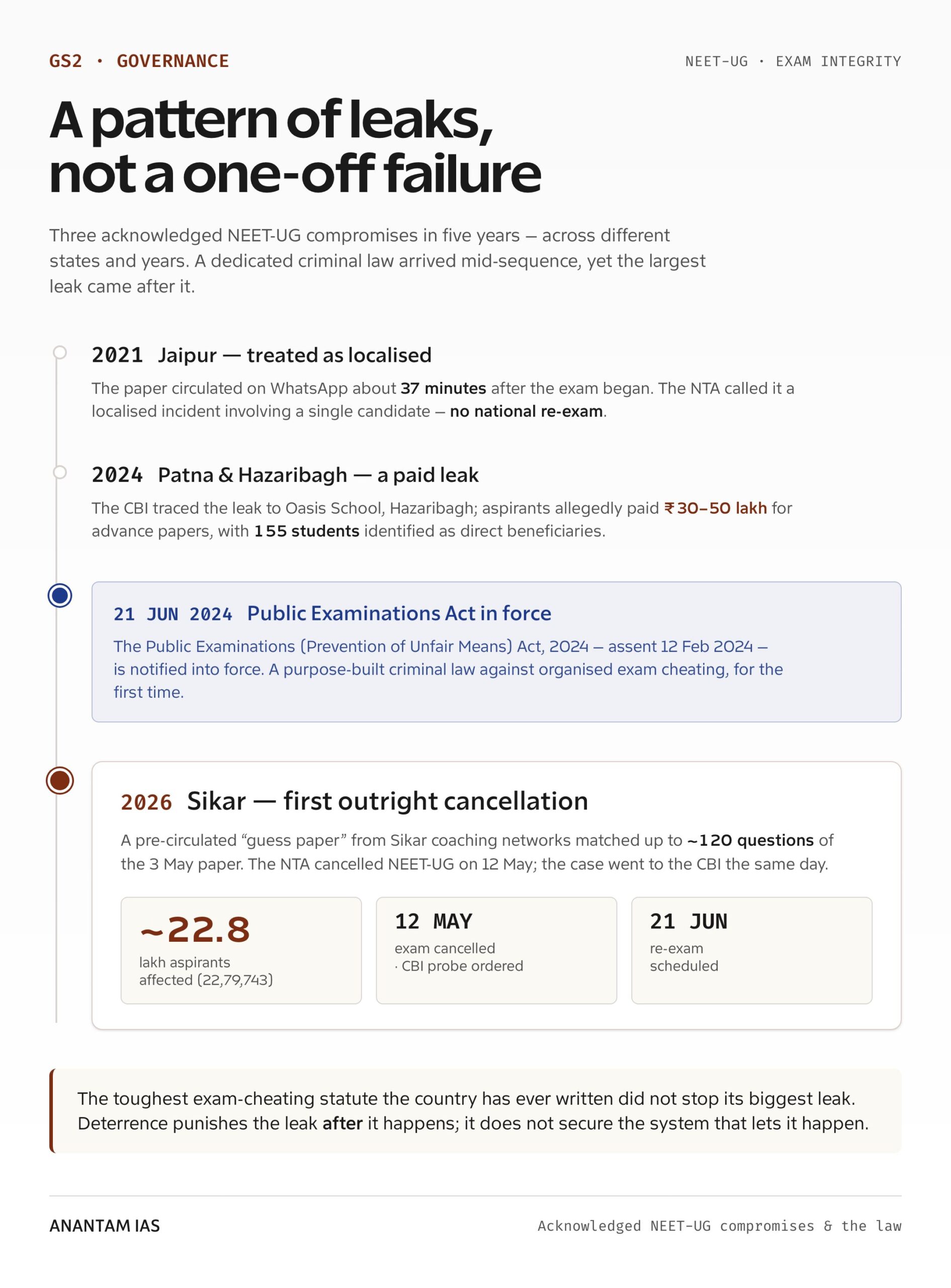
When a government scraps an exam that around 22.8 lakh young people have already sat, it isn’t admitting a small clerical slip. It’s conceding that the thing meant to be the fairest gate in the country, a single test where merit alone is supposed to decide, has been broken from the inside. That’s what happened on 12 May 2026, when the National Testing Agency cancelled the NEET-UG 2026 medical entrance exam held nine days earlier. A pre-circulated “guess paper” out of Sikar in Rajasthan had matched the real questions too closely to ignore, the Centre handed the case to the CBI the same day, and a re-exam was fixed for 21 June. So the cancellation wasn’t the failure. It was the price of an earlier one nobody managed to stop.
Here’s the tension that makes this a governance question and not just a news story. India now has a tough criminal law written specifically to punish exam cheating, passed within months of the last crisis. And the country’s biggest leak still happened after that law came into force. So the real debate isn’t whether to punish leak organisers harder. It’s whether punishment, however severe, can secure an exam system that was never built to carry the load it carries now.
The Issue, Framed
The argument here isn’t about whether paper leaks are bad. Everyone agrees they’re corrosive. The argument is about what actually fixes them, and the honest answer is uncomfortable for both the people who want more jail time and the people who want the whole machine torn down.
Let’s fix the vocabulary first, because most of the loose talk around this topic comes from people using these words without meaning the same thing. The National Testing Agency, or NTA, is the autonomous central body the Ministry of Education set up to run the country’s high-stakes entrance and eligibility tests. One agency runs NEET-UG for medical seats, JEE-Main for engineering, the UGC-NET eligibility test, and CUET for university admissions. That’s tens of lakhs of candidates flowing through a single institution. So when something breaks inside it, the blast radius is national, not local.
The next word that matters is the format itself. Most of these exams are still pen-and-paper, which means a physical question paper is printed, transported, stored, and opened at thousands of centres on a fixed morning. The proposed alternative is computer-based testing, or CBT, where candidates answer on-screen from a large randomised pool of questions rather than from one shared printed paper. The difference is the whole ballgame. A printed paper is a single physical object that can be photographed, copied, or stolen somewhere along its journey. A well-built CBT system, drawing from what’s called question-bank security, an encrypted and randomised pool so large that no two candidates see the same set, removes the one fragile object the leak chain depends on. There’s no single paper to leak when there’s no single paper.
And the leak doesn’t always strike where you’d expect. The Supreme Court was told the 2026 compromise originated during the question-paper-setting process itself, which is the design stage, long before any sealed packet reaches a centre. So this wasn’t a courier going rogue or an invigilator selling a photo. It was a breach at the point where the paper is born. That detail reframes the entire problem. You can frisk every candidate and jam every phone at the centre and still lose the exam, if the weak link sits upstream in a committee room.
A leak is a symptom. The disease is a testing architecture where one paper, one agency, and one sitting carry the futures of a generation. That’s the frame.
What the Data Says
The numbers are where you slow down, because the scale is the whole argument. NEET-UG 2026 drew 22,79,743 registered candidates, which is why coverage rounded it to “over 2.27 million” or “around 22.8 lakh.” For context, NEET 2024 hit India’s all-time high of about 24 lakh applicants. There is no larger single examination on the planet. So when the NTA cancelled the 3 May 2026 paper on 12 May, it was voiding the largest exam humanity runs, on the finding that, in its own words, a compromised result would cause “far deeper and longer-lasting damage” than a re-exam. The guess paper traced to Sikar’s coaching networks matched up to around 120 of the actual questions, concentrated in Chemistry and Biology, and spread across several states before the test.
What should bother an aspirant most is that 2026 wasn’t the first time, or even the second. NEET has now seen three acknowledged compromises in five years. In 2021, a leak in Jaipur saw the paper circulate on WhatsApp roughly 37 minutes after the exam began; the NTA treated it as a localised incident involving a single candidate and held no national re-exam. In 2024, it got far worse. The CBI traced that leak to Oasis School in Hazaribagh, Jharkhand, where an employee entered secure storage at 8:02 in the morning, photographed the paper, and forwarded the images by 9:23, with solvers finishing before the exam even started. Aspirants in that network allegedly paid 30 to 50 lakh rupees for advance papers, and the CBI identified 155 students who directly benefited. Then came Sikar in 2026, the first time the NTA cancelled and re-conducted NEET-UG outright over a leak. The pattern runs Jaipur to Hazaribagh to Sikar, across years and states, which tells you this is the system’s default failure mode, not an unlucky exception.
And 2024 wasn’t only a NEET problem. In a single fortnight, the NTA cancelled the UGC-NET eligibility test on 19 June 2024, a day after it was held, over security concerns; postponed the CSIR-UGC-NET on 21 June; and pushed NEET-PG from 23 June to 11 August. That cluster is the clearest evidence of an agency stretched past its capacity. The 2024 NEET fallout dragged on too: the NTA awarded grace marks to 1,563 candidates, then offered a partial retest on 23 June 2024 that only 813 of them turned up for, before the Supreme Court declined a full re-test on 23 July, finding no proof the leak was widespread enough to taint the whole exam. So the churn itself, the grace marks, the partial retests, the climbdowns, eroded trust almost as much as the leaks did.
The Case For
The case that the system is responding seriously, and not just flailing, is stronger than critics like to admit. So let’s state it at full strength before tearing into it.
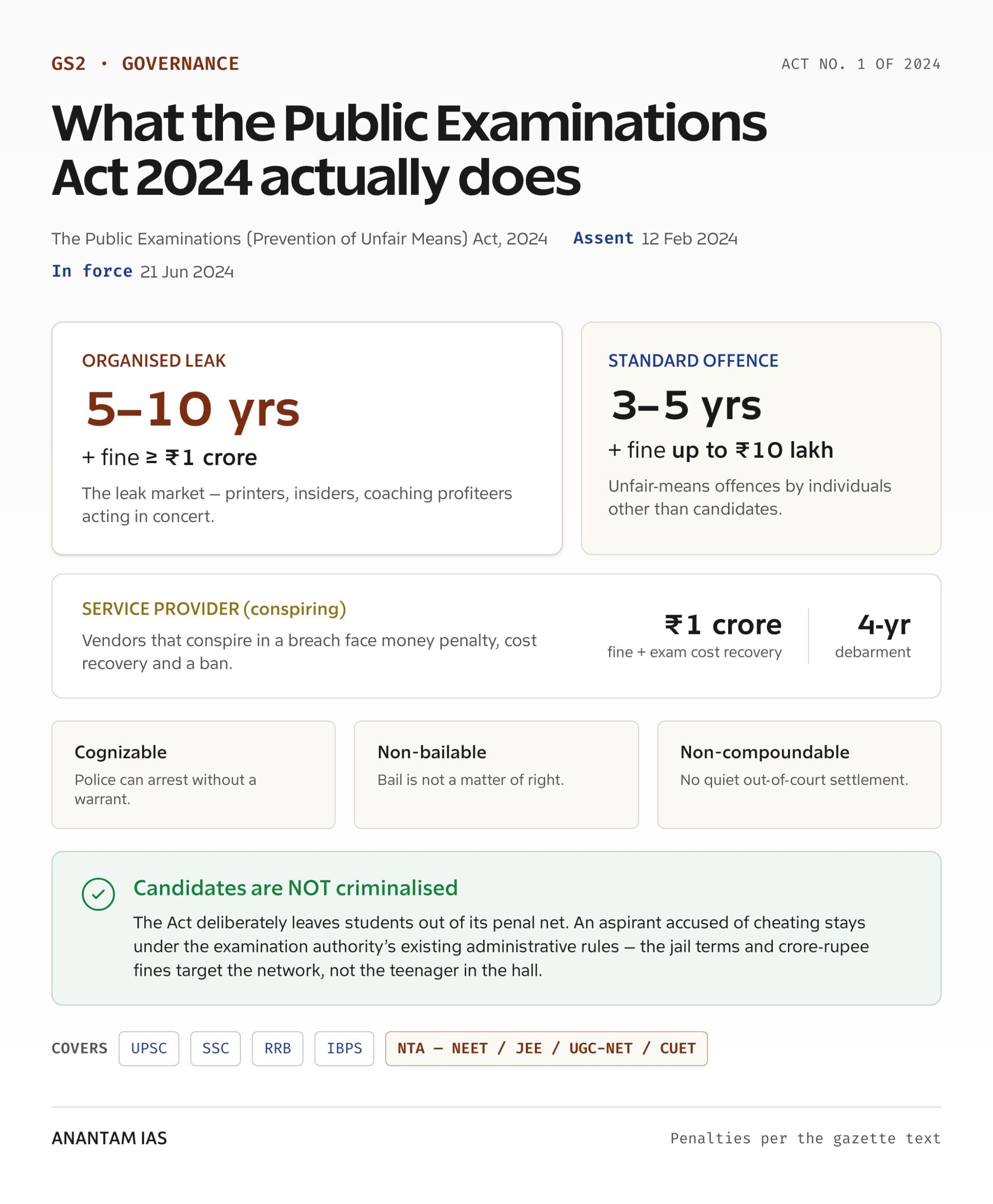
Start with the law, because before 2024 there wasn’t one. India had no dedicated central statute against organised exam cheating at all. The Public Examinations (Prevention of Unfair Means) Act, 2024 changed that within months of the previous crisis. It got presidential assent on 12 February 2024 and the Centre notified it into force on 21 June 2024, alongside its rules. The Act covers the big public recruiters and testers together: UPSC, the Staff Selection Commission, the Railway Recruitment Boards, the banking-sector IBPS, the central-government departments, and the NTA that runs NEET, JEE-Main, UGC-NET and CUET. So for the first time, leak organisers face a purpose-built criminal law rather than a patchwork of general offences.
The deterrence inside that law is sharp, and it’s aimed at the right people. The Act prescribes three to five years’ imprisonment and a fine up to 10 lakh rupees for standard unfair-means offences. For organised crime, the kind that drives a leak market, it’s five to 10 years and a fine of not less than one crore rupees. A service provider that conspires faces a fine up to one crore, recovery of the proportionate cost of the examination, and a four-year debarment from conducting any public exam. And every offence is cognizable, non-bailable, and non-compoundable, which in plain terms means the police can arrest without a warrant, bail isn’t a matter of right, and the case can’t be quietly settled out of court. That’s a serious enforcement posture, not a token gesture.
Now the part that answers the fairness worry head-on. Candidates are not criminalised under this Act. The statute deliberately leaves students out of its penal net; an aspirant accused of cheating stays under the examination authority’s existing administrative rules, not these jail terms. So the law goes after the mafia, the printers, the insiders, and the coaching profiteers, not the nervous teenager in the exam hall. That’s the right line to draw, and the Act draws it explicitly.
The institutional response in 2026 backs the law up. The cancellation itself was an integrity-first call: the NTA chose to scrap a tainted exam for 22 lakh students rather than let compromised results stand, and re-scheduled within about six weeks with a full fee refund and no fresh registration needed. The CBI was brought in the same day the exam was cancelled, arrests reached coaching-mafia figures across states within days, and the Solicitor General told the Supreme Court the Prime Minister was personally supervising the matter. So the response was fast and high-level, not buried.
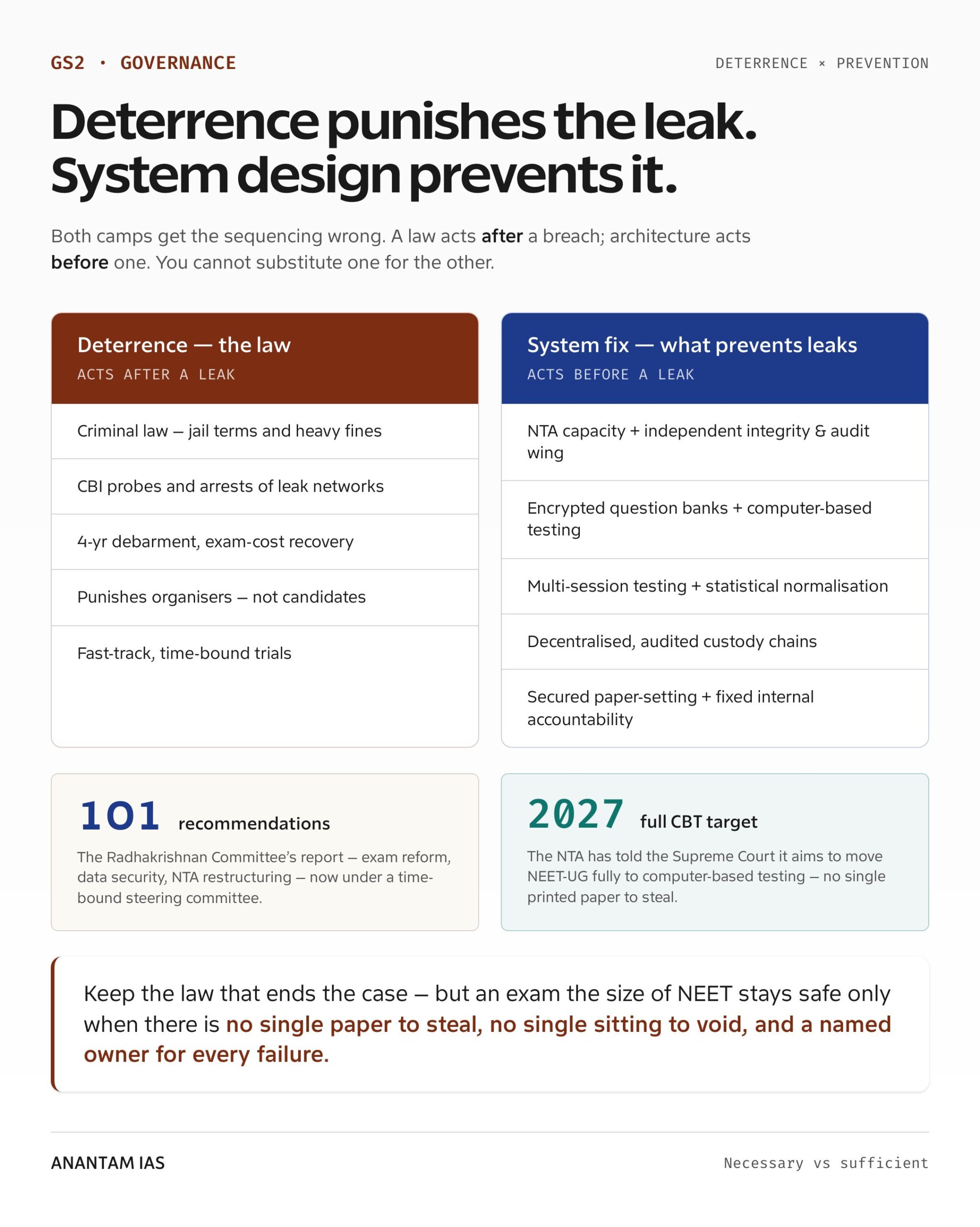
And there’s a real reform blueprint already in motion. The Ministry of Education set up a high-level committee under Dr K. Radhakrishnan, the former ISRO chairman, which submitted its report on 21 October 2024 with 101 recommendations spanning exam reform, data security, NTA restructuring, and candidate mental-health support, and a high-powered steering committee was formed in November 2024 to implement them on a time-bound basis. As the NTA told the Court in May 2026, more than 99.5 percent of NEET-UG 2026 centres were government institutions, with Aadhaar biometric authentication, multi-layer frisking, CCTV, jammers, and response-pattern analytics now deployed. That looks like an institution learning, not denying.
The Case Against
Here’s what that confident case walks straight past. The single most damning fact in this story is the timeline. The Public Examinations Act has been in force since 21 June 2024, yet the largest NEET compromise in history happened in 2026, after the law was live. So the toughest exam-cheating statute the country has ever written did not stop its biggest leak. That’s not proof the law is useless. It’s proof that deterrence, on its own, isn’t sufficient. A law punishes the crime after it happens; it doesn’t secure the system that let the crime happen.
The repetition is the tell. Jaipur in 2021, Hazaribagh in 2024, Sikar in 2026, plus the fortnight in 2024 when UGC-NET was cancelled and two more exams postponed, isn’t a run of bad luck. It’s a structural fragility surfacing again and again. When the same kind of failure keeps recurring across different years, states, and exams, the problem is the architecture, not the individual bad actor in any one episode.
That architecture has a single-point-of-failure problem baked in. One agency runs NEET, JEE-Main, UGC-NET and CUET for tens of lakhs of candidates, so one breach, especially upstream at the paper-setting stage as in 2026, can void a 22-lakh exam in one stroke. The Supreme Court put its finger on exactly this. At the 29 May 2026 hearing, Justice P. S. Narasimha asked how a breach could occur “despite the existence of monitoring systems and expert committees,” and warned that “procedural improvements alone would not be sufficient unless accountability was clearly fixed.” That second line is the heart of the critique. The reforms so far address process, the frisking, the cameras, the biometrics. They have not yet fixed responsibility, the question of who answers when the system fails.
Then there’s the human cost, which gets lost in the institutional language. Around 22 lakh students in 2026 had to re-sit an exam after months of single-minded preparation, their timelines and nerves scrambled through no fault of their own. In 2024, the grace-marks-then-partial-retest churn, 1,563 candidates affected, only 813 reappearing, taught a generation of aspirants that even a clean result could be reopened. For a test that’s supposed to reward merit, that’s a slow poisoning of faith.
And the leak doesn’t operate in a vacuum. It spreads fastest through dense coaching hubs like Sikar, where a market for advance papers, those 30 to 50 lakh rupee deals in 2024, links professors, institute owners, and printers across Rajasthan, Maharashtra, Jharkhand, and Bihar. Because education sits on the Concurrent List, policing this nexus crosses Centre and state lines, which slows investigation and muddies accountability. Punishment alone can’t dismantle a market this profitable and this distributed.
The Deeper Structural Read
Step back from any single leak and the real fault line shows up. This isn’t a contest between “punish harder” and “reform the system.” It’s a sequencing question that both camps get wrong. Deterrence acts after a leak; system design acts before one. You need both, but you can’t substitute one for the other, and right now the country has loaded almost all its political energy onto the first.
Think about what a leak needs to succeed. It needs a single, knowable target, one paper, one sitting, one morning, valuable enough to be worth corrupting. Every feature of the present exam concentrates value onto that one object. A printed paper exists physically and can be photographed. A single nationwide sitting means compromising one paper compromises everything. A single agency setting that paper gives the whole chain one upstream brain that, if breached, takes the rest down with it. The 2026 leak at the paper-setting stage is the purest illustration: the failure hit the most concentrated point in the system, where value is highest and exposure widest.
So the structural fix isn’t to guard that single object better, though you should. It’s to stop having a single object at all. That’s the logic behind the NTA’s stated plan, told to the Supreme Court, to move NEET-UG fully to CBT from 2027, drawing answers from a large randomised question bank rather than one printed paper, with multi-session and multi-stage testing so a compromise in one slot can’t void the whole exam. Pair that with normalisation, the statistical method that adjusts scores across different sessions so candidates who sit a slightly harder or easier slot aren’t unfairly advantaged or penalised, and the single-paper, single-sitting fragility largely dissolves. You can’t photograph a paper that doesn’t exist, and you can’t void an exam by breaking one slot when the slots are normalised against each other.
But there’s a deeper point the Court keeps pressing, and it’s the one an administrator should sit with. Technology secures the paper. It does not, by itself, fix accountability. Justice Narasimha’s question, how did this happen despite monitoring systems and expert committees, isn’t answered by adding more monitoring systems. It’s answered by defining, in advance, exactly who is responsible when a breach occurs and what consequence attaches to them, inside the institution, not just to the outsiders the CBI arrests. An exam system can have flawless biometrics and still rot if no one inside it ever owns the failure. Deterrence aimed only outward, at the mafia, leaves the institution’s own responsibility undefined. That gap is where the next leak lives.
There’s a federal layer underneath all of it. Because education sits on the Concurrent List, a centrally run exam leans on state machinery for centres, invigilation, and policing, while the coaching market that feeds leaks operates across state lines. So even a perfectly designed central system needs decentralised, audited cooperation to hold. The architecture problem is constitutional as much as technical.
What Should Be Done
So what does an exam system that’s actually hard to break look like? Not a vague call for “more integrity,” but a set of moves you could hand a reform committee tomorrow. Six of them, and none weakens deterrence; they complete it.
- Build NTA capacity instead of only punishing leaks. A single stretched agency running four mega-exams is the structural weak point. Give it adequate professional staffing, dedicated exam-security expertise, and an independent integrity and audit wing that answers to no one it’s auditing. You can read more on institutional design at https://anantamias.com/statutory-regulatory-bodies/.
- Move high-stakes exams to question-bank security and CBT. Encrypted, randomised item pools and computer-based testing remove the single physical paper that the entire leak chain depends on. The NTA’s own stated target of full CBT for NEET-UG from 2027 is the right direction. Just secure the paper-setting stage specifically, since that’s where 2026 broke. Background on the testing body sits at https://anantamias.com/national-testing-agency-nta/.
- Replace the single sitting with multi-session, multi-stage testing plus normalisation. When the exam runs across several sessions and stages, a compromise in one slot doesn’t void the whole thing, and statistical normalisation keeps scores fair across slots. That alone removes the all-or-nothing fragility that makes cancellation the only option today.
- Decentralise logistics with audited custody chains. State and district coordination committees, government-only centres, the 99.5 percent already achieved in 2026, biometric authentication, jammers, and CCTV all help, but every piece of physical material needs a documented, audited chain of custody from setting to opening.
- Make the law bite with fast, time-bound trials. A cognizable, non-bailable offence only deters if cases actually reach conviction quickly. Fast-track courts and adequate CBI capacity matter as much as the statute on paper. A deterrent that takes a decade to land isn’t much of a deterrent.
- Fix accountability inside the institution, not just outside it. Per the Supreme Court, define where responsibility lies when the system fails, with consequences for the officials who hold it, while keeping the Act’s principle that candidates aren’t criminalised and pairing every re-exam with clear refunds and honest communication. You can explore the governance-accountability angle further at https://anantamias.com/accountability-in-governance/.
Every one of these strengthens integrity. A system with no single paper to steal, no single sitting to void, and a named owner for every failure is a system aspirants can actually trust. That trust is the entire point of the exam.
For Your Mains Answer
This is a clean GS2 governance question that rewards structure. It touches statutory and regulatory bodies, government policy on the social sector, the rule of law, federalism, and even a GS4 ethics crossover on probity and public trust. Treat it as a deterrence-versus-system-design balance problem, not a rant about cheating.
GS paper mapping: GS2: governance, statutory and regulatory bodies, government policies and interventions, social-sector management, and accountability. GS4 crossover: integrity, probity, and public trust in institutions.
Likely question frames:
- A dedicated anti-cheating law is necessary but not sufficient to secure India’s public examinations. Critically examine in light of recent paper-leak episodes.
- “Procedural improvements alone are not enough unless accountability is fixed.” Discuss with reference to the National Testing Agency and recent examination reforms.
- Recurring paper leaks reflect a structural fragility in India’s high-stakes testing system, not merely individual criminality. Analyse and suggest reforms.
Quotable data points:
- NTA cancelled NEET-UG 2026 on 12 May 2026 after the 3 May paper was compromised; 22,79,743 candidates registered, with a re-exam on 21 June 2026.
- Three acknowledged NEET compromises in five years: Jaipur 2021, Hazaribagh 2024 (30 to 50 lakh rupees per advance paper, 155 direct beneficiaries), Sikar 2026 (up to around 120 questions overlapping).
- Public Examinations (Prevention of Unfair Means) Act 2024: assent 12 February 2024, in force 21 June 2024; three to five years and up to 10 lakh rupees for standard offences, five to 10 years and at least one crore rupees for organised crime, plus four-year debarment and cost recovery for service providers; all offences cognizable, non-bailable, and non-compoundable; candidates not criminalised.
- Radhakrishnan committee: 101 recommendations submitted 21 October 2024; NTA’s stated target to move NEET-UG fully to CBT from 2027.
Keywords to use: exam integrity, question-bank security, computer-based testing, multi-session testing, normalisation, deterrence versus systemic reform, institutional accountability, single point of failure, candidate protection.
Syllabus linkages: statutory and regulatory bodies, government policy on social-sector services, rule of law, Concurrent List and federal logistics, role of civil services and accountability.
Balanced conclusion line: A tough law that punishes the leak after it happens is worth keeping, but an exam the size of NEET stays safe only when there’s no single paper to steal, no single sitting to void, and a named owner for every failure; deterrence ends the case, system design prevents it.
How to Build the Answer
Open with the tension, not a definition. The whole topic turns on one line: India has a tough new anti-cheating law, and the biggest leak still happened after it. That sentence tells the examiner you’ve grasped that deterrence and prevention are different things. A definition of the NTA or CBT can follow in the second sentence. The opening should frame the value clash, not recite a glossary.
Bring data in early, but ration it. A strong first body paragraph can carry three figures: 22 lakh candidates affected in 2026, three NEET compromises in five years, and the Act in force from 21 June 2024 yet unable to stop the 2026 leak. Then say what those numbers prove. The mark is in the move from fact to inference, not in the fact alone.
Steelman the other side before your stance. If you argue the law isn’t enough, first credit what it does well: a purpose-built statute, hard penalties aimed at organisers, candidates protected. If you argue the response is working, first admit the timeline problem. That’s how an answer reads balanced rather than vague.
Group the way forward. Cluster the reforms under clear actors: NTA capacity and an audit wing, CBT and question-bank security, multi-session testing with normalisation, decentralised audited logistics, fast-track trials, and institutional accountability. Use the topic’s own vocabulary so it reads like governance analysis, not a news recap.
Close on the syllabus link, statutory bodies and accountability, and let the last line show judgment, not echo the introduction. The reliable pattern is “X is necessary but not sufficient; you also need Y.”
Common Mistakes to Avoid
- Don’t write only the newspaper version. The leak and the arrests are the starting point. A Mains answer needs the statutory, administrative, and ethical layers on top.
- Don’t conflate the penalties. A lone cheating candidate isn’t criminalised under the Act and doesn’t face the one-crore fine or 10-year term; those attach to organised crime and service providers. Getting this wrong signals you skimmed the law.
- Don’t go one-sided. The law genuinely does useful work and genuinely failed to prevent 2026. Hold both.
- Don’t end on a slogan. Close with an implementable principle, secure the paper-setting stage, fix internal accountability, not a flourish about “the future of our youth.”
- Don’t forget the aspirant. Name the 22 lakh students who re-sat, the migrant from a coaching town, the candidate who can’t afford a leaked paper. UPSC rewards answers that name who gains and who’s at risk.
A Compact Answer Spine
- Introduction: Open with the deterrence-versus-prevention tension in one line; define the NTA and CBT in the next.
- Evidence: Two or three attributed data points, each tied to an implication.
- Arguments: The case that the system is responding (law, CBI, reforms), then the case that it’s a structural failure (timeline, repetition, single point of failure). Keep both fair.
- Structural diagnosis: A single paper, single sitting, and single agency concentrate value at one point; the fix is to remove the single object, not just guard it.
- Way forward: Five or six grouped reforms, each with a clear actor, NTA, courts, Centre and states.
- Conclusion: Adapt the balanced conclusion line to the exact question wording.
Diagram or Flowchart Idea
For a 15-marker, draw one causal chain rather than a decorative web: single printed paper plus single sitting plus single agency leads to a concentrated, high-value target, which a breach at the paper-setting stage exploits, which forces a 22-lakh cancellation, which deterrence punishes but doesn’t prevent, which points to CBT, multi-session testing, and fixed accountability as the prevention layer. The examiner reads that logic in five seconds.
For a 10-marker, skip the diagram and use a two-column table instead: “Deterrence (acts after the leak)” against “System design (prevents the leak).” It does more work and is faster to evaluate under time pressure.
Ethics and Governance Angle
Add one ethical line even in a GS2 answer. The leak isn’t only an administrative failure; it’s a breach of probity that transfers an unearned advantage to those who can pay and punishes the honest aspirant who can’t. Name that person, the candidate from a family that scraped together coaching fees, now told the exam is void through no fault of theirs. Public trust in the fairness of the exam is the real casualty, and trust, once broken, is slow to rebuild.
Then convert the ethics into design. Don’t just say “ensure integrity.” Say how: protect candidates from criminal liability while punishing organisers, secure the paper-setting stage, fix internal accountability so officials own failures, and communicate honestly with aspirants during a re-exam. That’s the move from moral language to administrative maturity.
A sentence pattern that travels across topics: “The aim is legitimate and the law is sound, but legitimacy depends on the system’s capacity to deliver it fairly.” It credits the State’s objective without handing it a blank cheque, which is exactly what a balance question wants.
How to Use Data Without Sounding Mechanical
Use fewer numbers than you know. Three well-explained figures beat ten scattered ones. Lead with scale (22 lakh candidates), use a second for the pattern (three compromises in five years), and use a third for the core paradox (the Act in force from 21 June 2024, yet the biggest leak came after). One scale figure, one pattern figure, one paradox is plenty.
Never leave a statistic standing alone. Follow it with “This means…” or “The implication is…” That small move turns a fact sheet into analysis. In Mains, facts are raw material; judgment is the finished answer.
Finish by asking one question: can a tired examiner follow this in a single pass? If it needs rereading, simplify. Short introduction, data early, two sides marked cleanly, grouped way forward. For UPSC, clarity is how depth becomes visible. Cut any line that sounds impressive but does no work, and replace it with a fact, a cause, a consequence, or a reform.
FAQ
Why did the NTA cancel NEET-UG 2026 instead of just penalising the cheats?
Because the compromise was judged serious enough to taint the result itself, not just a handful of candidates. A pre-circulated guess paper from Sikar matched up to around 120 of the actual questions and had spread across several states before the 3 May 2026 exam. The NTA concluded that letting compromised results stand would cause deeper, longer-lasting damage than a re-exam, so it cancelled on 12 May, handed the case to the CBI, and scheduled a re-test for 21 June 2026 with a full fee refund.
What does the Public Examinations (Prevention of Unfair Means) Act, 2024 actually punish?
It targets organised exam cheating, not individual candidates. Standard unfair-means offences carry three to five years in jail and a fine up to 10 lakh rupees; organised crime carries five to 10 years and a fine of at least one crore; service providers that conspire face fines up to one crore, recovery of the exam’s cost, and a four-year ban. Every offence is cognizable, non-bailable, and non-compoundable, meaning arrest without warrant, no automatic bail, and no private settlement. The Act got assent on 12 February 2024 and came into force on 21 June 2024. Candidates are deliberately left out of its criminal net.
If there’s already a tough law, why do leaks still happen?
Because a law punishes the crime after it happens; it doesn’t secure the system that enabled it. The Act has been in force since 21 June 2024, yet the largest NEET compromise occurred in 2026, partly because the breach happened upstream at the paper-setting stage, where no amount of centre-level frisking helps. Deterrence is necessary but not sufficient. The structural fixes, computer-based testing from a randomised question bank, multi-session testing, and fixed institutional accountability, are what prevent leaks rather than just avenging them.
What reforms are actually on the table?
The Radhakrishnan committee submitted 101 recommendations on 21 October 2024, and a high-powered steering committee was formed to implement them on a time-bound basis. The headline shift is the NTA’s stated plan, told to the Supreme Court, to move NEET-UG fully to computer-based testing from 2027, with multi-session and multi-stage testing. Alongside that sit Aadhaar biometric authentication, government-only centres (over 99.5 percent in 2026), CCTV, jammers, and response-pattern analytics. The Court has pressed that these process fixes won’t be enough unless accountability for failures is clearly fixed inside the system.