PCPNDT Act, 1994: Ban on Sex Selection — Complete Guide
UPSC guide to the PCPNDT Act — provisions against sex-selective abortion, 2003 amendment, enforcement, sex ratio trends, and key Supreme Court cases.
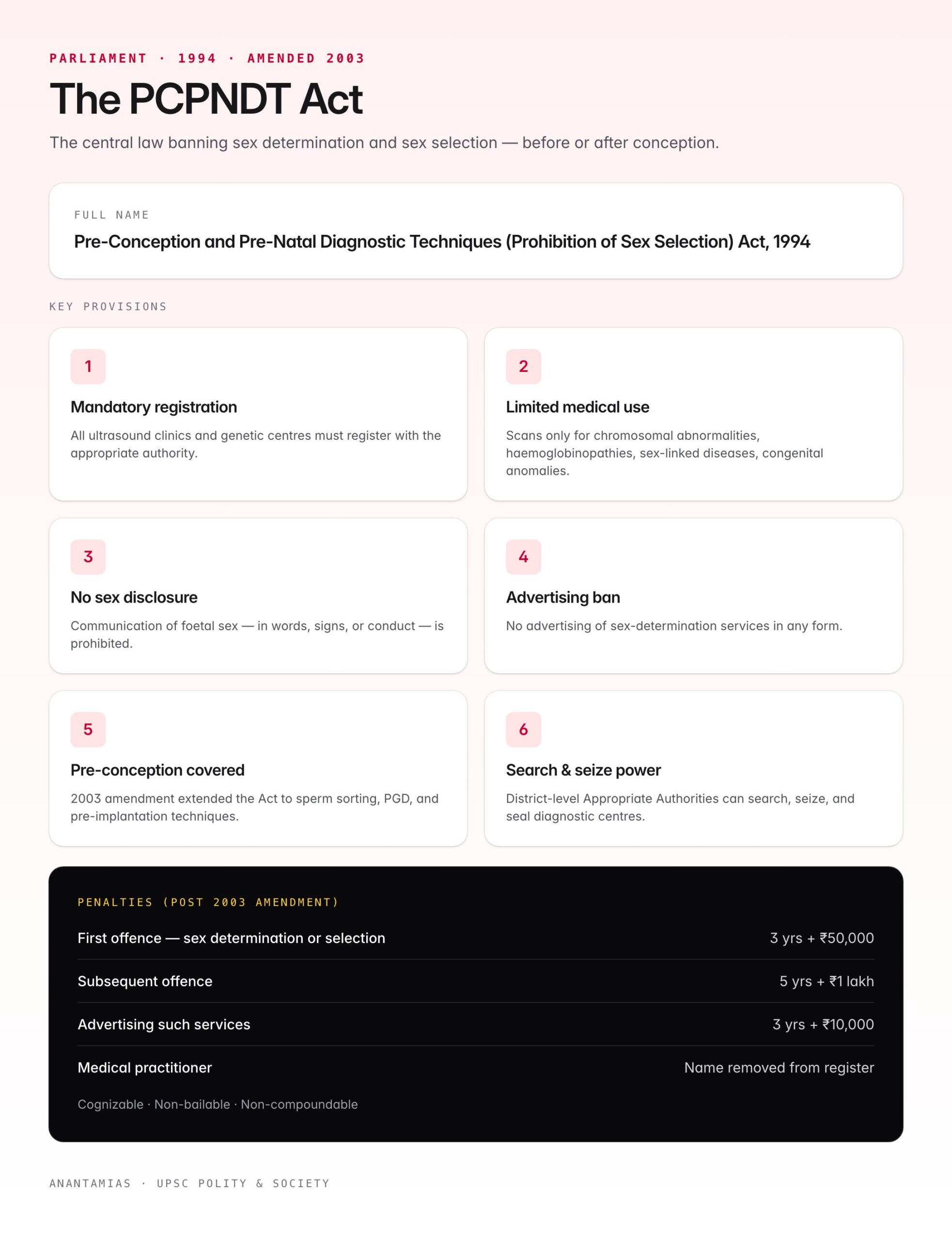
The Pre-Conception and Pre-Natal Diagnostic Techniques (Prohibition of Sex Selection) Act, 1994, better known as the PCPNDT Act, is the central legislation banning sex determination before or after conception. Enacted to halt India's collapsing child sex ratio, the Act outlaws the use of ultrasound, amniocentesis, chorionic villus sampling (CVS), pre-implantation genetic diagnosis, and sperm-separation techniques for identifying or selecting the sex of a foetus.
The law was originally passed in 1994 as the PNDT Act and significantly strengthened by a 2003 amendment following the CEHAT v. Union of India Supreme Court case. Despite a clear legal framework, enforcement remains a challenge, and sex ratios in several Indian states continue to signal widespread selective abortion of female foetuses.
Background: Why Was the Law Needed?
- The 1991 Census revealed that the child sex ratio (0–6 years) had fallen to 945 girls per 1,000 boys, down from 972 in 1971.
- Advances in ultrasonography from the 1980s made prenatal sex identification cheap and widely available.
- Son preference, dowry, and patrilocal inheritance turned diagnostic technology into a tool of sex-selective abortion — particularly in Punjab, Haryana, Gujarat, Delhi, and western UP.
- Maharashtra passed the first state law — Maharashtra Regulation of Prenatal Diagnostic Techniques Act, 1988 — which later informed the central legislation.
PNDT Act, 1994
Full name: Pre-Natal Diagnostic Techniques (Regulation and Prevention of Misuse) Act, 1994. Came into force: 1 January 1996.
Key objectives
- Regulate the use of pre-natal diagnostic techniques for genuine medical purposes.
- Prohibit misuse of these techniques for sex determination.
- Prevent sex-selective abortion and correct the declining child sex ratio.
Main provisions
- Ultrasound clinics and genetic centres must register with the appropriate authority.
- Use of prenatal diagnostic techniques permitted only for detecting:
- Chromosomal abnormalities
- Genetic metabolic diseases
- Haemoglobinopathies
- Sex-linked genetic diseases
- Congenital anomalies
- Communication of sex of the foetus — even through words, signs, or conduct — is prohibited.
- Advertisement of sex-determination services banned.
2003 Amendment
The 1994 law was weak and poorly enforced. The CEHAT v. Union of India (2001) PIL filed by CEHAT, MASUM and Dr. Sabu George forced the government to amend the Act.
Renamed the Pre-Conception and Pre-Natal Diagnostic Techniques (Prohibition of Sex Selection) Act, 1994 with the 2003 amendment bringing the following changes:
| Change | Effect |
|---|---|
| Title extended to "Pre-Conception" | Covers pre-implantation techniques (e.g., sperm sorting, PGD) |
| Definition of "sex selection" widened | Includes any procedure or technique aimed at increasing probability of a particular sex |
| Ultrasound machines brought under direct control | Manufacturers, distributors, and users all regulated |
| Penalties enhanced | Higher fines, longer imprisonment |
| Central Supervisory Board strengthened | Chaired by Union Health Minister |
| Appropriate Authorities empowered | To search, seize, and seal diagnostic centres |
Structure of the Act
Central Supervisory Board (CSB)
- Chairperson: Union Minister for Health and Family Welfare.
- Vice-Chairperson: Minister of State for Health.
- Reviews implementation; recommends policy changes; monitors technology developments.
State Supervisory Board
- Chaired by State Health Minister.
- Monitors state-level implementation.
Appropriate Authorities
- District-level officials (CMO, Civil Surgeon).
- Power to grant / suspend / cancel registration, search and seize equipment, and file complaints.
Advisory Committees
- Constituted at the Central and State levels to advise the Appropriate Authorities.
Offences and Penalties
| Offence | Penalty (as per 2003 amendment) |
|---|---|
| Sex determination or selection | First offence: up to 3 years imprisonment + fine up to ₹50,000 |
| Subsequent offence: up to 5 years + fine up to ₹1,00,000 | |
| Advertising sex-determination services | Up to 3 years + ₹10,000 fine |
| Aiding and abetting | Same as principal offence |
| Medical practitioners convicted | Name removed from medical register for 5 years (first offence) or permanently (subsequent) |
The offences are cognizable, non-bailable, and non-compoundable.
Key Judicial Pronouncements
CEHAT v. Union of India (2001–2003)
- Supreme Court directed the central and state governments to implement the Act strictly.
- Ordered registration of all ultrasound clinics; seizure of unregistered machines; monthly reports from all states.
- Triggered the 2003 amendment.
Voluntary Health Association of Punjab v. Union of India (2013)
- SC ordered strict monitoring of ultrasound clinics in Punjab and Haryana.
- Called for a national awareness campaign and involvement of medical associations.
Indian Medical Association v. Union of India (2016)
- SC rejected IMA's plea to dilute the Act's penalty provisions.
- Held that the PCPNDT framework is a constitutional necessity.
Impact on Sex Ratio
Child Sex Ratio (0–6 years)
| Census / Survey | CSR (girls per 1,000 boys) |
|---|---|
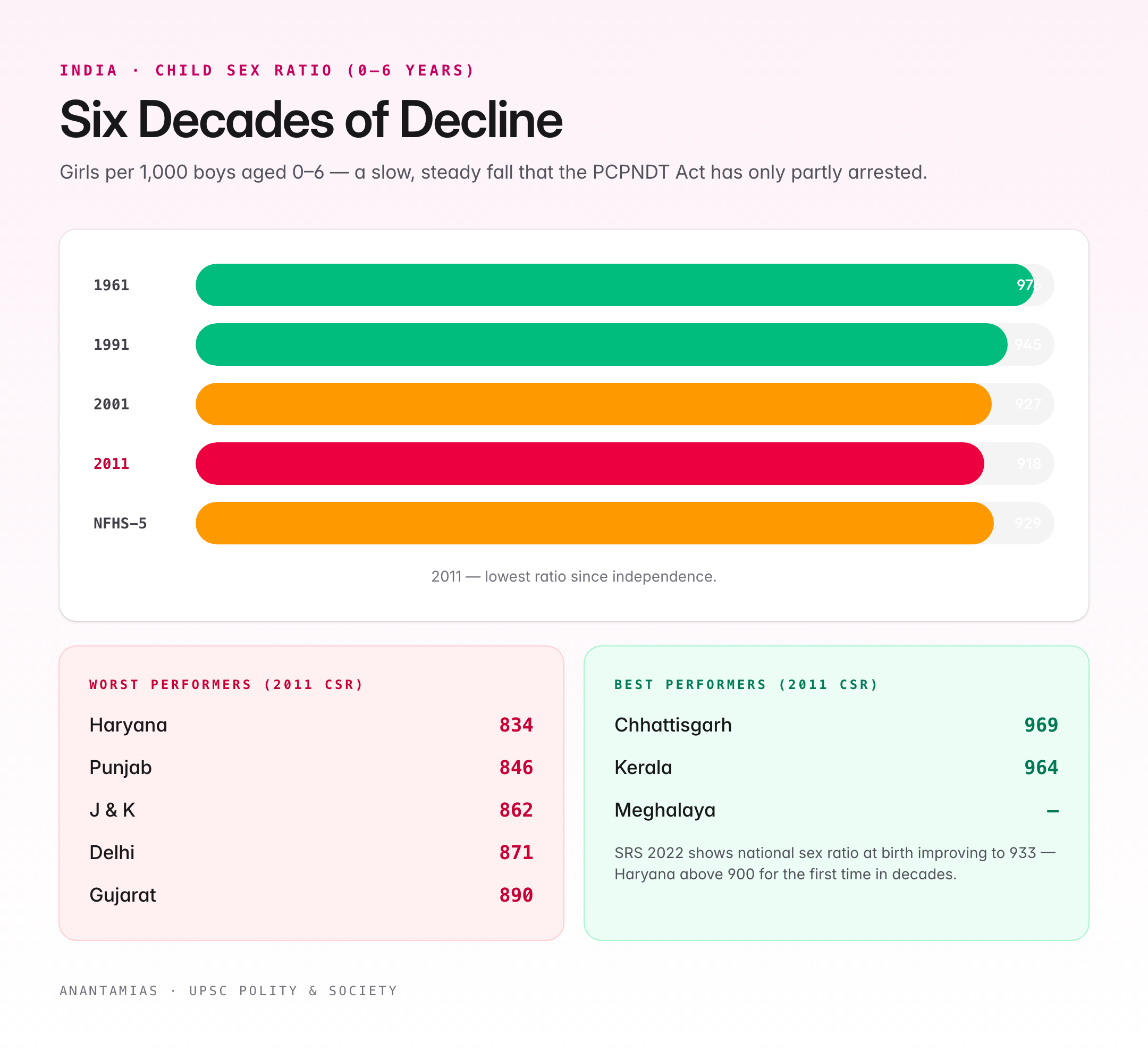
| 1961 | 976 |
| 1991 | 945 |
| 2001 | 927 |
| 2011 | 918 (lowest post-independence) |
| NFHS-5 (2019–21) | 929 |
Sex Ratio at Birth (NFHS-5, 2019–21)
- 929 girls per 1,000 boys at the national level.
- Worst performers: Haryana, Delhi, Gujarat, Punjab, Uttarakhand.
- Best performers: Kerala, Chhattisgarh, Meghalaya.
State-level Comparisons (Child Sex Ratio 2011)
| State | CSR (2011) |
|---|---|
| Haryana | 834 |
| Punjab | 846 |
| Jammu & Kashmir | 862 |
| Delhi | 871 |
| Gujarat | 890 |
| Kerala | 964 |
| Chhattisgarh | 969 |
The law has prevented the ratio from collapsing further but has not reversed the trend in many states.
Enforcement Challenges
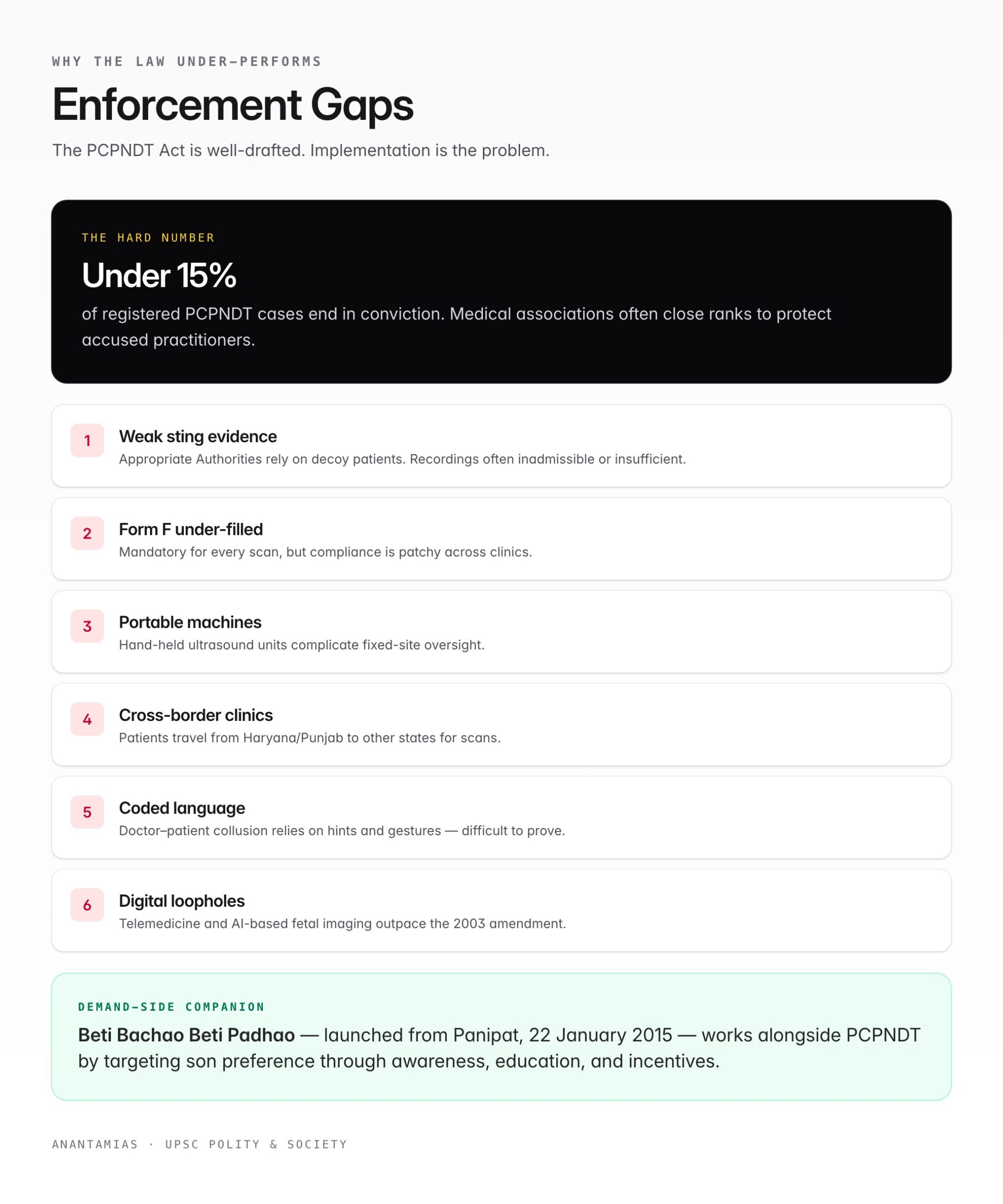
- Low conviction rates: Fewer than 15% of registered cases end in conviction. Medical associations often close ranks.
- Sting operations limited: Appropriate Authorities rely heavily on decoy patients; evidence often weak.
- Form F compliance poor: Mandatory for each scan but under-filled in many clinics.
- Portable ultrasound machines complicate oversight.
- Cross-border clinics — patients travel from Haryana/Punjab to other states for scans.
- Doctor–patient collusion: Coded language makes proof difficult.
- Shortage of trained inspectors in district offices.
Beti Bachao Beti Padhao (BBBP)
- Launched 22 January 2015 from Panipat, Haryana.
- Multi-ministerial programme (WCD + Health + Education).
- Targets districts with low CSR.
- Works alongside PCPNDT by addressing demand-side factors — awareness, education, incentives.
Related Laws and Schemes
| Law / Scheme | Role |
|---|---|
| MTP Act, 1971 (amended 2021) | Regulates conditions for legal abortion |
| Dowry Prohibition Act, 1961 | Addresses root socio-economic cause |
| Sukanya Samriddhi Yojana (2015) | Savings scheme for girl child |
| Ladli / Mukhyamantri Kanya Suraksha Yojana | State-level conditional cash transfers |
| Hindu Succession (Amendment) Act, 2005 | Equal inheritance rights for daughters |
Criticisms and Debates
- Targets doctors, not demand. Root cause — son preference — is social, not medical.
- Over-regulation burdens legitimate ultrasound clinics in rural areas.
- Conflict with MTP Act 2021 — which expanded abortion access up to 24 weeks in certain cases.
- Data gaps: Sex ratio at birth is measured through SRS and NFHS; inconsistencies hinder enforcement.
- Digital / telemedicine loopholes: Online consultations and cross-border scans not adequately covered.
Recent Developments (2024–25)
- Sample Registration System 2022 showed sex ratio at birth improving slightly to 933 at the national level, with Haryana rising from 832 (2011) to above 900.
- Central and state governments increased online monitoring of ultrasound machines under the PCPNDT online portal.
- National Commission for Women pressed for amendments to plug telemedicine gaps.
- MoH guidelines issued in 2024 on AI-based fetal imaging — flagged as a potential new risk area.
Quick Revision
- Full name: Pre-Conception and Pre-Natal Diagnostic Techniques (Prohibition of Sex Selection) Act, 1994 (2003 amendment).
- Prohibits: Sex determination and sex selection.
- Implementing body: Central Supervisory Board + State Boards + Appropriate Authorities.
- Penalty: Up to 5 years imprisonment + ₹1 lakh fine + cancellation of medical registration.
- Key case: CEHAT v. Union of India (2001–2003).
UPSC Relevance
Prelims (GS Paper II): Direct questions on the PCPNDT Act, its 2003 amendment, composition of the Central Supervisory Board, and child sex ratio trends appear regularly.
Mains (GS Paper I — Society):
- Analyse the decline in India's child sex ratio and the role of the PCPNDT Act in addressing it.
- Discuss the socio-economic roots of son preference and evaluate legal responses.
Mains (GS Paper II — Governance):
- Critically examine the enforcement challenges of the PCPNDT Act.
- Compare legislative interventions (PCPNDT) with awareness campaigns (BBBP) in tackling gender-biased sex selection.
Essay: Themes like "daughters of India — a question of justice," "law and society," and "gender and development" relate directly.
GS Paper IV (Ethics): Medical ethics, conflict of interest, and the professional duty of doctors under the PCPNDT Act offer strong case-study material.