Personal Liberty under Article 21 — Maneka Gandhi to Puttaswamy (UPSC Polity)
UPSC guide to personal liberty under Article 21: Gopalan to Maneka Gandhi to Puttaswamy, triple test, recent SC verdicts on bail, privacy, and digital surveillance.
Personal liberty is the bedrock of constitutional democracy. In the Indian Constitution, it is guaranteed under Article 21 — "No person shall be deprived of his life or personal liberty except according to procedure established by law." What looks like a single sentence has, over seven decades, become the most elastic and most litigated provision of the Constitution. Through judicial interpretation, the original narrow meaning — freedom from physical restraint — has expanded to include privacy, dignity, livelihood, sleep, shelter, internet access, and a clean environment.
For UPSC, personal liberty under Article 21 is the central case study for how Indian courts read fundamental rights. The journey from A.K. Gopalan v. State of Madras (1950), through Maneka Gandhi (1978), Puttaswamy (2017), the Aadhaar verdict (2018), and the recent Supreme Court rulings on bail, encounters, and digital surveillance (2023-2026) maps the entire arc of Indian constitutionalism.
This guide unpacks the constitutional text, the leading cases, the triple test, the relationship with Articles 14 and 19, the contemporary debates on preventive detention, UAPA, encounter killings, and digital surveillance, and the Mains-ready synthesis.
Constitutional basis
Article 21 of the Constitution states:
"No person shall be deprived of his life or personal liberty except according to procedure established by law."
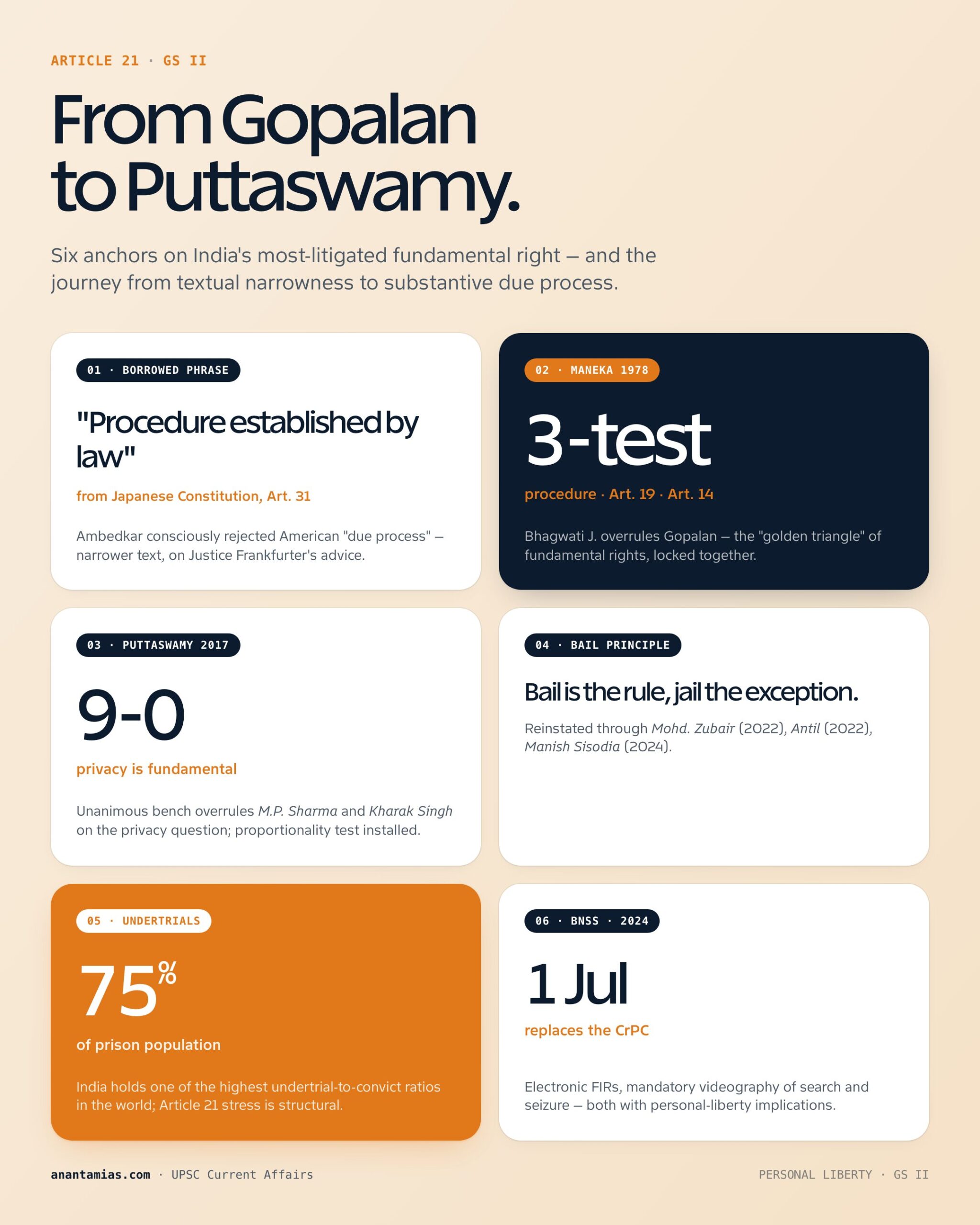
The phrase "procedure established by law" was directly borrowed from the Japanese Constitution (Article 31), in conscious rejection of the American "due process of law." The Constituent Assembly debated this at length — Dr B.R. Ambedkar, after consulting with Justice Felix Frankfurter (US Supreme Court), preferred the narrower Japanese formulation to avoid judicial overreach. Justice Frankfurter himself had warned that "due process" was an undefined judicial weapon.
This narrow textual base was then dramatically broadened by the Supreme Court — making Indian Article 21 today substantively closer to American "due process" than to Japanese "procedure established by law."
What does "personal liberty" mean?
Personal liberty is not limited to freedom from arrest, detention, or physical confinement. The Supreme Court has read it to include:
- Freedom from arbitrary arrest, false imprisonment, or wrongful confinement.
- Freedom of movement (overlap with Article 19(1)(d)).
- Right to travel abroad (Maneka Gandhi v. UoI, 1978).
- Right to privacy (Puttaswamy, 2017 — declared a fundamental right under Article 21).
- Right to dignity (Francis Coralie Mullin v. UT Delhi, 1981).
- Right to legal aid (Hussainara Khatoon, 1979).
- Right to speedy trial (Hussainara Khatoon, 1979).
- Right against custodial torture (D.K. Basu, 1997).
- Right against handcuffing (Prem Shankar Shukla, 1980).
- Right against solitary confinement (Sunil Batra, 1978).
- Right to die with dignity / passive euthanasia (Common Cause v. UoI, 2018).
- Right to choose one's life partner (Hadiya, 2018).
- Right to sexual autonomy (Navtej Singh Johar, 2018).
In Kharak Singh v. State of UP (1963), Justice Subba Rao's dissent had argued that personal liberty includes privacy. That dissent became majority in Puttaswamy.
A.K. Gopalan v. State of Madras (1950)
The first major test of Article 21. Gopalan, a communist leader, was detained under the Preventive Detention Act, 1950. He challenged the Act under Articles 14, 19, and 21.
The court's reasoning:
- Read Articles 14, 19, and 21 as mutually exclusive silos.
- Held that "procedure established by law" meant any procedure laid down by valid legislation — even arbitrary or unfair, as long as enacted by a competent legislature.
- Justice Fazl Ali alone dissented, arguing for a holistic reading.
This narrow Gopalan view held the field for 28 years. It permitted Parliament to enact any procedure however arbitrary, so long as it was law.
Maneka Gandhi v. Union of India (1978)
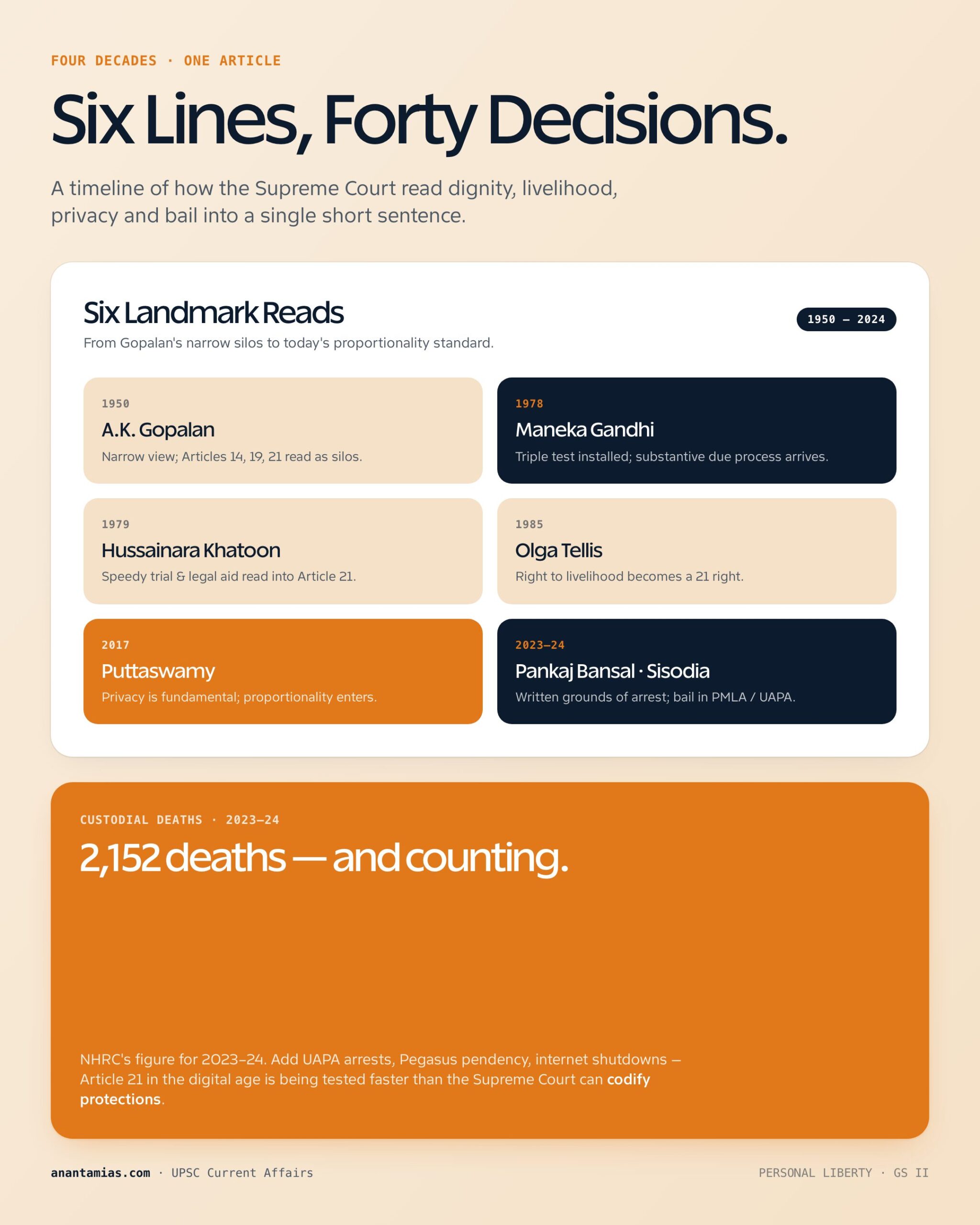
The watershed. Maneka Gandhi's passport was impounded by the government without giving reasons. She challenged the action under Articles 14, 19, and 21.
The court's reasoning (Justice P.N. Bhagwati, leading a 7-judge bench):
- Overruled Gopalan.
- Held that Articles 14, 19, and 21 are not silos but interconnected — together they form the "golden triangle" of rights.
- Any law that deprives a person of life or personal liberty must satisfy three tests:
- Procedure prescribed — the deprivation must be under a procedure laid down by law.
- Article 19 test — the procedure must not violate the freedoms under Article 19 (movement, speech, etc.).
- Article 14 test — the procedure must be just, fair, and reasonable; not arbitrary, oppressive, or fanciful.
This triple test is the central doctrinal contribution of Maneka Gandhi. It effectively read substantive due process into Article 21 through the back door, transforming the Constitution.
The expanding canopy of Article 21
After Maneka Gandhi, the Supreme Court systematically extended Article 21 to cover almost every dimension of dignified human existence.
| Decade | Landmark case | Right read into Article 21 |
|---|---|---|
| 1978 | Maneka Gandhi | Procedural due process |
| 1979 | Hussainara Khatoon | Speedy trial; legal aid |
| 1980 | Prem Shankar Shukla | Right against handcuffing |
| 1981 | Francis Coralie Mullin | Right to live with human dignity |
| 1981 | Olga Tellis | Right to livelihood |
| 1986 | Mohini Jain / Unni Krishnan | Right to education (later Article 21A by 86th Amendment) |
| 1989 | Bandhua Mukti Morcha | Right against bonded labour |
| 1993 | Unni Krishnan | Free education up to age 14 |
| 1996 | Vishaka | Workplace safety; right against sexual harassment |
| 1997 | D.K. Basu | Right against custodial violence |
| 2001 | Murli Deora | Right to clean air |
| 2002 | PUCL v. UoI | Right to food |
| 2014 | NALSA | Right to gender identity (transgender persons) |
| 2017 | Puttaswamy | Right to privacy |
| 2018 | Common Cause | Right to die with dignity (passive euthanasia) |
| 2018 | Navtej Singh Johar | Decriminalisation of consensual same-sex relations |
| 2018 | Joseph Shine | Decriminalisation of adultery |
| 2018 | Hadiya | Right to choose life partner |
| 2023 | Supriyo (Same-Sex Marriage) | Right to dignity reaffirmed; marriage equality not yet recognised |
Triple test — the operating standard
A law that interferes with personal liberty must satisfy:
- It must prescribe a procedure — not be a mere executive fiat.
- The procedure must withstand the test of Article 19 — if applicable in the situation.
- The procedure must be tested against Article 14 — must be just, fair, and reasonable.
This is the standard the Supreme Court applies to bail orders, custodial deaths, surveillance laws, internet shutdowns, and preventive detention.
Justice K.S. Puttaswamy v. Union of India (2017)
The 9-judge bench unanimously held:
- Right to privacy is a fundamental right under Article 21 read with Article 14 and Article 19.
- Privacy includes informational privacy, bodily integrity, decisional autonomy, and personal choice.
- Any interference with privacy must satisfy a proportionality test:
- Legitimate state aim
- Suitability (rational connection)
- Necessity (least restrictive means)
- Proportionality stricto sensu (balance between right and aim)
Puttaswamy overruled M.P. Sharma (1954) and Kharak Singh (1963) on the question of privacy.
Personal liberty and preventive detention
Article 22 sits in tension with Article 21. It permits preventive detention — detention without trial — under specific safeguards. Statutes such as NSA, COFEPOSA, PASA, NDPS Act, UAPA, and the new Bharatiya Nyaya Sanhita, 2023 all engage Article 21.
Recent cases
- Mohd. Zubair v. State of NCT of Delhi (2022) — bail is the rule, jail the exception.
- Satender Kumar Antil v. CBI (2022) — operationalised bail principles; SC issued comprehensive guidelines on bail jurisdiction.
- Pankaj Bansal v. UoI (2023) — written grounds of arrest must be furnished to the arrestee under PMLA; otherwise arrest is illegal.
- Prabir Purkayastha v. State (NCT of Delhi) (2024) — applied Pankaj Bansal to UAPA arrests.
- Manish Sisodia v. Directorate of Enforcement (2024) — Supreme Court reaffirmed bail as rule even in PMLA cases when trial is delayed.
- Arvind Kejriwal v. CBI (2024) — interim bail granted; reaffirmed proportionality.
Personal liberty in the digital age (2024-26)
- Pegasus Spyware case (still pending) — Supreme Court committee submitted report (August 2022); the question of state surveillance under Section 5(2) Telegraph Act and Section 69 IT Act remains live.
- Digital Personal Data Protection Act, 2023 — operationalisation in 2024-26 raises questions about state exemptions and personal liberty.
- Internet shutdowns — Anuradha Bhasin v. UoI (2020) held shutdowns must satisfy proportionality. 2024-26 shutdowns in Manipur and parts of Punjab tested this further.
- Encounter killings — Vikas Dubey (UP, 2020), Atiq Ahmed (UP, 2023); NHRC and SC guidelines (2014, PUCL) mandate independent investigation; compliance remains uneven.
- Bharatiya Nagarik Suraksha Sanhita, 2023 — new procedural code in force since July 2024; includes electronic FIRs, mandatory videography of search and seizure — both with personal liberty implications.
Major committee and reform recommendations
| Committee/Reform | Key recommendation |
|---|---|
| Justice Verma Committee (2013) | Stronger procedural safeguards for women; consent-based jurisprudence |
| Justice A.P. Shah Committee (2012) | Privacy framework — accepted in Puttaswamy |
| Justice Srikrishna Committee (2018) | Data Protection Bill — informed DPDP Act 2023 |
| Law Commission 268th Report | Bail reform |
| Justice Madan Lokur (2024) | Need for an independent prison oversight body |
Issues and concerns (2024-26)
- Undertrials in jail — over 75% of prison population are undertrials; India has one of the highest undertrial-to-convict ratios.
- PMLA, UAPA, BNS arrests without grounds — repeated SC interventions in 2023-25 show systemic non-compliance.
- Custodial deaths — NHRC reported 2,152 custodial deaths in 2023-24 alone; Manipur and UP top the list.
- Lack of effective remedy under Article 32 in PMLA cases — courts have called for legislative correction.
- Arrest of journalists and activists under UAPA — Bhima Koregaon arrests, the Stan Swamy case, raise persistent personal liberty concerns.
Way forward
- Bail reform — codify Satender Kumar Antil principles into statute.
- Independent prosecution — separate prosecution from police investigation (Law Commission 197th Report).
- Strengthen Section 41A CrPC / BNSS Section 35 notices to reduce unnecessary arrests.
- Pegasus-style surveillance — bring under parliamentary oversight (UK Investigatory Powers Tribunal model).
- Real-time judicial scrutiny of internet shutdowns.
- NHRC empowerment — give it the power to enforce, not just recommend.
Mains-style answer hook
"Personal liberty under Article 21 has evolved from the formalistic Gopalan view to the substantive triple test of Maneka Gandhi and the proportionality standard of Puttaswamy. The 2023-25 Supreme Court bail jurisprudence in Pankaj Bansal, Prabir Purkayastha and Manish Sisodia restores the constitutional intuition that 'bail is the rule, jail the exception.' But statutory regimes like UAPA and PMLA, custodial violence, and digital surveillance continue to test the limits of Article 21 in the digital age."
Prelims pointers
- Article 21 — "procedure established by law" borrowed from Japan.
- Gopalan (1950) — narrow view; Maneka Gandhi (1978) — broad view, triple test.
- Puttaswamy (2017) — privacy a fundamental right; 9-judge bench.
- Hussainara Khatoon (1979) — speedy trial, legal aid read into Article 21.
- Olga Tellis (1985) — right to livelihood under Article 21.
- Common Cause (2018) — passive euthanasia.
- Navtej Singh Johar (2018) — decriminalised Section 377.
- Pankaj Bansal (2023) — written grounds of arrest mandatory under PMLA.
- BNSS replaced CrPC w.e.f. 1 July 2024.
FAQ
Is Article 21 absolute?
No. The State can restrict personal liberty, but only through a procedure that is just, fair, and reasonable.
What is the triple test?
A law affecting personal liberty must (a) prescribe a procedure, (b) satisfy Article 19 if applicable, and (c) satisfy Article 14 (just, fair, reasonable).
Is Article 21 available to non-citizens?
Yes. "No person" includes foreigners, except enemy aliens during war.
Related: Article 14, Article 19, Right to Privacy Puttaswamy, Maneka Gandhi case.