PM Awas Yojana Apply Online: Eligibility, Documents and Step-by-Step Application
PM Awas Yojana has two separate application routes — an online form for urban applicants and a survey-based process for rural ones. Here is exactly how each works, what you need, and how to track it.
Pradhan Mantri Awas Yojana is really two schemes wearing one name. PMAY-Urban, run by the Ministry of Housing and Urban Affairs, now operates as PMAY-U 2.0. PMAY-Gramin, run by the Ministry of Rural Development, covers villages. They have different eligibility rules, different money, and — this is what trips most people up — completely different ways of applying.
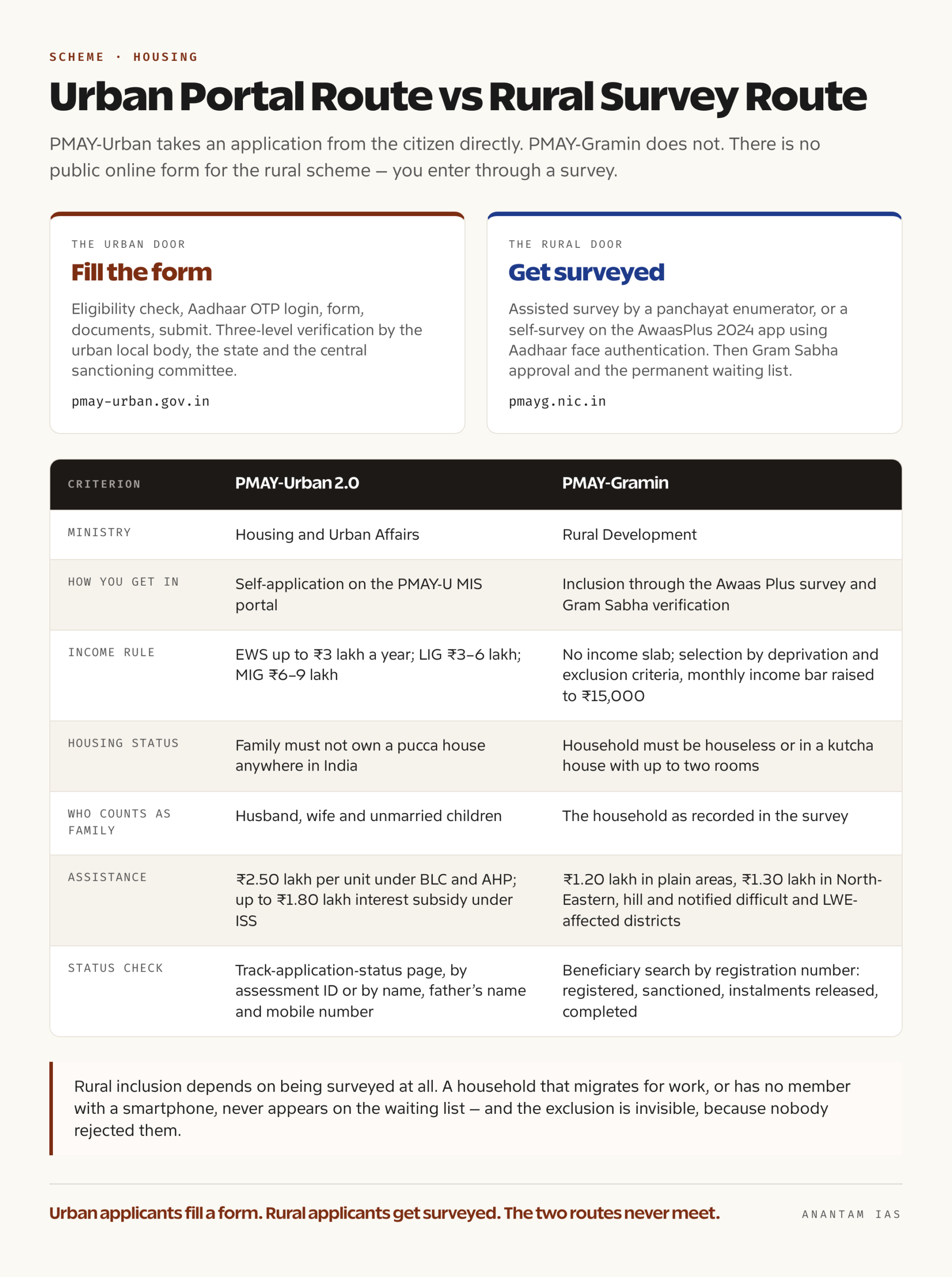
The urban scheme takes an online application from the citizen directly. The rural scheme does not. There is no public online form for PMAY-Gramin; you get in through a government survey, and since 2024 that survey can be done on your own phone. If you have been hunting for a “PMAY Gramin apply online” link and finding only aggregator sites, that is why.
What PM Awas Yojana Offers
PMAY-U 2.0 was cleared by the Union Cabinet in August 2024 to help one crore urban poor and middle-class families build, buy or rent a house over five years, with government assistance of ₹2.30 lakh crore. It runs through four verticals.
| Vertical | What it does | Assistance |
|---|---|---|
| Beneficiary-Led Construction (BLC) | You build or extend a house on land you already own | ₹2.50 lakh per unit (Centre and state combined) |
| Affordable Housing in Partnership (AHP) | You buy a unit in a project built by a public or private developer | ₹2.50 lakh per unit |
| Affordable Rental Housing (ARH) | Rental stock for working women, industrial workers, migrants and the urban poor | Support to the project, not a cash transfer to you |
| Interest Subsidy Scheme (ISS) | Interest subsidy on a home loan taken from a lending institution | Up to ₹1.80 lakh |
The Interest Subsidy Scheme is the vertical most middle-class applicants care about. On a loan of up to ₹25 lakh for a house valued up to ₹35 lakh, the subsidy is 4 per cent on the first ₹8 lakh of the loan, over a tenure of up to 12 years, capped at ₹1.80 lakh and released in five yearly instalments through a push-button transfer to the loan account. It is not a lump sum handed to you — it reduces your outstanding principal.
PMAY-Gramin works on a different logic. It pays a unit assistance of ₹1.20 lakh in plain areas and ₹1.30 lakh in North-Eastern and hill states and notified difficult and Left-Wing-Extremism-affected districts, for a house of at least 25 square metres with a hygienic cooking space. The cash is topped up by convergence: 90 days of unskilled wage employment under MGNREGS (95 in hilly and difficult areas), ₹12,000 for a toilet under Swachh Bharat Mission-Gramin, and linkages for an LPG connection, an electricity connection and piped water. In August 2024 the Cabinet approved a fresh phase covering 2024-25 to 2028-29 with a target of two crore additional rural houses.
The older urban mission is still finishing its work. PMAY-U 1.0 ran BLC and AHP at ₹1.5 lakh per EWS house, In-Situ Slum Redevelopment at ₹1 lakh per house, and the Credit Linked Subsidy Scheme, and its period was extended to the end of 2025 to complete houses sanctioned up to March 2022. PMAY-U 2.0 sanctions had crossed 13.61 lakh houses by the sixth meeting of the Central Sanctioning and Monitoring Committee.
Applying Online Under PMAY-Urban 2.0, Step by Step
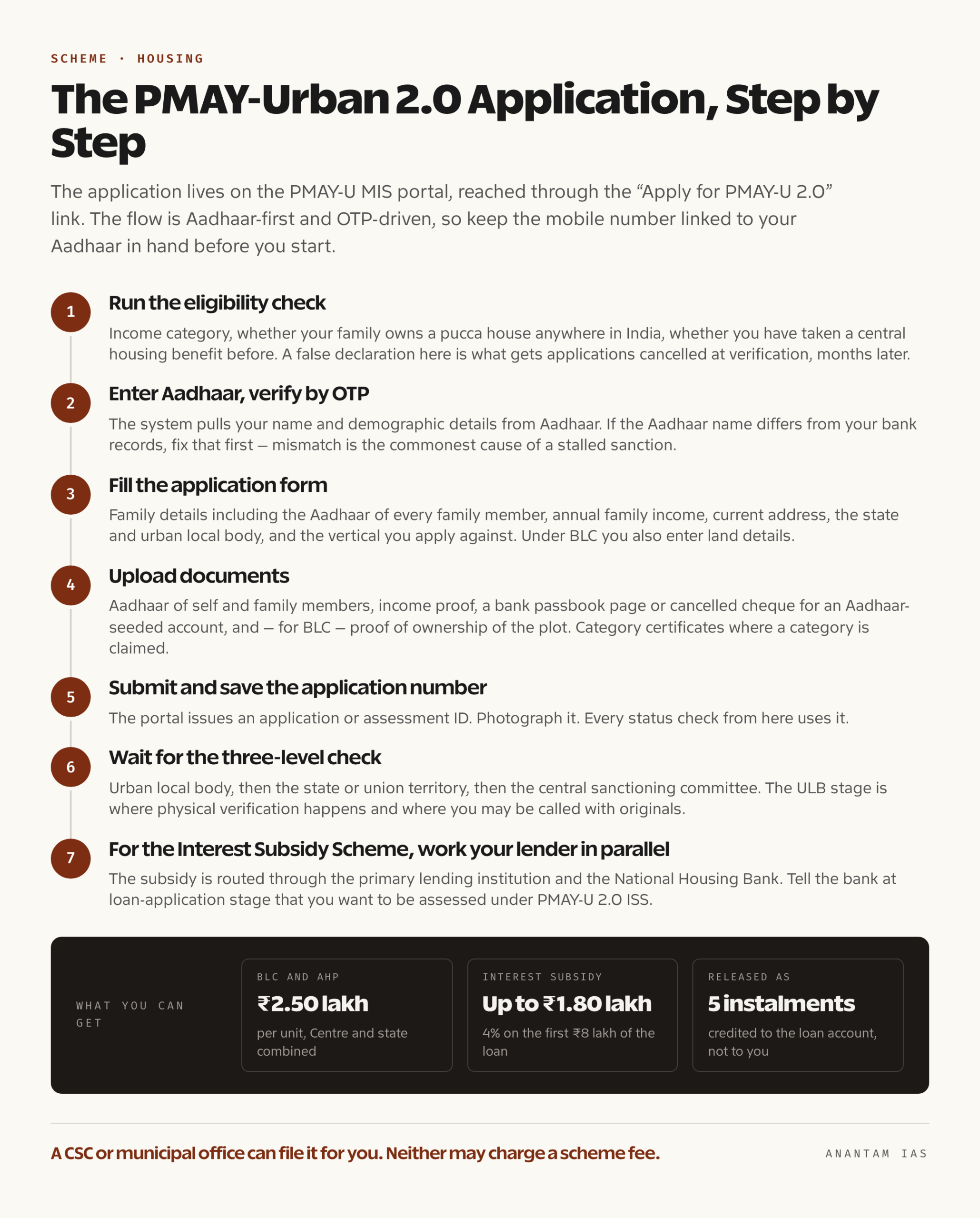
The application lives on the PMAY-U MIS portal, reached through the “Apply for PMAY-U 2.0” link on the ministry’s site at pmay-urban.gov.in. The flow is Aadhaar-first and OTP-driven, so before you start, make sure the mobile number linked to your Aadhaar is the one in your hand.
- Run the eligibility check. The portal opens with a short self-assessment — income category, whether your family owns a pucca house anywhere in India, whether you have taken a central housing benefit before. Answer honestly. A false declaration here is what gets applications cancelled at verification, months later.
- Enter your Aadhaar number and verify by OTP. The system pulls your name and demographic details from Aadhaar. If the name on your Aadhaar differs from your bank records, fix that first — mismatch is the commonest cause of a stalled sanction.
- Fill the application form. You enter family details including the Aadhaar of every family member, annual family income, current address, the state and urban local body you fall under, and the vertical you are applying against. Under BLC you also enter land details.
- Upload documents. The standard set is your Aadhaar and the Aadhaar of family members, an income proof, a bank passbook page or cancelled cheque for an Aadhaar-seeded account, and — for BLC — proof of ownership of the plot. Caste or community certificates go in where a category is claimed. For the Interest Subsidy Scheme, the lender collects the loan-side papers separately.
- Submit and save the application number. The portal issues an application or assessment ID. Photograph it. Every status check from here uses it.
- Wait for the three-level check. Your application goes to the urban local body, then the state or union territory, then the central sanctioning committee. The ULB stage is where physical verification happens, and where you may be asked to come in with originals.
- For the Interest Subsidy Scheme, deal with your lender in parallel. The subsidy is routed through the primary lending institution and the National Housing Bank. Tell your bank or housing finance company at the loan application stage that you want to be assessed under PMAY-U 2.0 ISS — retrofitting the claim after disbursal is harder.
Applications can also be filed through a Common Service Centre or at the municipal office if you would rather not do it yourself. Neither should charge you a scheme fee; a CSC may charge its own small service fee, and nothing more.
Who Is Eligible
| Criterion | PMAY-Urban 2.0 | PMAY-Gramin |
|---|---|---|
| Income | EWS up to ₹3 lakh a year; LIG ₹3-6 lakh; MIG ₹6-9 lakh | No income slab; selection is by deprivation and exclusion criteria, with the monthly income bar raised to ₹15,000 |
| Housing status | Family must not own a pucca house anywhere in India | Household must be houseless or living in a kutcha house with up to two rooms |
| Prior benefit | Must not have availed assistance under any central housing scheme | Must not have received a house under an earlier government housing programme |
| Who counts as family | Husband, wife and unmarried children | The household as recorded in the survey |
| How you get in | Self-application on the portal | Inclusion through the Awaas Plus survey and Gram Sabha verification |
For the urban scheme, an adult earning member is treated as a separate household regardless of marital status, which is how a working son or daughter can apply independently. Preference is given to widows, single women, scheduled castes and tribes, other backward classes, minorities, persons with disabilities, transgender persons, safai karamcharis, and beneficiaries of the PM SVANidhi and PM Vishwakarma schemes.
For the rural scheme, the automatic exclusion list was trimmed in 2024 from thirteen conditions to ten. Ownership of a motorised two-wheeler, a mechanised fishing boat, a landline phone and a refrigerator no longer disqualifies a household, and the monthly income ceiling was raised to ₹15,000. What still excludes you includes owning a motorised three- or four-wheeler, owning mechanised farm equipment, holding a Kisan Credit Card above a specified limit, having a government employee in the household, paying income tax or professional tax, and owning substantial irrigated or unirrigated land.
The Rural Route: Awaas Plus and the Self-Survey App
There is no citizen-facing online application form for PMAY-Gramin. Households enter the list through a survey, and the current one is Awaas Plus 2024, launched in September 2024 to enrol families left out of earlier lists.
It runs in two modes. In the assisted survey, a panchayat enumerator visits and records your household on a tablet or phone. In the self-survey, any eligible household member with an Android phone can install the AwaasPlus 2024 app, authenticate with Aadhaar face authentication, and register the household directly — no physical documents are submitted at this stage, just your Aadhaar, a photograph of your present house and basic income and asset details.
After that, the process is out of your hands and into the panchayat’s. The survey data is validated against the exclusion criteria, the Gram Sabha reviews and approves the list, and the permanent waiting list is drawn up in priority order. Sanction, geo-tagging of the site, and release of the money in instalments follow — each instalment released only after the previous stage of construction is photographed and geo-tagged on AwaasSoft.
The practical advice for rural applicants is unglamorous but effective: get surveyed, then check that your name actually appears. Use the beneficiary search on the PMAY-G portal at pmayg.nic.in, which also resolves to the ministry’s newer domain, and follow it up at the panchayat office. Names dropped for a data error are recoverable if you catch them before the list is finalised.
How to Check Your Application Status
For PMAY-Urban, the MIS portal carries a track-application-status page. You can search by your assessment or application ID, or by name, father’s name and mobile number if you have lost the ID. Sanction and progress data at the aggregate level sits on the PMAY-U dashboard.
For PMAY-Gramin, the beneficiary search on the PMAY-G portal takes your registration number and returns your stage — registered, sanctioned, instalments released, completed. If it shows an instalment released but nothing has reached your account, the problem is nearly always Aadhaar-bank seeding at your branch rather than the scheme.
A word on the third-party sites that dominate these searches. Beneficiary lists, status pages and application forms exist only on government domains. A site asking for a fee to “check your PMAY name” or to “register you” is not part of the scheme.
Challenges and What to Watch
Verification is where applications die. A pucca house registered in a family member’s name, an income declaration that does not match records, a name spelt differently across Aadhaar and bank — each is enough to stop a file at the ULB stage, and applicants often learn about it only after months of silence.
The interest subsidy is smaller than it looks. ₹1.80 lakh spread over five yearly instalments on a ₹25 lakh loan is real money, but it is a fraction of total interest and it does not change what you can afford. Treating it as a reason to stretch into a larger loan is a mistake.
Urban land is the binding constraint. Beneficiary-Led Construction assumes you own a plot. In cities where the poor overwhelmingly do not, that vertical is unreachable, which is why in-situ redevelopment and rental housing matter more than their budget share suggests. The wider structural problem is worth reading at https://anantamias.com/urban-housing-crisis/.
Rural inclusion depends on being surveyed at all. A household that migrates for work, or has no member with a smartphone, or is simply missed by the enumerator, does not appear on the permanent waiting list — and the exclusion is invisible, because nobody rejected them.
Completion lags sanction. Sanctioned, grounded and completed are three different numbers, and the gap between them reflects construction cost inflation, delayed state shares and beneficiaries who cannot fund the difference between the assistance and the actual cost of a house.
FAQ
Can I apply for PMAY-Gramin online myself? Not through a public application form. Rural inclusion happens through the Awaas Plus survey, either by a panchayat enumerator or by a self-survey on the AwaasPlus 2024 mobile app using Aadhaar face authentication. After that, the Gram Sabha verifies and the permanent waiting list decides your turn.
What is the income limit for PM Awas Yojana in cities? Under PMAY-U 2.0, annual household income up to ₹3 lakh is Economically Weaker Section, ₹3-6 lakh is Low Income Group, and ₹6-9 lakh is Middle Income Group. All three are eligible, though the vertical and the form of assistance differ.
What documents do I need for the online application? Aadhaar for yourself and every family member, an income proof, bank account details for an Aadhaar-seeded account, and land ownership papers if you are applying to build on your own plot. Category certificates go in where a preference is claimed. Your lender collects loan documents separately for the interest subsidy route.
How much subsidy will I actually get on a home loan? A maximum of ₹1.80 lakh, calculated as a 4 per cent interest subsidy on the first ₹8 lakh of a loan up to ₹25 lakh, for a house valued up to ₹35 lakh, over a tenure of up to 12 years. It is credited to your loan account in five yearly instalments, not paid to you in cash.
My application shows pending for months. What should I do? Note your application ID, check the status page, and then approach the urban local body handling your ward — that is where verification sits. Confirm that your Aadhaar name matches your bank records and that your account is Aadhaar-seeded, because a mismatch will hold up a sanction that has otherwise been cleared.
Practice Questions
Prelims MCQs
- PMAY-Urban 2.0 is implemented through which set of verticals? (a) BLC, AHP, ISSR and CLSS (b) BLC, AHP, ARH and ISS (c) ISSR, CLSS, ARH and BLC (d) AHP, ISSR, ISS and MGNREGS convergence — Answer: (b) PMAY-U 2.0 runs Beneficiary-Led Construction, Affordable Housing in Partnership, Affordable Rental Housing and the Interest Subsidy Scheme.
- Under PMAY-Gramin, the unit assistance for a house in a hilly or difficult area is: (a) ₹1.20 lakh (b) ₹1.30 lakh (c) ₹1.50 lakh (d) ₹2.50 lakh — Answer: (b) Plain areas get ₹1.20 lakh; North-Eastern states, hill states and notified difficult and LWE-affected districts get ₹1.30 lakh.
- The maximum interest subsidy available under the Interest Subsidy Scheme of PMAY-U 2.0 is: (a) ₹1.80 lakh (b) ₹2.30 lakh (c) ₹2.50 lakh (d) ₹2.67 lakh — Answer: (a) It is 4 per cent on the first ₹8 lakh of the loan, capped at ₹1.80 lakh over up to 12 years.
- Which ministry implements PMAY-Gramin? (a) Ministry of Housing and Urban Affairs (b) Ministry of Rural Development (c) Ministry of Panchayati Raj (d) Ministry of Finance — Answer: (b) PMAY-Gramin is with the Ministry of Rural Development; the urban mission sits with Housing and Urban Affairs.
- Which of the following no longer automatically excludes a household from PMAY-Gramin after the 2024 revision? (a) Owning a motorised four-wheeler (b) Owning a refrigerator (c) Having a government employee in the household (d) Paying income tax — Answer: (b) Refrigerator, motorised two-wheeler, mechanised fishing boat and landline phone were removed from the exclusion list.
Mains Practice Questions
- “Housing for All is as much a land question as a finance question.” Examine this statement with reference to the design of PMAY-Urban and its verticals. (15 marks, 250 words)
- Compare the beneficiary identification methods used by PMAY-Urban and PMAY-Gramin, and assess which is better protected against exclusion errors. (15 marks, 250 words)
- Evaluate the role of convergence — with MGNREGS, Swachh Bharat Mission and Ujjwala — in making rural housing assistance adequate. What are the limits of the convergence approach? (15 marks, 250 words)
- Discuss the case for prioritising affordable rental housing over ownership-linked subsidies in Indian cities. (10 marks, 150 words)
- Direct Benefit Transfer has improved leakage control in housing schemes but created new forms of exclusion. Critically analyse with examples. (15 marks, 250 words)