PM-KUSUM Scheme: Components A, B, C, Solar Pumps & UPSC Notes 2026
PM-KUSUM makes farmers Annadata to Urjadata via solar pumps and grid-connected solar plants. 3 components, Rs 34,422 crore outlay, 2025-26 progress, UPSC GS-III.
PM-KUSUM (Pradhan Mantri Kisan Urja Suraksha evam Utthaan Mahabhiyan) is the Government of India's flagship solar agriculture scheme that aims to convert the "Annadata" (food provider) into an "Urjadata" (energy provider). Launched by the Ministry of New and Renewable Energy (MNRE) in March 2019 and expanded thereafter, PM-KUSUM provides farmers with grid-connected solar power plants on barren land, solar-powered standalone irrigation pumps, and solarisation of existing grid-connected pumps, with the dual objective of supplementing farm incomes and decarbonising the agricultural energy footprint. The total scheme target is 34,800 MW of solar capacity by 2026, with a Central Financial Assistance (CFA) of Rs 34,422 crore budgeted for the period 2019-2026.
For UPSC, PM-KUSUM is a GS-III topic at the intersection of agriculture, renewable energy, climate change, doubling farmers' income, and energy security. Prelims has tested launch year, the three components, target capacities, the implementing ministry (MNRE), and the GHG abatement potential. Mains has asked about how PM-KUSUM contributes to doubling farmers' income and the role of renewable energy in agricultural diversification.
What is PM-KUSUM?
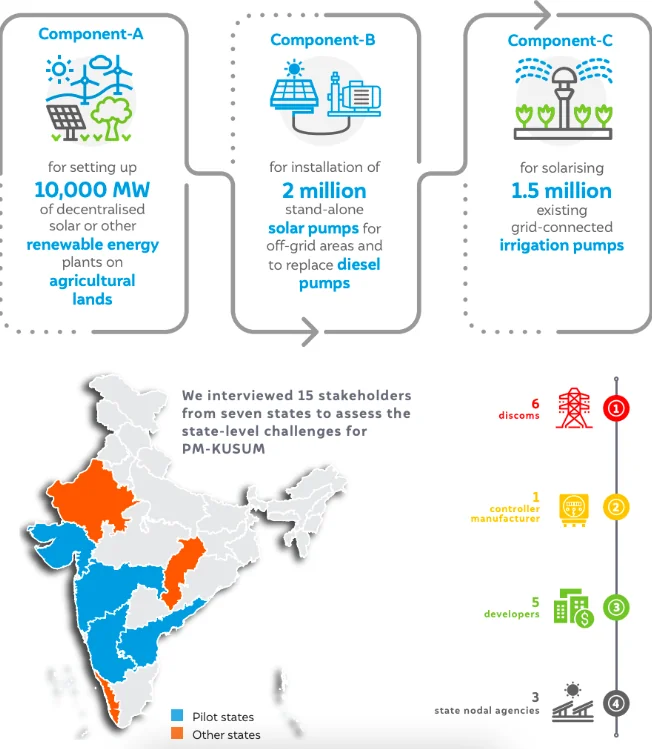
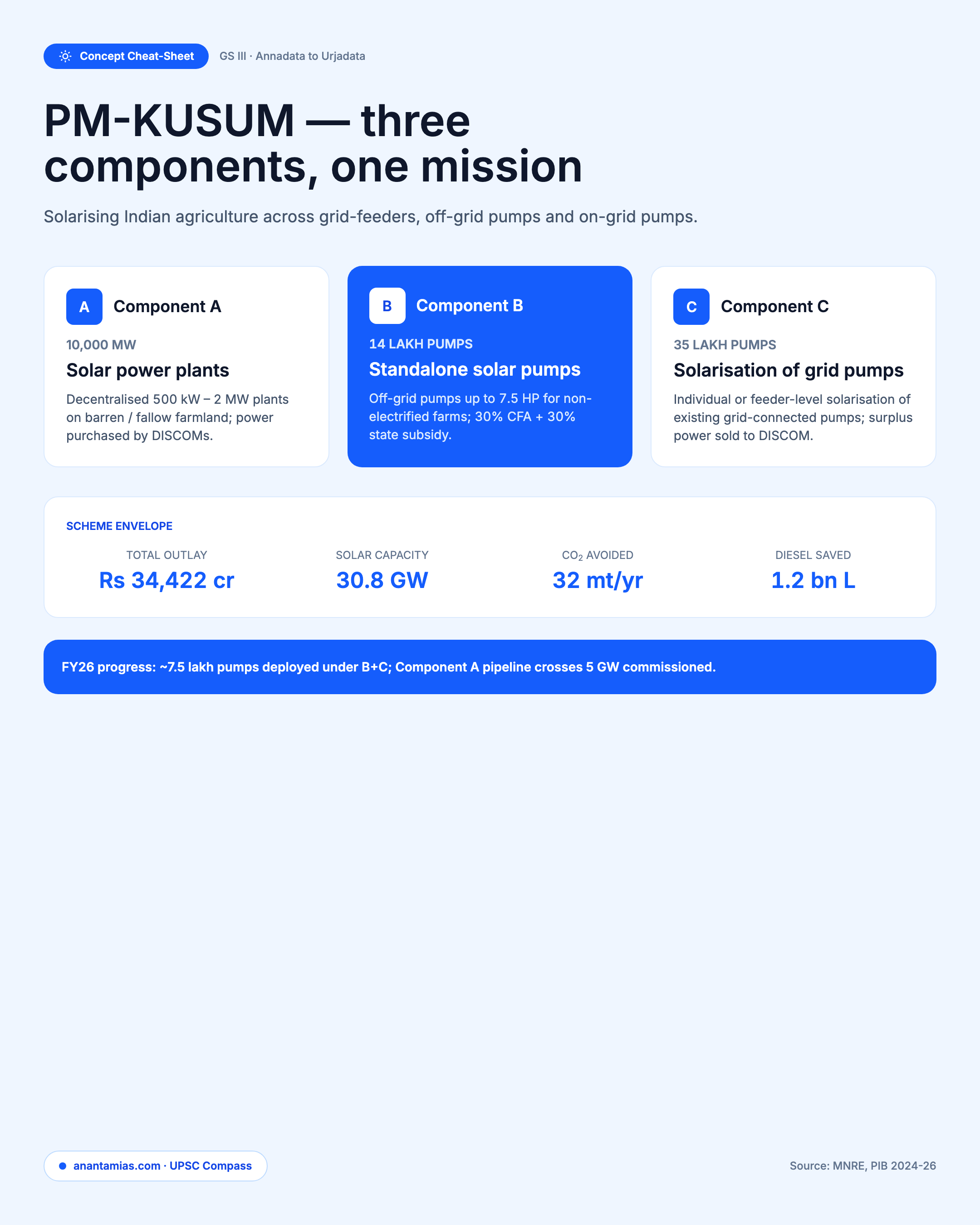
PM-KUSUM has three structured components designed to address different farmer realities — landlocked, off-grid, and grid-connected. Each component opens a distinct income or savings channel for farmers.
The Three Components
| Component | Description | Target Capacity |
|---|---|---|
| Component A | Setting up grid-connected solar/other renewable energy plants on barren/uncultivable land by farmers, panchayats, FPOs, cooperatives | 10,000 MW |
| Component B | Off-grid areas — replacement of diesel pumps with 20 lakh solar agriculture pumps | 20 lakh standalone pumps |
| Component C | Grid-connected areas — solarisation of 15 lakh existing grid-connected agriculture pumps | 15 lakh pumps + Feeder-Level Solarisation (FLS) |
How Each Component Works
Component A — A farmer with 2-5 acres of barren or uncultivable land can set up a solar plant of 500 kW to 2 MW capacity, sell the power to the local DISCOM at a tariff (typically Rs 3.10-3.50/unit), and earn a steady annual income of Rs 60,000-1,00,000 per acre.
Component B — Farmers with no grid connectivity receive a standalone solar pump (1-7.5 HP). The Centre subsidises 30%, the state another 30%, and the farmer pays the remaining 40% (20% for farmer, 20% as bank loan). Special category states (NE, hilly, islands) get higher CFA.
Component C — Existing grid-connected pumps are solarised. The farmer continues using grid power at night and during cloudy days, but during daytime uses solar power for irrigation. Surplus solar power is sold back to the DISCOM under net-metering. Feeder-Level Solarisation (FLS) — added in 2022 — solarises agricultural feeders at the substation level, simpler to implement.
Background: Why PM-KUSUM Was Needed
India's Agriculture-Energy Paradox
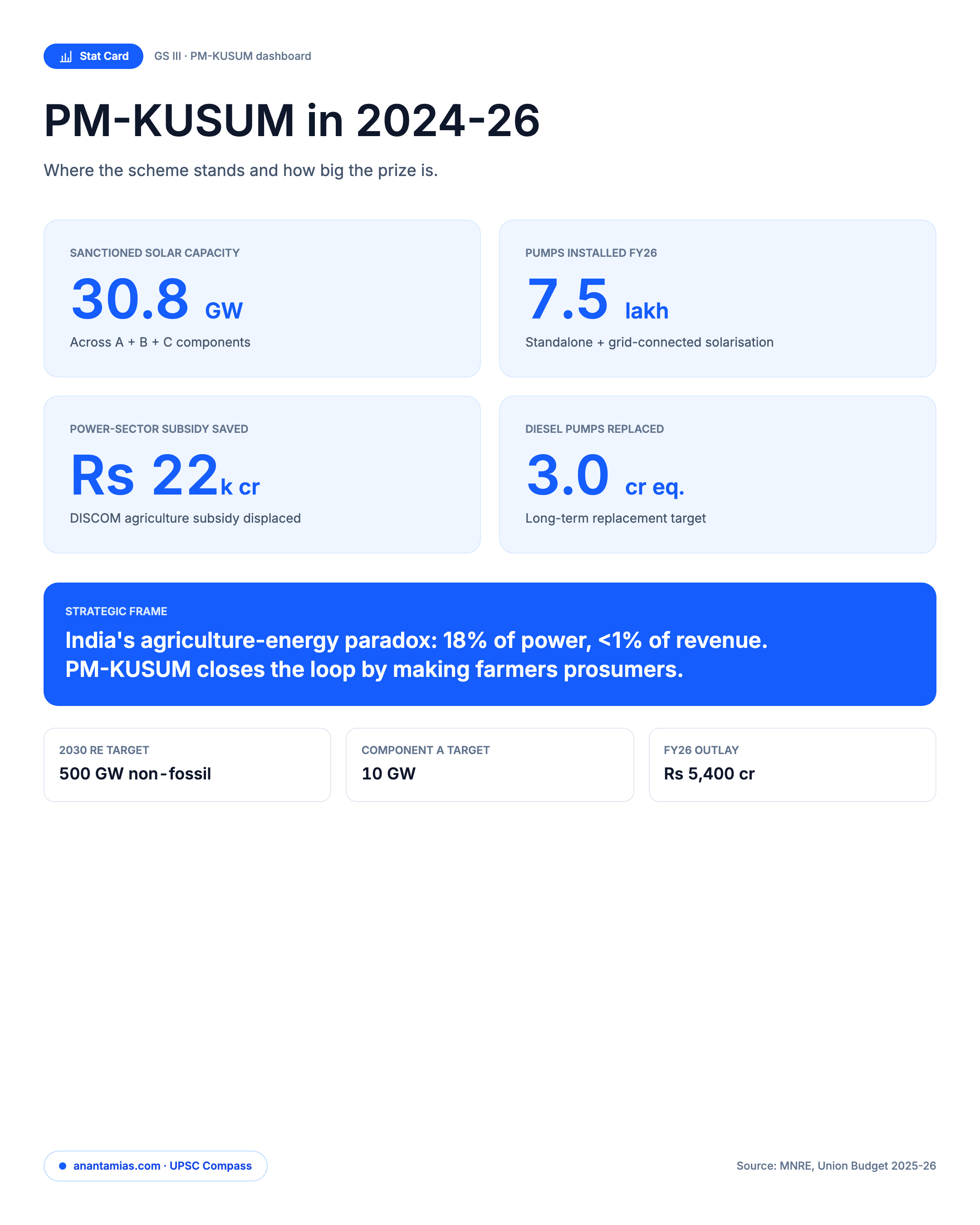
- Agriculture consumes ~17% of India's electricity but pays only 6-8% of the bill because of free or heavily subsidised farm power.
- Free electricity to pump groundwater drives water-table depletion in Punjab, Haryana, Maharashtra.
- DISCOM losses from agriculture subsidy total Rs 1.5 lakh crore+ annually.
- Diesel pumps in off-grid areas pollute and burden farmers with fuel costs.
Renewable Energy Targets
India committed at COP26 to 500 GW non-fossil capacity by 2030, with 300 GW solar. PM-KUSUM contributes 34,800 MW to this goal — with the unique advantage of using land already in agricultural ownership.
Doubling Farmers' Income
- Component A income for 1 MW plant: Rs 60,000-1,20,000/year/acre.
- Component B savings: Rs 8,000-15,000/year/pump in diesel cost.
- Component C income: Rs 5,000-15,000/year/pump through net-metering.
- Annadata to Urjadata — farmers diversify income streams.
Climate Mitigation
PM-KUSUM at full capacity will save ~27 million tonnes of CO2 emissions/year and 1.4 billion litres of diesel/year — a major contribution to India's Net Zero by 2070 trajectory.
Components in Greater Detail
Component A — Grid-Connected Solar Plants
- Targeted at farmers with barren, fallow, or pasture land unsuitable for cultivation.
- Plants of capacity 500 kW to 2 MW, scalable.
- Power purchase agreement (PPA) with DISCOM.
- DISCOMs receive PSF (Procurement-based incentive) of Rs 0.40/unit for 5 years from MNRE.
- Annual income: ~Rs 60,000-1,00,000/acre.
- States leading in adoption: Maharashtra, Rajasthan, Gujarat, Madhya Pradesh, Karnataka, Tamil Nadu.
Component B — Standalone Solar Pumps
- For farmers in off-grid areas without electricity access.
- Pump sizes from 1 HP to 7.5 HP (some states allow up to 10 HP).
- CFA structure: 30% Centre + 30% State + 40% farmer (split as 30% loan + 10% own).
- For special category states (NE, hilly): 50% Centre + 30% State + 20% farmer.
- Targets agriculture, drinking water, and small-scale enterprise irrigation.
Component C — Solarisation of Grid-Connected Pumps
- For farmers with existing grid-connected pumps (mostly in Punjab, Haryana, MP, Maharashtra, Karnataka).
- Two delivery modes:
- Individual pump solarisation (IPS) — solar panel on each pump.
- Feeder-Level Solarisation (FLS) — solar plant at substation feeding multiple pumps.
- Net-metering allows farmers to sell excess solar power.
- FLS is now the preferred mode because it is cheaper and easier to scale.
Benefits of PM-KUSUM
Environmental
- Saves ~27 million tonnes of CO2/year at full capacity.
- Reduces diesel consumption by 1.4 billion litres/year.
- Decarbonises ~17% of India's electricity demand from agriculture.
Economic
- Reduces DISCOM subsidy burden of Rs 1.5+ lakh crore.
- Reduces crude oil imports (Component B) — diesel replacement.
- Promotes domestic solar manufacturing under PLI for solar modules.
- Supplements farmer income via Components A and C.
Social
- Annadata to Urjadata transition.
- Self-employment for solar entrepreneurs in rural areas.
- Empowerment of farmers — energy independence.
- Reduces forced groundwater overuse in Component C areas through metering and better demand management.
Energy Security
- Reduces grid load during agricultural peak hours.
- Improves rural electricity reliability.
- Builds distributed renewable capacity.
Challenges and Criticism
Inter-State Disparity
Chhattisgarh and Rajasthan together account for ~50% of the 2 lakh+ solar pumps deployed. Other states lag because of:
- DISCOM PPA reluctance for Component A.
- State subsidy non-availability in cash-strapped states.
- Awareness gaps in farmer community.
Intra-State Disparity
Within states, large farmers capture a disproportionate share — small/marginal farmers struggle to put up the 40% upfront cost for Component B.
One-Size-Fits-All Approach
- Pump sizes standardised at 1, 2, 3, 5, 7.5 HP — but real farm needs vary.
- Subsidy structure uniform — small farmers need higher CFA.
Pump Efficiency Issues
Solarisation of old, inefficient diesel/electric pumps without replacement leads to suboptimal solar utilisation. Component C should include mandatory replacement with energy-efficient pumps.
Post-Harvest Loss Linkage Missing
Solar power generated in excess of irrigation needs could power cold storage, drying, milling, but most schemes restrict use to irrigation alone.
Quality Concerns
Reports of substandard solar panels and pumps in some states — needs strict BIS certification enforcement.
DISCOM Resistance
Some DISCOMs delay PPAs because they fear loss of farm subsidy revenue (the gap they are reimbursed for).
Land-Use Concerns
Component A requires barren/uncultivable land — but in densely populated regions, even fallow land is contested.
Recent Developments (2024-2026)
| Year | Update |
|---|---|
| 2019 | PM-KUSUM launched; 17,500 MW initial target |
| 2020 | Target raised to 30,800 MW by 2022; later extended to 2026 |
| 2022 | Feeder-Level Solarisation (FLS) added under Component C |
| 2024 | Cumulative 2.4 lakh solar pumps installed under Components B and C |
| 2024 | Component A capacity crosses 500 MW in Maharashtra alone |
| Budget 2024-25 | Rs 10,000 crore for PM-KUSUM |
| 2025 | Target revised to 34,800 MW by FY26 |
| 2025 | Surya Ghar Yojana launched — separate but complementary residential solar scheme |
| Budget 2025-26 | Rs 12,000 crore for PM-KUSUM; FLS prioritised |
| 2025-26 | PM-KUSUM 2.0 discussions for FY27 onwards with broader scope |
| 2026 | 3 lakh+ solar pumps in operation; ~3,000 MW Component A capacity |
Reforms and Way Forward
Reducing Inter-State Disparity
- Target-linked financial assistance to incentivise lagging states.
- DISCOM-level performance benchmarks for PPA execution.
- Centre-state coordination through MNRE-monitored dashboards.
Reducing Intra-State Disparity
- Higher CFA for small/marginal farmers — raise from 30% to 50% Centre share.
- Long-term loans with interest subvention for the farmer share.
- Women farmer reservations in subsidy allocation.
One Size Doesn't Fit All
- Custom pump sizing based on farm needs.
- Cluster-level Component A for FPOs and cooperatives.
- Group financing through PACS and cooperatives.
Pump Efficiency
- Mandatory pump replacement with energy-efficient newer-generation pumps for Component C.
- BIS Star labels for solar pumps.
- Component-level performance audits.
Post-Harvest Linkage
- Allow solar power to run cold storage, dryers, mills, sorting equipment — not just irrigation.
- Promotes value addition and secondary agriculture at farm gate.
Quality and Maintenance
- Long-term Operation & Maintenance (O&M) contracts with vendors.
- Field service centres at block level.
- Insurance for solar systems against theft, damage.
Demand-Side Management
- Smart metering to track water-energy-food nexus.
- Tariff incentives for daytime solar usage.
- Aquifer management linked to Component B subsidies.
Convergence
- Pair PM-KUSUM with PMKSY (drip irrigation) — solar + drip is the highest-efficiency combo.
- Link with PM-AASHA for crop diversification.
- Combine with PM-PRANAM for fertiliser efficiency rewards.
Government Schemes and Budget Allocations (2025-26)
- PM-KUSUM: Rs 12,000 crore in Budget 2025-26.
- PMKSY (Per Drop More Crop): Rs 6,500 crore Micro-Irrigation Fund.
- Surya Ghar Yojana: residential solar (separate from KUSUM).
- Solar PLI Scheme: Rs 24,000 crore for module manufacturing.
- National Solar Mission: 280 GW solar capacity target by 2030.
- PM-AASHA: linked crop diversification.
- NMSA: sustainable agriculture link.
Mains Answer Hook
A high-scoring GS-III answer should: (a) frame PM-KUSUM as the most consequential agriculture-energy nexus reform since rural electrification; (b) describe the three components (A, B, C) with their differentiated targets; (c) cite 34,800 MW target, 27 mt CO2 abatement, Rs 34,422 crore CFA; (d) flag inter-state disparity (Rajasthan-Chhattisgarh dominance) and DISCOM resistance; (e) propose reforms — higher CFA for small farmers, FLS focus, post-harvest power use, pump efficiency.
Use: "PM-KUSUM is climate policy disguised as agricultural policy — every solar pump installed is a micro-decarbonisation event with a farmer income upside."
Prelims Pointers
- PM-KUSUM full form: Pradhan Mantri Kisan Urja Suraksha evam Utthaan Mahabhiyan.
- Launch year: March 2019.
- Implementing ministry: Ministry of New and Renewable Energy (MNRE).
- Three components: A (grid-connected solar plants on barren land), B (off-grid solar pumps), C (solarisation of grid-connected pumps).
- Target: 34,800 MW by FY26.
- Component A: 10,000 MW.
- Component B: 20 lakh standalone solar pumps.
- Component C: 15 lakh grid-connected pumps + FLS.
- CFA structure (general): 30% Centre + 30% State + 40% farmer (Component B).
- Special category states: 50% Centre + 30% State + 20% farmer.
- CO2 saving: 27 million tonnes/year at full capacity.
- Diesel saving: 1.4 billion litres/year.
- Tagline: "Annadata se Urjadata".
FAQ on PM-KUSUM Scheme
What is PM-KUSUM?
A scheme by the Ministry of New and Renewable Energy that helps farmers install solar power plants and replace/solarise diesel and grid-connected pumps to supplement farm income and decarbonise agriculture.
What are its three components?
Component A — grid-connected solar plants on barren land (10,000 MW). Component B — standalone solar pumps in off-grid areas (20 lakh). Component C — solarisation of grid-connected pumps (15 lakh + FLS).
How much does the farmer pay?
For Component B in general states: 40% of the cost (20% own + 20% loan); Centre and State pay 30% each. Special category states: only 20% from farmer.
What is FLS?
Feeder-Level Solarisation — solar plants installed at substation feeders to power multiple agriculture pumps at once. Cheaper and easier than individual pump solarisation.
How much CO2 will PM-KUSUM save?
~27 million tonnes per year at full capacity, plus 1.4 billion litres of diesel.
Why are Rajasthan and Chhattisgarh leading?
Strong DISCOM PPA execution, state-level co-financing, abundant solar irradiation, and proactive farmer outreach.
PM-KUSUM is one of the most ambitious agriculture-energy convergence schemes in the world. For UPSC, anchor your answers in the three-component structure, 34,800 MW target, 27 mt CO2 abatement, Annadata-to-Urjadata transition, and the DISCOM-PPA challenge. Pair these with inter-state disparity and pump efficiency reforms for a Mains-grade answer.