Pradhan Mantri Fasal Bima Yojana (PMFBY): Crop Insurance Scheme, Premium Rates, and the 2026 Extension
Pradhan Mantri Fasal Bima Yojana is India's flagship crop insurance scheme launched in 2016. Covers premium rates, coverage, claims process, the 2026 cabinet extension, and key criticisms.
The Pradhan Mantri Fasal Bima Yojana is India’s flagship crop insurance scheme, and it sits in that uncomfortable middle ground where the policy is genuinely important but the actual experience for farmers is uneven enough that it stays in the headlines for the wrong reasons. The Pradhan Mantri Fasal Bima Yojana was launched in April 2016 to replace two older crop insurance schemes that had become unworkable. Since then the scheme has been tweaked, criticized, partially redesigned, and most recently extended through the 2025-26 season with a substantially larger budget envelope and a few structural changes that come into effect from Kharif 2026.
For UPSC aspirants the Pradhan Mantri Fasal Bima Yojana is one of the most testable schemes on the GS3 agricultural side. It combines economic policy, federalism (because states can opt in or out), insurance principles, technology adoption (satellite and smartphone-based crop loss assessment), and the broader question of how to build resilience into Indian agriculture against climate stress.
This piece walks through what the Pradhan Mantri Fasal Bima Yojana is, the premium rates that farmers actually pay, who pays the rest, how a claim moves from a damaged field to a bank account, what changed in 2020 when participation became voluntary for states, and what the 2026 extension and reform package brings.
Quick Facts at a Glance
- Scheme name: Pradhan Mantri Fasal Bima Yojana (PMFBY)
- Launched: April 2016 by the Ministry of Agriculture and Farmers Welfare
- Replaces: National Agricultural Insurance Scheme (NAIS) and Modified NAIS (MNAIS)
- Companion scheme: Restructured Weather Based Crop Insurance Scheme (RWBCIS)
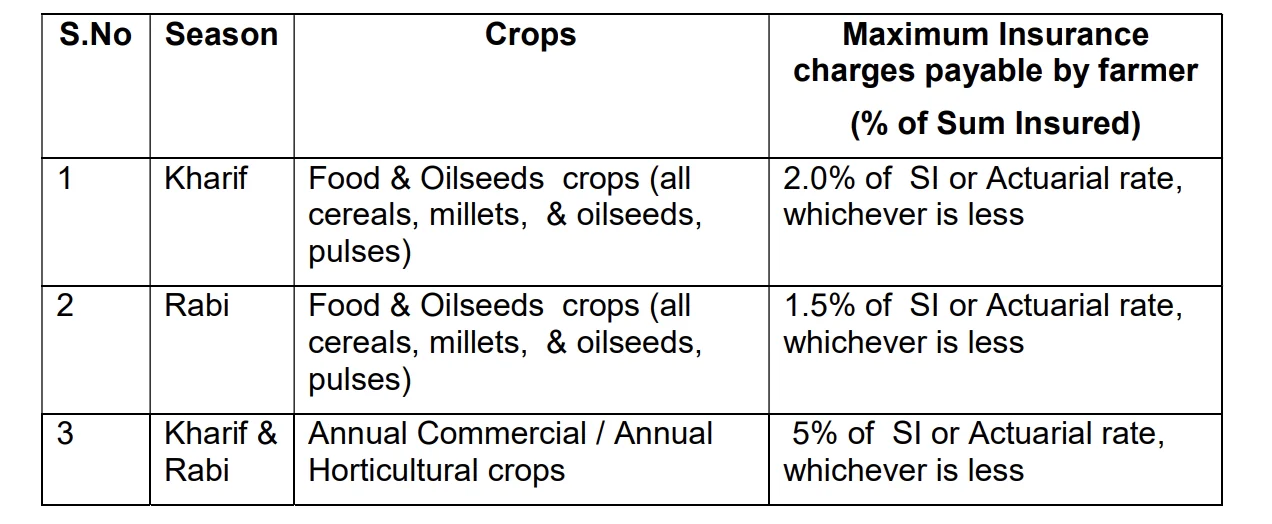
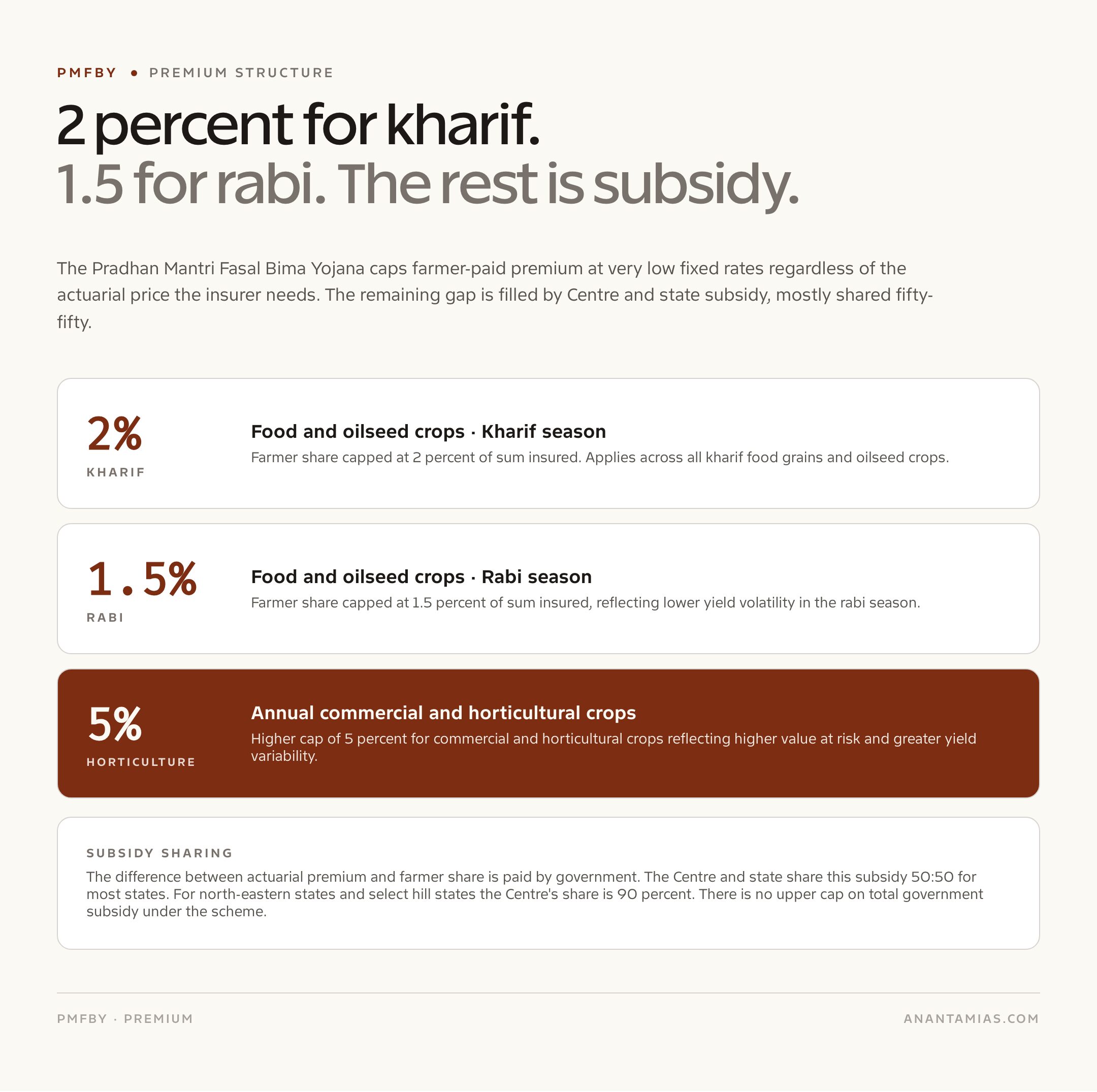
- Premium paid by farmer: 2% of sum insured for kharif food and oilseed crops, 1.5% for rabi food and oilseed crops, 5% for annual commercial and horticultural crops
- Premium subsidy: Difference between actuarial premium and farmer share, shared 50:50 between Centre and most states (90:10 for north-eastern and select hill states from 2020)
- Coverage: Yield loss, prevented sowing, post-harvest losses, localized calamities; recent additions include wild animal attack and paddy inundation modalities
- State participation: Voluntary for states since the Kharif 2020 redesign
- Latest extension: Cabinet approved continuation of PMFBY and RWBCIS through 2025-26 with around ₹69,515 crore total allocation
- Reform rollout: Revised PMFBY from Kharif 2026 season
Why PMFBY Was Launched
The Pradhan Mantri Fasal Bima Yojana was designed to fix three problems with the older crop insurance schemes. First, premium for farmers was too high, which kept enrolment low and meant many of the genuinely vulnerable were uninsured. Second, the claim assessment process was slow and opaque, with disputed yield data and delayed payouts. Third, the schemes were thinly capitalized and unable to handle large climatic shocks across multiple states.
The Pradhan Mantri Fasal Bima Yojana cut farmer premium to a flat 2% for kharif food and oilseed crops, 1.5% for rabi, and 5% for commercial horticulture, regardless of the actuarial premium that the insurer needed. The remaining premium gap is covered as subsidy by the Centre and state in equal share. The scheme also brought in technology mandates, including the use of remote sensing, smartphone apps for crop cutting experiments, and an integrated National Crop Insurance Portal launched in 2018 to clean up enrolment and claims data.
How the Premium Structure Works
The Pradhan Mantri Fasal Bima Yojana uses an actuarial premium rate, which is what the insurance company calculates as the true risk-adjusted price of covering a particular crop in a particular cluster of districts for a particular season. This rate varies widely depending on cropping pattern, irrigation, and yield volatility.
The farmer pays a capped share: 2% for kharif food and oilseed, 1.5% for rabi food and oilseed, 5% for annual commercial and horticulture. The Centre and the state government together pay the rest. The Centre’s share of subsidy is capped in some cases for premium rates above a threshold, which has been a flashpoint in negotiations between the Centre and large agrarian states.
Background and Historical Context
The actuarial premium method makes the Pradhan Mantri Fasal Bima Yojana more realistic from an insurance industry perspective than the older NAIS, which used fixed cropwise rates. Insurance companies bid for clusters of districts on a tender basis, and the lowest bidder gets the contract, which is supposed to keep subsidy costs in check.
What PMFBY Covers
The Pradhan Mantri Fasal Bima Yojana covers a wider range of risks than the earlier schemes. The main coverage heads are: yield losses due to non-preventable natural risks (drought, flood, pests, disease, fire, lightning, hailstorm, cyclone), prevented sowing where adverse weather prevented planting after the farmer had prepared, post-harvest losses for crops left in the field to dry, and localized calamities like hailstorm, landslide, inundation, cloud burst, and natural fire.
Recent additions, finalized for rollout from Kharif 2026, include modalities for crop loss due to wild animal attacks, which has been a long-standing demand from hill and forest-fringe districts, and explicit treatment of paddy inundation losses. These additions matter because they recognize categories of loss that had previously been excluded or contested.
How a PMFBY Claim Moves Through the System
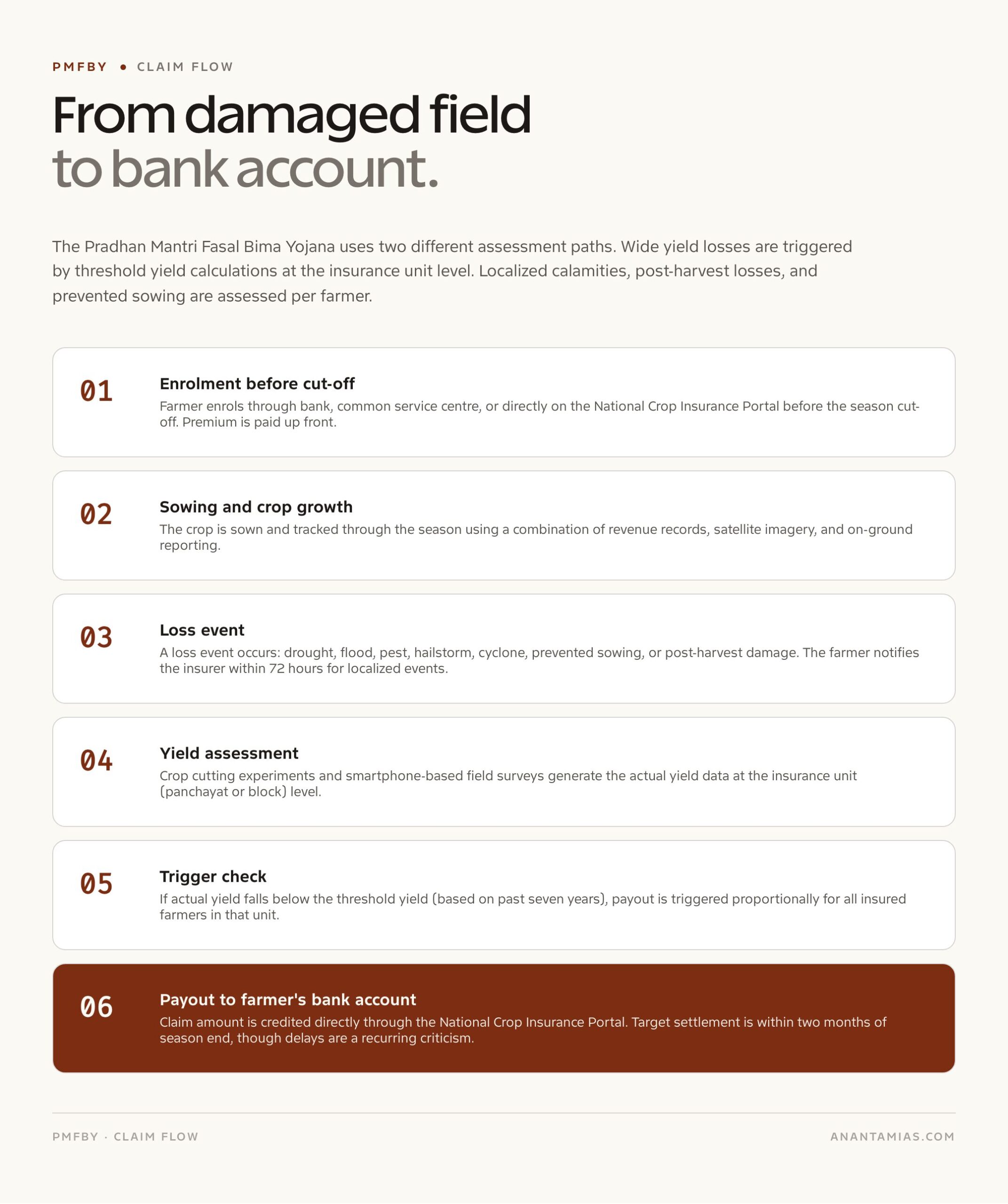
The claims process under the Pradhan Mantri Fasal Bima Yojana works through a layered assessment system. For widespread yield losses, the trigger is the threshold yield, calculated from the past seven years of crop cutting experiments at the insurance unit level (usually village panchayat for major crops, block for others). If the actual yield in a given season falls below the threshold, all insured farmers in that unit get a proportional payout regardless of their individual losses.
For localized calamities, post-harvest losses, and prevented sowing, the assessment is per-farmer. The farmer notifies the insurance company within 72 hours of the loss event, and the company sends a surveyor to assess. Crop cutting experiments and surveys are now mostly done with smartphone apps that geo-tag the location and timestamp the data.
Payouts are credited directly to the farmer’s bank account, mostly through the National Crop Insurance Portal which centralizes enrolment, premium subsidy disbursal, and claims tracking. The headline promise is that claim settlement should happen within two months of the season’s end, though in practice delays have been common.
The 2020 Redesign and State Opt-Out
A major structural change came in 2020 when the Centre made participation voluntary for state governments. Until then states were effectively required to participate. Voluntary participation was a recognition that some state governments had grievances about premium cost-sharing and state-specific design choices.
A few states, including Andhra Pradesh, Bihar, Gujarat, Jharkhand, Telangana, and West Bengal, have at various points opted out of the Pradhan Mantri Fasal Bima Yojana, sometimes running their own crop insurance schemes instead. This created a patchy national picture and has been one of the most-discussed reform debates around PMFBY.
The 2020 redesign also raised the Centre’s subsidy share to 90% for north-eastern states and select hill states, recognizing the limited fiscal capacity of those states.
The 2026 Cabinet Extension and Reform Package
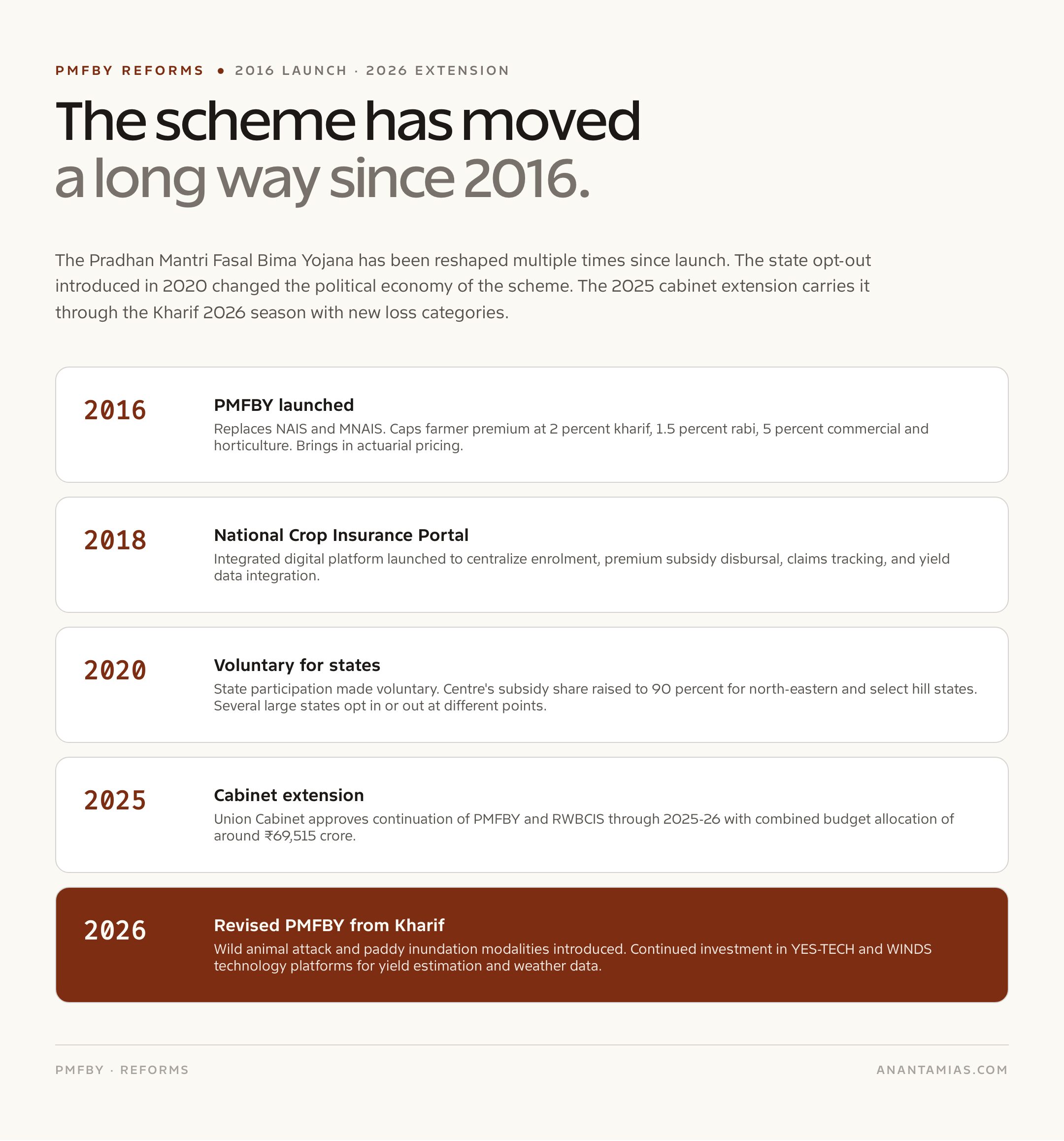
In early 2025 the Union Cabinet approved the continuation of the Pradhan Mantri Fasal Bima Yojana and the Restructured Weather Based Crop Insurance Scheme (RWBCIS) through the 2025-26 season, with a combined budget allocation of around ₹69,515 crore. The reform package, scheduled for rollout from Kharif 2026, includes the wild animal attack and paddy inundation modalities mentioned earlier, along with continued investment in technology, remote sensing, and the Yield Estimation System based on Technology (YES-TECH) and Weather Information and Network Data Systems (WINDS) initiatives.
The extension matters for several reasons. It reaffirms PMFBY as the central architecture of Indian agricultural insurance even in the face of state-level alternatives. It provides budget visibility for insurance companies that bid for clusters. And it allows for the integration of newer technology platforms that should, in principle, reduce claim disputes and accelerate settlement.
Criticism of PMFBY
The Pradhan Mantri Fasal Bima Yojana is not without serious criticism. The most frequent complaints from farmers are about delayed claim settlement, opaque yield data at the panchayat level, and the perception that insurance companies under-pay. Surveys conducted by various agricultural economists have found that actual claim ratios have varied widely across years and states, and that some clusters appear to be persistently underserved.
There are also structural criticisms. The state opt-out option, while flexible, has fragmented the national risk pool, which weakens the actuarial logic of the scheme. The reliance on yield data from crop cutting experiments has been challenged for being slow and inconsistent, even with technology upgrades. And the question of whether insurance is the right policy tool, as against direct income support or a permanent climate adaptation fund, remains live in agricultural policy debates.
PMFBY and the Broader Indian Agriculture Policy Mix
The Pradhan Mantri Fasal Bima Yojana sits alongside other agricultural support schemes, and a clean understanding of how they fit together helps in mains answers. PM-KISAN provides direct income support of ₹6,000 a year to eligible landholding farmers. Minimum support prices and procurement under the Food Corporation of India address the price-side risk. The Pradhan Mantri Fasal Bima Yojana covers the yield risk, the loss that comes when the crop doesn’t reach the market in the first place.
For a holistic Indian agricultural economics view, PMFBY is the yield-risk pillar in a multi-instrument policy stack. Its effectiveness depends on the other pillars working too. A robust MSP regime without yield insurance leaves farmers exposed to drought and flood, while yield insurance without price support leaves them exposed to commodity price crashes. The current Indian framework tries to cover both.
Why PMFBY Matters for UPSC
For UPSC the Pradhan Mantri Fasal Bima Yojana is a high-yield topic. GS3 directly tests agricultural insurance schemes, so the scheme’s design, premium structure, coverage, and reforms are fair game in prelims and mains. The federalism angle (state opt-out) connects to GS2. The technology angle (YES-TECH, WINDS, smartphone CCE apps) connects to science and technology. The criticism around delayed payouts and farmer distress connects to social justice in GS1.
The Pradhan Mantri Fasal Bima Yojana is also useful as an essay anchor for any prompt around farm income, climate adaptation, agricultural risk, or rural distress, because it is a concrete policy instrument with measurable performance data.
Conclusion
The Pradhan Mantri Fasal Bima Yojana is the central architecture of India’s response to crop yield risk. It cut farmer-paid premium to 2% for kharif and 1.5% for rabi, brought in actuarial pricing, modern technology, and centralized data, and absorbed the older NAIS and MNAIS schemes. The 2020 redesign that made participation voluntary for states, and the 2025-26 extension that continues the scheme into Kharif 2026 with new loss categories, define the current shape of the Pradhan Mantri Fasal Bima Yojana. Whether it delivers depends on the quality of claim settlement on the ground, which remains the weak link.
Frequently Asked Questions
What is the Pradhan Mantri Fasal Bima Yojana?
The Pradhan Mantri Fasal Bima Yojana is India’s flagship crop insurance scheme, launched in April 2016 to provide affordable yield-risk coverage to farmers against losses from natural calamities, pests, and weather events.
What premium does a farmer pay under PMFBY?
A farmer pays 2% of the sum insured for kharif food and oilseed crops, 1.5% for rabi food and oilseed crops, and 5% for annual commercial and horticultural crops. The remaining actuarial premium is paid as subsidy by the Centre and state government.
Is PMFBY mandatory for farmers and states?
Since the 2020 redesign, participation is voluntary for both farmers (it is no longer compulsory even for loanee farmers if they opt out in writing) and for state governments.
Which schemes did PMFBY replace?
The Pradhan Mantri Fasal Bima Yojana replaced the National Agricultural Insurance Scheme (NAIS) and the Modified National Agricultural Insurance Scheme (MNAIS).
What does the 2026 extension of PMFBY bring?
The 2025 cabinet approval extended PMFBY and RWBCIS through 2025-26 with a combined allocation of about ₹69,515 crore, along with new modalities from Kharif 2026 covering crop loss due to wild animal attacks and paddy inundation.
What is the main criticism of PMFBY?
The main criticisms are delayed claim settlement, opaque yield data at the village panchayat level, and the fragmentation of the national risk pool caused by some states opting out of the scheme.