PMGDISHA and Digital Literacy in Rural India (UPSC Governance)
PMGDISHA set out to make 6 crore rural households digitally literate — one person aged 14-60 per household, trained through Common Service Centres. Here is the full picture: what digital literacy means, how the scheme is built, what it achieved, and the rural-urban digital divide it was meant to bridge, explained for UPSC GS2.
A smartphone in the hand is not the same thing as the confidence to use it. Across rural India you can find tens of millions of people who own a phone but have never sent an email, never paid a bill online, never typed their own name into a search box — who hand the device to a child or a shopkeeper whenever a screen asks them to do something. That gap, between owning a digital device and actually being able to use it, is exactly what the Pradhan Mantri Gramin Digital Saksharta Abhiyan, or PMGDISHA, set out to close. Launched in February 2017 by the Ministry of Electronics and Information Technology, it aimed to make one person in every one of 6 crore rural households digitally literate — among the largest digital-literacy drives ever attempted anywhere in the world.
And it matters for an aspirant because PMGDISHA sits at the meeting point of three things examiners love to test together: a flagship government scheme, the architecture of Digital India, and the stubborn social problem of the digital divide. It is a governance story about delivery — how you take a service to 6 lakh villages through a network of local centres — and a development story about inclusion, about who gets left behind when a country goes online. Get the scheme’s design, its numbers, and its limits right, and you have a ready-made case study for half a dozen different questions.
What Digital Literacy Means and Why PMGDISHA Was Launched
Start with the idea, because the scheme only makes sense once you know what it was trying to build. Digital literacy, in PMGDISHA’s own framing, is not coding or programming — it is the basic, practical ability to operate a digital device and use it to run your own life. The scheme defines a digitally literate person as someone who can operate a computer or a digital access device like a tablet or smartphone, send and receive email, browse the internet, search for information, access government services online, and undertake a digital payment. That is the floor. The goal was never to turn villagers into IT professionals; it was to make sure a farmer could check a crop price, a pensioner could draw a benefit, and a parent could fill a school form without depending on a middleman.
India came to this problem with a hard fact behind it. For most of the last decade, internet access in the country was wildly unequal between town and village. Cheap data and cheap phones pushed connectivity outward fast, but the skills to use that connectivity lagged badly behind, especially in rural areas, among women, the elderly, and the poor. A device without the know-how is a half-gift. So digital literacy became a precondition for almost everything else the government wanted to deliver online — from Aadhaar-linked benefits to digital payments to e-governance — because a citizen who cannot navigate a screen simply cannot reach those services on their own.
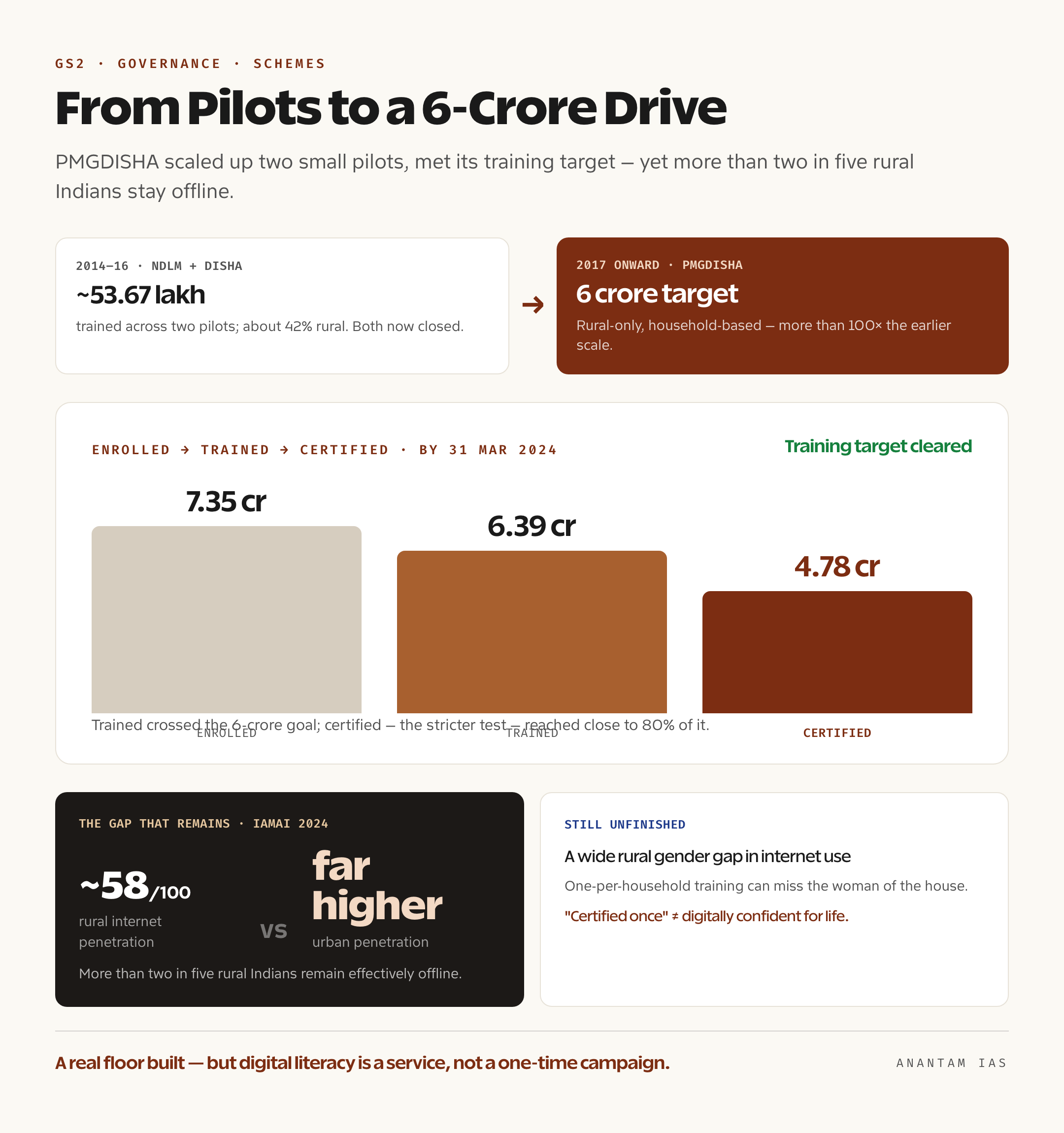
PMGDISHA was also not the first attempt. Between 2014 and 2016 the government ran two earlier schemes, the National Digital Literacy Mission (NDLM) and the Digital Saksharta Abhiyan (DISHA), with a combined target of 52.5 lakh people; together they trained about 53.67 lakh, of whom roughly 42 per cent were rural. Useful, but small, and tilted toward groups like Anganwadi and ASHA workers and ration dealers rather than the rural household at large. PMGDISHA was the scaled-up successor, deliberately rural-only and household-based, designed to take what those pilots learned and apply it across the whole countryside at a scale more than a hundred times larger.
How the Scheme Is Designed: Eligibility, Architecture and Delivery
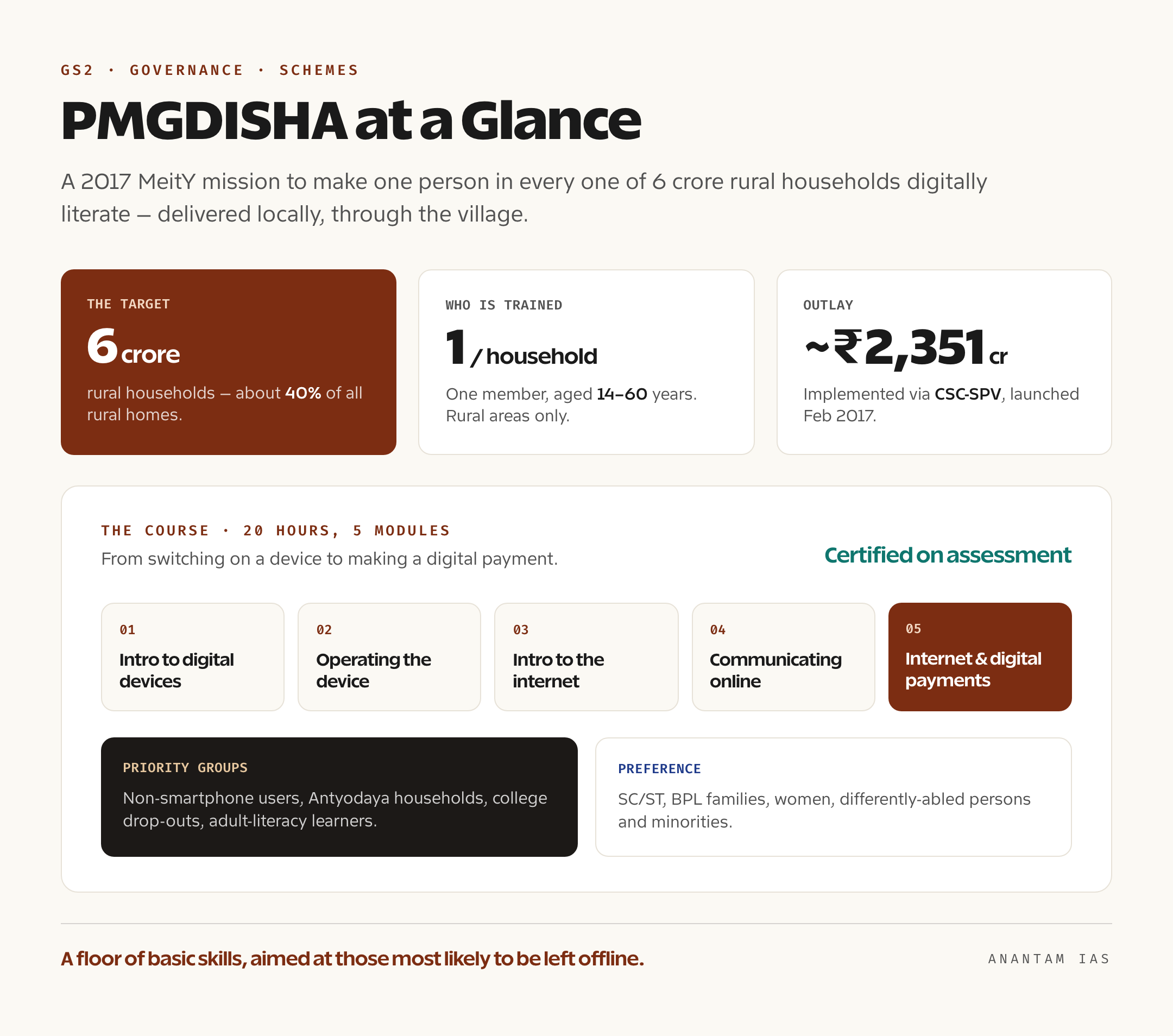
Now the machinery, because this is where the scheme’s governance logic lives. The targeting rule is simple and deliberately wide: only one person per eligible rural household, aged between 14 and 60 years, would be trained. That single-member-per-household design is what let a 6 crore target translate into roughly 40 per cent coverage of all rural households — the scheme spread one literate person across as many homes as possible rather than training several people in a few. The scheme applies only to rural areas; urban digital literacy was left to other channels.
Within that pool, PMGDISHA layered priorities to bend the benefit toward those most likely to be excluded. Priority was given to non-smartphone users, to Antyodaya households (the poorest of the poor under the food-security system), to college drop-outs, to participants in the adult-literacy mission, and to digitally illiterate school students of classes 9 to 12 where their schools had no computer training. On top of that, preference was to be given to Scheduled Castes and Scheduled Tribes, Below Poverty Line families, women, differently-abled persons, and minorities. So the eligibility was not just “any villager” — it was a designed filter pointing the scheme at the households where the digital divide bites hardest. This is exactly the kind of detail that distinguishes a precise answer from a vague one.
Common Service Centres: Taking Training to the Village
The boldest part of PMGDISHA is not its target but its delivery, and it rests on one institution: the Common Service Centre. The scheme is implemented by CSC e-Governance Services India Limited, the special-purpose vehicle that runs India’s vast network of village-level CSCs — small, entrepreneur-run digital kiosks set up under Digital India to deliver government and private services in places no government office reaches. PMGDISHA piggybacked on that network. Training happened at a CSC or an identified training centre inside the Gram Panchayat, run by a local Village Level Entrepreneur, so a learner never had to travel far or deal with a distant bureaucracy.
The course itself was short and intensely practical: about 20 hours of training, spread over a flexible window, built around five modules. A learner moved from an introduction to digital devices, to operating them, to understanding the internet, to communicating over it, and finally to applying it — using the internet and digital financial tools to make cashless transactions. The emphasis on digital payments was deliberate, slotting the scheme straight into the government’s broader push for a less-cash economy. After training, a candidate sat an online assessment conducted by a recognised certifying agency, and only on passing did they count as “certified” — which is why, in the scheme’s data, the certified number is always smaller than the number trained.
That CSC-anchored model is the scheme’s real innovation as a piece of governance. Instead of building new infrastructure, PMGDISHA used an existing last-mile network and a local human face to deliver a public good at enormous scale and low marginal cost. It is a textbook example of public-private partnership at the grassroots — and a useful counter-example to the assumption that scale always requires the state to do everything itself.
What PMGDISHA Achieved and Where the Divide Still Stands
Now the results, because a scheme is judged on delivery, not intentions. On the headline target, PMGDISHA cleared the bar on paper. As of 31 March 2024, around 7.35 crore candidates had been enrolled, about 6.39 crore had been trained, and roughly 4.78 crore had been certified — against the original goal of 6 crore. In raw enrolment and training, then, the scheme met and exceeded its target; on certification, the stricter test, it reached close to 80 per cent of the goal. By the standard of a country where mass-scale schemes routinely fall short, training more than 6 crore rural Indians in basic digital skills is a genuine achievement, and one worth quoting in an answer.
But the scheme’s success has to be read against the problem it was fighting, and there the divide is far from closed. India’s internet base has exploded — the Internet and Mobile Association of India’s 2024 report put active internet users at around 886 million, with rural India now the larger user base in absolute numbers. Yet penetration tells the harder story: rural internet penetration was around 58 per 100 people against a far higher urban figure, meaning more than two in five rural Indians were still effectively offline. The gender gap is sharper still — rural women’s access lags rural men’s by a wide margin, so a scheme that trains “one person per household” can, in practice, leave the woman of the house untouched. And digital literacy is a moving target: a person certified in 2018 on basic browsing may be lost in front of a 2026 app for filing taxes or booking a health appointment.
So the honest verdict is mixed, and that nuance is what earns marks. PMGDISHA built a real floor of basic skills across rural India and proved that a CSC-based, household-targeted model can deliver at continental scale. But “certified once” is not the same as “digitally confident for life”, the one-per-household rule has limits for gender inclusion, and the underlying divide in access, language, and advanced skills persists. The scheme also has a sunset — it covered the period up to its targeted completion, and the larger task of keeping rural India digitally current has passed to the next phase of Digital India and to newer skilling efforts. The lesson for governance is that digital literacy is not a one-time campaign you can declare won; it is a permanent service that has to keep pace with the technology citizens are expected to use.
For Your Mains Answer
This is a high-value topic for GS Paper 2, which covers government policies and schemes for vulnerable sections, issues relating to the development of the social sector, and e-governance. It also feeds GS Paper 1 on Indian society (the digital divide as a form of inequality) and GS Paper 3 on the digital economy and inclusive growth. The skill examiners reward is the same one this article uses: describe the scheme precisely, judge it against the problem it set out to solve, and place it inside the wider Digital India story rather than treating it in isolation.
How to Build the Answer
Open by defining the problem, not the scheme — the rural digital divide and why owning a device is not the same as using one. Then move in a chain: what digital literacy means, why PMGDISHA was launched (and how it improved on NDLM/DISHA), how it is designed (one person per household, 14-60, priority to the excluded), how it is delivered (CSCs, 20 hours, five modules, certification), what it achieved (6.39 crore trained, 4.78 crore certified), and finally a balanced verdict on the gaps that remain. That arc — problem, design, delivery, outcome, evaluation — fits almost any scheme question.
Common Mistakes to Avoid
Don’t confuse digital literacy with digital infrastructure — PMGDISHA trains people; it does not lay cable or hand out phones. Don’t say it covers urban areas; it is rural-only. Don’t quote the target as the achievement — the 6 crore was the goal, while the trained and certified figures are what you cite as results. And don’t present the scheme as an unqualified success: the gender gap and the “certified once” problem are exactly the critical points that lift an answer from descriptive to analytical.
A Compact Answer Spine
Rural digital divide → digital literacy = basic ability to use devices, internet, e-services, digital payments → PMGDISHA (2017, MeitY) targets 6 crore rural households, one person each, aged 14-60, ~40% of rural homes → priority to Antyodaya, college drop-outs, non-smartphone users; preference to SC/ST/BPL/women/disabled/minorities → delivered via CSC-SPV through village CSCs, 20-hour, 5-module course, certified on assessment → outcome: ~6.39 crore trained, ~4.78 crore certified (by Mar 2024) → verdict: built a real floor, but gender and advanced-skill gaps persist; literacy needs continuous renewal.
Diagram or Flowchart Idea
Draw a simple delivery chain: Household (one trainee, 14-60) → village CSC → 20-hour, 5-module course → online assessment → certified citizen who can pay, search and access e-services. Beside it, a small bar contrasting rural and urban internet penetration. The pairing — how the scheme works, plus the gap it targets — communicates both design and significance at a glance.
A Balanced-Conclusion Line
A line that lands the marks: “PMGDISHA proved that digital literacy can be delivered to rural India at scale through a local-entrepreneur network, but it also showed that closing the digital divide is less a one-time campaign than a permanent service — one that must keep pace with the very technology it teaches and reach the women and households it still misses.”
How to Use Data Without Cramming
You need only a handful of anchors, not a spreadsheet: 6 crore (the target households), one person per household aged 14-60 (the rule), 20 hours and 5 modules (the course), and roughly 6.39 crore trained / 4.78 crore certified (the result). Add one divide figure — rural internet penetration around 58 per cent — to show the problem is unfinished. Attribute them plainly, as scheme data or the IAMAI’s 2024 report, rather than scattering numbers without a source.
FAQ
What is PMGDISHA and who runs it? PMGDISHA — the Pradhan Mantri Gramin Digital Saksharta Abhiyan — is a rural digital-literacy scheme launched in February 2017 by the Ministry of Electronics and Information Technology (MeitY). It aimed to make one person in each of 6 crore rural households digitally literate, covering around 40 per cent of rural homes. It is implemented by CSC e-Governance Services India Limited through the network of village-level Common Service Centres.
Who is eligible for training under PMGDISHA, and what is the age limit? Only one person per eligible rural household, aged between 14 and 60 years, is trained. Within that, priority goes to non-smartphone users, Antyodaya households, college drop-outs, and adult-literacy participants, with preference for SC/ST, BPL families, women, differently-abled persons, and minorities — the groups most affected by the digital divide.
What does the training cover and how is it certified? The course runs about 20 hours across five modules — from using a digital device to browsing the internet, communicating online, and making digital payments. Training happens at a village CSC, and a candidate counts as “certified” only after passing an online assessment by a recognised certifying agency, which is why the certified figure is lower than the number trained.
Did PMGDISHA meet its target of 6 crore households? On enrolment and training, yes — as of 31 March 2024 about 7.35 crore had enrolled and around 6.39 crore had been trained, against a goal of 6 crore, with roughly 4.78 crore certified. But the underlying digital divide is not closed: more than two in five rural Indians were still effectively offline, and the gender gap in rural internet use remains wide.
Practice Questions
Prelims MCQs
- With reference to the Pradhan Mantri Gramin Digital Saksharta Abhiyan (PMGDISHA), consider the following:
(a) It is implemented by the Ministry of Rural Development
(b) It is a digital-literacy scheme of the Ministry of Electronics and Information Technology covering rural households
(c) It provides free smartphones to all rural citizens
(d) It targets only urban slum dwellers
Answer: (b) PMGDISHA is a MeitY scheme launched in 2017 to make rural households digitally literate; it trains people rather than distributing devices. - Under PMGDISHA, training is provided to:
(a) Every member of an eligible household
(b) Only one person per eligible rural household, aged 14 to 60 years
(c) Only women in rural households
(d) Only persons above 60 years of age
Answer: (b) The scheme trains one member per eligible rural household within the 14-60 age group, to spread coverage across as many households as possible. - PMGDISHA training is primarily delivered through which of the following?
(a) Government degree colleges
(b) Common Service Centres in Gram Panchayats
(c) Post offices
(d) Primary Health Centres
Answer: (b) Training is conducted at village-level Common Service Centres run by Village Level Entrepreneurs, implemented through CSC e-Governance Services India Limited. - Which of the following groups are given priority or preference under PMGDISHA? (1) Antyodaya households (2) College drop-outs (3) Non-smartphone users (4) Women, SC/ST and differently-abled persons. Select the correct answer:
(a) 1 and 2 only
(b) 3 and 4 only
(c) 1, 2 and 3 only
(d) 1, 2, 3 and 4
Answer: (d) Priority goes to non-smartphone users, Antyodaya households and college drop-outs, with preference for SC/ST, BPL, women, differently-abled persons and minorities. - Which two earlier schemes preceded PMGDISHA as digital-literacy efforts run between 2014 and 2016?
(a) NDLM and DISHA
(b) PMKVY and DDU-GKY
(c) BharatNet and PMGSY
(d) UMANG and DigiLocker
Answer: (a) The National Digital Literacy Mission (NDLM) and Digital Saksharta Abhiyan (DISHA) were the earlier pilots; PMGDISHA was their scaled-up, rural-focused successor.
Mains Practice Questions
- “Owning a digital device is not the same as being able to use it.” In this light, examine the objectives and design of PMGDISHA as a response to India’s rural digital divide. (15 marks, 250 words)
- Discuss how PMGDISHA uses the Common Service Centre network to deliver digital literacy at scale. What does this model tell us about public-private partnership in last-mile governance? (15 marks, 250 words)
- Critically evaluate the achievements and limitations of PMGDISHA. To what extent has it bridged the digital divide in rural India? (15 marks, 250 words)
- The digital divide in India is as much a gender divide as a rural-urban one. Analyse this statement with reference to digital-literacy schemes and the data on rural women’s internet access. (10 marks, 150 words)
- “Digital literacy is not a one-time campaign but a permanent public service.” Discuss in the context of India’s digital-literacy programmes and the need to keep pace with evolving technology. (15 marks, 250 words)